
In Hindi, the dodo bird is called डोडो (pronounced ḍoḍo), and that is exactly the word you will find in modern Hindi dictionaries, school textbooks, and news articles. For a cockatiel, the meaning in Hindi is often explained with the bird’s common description and local name cockatiel bird meaning in hindi. There is no separate native Hindi name for this bird because the dodo went extinct before it ever entered the everyday vocabulary of Indian languages organically. The term is a direct phonetic borrowing, and it has stuck. If you search Shabdkosh or Hindwi, the entry reads डोडो (पक्षी), meaning डोडो (bird), confirming what most Hindi speakers already use when they talk about it.
Dodo Bird Meaning in Hindi: डोडो का अर्थ और उपयोग

Rajesh Sharma
23 Jun 2026

The Hindi translation of 'dodo' you are looking for
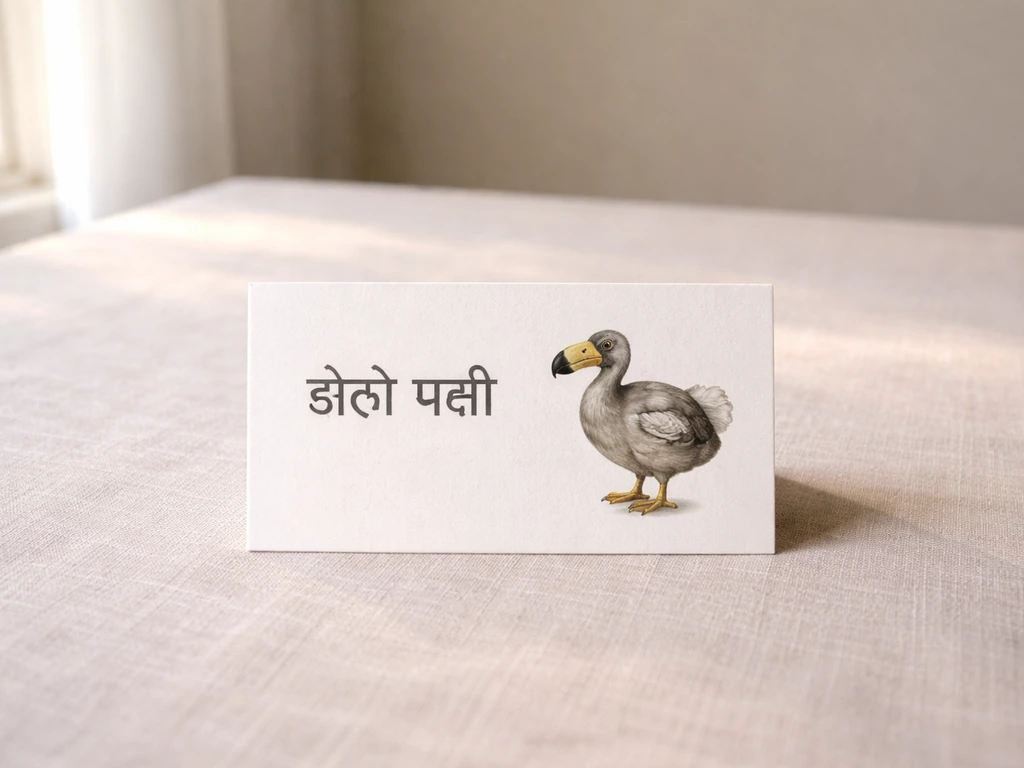
The standard Hindi word for dodo is डोडो. In formal or educational writing you will often see it extended to डोडो पक्षी (ḍoḍo pakṣī), which simply means 'dodo bird.' The scientific name, when cited in Hindi texts, appears as रैफस क्यूकुलैटस (Raphus cucullatus). blank" rel="noopener noreferrer">Shabdkosh records the Hindi headword as डोडो, describes it as the extinct bird of Mauritius, and notes that the last confirmed sightings were in the late 1600s, specifically around 1681. The Wiktionary entry for 'dodo' also lists the Hindi translation as डोडो (masculine noun, ḍoḍo), so there is no ambiguity about spelling or gender in contemporary usage.
One older form worth knowing is गीध (gīdh), which Wiktionary notes as an archaic Hindi label once loosely applied to the dodo. This is almost never used today and can cause confusion because गीध is also the standard Hindi word for vulture. If you encounter it in an old text referring to the dodo, treat it as a historical quirk rather than a living synonym.
How डोडो is actually used in everyday Hindi
Modern Hindi media and educational content treat डोडो as a fully absorbed loanword. You will see it declined and used naturally in sentences without any special marking. A TV9 Hindi article discussing dodo genetics, for instance, uses the phrase 'डोडो जैसा दिखे' (looks like a dodo) and matter-of-factly states 'ये प्रजाति 350 साल पहले विलुप्त हो चुकी है' (this species went extinct 350 years ago). In a Balbharti children's magazine (January 2002), the plural form डोडों appears in the phrase 'ही डोडों के विनाश की दास्तान,' meaning 'the story of the destruction of the dodos.' These examples show the word working exactly like any other Hindi bird name.
There is also a figurative thread worth noting. The Langeek Hindi dictionary entry includes an illustrative sentence with a moral or insult-style framing, roughly equivalent to calling someone foolish or hopelessly out of touch. This connects to the word's origin: the name 'dodo' comes from the Portuguese word 'doudo,' meaning fool or simpleton, and that sense of the word has filtered into casual Hindi usage as a light metaphor. Glosbe's Hindi translations even flag एकदम बेजान (completely lifeless or dull) as an associated sense, reinforcing this figurative layer.
Common Hindi phrases involving डोडो

- डोडो पक्षी (ḍoḍo pakṣī) — the standard phrase for 'dodo bird,' used in textbooks and educational content
- डोडो का वैज्ञानिक नाम रैफस क्यूकुलैटस है (ḍoḍo kā vaijñānik nām Raphus cucullatus hai) — 'the scientific name of the dodo is Raphus cucullatus,' common in classroom writing
- डोडों के विनाश की दास्तान (ḍoḍõ ke vināś kī dāstān) — 'the story of the destruction of the dodos,' used in literary or narrative Hindi
- डोडो जैसा (ḍoḍo jaisā) — 'like a dodo,' used informally to mean extinct, obsolete, or helplessly old-fashioned
- डोडो की तरह विलुप्त होना (ḍoḍo kī tarah vilupt honā) — 'to go extinct like the dodo,' a phrase used in conservation discussions and sometimes figuratively
Dodo bird names across Hindi and related Indian languages
Across the Indian languages this site covers, the dodo is handled as a phonetic borrowing almost universally. There was never a Sanskrit name for the bird because it lived on a remote island in the Indian Ocean and was extinct before Sanskrit ornithological literature had any reason to name it. Here is how the name appears across the major languages:
| Language | Script / Transliteration | Notes |
|---|---|---|
| Hindi | डोडो (ḍoḍo) | Standard modern term; डोडो पक्षी in full form |
| Marathi | डोडो (ḍoḍo) | Used as-is in Marathi media such as Loksatta; same phonetic form |
| Punjabi | ਡੋਡੋ (ḍoḍo) | Phonetic borrowing; no distinct Punjabi name exists |
| Gujarati | ડોડો (ḍoḍo) | Phonetic borrowing; same pronunciation pattern |
| Tamil | டோடோ (ṭōṭō) | Listed in multilingual dictionaries; slight phonetic shift in the Tamil consonant |
| Sanskrit | No classical term | The dodo was never part of classical Sanskrit texts or mythology |
The consistency across these languages is actually useful for language learners: if you know डोडो in Hindi, you essentially know the word in Marathi and Gujarati too. The Loksatta Marathi article on attempts to bring the dodo back from extinction, for example, uses डोडो throughout with no alternative name offered, which tells you everything about how settled the borrowed form is.
Where the dodo came from and why everyone knows it

The dodo (Raphus cucullatus) was a large, flightless bird that lived only on the island of Mauritius in the Indian Ocean. It stood roughly a meter tall, could not fly, and had evolved without natural predators, which made it completely unafraid of humans. When Dutch sailors arrived in Mauritius in the late 1500s, the dodo had no instinct to flee. Sailors hunted it, and more critically, the animals they brought with them, including pigs, rats, cats, and macaques, raided dodo nests and destroyed eggs. According to Drishti IAS, the real cause of extinction was not the bird's supposed stupidity but this combination of direct hunting and introduced predators overwhelming a species that had no defense strategies. The last confirmed sighting was around 1681, and the dodo was formally classified as extinct.
The bones found in the Mare aux Songes marsh in Mauritius, first excavated in 1865, gave scientists their most complete picture of what the dodo actually looked like and how it lived. Before those finds, many people doubted the bird had ever existed. The Natural History Museum in London has done extensive reconstruction work using those remains, and Mauritius Life notes that the discovery triggered an international reassessment of the bird's history. That combination of mystery, confirmed reality, and irreversible loss is a big part of why the dodo became such a powerful cultural symbol globally.
The name itself adds another layer. 'Dodo' most likely comes from the Portuguese 'doudo,' meaning fool or simpleton, though some scholars trace it to the Dutch 'dodoor,' meaning sluggard. Either way, the name encoded a kind of mockery from the very beginning, which is why the bird carries that connotation of foolishness or naivety even in Hindi figurative usage today.
What the dodo symbolizes in Hindi cultural and spiritual thinking
The dodo does not appear in Hindu mythology, Vedic texts, or classical Indian bird symbolism the way birds like the peacock, crow, or owl do. It has no place in Puranic stories or Sanskrit literature. What it does carry, especially in modern Hindi-speaking cultural contexts, is a set of secular symbolic meanings that have built up through education, journalism, and popular culture.
The most prominent of these is the association with extinction and irreversible loss. In Hindi conservation writing and environmental journalism, 'डोडो की तरह विलुप्त हो जाना' (to go extinct like the dodo) is used as a benchmark phrase, the way English speakers say something 'went the way of the dodo.' This makes the dodo a symbol of what happens when a species, or by extension a tradition, a language, or a way of life, is destroyed through negligence and outside pressure.
The second symbolic layer is the one inherited from the bird's name: foolishness or naivety. Because 'doudo' in Portuguese meant fool, and because the dodo famously walked toward its own hunters, the bird has become associated in casual Hindi usage with someone who is hopelessly out of touch, too trusting, or unable to adapt. This is not a mythological symbolism but a living idiomatic one, the kind you pick up from how the word is used in sentences rather than from any religious text.
A third, more reflective meaning is emerging in Hindi environmental and children's literature: the dodo as a warning. Several Hindi school texts and publications treat the dodo not as a joke but as a cautionary figure, an example of how human activity can permanently erase something from the world. This framing gives the bird a certain moral weight in modern Indian educational culture that goes beyond simple extinction trivia.
Don't mix up the dodo with these other birds and terms
There are a few genuine confusion risks when searching for dodo-related terms in Hindi or across Indian languages, and it helps to know them upfront. In short, the drongo bird meaning in Hindi is ड्रोंगो (ड्रोंगो पक्षी), and it refers to the bird group known for their slender body and forked tail.
- गीध (gīdh) vs. डोडो: As mentioned, Wiktionary records गीध as an archaic label once applied to the dodo in older Hindi texts. But गीध is also the everyday Hindi word for vulture (Gyps species). If you see गीध in a modern text, it almost certainly means vulture, not dodo. The dodo connection is historical and largely obsolete.
- Garuda (गरुड़): Garuda is the divine eagle of Hindu mythology, the mount of Vishnu, and a bird with deep spiritual symbolism. The dodo shares none of this. If someone mentions the dodo in a mythological context, they are almost certainly drawing a modern comparison about extinction, not referencing classical symbolism.
- Phoenix or mythological 'lost birds': The dodo sometimes gets lumped in casual conversation with legendary extinct or mythical birds. It is not mythological. It was a real, scientifically documented species (Raphus cucullatus) that went extinct within recorded history. The confusion arises because its absence from living nature makes it feel legendary.
- Kakapo and other flightless birds: The kakapo is another flightless, critically endangered bird that sometimes appears alongside dodo references in conservation discussions. It is not extinct, and it has its own distinct Hindi terminology and symbolism worth exploring separately.
- डोडो (dodo) vs. other homophones in regional dialects: In some Marathi and Gujarati dialects, 'dodo' or similar sounds appear as unrelated local words. Always look for the context of the extinct Mauritius bird to confirm you have the right डोडो.
Quick answers and next steps for language learners
If you came here needing a fast answer for a translation exercise, a school project, or just curiosity, here is everything in one place. The Hindi word for dodo is डोडो. If you’re looking for the jacana bird meaning in Hindi, the Hindi name is जेकाना (Jacana). The full form is डोडो पक्षी. The scientific name in Hindi texts is रैफस क्यूकुलैटस. The bird is extinct, last seen around 1681 in Mauritius, and the name comes from Portuguese with a meaning of 'fool.' In modern Hindi, it symbolizes extinction, irreversible loss, and sometimes foolishness or inability to adapt.
- To confirm the spelling and meaning, search Shabdkosh for 'dodo' in the English-to-Hindi direction. The headword डोडो will appear with a short description of the bird.
- To find classroom-style usage, look at HindiVyakran's '10 Lines on Dodo Bird in Hindi,' which gives you the standard sentence structures used in Hindi school writing.
- To verify scientific usage, Wikipedia's Hindi page for Raphus cucullatus gives the full taxonomic context in Hindi.
- To explore related extinct or rare bird terms, consider looking at entries for birds like the kakapo, which is critically endangered and has its own interesting story in Hindi terminology, or the drongo, which has rich idiomatic usage in Hindi that parallels some of the dodo's figurative connotations.
- If you are researching Indian bird symbolism more broadly, the canary, jacana, and cockatiel all have distinct Hindi names and cultural meanings worth comparing against borrowed terms like डोडो, since they show how native versus loanword naming conventions work differently across Indian languages.
- For regional language confirmation, check Wiktionary's multi-language section under 'dodo' to see the Marathi, Tamil, and Gujarati forms side by side.
The dodo is one of those words where the Hindi translation is simpler than people expect. It is just डोडो. The more interesting territory is what the word carries with it: a history of extinction, a name rooted in mockery, and a growing role as a cultural shorthand for loss. That combination makes it worth knowing well beyond the translation itself.
FAQ
Is the figurative meaning of “डोडो” in Hindi (fool/naive) the same as the bird’s literal meaning?
Yes. The figurative use in Hindi typically appears as a mild insult or warning, for example when someone is “out of touch” or “naive,” but it is not the same as calling someone a literal “vulture” or using it in a mythological way. In formal writing, prefer “डोडो जैसा/की तरह” only when the context is clearly metaphorical.
Can I use “गीध” as a synonym for dodo in Hindi?
Modern standard usage stays with “डोडो” and the compound form “डोडो पक्षी.” The archaic term “गीध” can show up in older sources, but since “गीध” also means “vulture,” it can mislead. If you are doing a translation or homework, avoid “गीध” unless the text is explicitly dated and you have the surrounding context.
What is the correct plural form of “डोडो” in Hindi?
For singular and plural, Hindi commonly uses “डोडो” (single) and “डोडों” (plural) in school and media contexts. If you are writing a sentence, follow normal Hindi grammar by adding the plural ending when you mention multiple dodos.
Does “डोडो” have a masculine or feminine gender in Hindi usage?
In Hindi, the dictionary headword is gendered as a masculine noun, but in everyday sentences that rarely matters. Practically, you should focus on using the correct form “डोडो” or “डोडों” plus the verb agreement your sentence requires, rather than worrying about gender markers.
When should I use the “extinction” meaning of dodo versus the “foolish/naive” metaphor in Hindi?
If you write about the dodo in an environment or history assignment, treat “extinction” as the core factual meaning. The metaphor about foolishness is secondary and can sound insensitive if you use it when the task is scientific or educational.
Should I include the scientific name “रैफस क्यूकुलैटस” in Hindi translation assignments?
The correct scientific name shown in Hindi references is “रैफस क्यूकुलैटस,” which is useful for research reports. However, for basic translation exercises, you can usually stick to “डोडो (डोडो पक्षी)” and only add the scientific name if the question explicitly asks for taxonomy.
What are common search or translation mistakes people make with Hindi dodo-related terms?
Be careful with homographs when searching. For example, “डोडो” is a borrowed bird name, but older texts might mix it with other labels, and “गीध” can trigger unrelated bird meanings (vulture). A good approach is to confirm the definition by checking whether the text also mentions Mauritius, extinction around the late 1600s, or flightlessness.
How do I correctly use “डोडो जैसा” in Hindi sentences (comparison vs extinction)?
If your sentence uses a comparison structure, “डोडो जैसा/की तरह” is the most natural pattern in Hindi. For example, “यह प्रणाली डोडो जैसी बन गई” will usually be understood as “it has become outdated and defenseless,” but if you mean “it became extinct,” use wording related to “विलुप्त होना” instead of “जैसा/की तरह.”
Next Articles

Cockatiel Bird Meaning in Hindi: Name, Pronunciation, Symbolism
Cockatiel का हिंदी नाम, उच्चारण और प्रयोग जानें, साथ ही सांस्कृतिक प्रतीकात्मक अर्थ का सरल फर्क भी समझें
Bird Beak Meaning in Hindi: Chonch, Bill, Pronunciation
Bird beak in Hindi chonch or bill, pronunciation, examples, beak vs bill differences, and figurative Hindi use
Bird Pankh in English Meaning: Wings or Feathers?
Learn bird pankh in English meaning: pankh means feathers or wings, with context rules, examples, and regional equivalen