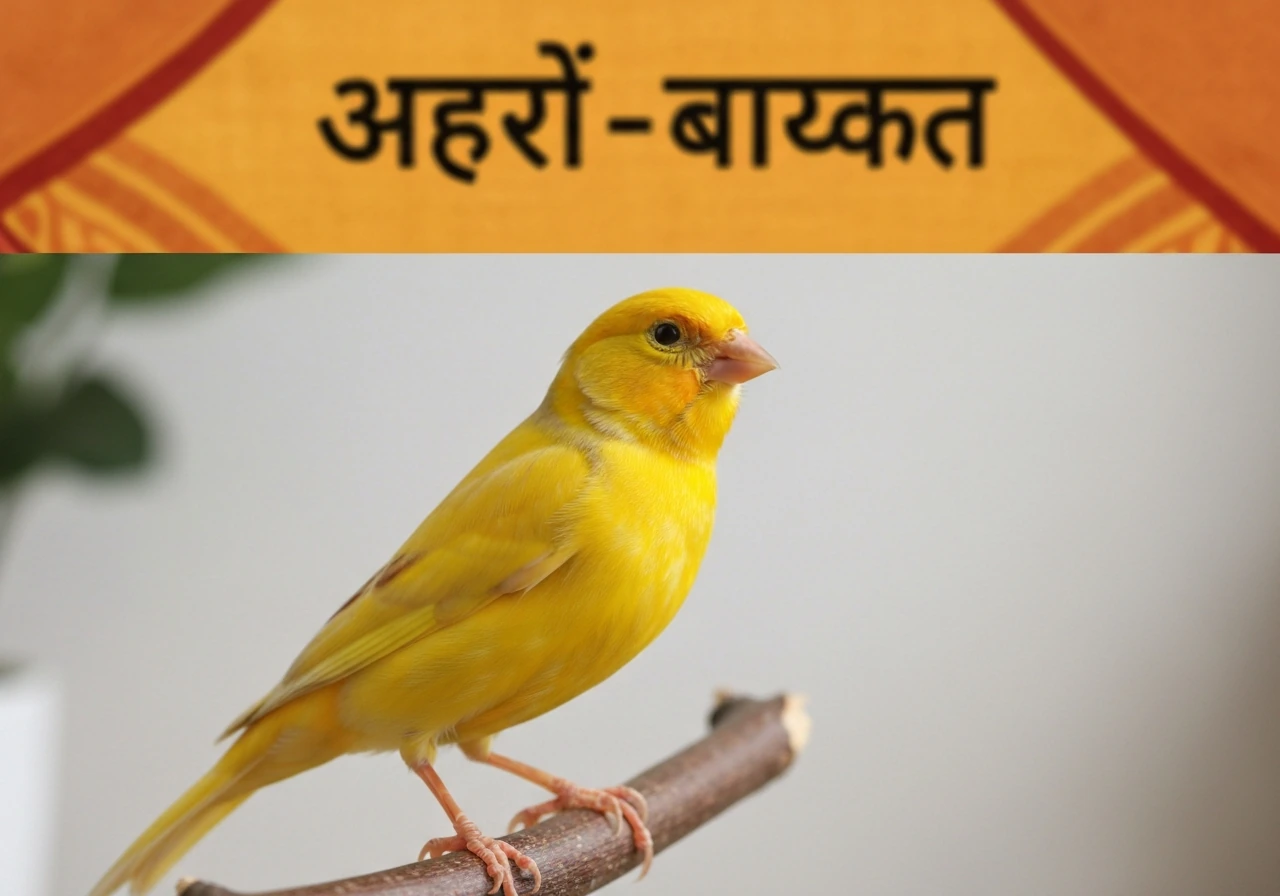
In Hindi, the canary bird is called कनारी चिड़िया (kanārī chiṛiyā) or simply कनारी (kanārī). You will also see the spelling कैनरी (kainrī) in modern pet-care articles and vocabulary lists, which is a closer phonetic borrowing from English. Both forms are widely understood, and native Hindi speakers use them interchangeably when talking about this small, bright yellow songbird.
Canary Bird Meaning in Hindi and Marathi With Usage

Rajesh Sharma
8 Jul 2026
The Hindi meaning of canary bird
The word कनारी comes directly from the English "canary," which itself traces back to the Canary Islands. Because the bird has no deep Sanskrit or classical Hindi root, it is treated as a borrowed term in every major Hindi dictionary. Shabdkosh, HamariWeb, and ShabdKhoj all list the primary Hindi equivalent as कनारी चिड़िया (Kanari Chidiya), where चिड़िया simply means "small bird" or "bird" in everyday speech. In more formal or written Hindi, you might see पक्षी (pakṣī) substituted for चिड़िया, giving कनारी पक्षी, but in daily conversation चिड़िया is the natural choice.
Hindi pet-care writing, including articles and PDFs circulating online, uses कैनरी की देखभाल (kainrī kī dekh-bhāl, "caring for a canary") as a standard phrase, confirming that the कैनरी spelling is perfectly acceptable in modern written Hindi. If you are writing formally or making a vocabulary list, go with कनारी चिड़िया. If you are writing a pet-care blog post or a casual Instagram caption, कैनरी works just fine on its own.
Canary bird meaning in Marathi
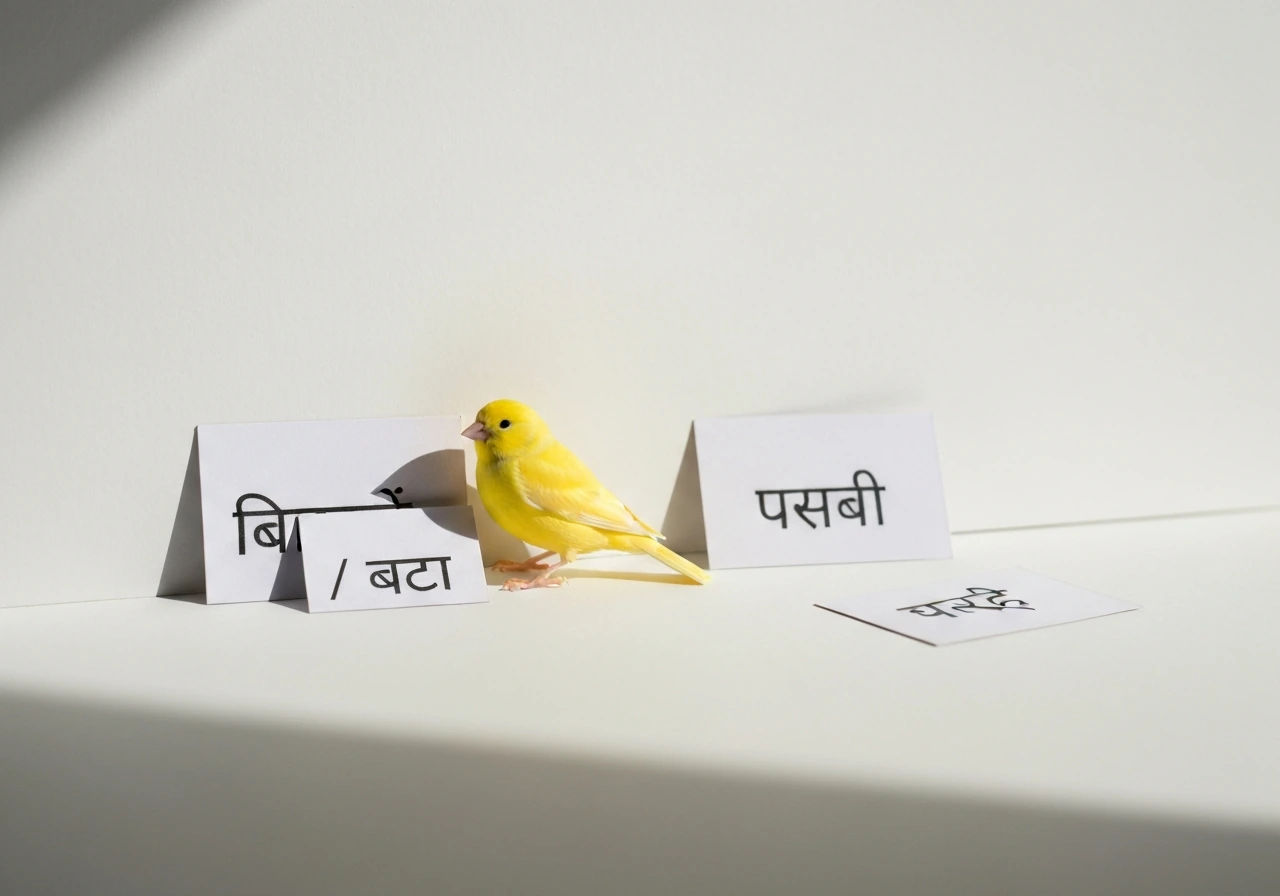
In Marathi, the canary is referred to using the same phonetic borrowing: कॅनरी (kanarī) or कॅनरी पक्षी (kanarī pakṣī). The Cambridge Dictionary's Marathi interface defines the canary in its songbird and pet-bird sense, and Uptoword's Marathi meaning page describes it specifically as a cage bird bred in bright yellow. Marathi speakers, particularly in urban Maharashtra, tend to drop the standalone word for "small bird" and just say कॅनरी, much like English speakers say "canary" without adding "bird." In written Marathi, especially in school textbooks or bird identification guides, you will occasionally see the descriptive phrase पिवळा गाणारा पक्षी (pivaḷā gāṇārā pakṣī), meaning "yellow singing bird," used alongside or instead of the borrowed term when the audience may not be familiar with the English-origin word.
How the canary is named across Indian languages
The canary does not have a classical Sanskrit name because it is not native to the Indian subcontinent. Its origins in the Atlantic islands mean it arrived in India primarily through European colonial trade, so every Indian language borrows the term phonetically rather than assigning a native root. Here is how it maps across the languages this site covers:
| Language | Term / Transliteration | Literal sense |
|---|---|---|
| Hindi | कनारी चिड़िया / kanārī chiṛiyā | Canary bird (borrowed + native word for bird) |
| Hindi (modern/pet context) | कैनरी / kainrī | Phonetic borrowing from English |
| Marathi | कॅनरी पक्षी / kanarī pakṣī | Canary bird (borrowed + standard word for bird) |
| Punjabi | ਕੈਨਰੀ / kainrī | Phonetic borrowing, same pattern as Hindi |
| Gujarati | કૅનેરી / kanerī | Phonetic borrowing with local vowel adaptation |
| Sanskrit / Classical | No established term | Described as पीत-गायक-खग (pīta-gāyaka-khaga), yellow singing bird, in descriptive usage |
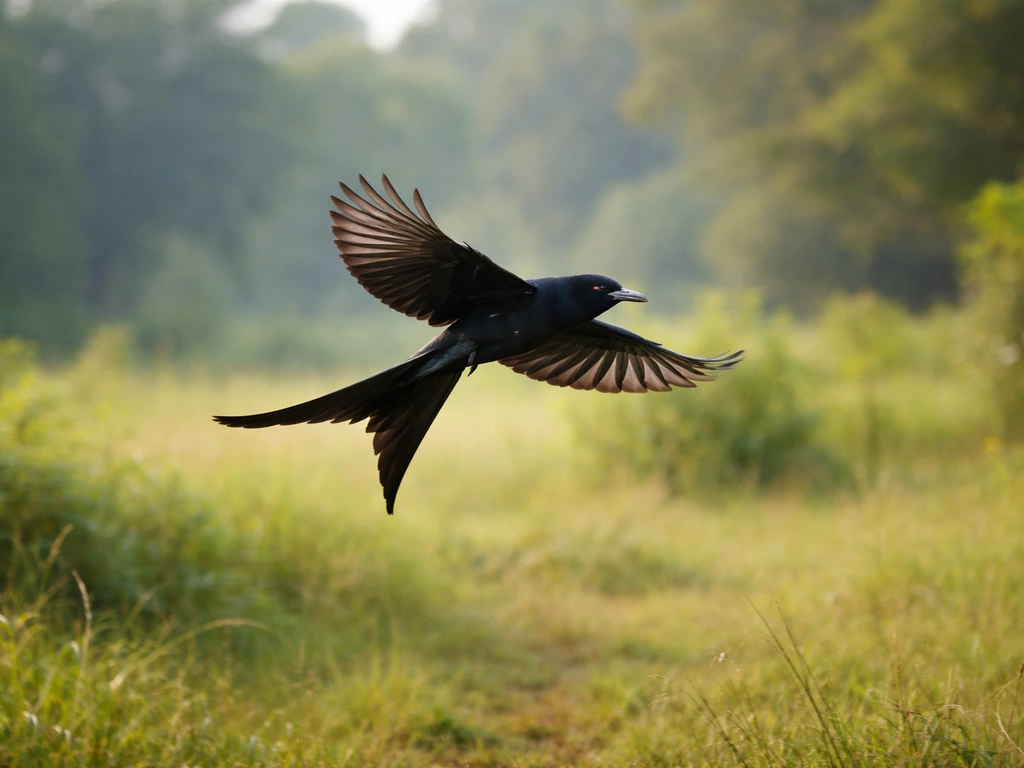
One useful comparison: the drongo, a bird with a deep presence in Indian folklore and Hindi vocabulary, has a proper classical Hindi name. The drongo bird meaning in Hindi can be understood as a specific local name used in Hindi vocabulary. The canary does not share that advantage, which is why learners sometimes feel unsure whether they are using the right term. If someone corrects your Hindi by saying कैनरी instead of कनारी or vice versa, both are correct, just reflecting different borrowing styles.
Symbolism and cultural associations in the Hindi context

Because the canary is not native to India, it does not carry the centuries-old mythological weight that birds like the crow, peacock, or parrot hold in Hindu tradition. That said, it has picked up clear cultural associations in the Hindi-speaking world, shaped partly by the bird's physical traits and partly by its crossover into South Asian popular culture through Urdu poetry and Hindi cinema.
The most consistent cultural association is with its bright yellow colour. In Indian symbolism, yellow is linked to optimism, auspiciousness, spring (especially the festival of Basant Panchami), and the energy of the sun. A canary's vivid yellow plumage naturally slots into this framework. When Hindi speakers describe something as "canary yellow," there is an implicit warmth and cheerfulness to the comparison. In informal usage, calling someone's voice कनारी जैसी (kanārī jaisī, "like a canary's") is a compliment, comparing their singing to the bird's famously melodic notes.
There is also a well-known street-level association borrowed from English and global organised-crime slang: the canary as an informant who "sings" to the police. This usage appears in Hindi crime dramas, thriller novels, and Bollywood dialogue, where a character might be called कनारी derisively, meaning they have revealed secrets. This is purely a borrowed cultural metaphor, not rooted in Indian folk tradition, but it is widely recognised in urban Hindi speech.
Spiritual and folklore meanings, and how they're read today
In the broader spiritual symbolism associated with canaries across cultures, three themes dominate: joy and positivity, the power of the voice or song, and alertness to danger. That last trait has an interesting zoological basis: canaries are highly responsive to the warning calls of other birds, making them naturally alert and communicative creatures. Miners historically used canaries in coal mines as early-warning systems for toxic gas, and this gave the bird a lasting symbolic link to vigilance and protective awareness.
In the Indian spiritual context today, especially among people who follow numerology, animal totems, or modern spiritual interpretive traditions, the canary is often read as a symbol of inner optimism, the courage to express oneself freely, and intuitive sensitivity to one's environment. These meanings are not drawn from classical Hindu scripture or Puranic tradition, but they align naturally with values already present in Indian spiritual culture, such as the reverence for a clear, true voice (often linked to Saraswati, the goddess of knowledge and music) and the idea of the soul singing freely. If someone asks you what a canary represents in a spiritual conversation in Hindi, you can honestly say it symbolises प्रसन्नता (prasannatā, joy), स्वर-शक्ति (svara-śakti, the power of voice), and सतर्कता (satarkatā, alertness).
It is worth being transparent here: the canary's spiritual meanings in an Indian context are largely interpretive and modern rather than rooted in ancient texts. They vary by region, community, and individual belief. A bird astrologer in Rajasthan and a spiritual blogger in Pune may give you quite different interpretations. Treat these associations as a living, evolving conversation rather than fixed doctrine.
Using the term correctly in Hindi and Marathi sentences

Getting the vocabulary right is one thing; using it naturally in a sentence is another. Here are some practical example sentences, with transliterations and English meanings, to help language learners feel comfortable with the term in context.
Hindi example sentences
- यह कनारी चिड़िया बहुत मधुर गाती है। (Yah kanārī chiṛiyā bahut madhur gātī hai.) — This canary bird sings very sweetly.
- मेरे पड़ोसी ने एक पीली कनारी पाल रखी है। (Mere paṛosī ne ek pīlī kanārī pāl rakhī hai.) — My neighbour has kept a yellow canary as a pet.
- कैनरी की देखभाल करना आसान नहीं है। (Kainrī kī dekh-bhāl karnā āsān nahīṃ hai.) — Taking care of a canary is not easy.
- उसकी आवाज़ कनारी जैसी मीठी है। (Uskī āvāz kanārī jaisī mīṭhī hai.) — Her voice is as sweet as a canary's.
Marathi example sentences
- हा कॅनरी पक्षी खूप गोड गातो. (Hā kanarī pakṣī khūp goḍ gāto.) — This canary bird sings very sweetly.
- त्याने एक पिवळा कॅनरी विकत घेतला. (Tyāne ek pivaḷā kanarī vikat ghetalā.) — He bought a yellow canary.
- कॅनरी हा एक लोकप्रिय पिंजऱ्यातील पक्षी आहे. (Kanarī hā ek lokapriya piñjaṛyātīl pakṣī āhe.) — The canary is a popular cage bird.
A quick tip for learners: in both Hindi and Marathi, the bird is grammatically feminine when using चिड़िया (Hindi) but can be masculine or neutral when using पक्षी (both languages), depending on the specific usage and regional convention. WordReference’s canary bird page is a useful English-Spanish dictionary entry for corroborating the standard term as a phrase. When in doubt, structure your sentence around पक्षी and you will almost always be correct.
Quick glossary: canary-related bird terms and common confusions

One of the most common problems people run into when looking up the canary in Indian languages is confusing it with other small yellow or singing birds. Reddit bird-identification threads are full of posts asking whether a spotted bird is a canary, a siskin, or a weaver. On r/devops, people also discuss mispronouncing “canary” in English contexts, which can be useful to keep in mind when you are learning pronunciation alongside the word’s borrowed spellings blank" rel="noopener noreferrer">Reddit bird-identification threads. Here is a compact glossary to help you keep the terms straight. In Hindi, the phrase used for a canary is कनारी चिड़िया, and its meaning is often explained alongside common related bird terms.
| English term | Hindi term | Marathi term | Quick distinction |
|---|---|---|---|
| Canary | कनारी / कनारी चिड़िया | कॅनरी पक्षी | Domesticated finch-type bird, bright yellow, melodic song, kept as a cage pet |
| Sparrow | गौरैया / चिड़िया (gauraiyā) | चिमणी (chimaṇī) | Common wild brown bird, much smaller beak, not kept for song |
| Munia / finch | मुनिया (muniyā) | मुनिया | Small Indian finch often confused with canary; native to India, usually brown/red |
| Parakeet / small parrot | तोता (totā) | पोपट (popaṭ) | Green cage bird; also trained to mimic speech, very different from canary |
| Siskin | सिस्किन (siskin) | सिस्किन | Wild finch with yellow-green plumage; sometimes confused with canary in appearance |
| Weaver bird | बया (bayā) | सुगरण (sugaraṇ) | Yellow bird native to India; different species entirely, builds hanging nests |
The baya weaver is the most common source of confusion in Indian contexts specifically. It is a native yellow bird with a melodic chirp that many rural Hindi and Marathi speakers are more familiar with than the canary. If you are discussing a wild yellow bird seen in a field in Maharashtra or Rajasthan, it is almost certainly the बया (bayā), not a कनारी. If you meant a specific pet-bird term in Hindi, you may also be looking for cockatiel bird meaning in hindi as a related option कनारी. The canary, by contrast, is almost exclusively encountered as a domesticated pet bird in India, sold in city bird markets.
If you enjoy exploring bird terminology across Indian languages, you will find similarly interesting translation puzzles with birds like the dodo, the cockatiel, and the kakapo, all of which, like the canary, are not native to the subcontinent and rely on phonetic borrowings or descriptive phrases in Hindi and Marathi rather than classical roots. The kakapo bird meaning in Hindi is typically explained using descriptive wording and phonetic borrowing, rather than a long-established classical term.
How to pick the right term for your context
Here is the practical takeaway. If you are learning Hindi vocabulary, use कनारी चिड़िया as your base term and you will be understood everywhere. If you are writing in a modern, urban Hindi context such as a blog, social media post, or pet-care article, कैनरी is equally acceptable and arguably more common in print. In Marathi, कॅनरी पक्षी is the clean, standard choice. If your context is mythology or classical symbolism and someone asks you for a Sanskrit equivalent, use the descriptive phrase पीत-गायक-खग and explain that no classical Sanskrit name exists for this bird, which itself is a culturally interesting fact worth sharing.
For spiritual or symbolic discussions, connect the canary to its three core associations: joy and brightness (its yellow colour), the power of an authentic, beautiful voice, and sensitive alertness to one's surroundings. These meanings resonate naturally within Indian spiritual frameworks even though the bird itself is not part of ancient Indian iconography. That combination of borrowed vocabulary and resonant symbolism makes the canary an interesting case study in how Indian languages and cultures absorb and interpret the wider world.
FAQ
Can I use both कनारी and कैनरी in Hindi, or is one wrong?
Most of the time you will be understood if you use either कनारी (kanārī) or कैनरी (kainrī). In print and official style, prefer कनारी चिड़िया (or कनारी पक्षी), because कनारी is the more widely treated Hindi dictionary form, while कैनरी is the modern spelling you will see in pet-care writing.
Do I have to say कनारी चिड़िया, or can I just say कनारी?
In everyday speech, calling it कनारी (kanārī) is acceptable, because लोग अक्सर context से “which bird” समझ लेते हैं. If you are teaching vocabulary or writing a caption where confusion is possible, add the classifier, कनारी चिड़िया (small bird) or कनारी पक्षी (bird).
How do I avoid confusing canary (कनारी/कॅनरी) with baya (बया) in Hindi or Marathi?
For meaning, canary and baya are often mixed up, but they are different birds. A baya is a common wild, native yellow bird in many parts of India, while canary is more associated with domesticated pet-bird contexts, so if your scene is a cage, store, or pet market, कनारी is the safer word.
Why does grammar change with कनारी चिड़िया vs कनारी पक्षी in Hindi?
Yes, both gender patterns appear because of the noun you attach. When you use चिड़िया (feminine in Hindi), the sentence grammar tends to follow feminine cues, but if you switch to पक्षी (often treated masculine or neutral), your verb agreement and adjectives usually follow that different convention. If unsure, build the sentence around पक्षी.
What meaning should I give in a spiritual context, and is it classical?
In a spiritual or symbolism-based conversation, you can say it represents प्रसन्नता (joy), स्वर-शक्ति (the power of voice), and सतर्कता (alertness). But if someone expects a strict classical Sanskrit or Puranic link, you should avoid claiming one, since the canary is a borrowed term with modern, interpretive symbolism.
Is “canary” meaning as an informant (police informant) appropriate in normal conversation?
People sometimes use canary as “informant” in crime-style Hindi, so it can sound derogatory or mocking depending on tone. If you are not writing a thriller dialogue, use a neutral descriptive phrase like “पीली चिड़िया” only for general reference, and reserve कनारी for the specific pet-bird meaning.
How can I use कनारी जैसी correctly in a sentence, especially for compliments?
In Hindi, “कनारी जैसी आवाज” is more natural than forcing “कनारी जैसी” with an unrelated noun. For example, complimenting a voice works well: “उसकी आवाज कनारी जैसी है,” but describing a person’s color is better as “कनारी जैसा पीला” (or “कैनरी पीला”) rather than stretching idioms.
If I see a yellow singing bird outdoors, should I call it canary or something else?
If you are identifying a wild bird from a photo, rely on description, not only the word. Ask yourself, is it a cage pet, or a natural field bird? If it is in a cage or pet setting, canary fits better, if it is a wild yellow singer in rural areas, baya is more likely.
Next Article
Drongo Bird Meaning in Hindi: नाम, अर्थ और प्रतीक
ड्रोंगो बर्ड का हिंदी नाम और अर्थ जानें, असली पक्षी पहचान, प्रतीकात्मक/सांस्कृतिक मतलब, और सही सत्यापन टिप्स