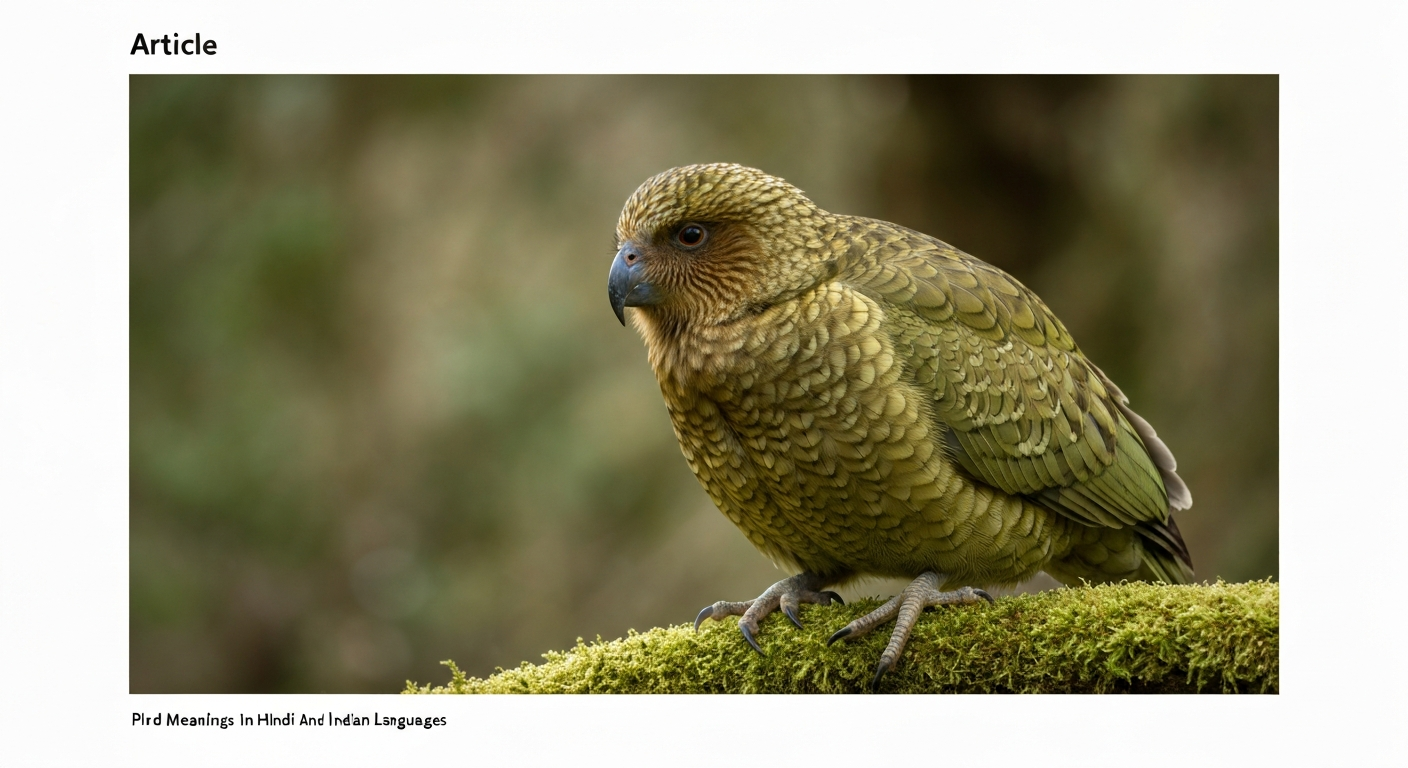
In Hindi, the kakapo is most commonly rendered as काकापो (kākāpō), pronounced 'kaa-kaa-poh' (IPA: /kɑːkɑːpoː/). The bird has no traditional Hindi name because it is native to New Zealand and entirely absent from the Indian subcontinent, so the Maori word is simply transliterated into Devanagari script. If you need a Sanskritized form for formal or literary use, 'रात्रिशुकः' (rātrišukaḥ), meaning 'night parrot', works as a descriptive equivalent.
Kakapo Bird Meaning in Hindi: Name, Pronunciation & Symbolism

Rajesh Sharma
18 Jul 2026
Quick Answer: Hindi Name, Script, and Pronunciation
| Element | Detail |
|---|---|
| Hindi name (transliteration) | कākāpō / काकापो |
| Devanagari spelling | काकापो |
| Transliteration (IAST / ISO 15919) | kākāpō |
| Hindi phonetics | kaa-kaa-poh |
| IPA | /kɑːkɑːpoː/ |
| English pronunciation (Merriam-Webster) | /ˈkä-kə-ˌpō/ |
| Sanskritized name | रात्रिशुकः (rātriśukaḥ) |
| Literal meaning | Night parrot |
When writing the word in Devanagari, use the long vowel markers throughout: का-का-पो. The 'पो' at the end uses the 'ो' vowel sign (o-matra) on प, giving the 'poh' sound. Hindi speakers will naturally stress the first syllable, producing 'KAA-kaa-poh', which is close enough to the Maori original to be understood in any context.
What Kind of Bird Is the Kakapo?
The kakapo (Strigops habroptilus Gray, 1845) is in a category entirely its own. It is a very large, flightless, nocturnal, ground-dwelling parrot native to New Zealand, and it holds the distinction of being the heaviest parrot species on Earth. Adult males can reach around 3 to 4 kilograms, while females are noticeably smaller. The plumage is a mottled moss-green with dark barring, and the face carries a distinct facial disc that gives the bird an owl-like appearance, which is why it is sometimes called the 'owl parrot' in informal English.
Behaviourally, the kakapo is extraordinary even by parrot standards. It is the only parrot known to use a lek-breeding system, where males gather at display arenas and boom loudly to attract females. Breeding is episodic rather than annual: it occurs only when certain trees, primarily rimu (Dacrydium cupressinum), undergo a mast-fruiting event and produce abundant fruit. The kakapo also has an exceptional lifespan, with estimates in the literature suggesting wild individuals can live 60 years or more, and some accounts report individuals exceeding that considerably, though rigorous ageing data remain limited.
- Scientific name: Strigops habroptilus Gray, 1845
- Order: Psittaciformes (parrots)
- Native range: New Zealand (currently restricted to predator-free offshore islands managed by the New Zealand Department of Conservation)
- Weight: adult males up to approximately 3 to 4 kg, making it the world's heaviest parrot
- Plumage: mottled moss-green with dark barring; facial disc gives an owl-like profile
- Flight: completely flightless
- Activity pattern: nocturnal and ground-dwelling
- Breeding system: lek-based, episodic, triggered by rimu mast years
- Lifespan: exceptionally long, commonly cited at 60 or more years in authoritative literature
Where the Name Comes From: Maori Roots and English Adoption
The word 'kakapo' is borrowed directly from te reo Maori. According to Te Aka, the authoritative Maori dictionary, the word breaks cleanly into two components: kākā, meaning parrot, and pō, meaning night. Put together, kākāpō simply means 'night parrot', which is an accurate description of its nocturnal habits. The macrons over the vowels in the Maori spelling (kākāpō) indicate long vowels, a feature standardised by Te Taura Whiri i te Reo Maori, the Maori Language Commission, and used by the New Zealand Department of Conservation in all official documentation.
English borrowed the word in the mid-19th century, around the time European naturalists were formally documenting New Zealand's wildlife. Merriam-Webster records the Maori origin and gives the English pronunciation as /ˈkä-kə-ˌpō/. The species was formally named by G.R. Gray in 1845, and the valid scientific name Strigops habroptilus was confirmed as the correct spelling in a 2023 nomenclatural note by Savage and Digby in the Bulletin of Zoological Nomenclature. The genus name Strigops is itself derived from Greek: strix (owl) and ops (face), a nod to that same owl-like facial disc that also inspired the bird's informal English nickname.
How to Break Down the Name for Hindi Learners
| Maori Component | Maori Meaning | Hindi Equivalent | Devanagari |
|---|---|---|---|
| kākā | parrot | तोता (tōtā) | तोता |
| pō | night | रात (rāt) | रात |
| kākāpō (combined) | night parrot | रात का तोता (rāt kā tōtā) | रात का तोता |
Symbolism and Cultural Meaning in Indian and Hindi Contexts
Here I need to be straightforward with you: the kakapo carries no traditional symbolic meaning in Indian mythology, Sanskrit literature, or regional folk traditions. It is a New Zealand species that was entirely unknown to ancient Indian cultures, so there is no Puranic story, no Sanskrit shloka, and no folk song that references it. Any 'symbolic meaning' we assign in Hindi or Indian cultural contexts today is necessarily modern, interpretive, and drawn from the bird's known characteristics rather than from tradition.
That said, when Indian language speakers and cultural enthusiasts encounter the kakapo, certain themes emerge naturally and resonate with existing Indian symbolic frameworks. Rarity is one: the kakapo is critically endangered and one of the rarest birds alive, and in Indian traditions rarity in nature often carries spiritual weight. Birds that appear once in a lifetime are treated as auspicious or as divine messengers in many Hindu folk beliefs. The kakapo's extraordinary longevity aligns with Sanskrit values around dirghayu (long life), a quality celebrated in blessings and prayers. And its flightless, ground-bound nature is an irony that a Hindi speaker might describe using the proverb 'पर होते हुए भी उड़ नहीं सकता' (par hote hue bhi ud nahin sakta), meaning 'even with wings, cannot fly', which has resonance as a metaphor for unrealised potential.
Comparing Kakapo to Parrot Symbolism in Indian Tradition
Parrots in general hold a rich place in Sanskrit and regional Indian traditions. The Sanskrit word for parrot is शुकः (śukaḥ), and the bird appears prominently in Indian culture. Shuka, the son of Vyasa in Hindu mythology, is depicted in parrot form in some traditions and is associated with divine speech and wisdom. The parrot features in Kamasutra texts as a pet of cultured women, in Panchatantra fables as a clever narrator, and in Tulsidas's Ramcharitmanas as part of the divine avian world. In Gujarati and Marathi folk traditions, the parrot is associated with love, eloquence, and the mimicking of sacred speech. The Hindi idiom 'तोते की तरह रटना' (tōte kī taraḥ raṭnā), meaning 'to memorise like a parrot', reflects both admiration and gentle critique of rote learning.
The kakapo, being a parrot in the taxonomic sense, can loosely inherit some of this symbolic territory when discussed in Hindi contexts. But unlike the bright-green Indian ringneck or the beloved Alexandrine parakeet that Indian traditions know well, the kakapo is nocturnal, flightless, and belongs to a completely different world. Think of it as the poetic opposite of the Sanskrit śuka: where the classical parrot is vivid, vocal, and a creature of daylight, the kakapo is moss-green, near-silent (except during breeding season), and a creature of the night. That contrast itself makes it a fascinating bird to write about in Indian languages.
Translations and Names Across Indian Languages
Because the kakapo has no established name in any Indian language, the standard approach across Hindi, Sanskrit, Marathi, Punjabi, and Gujarati is to transliterate the Maori word into the native script, following the long-vowel structure of the original. See also the jacana bird meaning in Hindi for how other non-native waterbirds are rendered and discussed in Indian languages. For related names and meanings of pet parrots, see the cockatiel bird meaning in Hindi. The ISO 15919 overview (transliteration standard for Indic scripts) provides mapping tables for long vowels, e.g. ā → आ, used in scholarly transliteration, so kākāpō transliterates to Devanagari काकापो. Below I have given the transliterated form in each script, a descriptive name where one is constructively useful, and a pronunciation guide for each language's speakers.
| Language | Script | Transliteration | Descriptive Name | Pronunciation Guide |
|---|---|---|---|---|
| Hindi | Devanagari | काकापो | रात का तोता (rāt kā tōtā) | kaa-kaa-poh |
| Sanskrit | Devanagari | काकापो | रात्रिशुकः (rātriśukaḥ) | raah-tri-shu-kah |
| Marathi | Devanagari | काकापो | रात्रीचा पोपट (rātrīcā popaṭ) | kaa-kaa-poh / raah-tree-chaa po-pat |
| Punjabi | Gurmukhi | ਕਾਕਾਪੋ | ਰਾਤ ਦਾ ਤੋਤਾ (rāt dā tōtā) | kaa-kaa-poh |
| Gujarati | Gujarati script | કાકાપો | રાત્રિનો પોપટ (rātrinō popaṭ) | kaa-kaa-poh |
A note on the Sanskrit Sanskritized form: रात्रिशुकः (rātriśukaḥ) is a constructive compound using rātri (night) and śuka (parrot), following the standard Sanskrit tatpurusha (determinative compound) pattern. It is not attested in classical literature (because the bird was unknown), but it follows correct grammatical formation and would be immediately understood by any Sanskrit reader. The Marathi descriptive 'रात्रीचा पोपट' and the Gujarati 'રાત્રિનો પોપટ' follow the same logic in their respective grammars.
Practical Usage: Example Sentences in Indian Languages
Here are natural example sentences that show how you might use the word in each language, whether in conversation, a school project, or a nature article.
Hindi
- काकापो (kākāpō) एक दुर्लभ और उड़ान-रहित तोता है जो न्यूज़ीलैंड में पाया जाता है। (The kakapo is a rare, flightless parrot found in New Zealand.)
- काकापो रात के समय सक्रिय होता है, इसीलिए इसे 'रात का तोता' भी कहते हैं। (The kakapo is active at night, which is why it is also called 'raat ka tota'.)
- यह संसार का सबसे भारी तोता है और गंभीर रूप से संकटग्रस्त है। (It is the world's heaviest parrot and is critically endangered.)
Marathi
- काकापो हा न्यूझीलंडमधील एक दुर्मीळ, उडता न येणारा पोपट आहे. (The kakapo is a rare, flightless parrot from New Zealand.)
- हा पक्षी रात्री जागा असतो, म्हणून त्याला 'रात्रीचा पोपट' म्हणतात. (This bird is active at night, so it is called the 'night parrot'.)
Punjabi
- ਕਾਕਾਪੋ ਨਿਊਜ਼ੀਲੈਂਡ ਦਾ ਇੱਕ ਦੁਰਲੱਭ ਤੋਤਾ ਹੈ ਜੋ ਉੱਡ ਨਹੀਂ ਸਕਦਾ। (The kakapo is a rare parrot from New Zealand that cannot fly.)
- ਇਹ ਰਾਤ ਨੂੰ ਸਰਗਰਮ ਹੁੰਦਾ ਹੈ ਅਤੇ ਦੁਨੀਆ ਦਾ ਸਭ ਤੋਂ ਭਾਰਾ ਤੋਤਾ ਹੈ। (It is active at night and is the world's heaviest parrot.)
Gujarati
- કાકાપો ન્યૂઝીલેન્ડનો એક દુર્લભ, ઉડી ન શકતો પોપટ છે. (The kakapo is a rare, flightless parrot from New Zealand.)
- આ પક્ષી રાત્રે સક્રિય રહે છે અને અત્યંત ભયંકર સ્થિતિમાં છે. (This bird is active at night and is in a critically endangered state.)
Useful Glossary Terms
| English Term | Hindi | Devanagari | Notes |
|---|---|---|---|
| Flightless bird | उड़ान-रहित पक्षी (uḍān-rahit pakṣī) | उड़ान-रहित पक्षी | Literal: flight-lacking bird |
| Nocturnal | रात्रिचर (rātricar) / रात में सक्रिय | रात्रिचर | From Sanskrit rātri (night) + cara (moving) |
| Parrot | तोता (tōtā) / शुक (śuka, Sanskrit) | तोता / शुक | Śuka is the formal Sanskrit term |
| Endangered species | संकटग्रस्त प्रजाति (saṅkaṭagrast prajāti) | संकटग्रस्त प्रजाति | Critically endangered = गंभीर रूप से संकटग्रस्त |
| Conservation | संरक्षण (saṃrakṣaṇ) | संरक्षण | Used in wildlife protection contexts |
| Native range | मूल आवास (mūl āvās) | मूल आवास | Where a species naturally occurs |
| Lek breeding | प्रदर्शन प्रजनन (pradarśan prajanan) | प्रदर्शन प्रजनन | Display-based mating system |
| Longevity | दीर्घायु (dīrghāyu) | दीर्घायु | Sanskrit compound: long (dīrgha) + life (āyu) |
If you arrived here while searching for similar exotic parrots and their Hindi names, you may also find it useful to explore what the cockatiel and the canary are called in Hindi, both of which appear elsewhere on this site. The dodo, like the kakapo, is a famous case of island bird evolution and has its own entry covering its Hindi name and the way extinct species are discussed in Indian languages. See the dodo bird meaning in Hindi for its Hindi name and how extinct island birds are discussed in Indian languages. The drongo and the jacana, by contrast, are birds you will actually encounter across the Indian subcontinent, and their entries give a richer sense of how Indian ornithological vocabulary developed for native species.
Why Conservation Status Shapes the Kakapo's Meaning Today
The kakapo is assessed as Critically Endangered on the IUCN Red List, the highest threat category before extinction. Within New Zealand, it carries an even more acute designation: 'Nationally Critical' under the New Zealand Threat Classification System, administered by the Department of Conservation. This is not background detail. For a bird like the kakapo, conservation status is inseparable from its identity and the way it is described and discussed in any language, including Hindi.
The New Zealand Department of Conservation runs the official Kakapo Recovery Programme, which involves intensive individual monitoring of every known bird, radio-tracking, supplementary feeding, predator-free island management, and carefully timed interventions during mast years. The kakapo is also listed on CITES Appendix I, which prohibits commercial trade in the species internationally. In practical terms, this means every living kakapo is a named, individually monitored individual, which is itself an extraordinary fact that speakers of any language find remarkable when they encounter it.
In the context of Indian languages and cultural framing, the kakapo's conservation story connects with the concept of 'संरक्षण' (saṃrakṣaṇ, conservation) and the Sanskrit idea of 'अहिंसा' (ahiṃsā, non-harm), which extends to wildlife protection in contemporary discourse. When Indian environmentalists, educators, and wildlife advocates write about global endangered species, the kakapo appears regularly as a striking example precisely because its situation is so extreme and the recovery effort so intensive. The bird's rarity gives it a kind of symbolic weight in modern Indian conservation writing even without any mythological precedent.
Its exceptional longevity, potentially spanning six or more decades, also gives the kakapo a quiet symbolic dignity in Indian contexts. In Sanskrit tradition, dirghayu (दीर्घायु) or long life is a virtue and a blessing, and a bird that can outlive most humans while carrying such rarity makes for a compelling natural metaphor. When Hindi writers discuss the kakapo in environmental journalism or children's nature books, these are the qualities that tend to anchor its meaning: rarity, endurance, and the urgent need for human protection.
SEO Publishing Reference
Suggested Title and Meta Description
- Title: Kakapo Bird Meaning in Hindi: Name, Script, Pronunciation and Symbolism
- Meta description (158 characters): Kakapo meaning in Hindi is काकापो (kākāpō). Learn the Devanagari spelling, pronunciation, Maori etymology, Indian language translations, and conservation significance.
Suggested Image Captions
- Photo caption (bird portrait): A kakapo (Strigops habroptilus) showing its characteristic moss-green mottled plumage and owl-like facial disc. Hindi name: काकापो (kākāpō). Image: Wikimedia Commons, File:Kakapo.jpg, CC BY-SA 4.0.
- Range map caption: Distribution map of the kakapo (Strigops habroptilus), showing its current restricted range on predator-free offshore islands of New Zealand. The bird is Critically Endangered (IUCN) and Nationally Critical (NZ DOC). Source: BirdLife International / IUCN Red List species factsheet (verify reuse terms before publication).
Quick-Reference Summary Table
| Field | Detail |
|---|---|
| Common English name | Kakapo (also: owl parrot) |
| Scientific name | Strigops habroptilus Gray, 1845 |
| Hindi name | काकापो (kākāpō) |
| Hindi phonetics | kaa-kaa-poh |
| IPA | /kɑːkɑːpoː/ |
| Sanskritized descriptive name | रात्रिशुकः (rātriśukaḥ) — night parrot |
| Maori etymology | kākā (parrot) + pō (night) |
| Native range | New Zealand (predator-free offshore islands) |
| Conservation status | Critically Endangered (IUCN); Nationally Critical (NZ DOC) |
| Symbolism in Indian contexts | Rarity, longevity (dīrghāyu), conservation (saṃrakṣaṇ); no traditional mythological symbolism |
| Closest Indian symbolic parallel | Sanskrit śuka (parrot) — wisdom, divine speech; kakapo is its nocturnal, flightless counterpart |
FAQ
What primary authoritative sources should I consult to verify the kākāpō's species facts and conservation status?
Use IUCN Red List for global threat assessment (Critically Endangered), New Zealand Department of Conservation (DOC) for national status, recovery programmes, and population facts, peer‑reviewed reviews (e.g., Bird Conservation International) for life history and behaviour, and New Zealand Birds Online for morphology and natural history. Cross‑check legal listings (CITES Appendices) from official treaty/legislation sources.
Which sources establish the correct scientific name and taxonomy to cite?
Cite original taxonomic authority (Gray, 1845) and modern nomenclatural treatments (e.g., Savage & Digby 2023) that confirm Strigops habroptilus as the valid name. Use taxonomic databases or the cited peer‑reviewed bulletin for verification.
How should I verify and present the Māori name and etymology for 'kākāpō'?
Use Te Aka Māori Dictionary and other authoritative Māori lexica for the word, and Te Taura Whiri i te Reo Māori guidance on orthography and macron use. Present the morpheme analysis (kākā + pō) and cite lexica and DOC materials that explain the Māori meaning.
What is the correct method to transliterate and render 'kākāpō' into Hindi (Devanagari) and other Indic scripts?
Follow ISO 15919/IAST conventions for scholarly transliteration to map Māori long vowels to Devanagari (ā → आ, ō → ओ), producing कākāpō → काकापो. For regional languages, use standard orthography rules for Marathi (Devanagari), Punjabi (Gurmukhi), Gujarati, and provide Sanskritized forms using classical orthographic rules. Cite ISO 15919 and consult native script specialists for each language.
How do I produce accurate pronunciation guides (Hindi phonetics and IPA) for the Hindi rendering?
Base the pronunciations on authoritative English/Māori pronunciation sources (e.g., Merriam‑Webster, DOC outreach respellings) and then render a Hindi phonetic respelling that fits Devanagari phonology (e.g., काकापो → 'kaa‑kaa‑po' with long a). Provide optional IPA transcriptions for the Māori original (/ˈkɑːkɑpoʊ/ or /ˈkä-kə-ˌpō/ per Merriam‑Webster) and map to a Hindi IPA approximate. Verify with native Hindi speakers familiar with phonetic notation.
What verifications are required for claims about behaviour and life history (flightless, nocturnal, lek‑breeding, longevity)?
Cite peer‑reviewed literature and authoritative species accounts (Bird Conservation International review, NZ Birds Online, DOC summaries). Avoid unsupported precise longevity maxima; instead cite sources that discuss longevity estimates (EoL/AnAge) and note uncertainty. Verify lek‑breeding and nocturnal, ground‑dwelling behaviour with multiple sources.
Next Article
Canary Bird Meaning in Hindi and Marathi With Usage
Know canary bird meaning in Hindi and Marathi, correct terms, usage examples, and common symbolism in Indian traditions.