If you are searching for the bustard bird meaning in Marathi, here is your direct answer: the bustard bird is called "माळढोक" (Maldhok) in Marathi. That is the word used across Maharashtra and in ornithological databases for the Great Indian Bustard, the species that most Indians mean when they say "bustard." The rest of this guide walks you through identification, pronunciation, the Hindi equivalents, cultural context, and how to cross-verify the term when sources give you conflicting names.
Bustard Bird Meaning in Marathi: Name, Hindi, and ID Guide

Rajesh Sharma
11 Apr 2026
What exactly is a bustard bird?
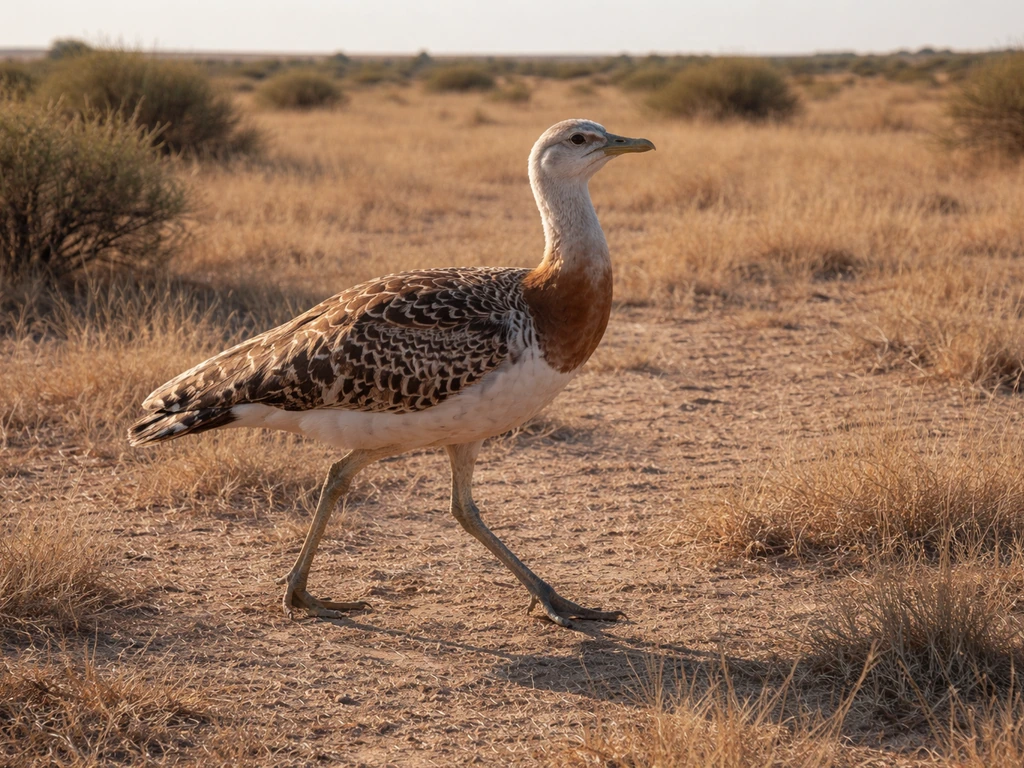
A bustard is any bird belonging to the family Otididae, a group of large, ground-dwelling birds found across Africa, Asia, Europe, and Australia. They are big, heavy birds built for walking through dry grasslands and steppes rather than flying. Think of them as the Old World equivalents of the crane family in terms of stature, though ornithologists now classify bustards separately from cranes and rails.
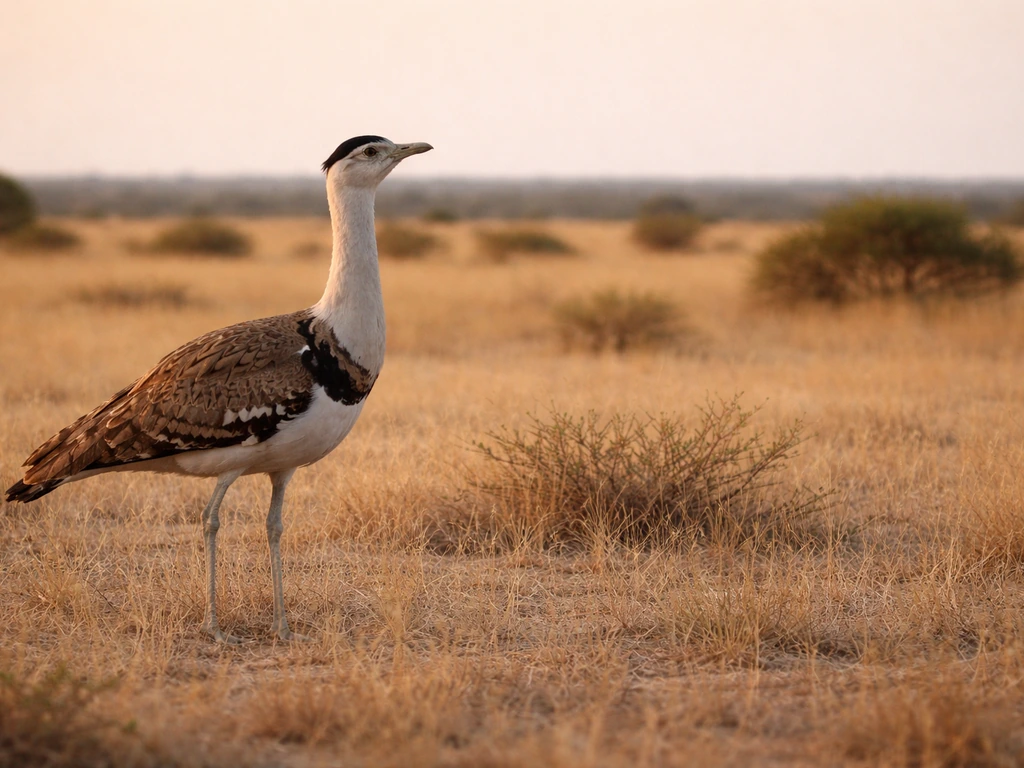
Here is where it gets a little tricky: there are multiple bustard species, and the word "bustard" alone does not pin down one bird. However, if you are in the Indian context and someone says "bustard," they almost certainly mean the Great Indian Bustard, scientific name Ardeotis nigriceps. The U.S. Fish & Wildlife Service lists the Great Indian Bustard under the accepted scientific name Ardeotis nigriceps. This is India's most iconic bustard species, critically endangered today, and the one that carries a Marathi name, a Hindi name, and genuine cultural weight. Older literature sometimes lists it under the synonym Choriotis nigriceps, so don't be thrown off if you see that in vintage field guides or vernacular databases.
The Marathi word for bustard: spelling, pronunciation, and usage
The Marathi word for the bustard (specifically the Great Indian Bustard) is "माळढोक" pronounced as Maldhok (maal-dhok, with a long "aa" in the first syllable). You will find this used in Marathi newspapers, conservation literature, and official wildlife documents. A Times of India report from Pune, for instance, explicitly identifies the Great Indian Bustard as "commonly known as GIB or Maldhok in Marathi," confirming this is the standard, widely accepted term and not a regional folk name.
Breaking it down phonetically: "Maal" (माळ) refers broadly to an open, flat land or plateau, and "Dhok" (ढोक) is a local term for the bird itself. So the name literally paints a picture of a bird of the open flatlands, which perfectly matches the Great Indian Bustard's habitat in dry grasslands across Maharashtra, Rajasthan, and Gujarat. If you are a language learner, that kind of embedded meaning in regional bird names is worth noting. Much like bird meaning in Marathi reflects deep ecological and cultural roots, Maldhok is not just a label but a habitat portrait in two syllables.
The Hindi word for bustard: multiple names, one bird
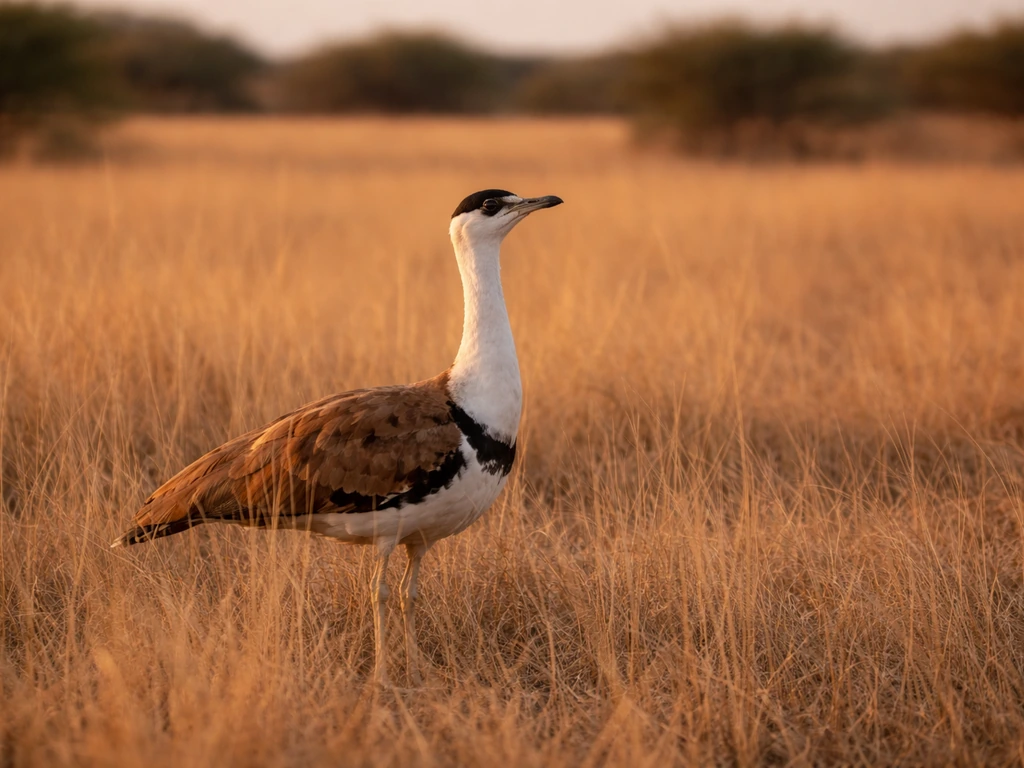
Hindi does not have just one word for the bustard. blank" rel="noopener noreferrer">The BNHS ENVIS vernacular-names database lists several Hindi names for the Great Indian Bustard: Sohan, Gughunbher, and Hukna. Regional usage determines which one you encounter. In Rajasthan, the bird is most famously called Godawan, a name so beloved that it became the state bird of Rajasthan. If you cross-reference with IUCN literature, you will also find "Hukna" listed as a local Hindi-style name for Otididae-type bustards.
The takeaway for Hindi speakers: there is no single canonical Hindi word the way Maldhok is for Marathi. Context and region matter. If you are writing or translating and need a broadly understood Hindi term, Godawan is likely your safest bet for a general audience because of its association with the Rajasthan state bird.
Cultural symbolism and traditional associations
The Great Indian Bustard does not appear prominently in classical Hindu mythology the way birds like the peacock, owl, or crow do. However, it holds real cultural significance at the folk and regional level, particularly in Maharashtra, Gujarat, and Rajasthan. In Maharashtra, the Maldhok is a symbol of the Deccan plateau's open grassland ecosystem, and its decline is treated as a cultural loss, not just an ecological one. Conservation campaigns in Marathi-speaking regions use the bird's local name emotionally, in the same way that regional languages invoke the names of endangered animals as part of environmental identity.
In Rajasthan, Godawan carries a stronger traditional presence. The word itself has folk-song associations, and the bird appears in oral traditions connected to the dry scrublands of the Thar Desert. Its slow walk, imposing size, and rarity have historically made it a bird of respect among rural communities who lived alongside it. Compare this to the hawk in Marathi tradition: if you look at hawk bird meaning in Marathi, you will see that raptors tend to carry stronger mythological and symbolic roles, while ground birds like the bustard are more rooted in ecological and folk identity.
There is also a practical spiritual angle: birds that are rare and majestic are often associated with auspiciousness in folk belief. Spotting a Maldhok was historically considered a fortunate sighting in rural Maharashtra, much the way certain birds are treated as omens in regional traditions. This is a softer, folk-level symbolism rather than a formal mythological role, but it is real and worth knowing if you are approaching this from a cultural studies angle.
Marathi vs Hindi naming: how to verify and avoid confusion
One of the most common frustrations when looking up Indian bird names is landing on different words across sources for what should be the same bird. This happens because vernacular names are not standardized the way scientific names are. The scientific name Ardeotis nigriceps (or its older synonym Choriotis nigriceps) is your anchor. If you find a source using the Marathi term "माळढोक" and another source using the Hindi term "Godawan," cross-checking both against the scientific name will confirm they are referring to the same species.
The BNHS ENVIS "Vernacular Names of Birds of the Indian Subcontinent" database is the most reliable reference for this kind of cross-check. It maps common English names and scientific names to regional vernacular names language by language, including Marathi and Hindi. The scientific name used in that database for the Great Indian Bustard is listed as Choriotis nigriceps (the older synonym), while the accepted current name is Ardeotis nigriceps, used by the Macaulay Library, IUCN, and U.S. Fish & Wildlife Service. Both refer to the same bird, so if you see either, you are on track.
This kind of synonym confusion is actually common across bird families. For instance, bat bird meaning in Marathi illustrates how colloquial and scientific naming can diverge significantly, and the same principle applies here: always anchor to the Latin binomial when you need certainty.
A practical tip for language learners: when you look up a bird name in Marathi or Hindi, search for the common English name plus the scientific name together. Searching "Great Indian Bustard Ardeotis nigriceps Marathi" will get you to Maldhok far more reliably than searching just "bustard Marathi." The scientific name cuts through the regional noise. Similarly, if you are curious about proverbs or idioms involving birds in Indian languages, note that regional languages often encode entirely different meanings, the way the early bird catches the worm meaning in Hindi differs from its English counterpart.
Marathi vs Hindi: quick name comparison

| Feature | Marathi | Hindi |
|---|---|---|
| Primary vernacular name | माळढोक (Maldhok) | गोडावण (Godawan) / सोहन (Sohan) |
| Other local names | Maldhok (standard across Maharashtra) | Gughunbher, Hukna (regional variants) |
| Scientific name anchor | Ardeotis nigriceps | Ardeotis nigriceps |
| Older synonym (in some databases) | Choriotis nigriceps | Choriotis nigriceps |
| Best known cultural context | Deccan plateau conservation symbol | Rajasthan state bird (Godawan) |
| Pronunciation guide | Maal-dhok (long 'aa') | Go-daa-wan (stress on second syllable) |
The recommendation here is simple: use "Maldhok" or "माळढोक" for Marathi contexts and "Godawan" for Hindi contexts when you need a broadly recognized term. If you are in an academic or scientific setting, lead with Ardeotis nigriceps and add the vernacular name in parentheses.
How to confirm the term and where to look next
If you want to verify the Marathi or Hindi name for a bustard species beyond the Great Indian Bustard (say, the Lesser Florican or the Bengal Florican, which are also Otididae members found in India), the process is the same. Start with the scientific name, then look it up in the BNHS ENVIS vernacular-names database or a regional field guide. The Bombay Natural History Society's publications are the gold standard for Indian vernacular bird names, and their vernacular-names PDF (BUCEROS, Volume 3) maps names across more than a dozen Indian languages.
For readers coming from a translation or language-learning angle, it is also worth exploring how related birds are named in Marathi. The falcon bird meaning in Marathi is a good companion read if you want to see how Marathi handles large, distinctive birds with both folk names and ornithological standing. The naming patterns often share interesting structural parallels.
- Confirm the species: are you asking about the Great Indian Bustard specifically, or bustards in general? For most Indian contexts, it is the Great Indian Bustard (Ardeotis nigriceps).
- Use the Marathi term माळढोक (Maldhok) for written or spoken Marathi. For Hindi, use Godawan for the broadest recognition.
- Cross-check using the scientific name Ardeotis nigriceps in BNHS ENVIS or any major ornithological database to eliminate synonym confusion.
- For other bustard species in India (Lesser Florican, Bengal Florican), repeat the same process: scientific name first, then vernacular lookup.
- If you are writing about the bird culturally or symbolically, note the Marathi folk context (Deccan grassland identity) and the Hindi/Rajasthani context (Godawan as state bird) separately, as they carry different nuances.
FAQ
If someone says “bustard” in Hindi, will it always mean “Godawan” (Great Indian Bustard)?
Not always. Hindi usage varies by region and sometimes refers more broadly to bustards (Otididae). If the context is Rajasthan, “Godawan” often points to the Great Indian Bustard, but for certainty you should match the scientific name Ardeotis nigriceps (or its older synonym Choriotis nigriceps).
How do I pronounce “माळढोक” correctly in Marathi when writing for others?
Use “Maldhok” with a long “aa” sound in the first syllable, roughly “maal-dhok.” Many people shorten it by mistake to “mal-dhok,” but in Marathi bird-name usage “माळ” is understood as the open land “maal” sound.
Is “माळढोक” used for any other bustard species besides the Great Indian Bustard?
Usually “माळढोक” is used for the Great Indian Bustard in Marathi contexts. Still, because vernacular names are not strictly standardized, if you see the name in a specific locality or field list, cross-check with the species by scientific name rather than relying only on the Marathi label.
What should I do when two sources give different Hindi names for the same bird?
Treat Hindi vernacular names as potentially overlapping labels. The decision rule is to anchor both names to the scientific binomial Ardeotis nigriceps. If the sources list different scientific names, then they are not the same species, even if the English “bustard” label feels identical.
Can “bustard bird meaning in Marathi” be interpreted differently in conversation versus formal bird lists?
Yes. In casual conversation people may use “bustard” loosely for ground birds that are large and walk on grasslands, while formal documents use “माळढोक” with species-linked intent. If you are translating, ask for the species context (region and any accompanying description like size, color, or habitat).
Is Ardeotis nigriceps the current name, and why do older guides use a different one?
Ardeotis nigriceps is the currently accepted name, while Choriotis nigriceps is an older synonym you may see in vintage references and some vernacular-name compilations. They refer to the same species, but the synonym difference can confuse searches unless you try both names together.
If I am searching online or in a PDF, what query will work best for getting “माळढोक” results?
Search using the pair “Great Indian Bustard Ardeotis nigriceps” plus “Marathi,” or “Ardeotis nigriceps माळढोक.” Searching only “bustard Marathi” can return unrelated bustard species or generic explanations because vernacular names vary.
Does “Godawan” ever get used outside Rajasthan for the Great Indian Bustard?
It can, especially in translations or conservation writeups targeting a wider Hindi audience. But for local conversation inside Maharashtra or other states, “माळढोक” may be more expected, so when writing, match the name to the target region and audience.
Are there bustard-like birds that might be confused with the Great Indian Bustard in lay descriptions?
Yes. Since the article highlights that “bustard” is a family-level group, descriptions can sometimes drift toward other ground birds. If someone mentions a different habitat, size, or appearance, verify the intended species using the scientific name rather than assuming the label is correct.
Next Article
Bird Beak Meaning in Hindi: Chonch, Bill, Pronunciation
Bird beak in Hindi chonch or bill, pronunciation, examples, beak vs bill differences, and figurative Hindi use