
The proverb "the early bird catches the worm" means that a person who acts early or before others will gain an advantage or opportunity. That is the core of it.
the early bird catches the worm meaning in Hindi

Rajesh Sharma
17 Apr 2026

It has nothing to do with actual birds or actual worms. In Hindi, the closest natural rendering is: जो जल्दी उठता है, वही पाता है (Jo jaldi uthta hai, wahi paata hai), meaning "the one who rises early is the one who gets it. " You will also see it paraphrased as जल्दी उठने वाला ही मिलता है, which carries the same message. The proverb is universally understood as a call to be proactive, punctual, and ahead of the crowd.
Collins Dictionary explains that the proverb means the person who arrives first is most likely to get what they want a call to be proactive, punctual, and ahead of the crowd.
What it means in Hindi (and how to say it naturally)
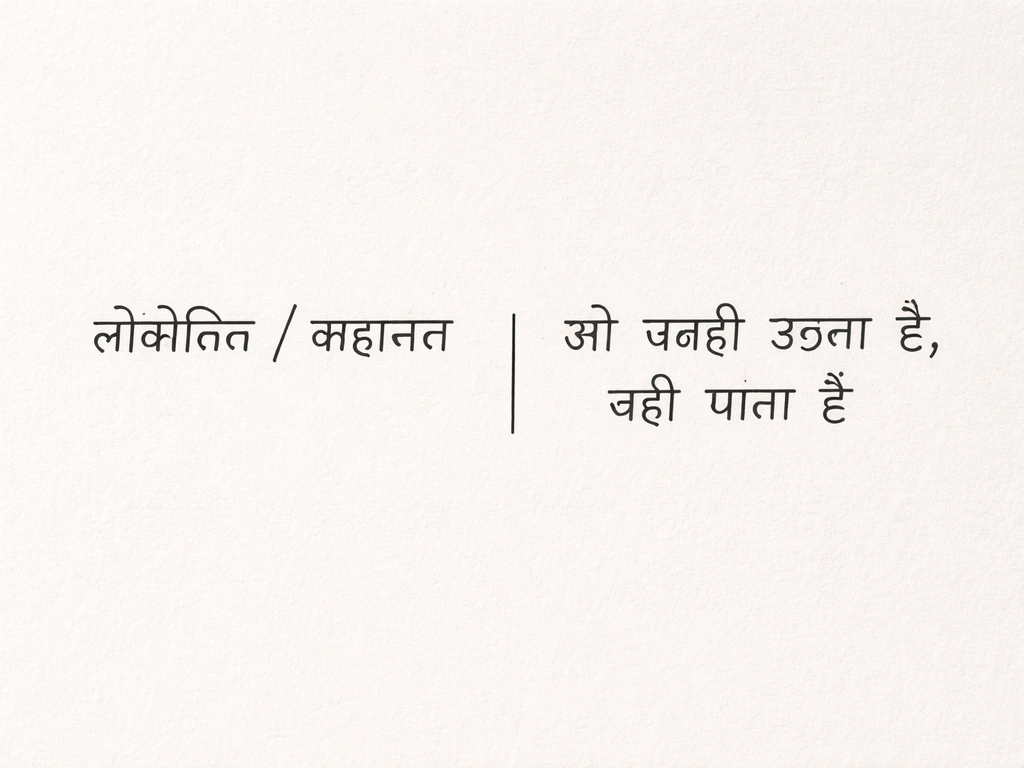
In Hindi, this proverb belongs to the category of लोकोक्तियाँ (lokoktiyan) or कहावतें (kahavaten), which are traditional sayings that carry a moral lesson. The literal translation of "the early bird catches the worm" would technically be something like "जो पक्षी जल्दी उठता है वह कीड़ा पकड़ता है," but nobody actually says that in everyday Hindi. That phrasing would sound clunky and foreign.
The natural Hindi equivalents you should actually use are:
- जो जल्दी उठता है, वही पाता है (Jo jaldi uthta hai, wahi paata hai) — "The one who wakes up early is the one who gets it."
- जल्दी उठने वाला ही मिलता है (Jaldi uthne wala hi milta hai) — "Only the early riser gets the reward."
- समय रहते काम करो (Samay rahte kaam karo) — "Do the work while there is still time" (a softer, situational variant).
- वक्त रहते सावधान रहो (Waqt rahte savdhaan raho) — "Be alert while time permits."
Of these, जो जल्दी उठता है, वही पाता है is the most direct and natural in spoken Hindi. The phrases समय रहते and वक्त रहते are not full proverbs on their own but are common time-related expressions that Hindi speakers attach to advice about acting promptly. They are your go-to words when you want to convey "before it is too late" in a Hindi conversation.
The same idea in Bengali, Marathi, and Urdu
Across Indian languages, this proverb adapts rather than translates directly. Each language has its own idiom culture, so forcing a word-for-word rendering usually fails. Here is how the concept travels:
| Language | Equivalent Expression | Literal Sense | Core Message |
|---|---|---|---|
| Hindi | जो जल्दी उठता है, वही पाता है | Who rises early, that one gets it | Early action = reward |
| Bengali | সময় সুযোগ বুঝে কাজ করো (Samay sujog bujhe kaj koro) | Act understanding time and opportunity | Seize the moment wisely |
| Marathi | लवकर उठणारा तोच मिळवतो (Lavkar uthnarya toch milavto) | The one who rises early, that one gains | Early riser wins the prize |
| Urdu | جو صبح جلدی اٹھتا ہے وہی پاتا ہے (Jo subah jaldi uthta hai wahi paata hai) | The one who rises early in the morning gets it | Proactive timing is rewarded |
In Bengali, the idea is often expressed through the proverb সময় সুযোগ বুঝে কাজ কর, which translates loosely as "act by reading the time and opportunity." This is less about waking up early and more about reading the moment correctly, which is a slightly broader and more philosophical Bengali framing of the same underlying message. Urdu borrows heavily from Hindi structure here, so the phrasing is nearly identical, just written in Nastaliq script and with صبح (subah) emphasizing morning as the window of opportunity.
For Marathi, if you are already exploring how birds are named and symbolized in the language, you will notice that the concept of the industrious or early bird runs deep. A look at what "bird" means in Marathi shows that the word पक्षी (pakshi) carries connotations of freedom and alertness across regional traditions, which is part of why bird-based proverbs feel intuitive to Marathi speakers.
Where this proverb actually came from
The proverb in English has two strong historical candidates for its first recorded use. Some sources point to William Camden's 1605 proverb collection as the earliest written reference. Others credit John Ray's "A Collection of English Proverbs" published in 1670, where the phrase appears in its archaic form: "the early bird catcheth the worm." The variation "catches" versus "gets" versus "catcheth" has existed for centuries, and today Cambridge recognizes both "the early bird catches the worm" and "the early bird gets the worm" as valid forms.
The image behind the proverb is simple and drawn from nature: birds that begin foraging at dawn find food before others arrive. The worm is freshest, most available, and most easily caught right after sunrise, before the ground dries and activity picks up. It is a behavioral observation turned into a life lesson. Interestingly, German speakers have their own near-identical version: "Der frühe Vogel fängt den Wurm," which literally means the same thing, suggesting that this was a widely shared folk observation across cultures.
In Indian folk tradition, the link between birds and alertness is ancient. Birds that hunt at dawn, like hawks and falcons, were observed closely and respected for their precision. The hawk bird meaning in Marathi reflects exactly this: the hawk is a symbol of sharpness, speed, and the advantage that comes from striking at the right moment. That cultural background is part of why bird-based proverbs about timing resonate so naturally in Indian languages.
How to actually use it in conversations
The proverb works best as motivational advice or gentle encouragement. It is not a criticism; it is a nudge. Here are real situations where it fits naturally:
- Someone is delaying a job application: "अरे, जल्दी करो! जो जल्दी उठता है, वही पाता है।" (Come on, hurry! The early bird catches the worm.)
- A student keeps sleeping in before exams: "वक्त रहते पढ़ लो, नहीं तो पछताओगे।" (Study while there is time, or you will regret it.)
- Advising someone to book tickets or a venue early: "Samay rahte book kar lo, warna sab bhar jayega." (Book it in time, or everything will fill up.)
- In Bengali, telling a friend to apply for a scholarship before the deadline: "সময় সুযোগ বুঝে কাজ কর, দেরি করো না।" (Act with an understanding of time and opportunity, do not delay.)
- In Urdu, encouraging a business partner to act on a deal: "Jo subah jaldi uthta hai wahi paata hai, yeh mauka haath se mat jaane do." (The early bird gets the worm, do not let this opportunity slip away.)
Tone-wise, this proverb is warm and encouraging, not aggressive. You would say it to a friend, a sibling, a student, or a colleague you care about. It is not a proverb you would use sarcastically or critically. In formal writing or speeches, the Hindi version जो जल्दी उठता है, वही पाता है works well as an opening line for motivational content.
Birds as symbols of opportunity and alertness in Indian culture
Birds occupy a unique symbolic space in Indian tradition, and the "early bird" idea connects directly to that. Across Hindu mythology and folk culture, birds represent the soul's alertness, divine messages, and the sharpness of perception. An alert bird does not wait; it sees the opportunity and acts. That is precisely the message of this proverb.
The falcon, for example, has long been associated in Indian and Persian cultural traditions with focus, precision, and decisive action. The falcon bird meaning in Marathi echoes this: the bird is admired for its ability to spot an opportunity from a great height and dive at exactly the right moment. That is not just hunting instinct; in symbolic terms, it is the embodiment of the "early bird" principle.
Even birds considered unusual or nocturnal carry lessons about timing and awareness. The bat bird meaning in Marathi is interesting here because bats act at dusk rather than dawn, and in folk tradition they are sometimes seen as creatures that have mastered a different kind of timing: they do not compete with others, they find their own window. That contrast actually highlights what the early bird proverb is really about: finding the right time and acting in it, not just waking up early for its own sake.
Ground birds like the bustard are another interesting case. The bustard bird meaning in Marathi reveals a bird that is slow, deliberate, and often associated with missing its moment. In folk symbolism, the bustard is sometimes the anti-early-bird: the creature that hesitates too long. That contrast enriches the proverb's lesson considerably.
Common misunderstandings and close alternatives
The biggest misunderstanding people have with this proverb is taking "worm" literally. The worm is not the point. The worm represents any real-world payoff: a job offer, a discount, a seat in a course, a business deal, a scholarship, a relationship opportunity. When you use this proverb, you are never actually talking about worms or birds. You are talking about the first-mover advantage in any human situation.
A second misunderstanding is thinking the proverb is only about waking up early in the morning. It is not. It is about acting early relative to others in any given situation. You can "be the early bird" by submitting a proposal before your competitors, by booking travel months in advance, or by learning a skill before it becomes mainstream demand. The timing is relative, not absolute.
There is also a well-known counter-proverb in English: "The second mouse gets the cheese," which argues that being too early can be risky (the first mouse gets caught in the trap). In Hindi, a similar cautionary idea exists: जल्दी का काम शैतान का (Jaldi ka kaam shaitan ka), meaning "hasty work is the devil's work." This is not a contradiction; it is a balance. The early bird proverb is about strategic earliness, not reckless rushing.
Close alternatives in Hindi that carry similar meaning include सवेरे का भूला शाम को घर आए तो भूला नहीं कहलाता (a forgiving proverb about returning before it is too late) and अब पछताए होत क्या जब चिड़िया चुग गई खेत (Ab pachhtaye hot kya jab chidiya chug gayi khet), which actually uses bird imagery directly. That second one means "what is the point of regretting now when the bird has already eaten the field," and it is the classic Hindi proverb closest in spirit to the English "early bird" idea. Interestingly, this Hindi proverb also features a bird as the central image, reinforcing just how naturally birds function as symbols of timing and opportunity in Indian linguistic tradition.
If you are learning Hindi and want to sound natural, memorize two things: जो जल्दी उठता है, वही पाता है for the positive, encouraging version, and अब पछताए होत क्या जब चिड़िया चुग गई खेत for the regretful, missed-opportunity version. Together, they cover the full emotional range of what the English proverb conveys. And if you are exploring the bird symbolism side of this, the hawk's symbolic meaning in Marathi is a great place to see how Indian languages encode alertness, timing, and advantage directly into bird names and imagery.
FAQ
Is “the early bird catches the worm” only used for waking up early, or can it apply to office and study situations too?
It applies to any situation where timing matters. In Hindi, you can use the idea as, “जो जल्दी करता है, उसे पहले मौका मिलता है,” meaning the person who acts sooner gets the first chance. So it fits tasks like submitting assignments early, booking tickets before prices rise, or preparing for exams before the syllabus peaks.
What is a natural way to say this proverb in spoken Hindi if I want it to sound polite and not preachy?
Use a soft motivational phrasing like, “समय रहते शुरुआत कर लो, जो जल्दी उठता है वही पाता है.” This keeps the proverb positive, and “समय रहते” works like a gentle reminder to act promptly without sounding harsh or blaming anyone.
Can I use the proverb sarcastically if someone is late or misses an opportunity?
It is usually not meant for sarcasm. If you try to mock someone, it can sound like criticism. For a gentle nudge, prefer “अभी भी मौका है, बस जल्दी करो,” and then optionally add the proverb. For blame, Hindi speakers more often use different criticism-style lines instead of this one.
How do I respond if someone says “जल्दी का काम शैतान का” to warn me against being too early?
Treat it as a caution against reckless rushing, not against planning. You can reply with the balance idea, “हाँ, पर जल्दी सही रणनीति के साथ करनी चाहिए,” meaning you should be early with preparation, not with panic. The “early bird” lesson is about smart first action, not unsafe haste.
What if I’m early but my information is wrong, and I end up wasting time or money. Does the proverb still apply?
The advantage is for early action that is also informed. Being “early” without accuracy can backfire, which is where you should pair the proverb with practical steps like checking facts, confirming deadlines, and testing a plan before committing. The proverb rewards being first, but smartly.
Is there a Hindi proverb closest to the English meaning if I want the bird imagery but also the “missed opportunity” tone?
“अब पछताए होत क्या जब चिड़िया चुग गई खेत” is a close match for missed opportunity. Use it when regret is already happening, for example after a deadline passes or a seat is gone, but keep in mind it can feel sharper, so it works best in informal, light contexts.
What are common mistakes learners make when translating this proverb into Hindi?
Two frequent mistakes are using a word-for-word bird and worm structure, which sounds unnatural, and confusing it with “always wake up early.” A more natural Hindi approach is to focus on the timing advantage, for example, “जो जल्दी करता है, वही पाता है,” and apply it to the specific context, not just mornings.
Can I use this proverb in formal emails or reports, and where should I place it?
Yes, but keep it brief. In formal writing, use it as a single line of motivation at the start of a section, like “जो जल्दी उठता है, वही पाता है, इसलिए हमने समय से पहले ड्राफ्ट तैयार किया.” For strictly professional documents, you can also replace it with plain phrasing like “we acted early to meet the deadline” if proverbs feel too informal.
Next Articles

Hawk Bird Meaning in Marathi: Name, Pronunciation, Symbolism
हॉक पक्ष्याचा मराठी अर्थ, उच्चार आणि नाव जाणून घ्या; प्रतीकात्मक गुणधर्म, वर्तन आणि योग्य रॅप्टर कसा ओळखायचा

Bustard Bird Meaning in Marathi: Name, Hindi, and ID Guide
बस्टर्ड पक्ष्याचे अर्थ, मराठी नाव आणि उच्चार, हिंदी समकक्ष, ओळख टिप्स आणि पडताळणी मार्गदर्शन जाणून घ्या.
Bird Beak Meaning in Hindi: Chonch, Bill, Pronunciation
Bird beak in Hindi chonch or bill, pronunciation, examples, beak vs bill differences, and figurative Hindi use