
In Hindi, 'kiwi bird' is called कीवी पक्षी (pronounced: kee-vee pak-shee). There is no ancient Sanskrit or classical Hindi name for this bird because the kiwi is native to New Zealand and was simply unknown to the Indian subcontinent until modern times. So Hindi speakers do exactly what makes practical sense: they transliterate the English name 'kiwi' into Devanagari script as कीवी and add पक्षी (bird) to make it clear they are referring to the animal, not the fruit.
Kiwi Bird Meaning in Hindi: Flightless NZ Kiwi Term

Rajesh Sharma
22 May 2026

Which kiwi bird are we talking about?

This is worth clarifying upfront because 'kiwi' can mean a few different things in casual conversation. When someone searches 'kiwi bird meaning in Hindi,' they are almost certainly asking about the flightless bird of New Zealand, scientifically classified under the genus Apteryx. Merriam-Webster also defines kiwi as flightless New Zealand birds in the genus Apteryx [flightless bird of New Zealand](https://www. merriam-webster.
com/dictionary/kiwi). This is the small, round, nocturnal bird with a long bill, vestigial wings, and no visible tail, which is the national symbol of New Zealand. It is not related to the kiwi fruit (which gets its name from the bird due to its fuzzy brown exterior resemblance) and has nothing to do with the informal term 'Kiwi' used for New Zealanders.
The kiwi bird (Apteryx) is genuinely one of the most unusual birds alive today. It is nocturnal, flightless, has hair-like feathers, and lays eggs that are enormous relative to its body size. If someone shows you a picture and you are unsure, look for the long drooping bill, rounded body, and brownish streaked feathers with no visible wings. That is the कीवी पक्षी.
कीवी पक्षी: Hindi spelling, script, and pronunciation
The Hindi name is straightforward once you see it written out. Here is everything a language learner needs to use it confidently:
| Element | Detail |
|---|---|
| Hindi name | कीवी पक्षी |
| Romanized spelling | Keevee Pakshee |
| Pronunciation guide | kee (long 'ee') + vee + pak (as in 'pack') + shee |
| Alternate short form | कीवी (used when context is clear) |
| Literal meaning | Kiwi bird / the bird called kiwi |
| Script | Devanagari |
| Transliteration style | Direct phonetic borrowing from English 'kiwi' |
In everyday Hindi speech, most people simply say कीवी when talking about the bird, just as they would say 'kiwi' in English conversation. The full form कीवी पक्षी is used when you need to be explicit, for example in writing, in a classroom setting, or when distinguishing the bird from the fruit. Collins English Dictionary (Hindi edition) confirms this usage, listing 'kiwi' as न्यूज़ीलैंड में रहने वाला पक्षी, which translates to 'the bird that lives in New Zealand.'
Regional variations across Indian languages

Unlike birds with deep roots in Indian tradition, such as the peacock, parrot, or crane, the kiwi has no regional name that differs across Marathi, Punjabi, or Gujarati. All Indian languages dealing with this bird adopt the same transliteration approach. In Marathi it becomes कीवी पक्षी with the same pronunciation. In Gujarati and Punjabi, the phonetic borrowing is identical. This makes sense because the kiwi entered Indian consciousness only through modern education, wildlife documentaries, and travel, so there was no time or cultural pressure to develop a localized name.
Does the kiwi bird have any cultural symbolism in India?
Honestly, no, not in any traditional or ancient sense. The kiwi has no place in Hindu mythology, Sanskrit literature, Vedic texts, or folk traditions of the Indian subcontinent. This is simply because the bird is endemic to New Zealand and was completely unknown to Indian civilizations before the modern era.
Unlike birds such as the dove, which carries rich symbolism in multiple cultures including India, or the hoopoe (हुदहुद), which appears in both Indian and Persian literary traditions, the kiwi has no mythological footprint in India. The hoopoe bird meaning in Hindi is commonly explained as the हुदहुद (hudhud), a name known from Indian and Persian literature hoopoe (हुदहुद).
Because searches for “dove bird meaning in hindi” usually ask about the Hindi meaning and common usage of the dove as a bird, it is a different topic from the kiwi bird described here.
What you will find is modern symbolic association. In contemporary Indian awareness, the kiwi is frequently referenced as the national bird of New Zealand and is used in educational contexts as an example of a flightless bird, alongside the ostrich and emu. It occasionally appears in environmental discussions as a symbol of endangered species conservation, which resonates with Indian ecological values. In that sense, among wildlife educators and students in India, the कीवी पक्षी has come to represent biodiversity, ecological fragility, and the importance of island species protection.
Mythology, folklore, and spiritual associations
Within Indian tradition specifically, there are no myths, folktales, or spiritual associations connected to the kiwi bird. It simply does not appear in the Ramayana, Mahabharata, Puranas, or any regional folk corpus. If you are researching Indian bird symbolism and spirituality, the kiwi is a fascinating scientific subject but not a mythological one from the Indian perspective.
That said, the Maori people of New Zealand have rich spiritual and cultural traditions surrounding the kiwi, where it is considered a taonga (treasure) and is protected under the guardianship of the forest god Tane. While this is not Indian mythology, it is worth knowing if you are using the bird symbolically in any cross-cultural or comparative context, since India's own traditions of forest reverence and animal protection have meaningful parallels with Maori cosmology.
Some Indian spiritual teachers and nature writers do draw loose parallels between the kiwi's nocturnal, solitary, earth-connected nature and the concept of tamasic energy in Ayurvedic and yogic philosophy, but this is a modern interpretive lens, not a traditional association. It is creative but not canonical.
How to use कीवी पक्षी correctly in Hindi sentences
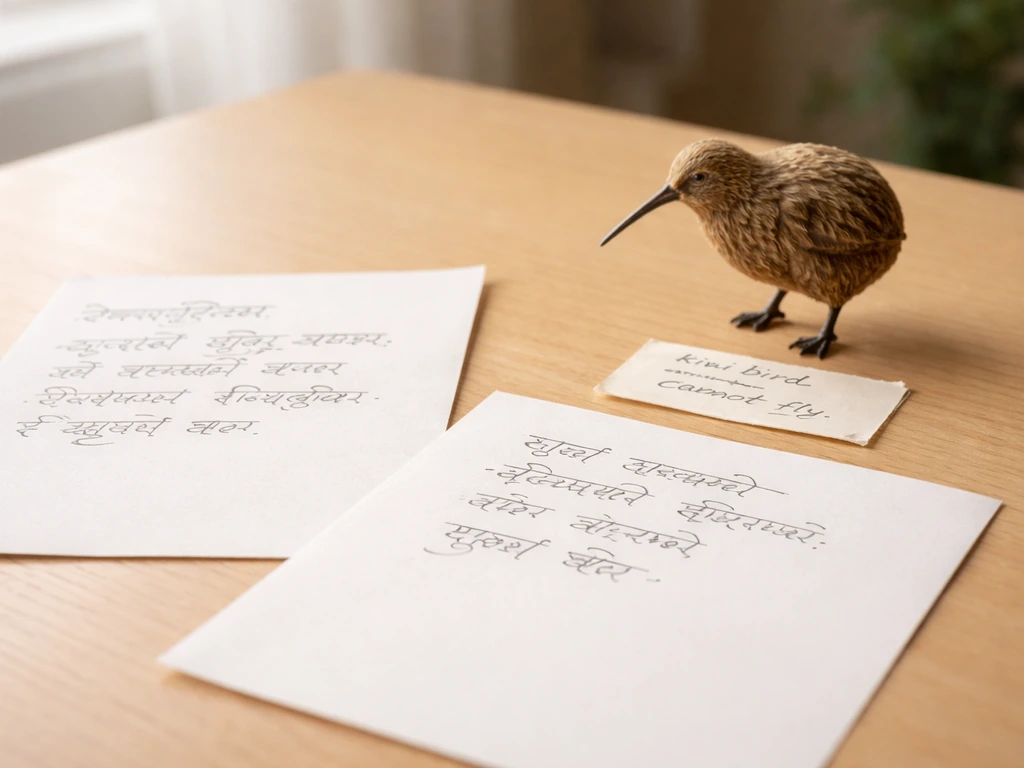
Here are real, practical sentences that show you how to use the Hindi term naturally in different contexts:
- कीवी पक्षी न्यूज़ीलैंड का राष्ट्रीय पक्षी है। (The kiwi bird is the national bird of New Zealand.)
- कीवी पक्षी उड़ नहीं सकता, लेकिन यह बहुत तेज़ दौड़ सकता है। (The kiwi bird cannot fly, but it can run very fast.)
- क्या आपने कभी कीवी पक्षी देखा है? (Have you ever seen a kiwi bird?)
- कीवी पक्षी रात में सक्रिय होता है और कीड़े खाता है। (The kiwi bird is active at night and eats insects.)
- कीवी पक्षी का अंडा उसके शरीर के आकार की तुलना में बहुत बड़ा होता है। (The kiwi bird's egg is very large compared to the size of its body.)
- यह कीवी फल है, कीवी पक्षी नहीं। (This is a kiwi fruit, not a kiwi bird.) — useful for disambiguation
Notice that in all these sentences, the structure follows standard Hindi grammar: noun first, then description or verb. You can drop पक्षी in casual speech once the context is established, just as English speakers say 'the kiwi' rather than 'the kiwi bird' after the first mention.
Common questions and quick answers
Is there a Sanskrit name for the kiwi bird? Sanskrit ornithological vocabulary does not include the kiwi, so you will not find a traditional Sanskrit name in Hindi either Sanskrit name for the kiwi bird. No. Sanskrit ornithological vocabulary, as rich as it is, does not include the kiwi because the bird was unknown in the ancient Indian world. Terms like विहग (vihaga), खग (khaga), and पक्षी (pakshi) are generic Sanskrit words for 'bird,' but none specifically names the kiwi.
Is 'कीवी' the correct Hindi spelling? Yes. The double 'i' sound in Hindi script is represented by the long vowel ई, giving you कीवी. Writing it as किवी (with a short 'i') would be a spelling error in Hindi, even though some informal texts do use it. Always use the long vowel: कीवी.
Is the kiwi bird the same as the kiwi fruit in Hindi? In Hindi, the fruit is also called कीवी or कीवी फल (kiwi fruit), so the words look identical. Context usually makes it clear, but if you want to be precise, say कीवी पक्षी for the bird and कीवी फल for the fruit. They share the name in English too because the fruit was named after the bird.
Why does Hindi not have a traditional name for the kiwi? Because traditional naming in Indian languages developed from direct cultural contact with animals. Birds like the sparrow (गौरैया), crow (कौआ), peacock (मोर), and parrot (तोता) all have deep indigenous names because they share the Indian landscape. The kiwi, living only in New Zealand, never entered that cultural orbit until the modern age.
How kiwi fits into the broader world of bird names in Hindi
Learning how the kiwi is handled in Hindi actually teaches you something useful about how Indian languages absorb foreign bird names. Birds with deep roots in Indian culture, like the dove (which has a rich Hindi and Sanskrit tradition), get layered, symbolic names. Birds from outside the Indian orbit, like the kiwi, the condor, the toucan, or the cassowary, get straightforward phonetic borrowings: you just transliterate the English name and add पक्षी if needed.
This same transliteration approach is used for the condor bird meaning in Hindi, where the name is written in Devanagari and matched with पक्षी (bird) when needed. This pattern holds consistently across Hindi, Marathi, Punjabi, and Gujarati for birds that were historically unknown to the subcontinent.
So if you are building vocabulary for foreign birds in Hindi, the strategy is simple: learn the Devanagari script transliteration, pair it with पक्षी when introducing the term, and you are set. The kiwi is a perfect example of this pattern and a good starting point for anyone exploring how modern Hindi handles the natural world beyond India's borders.
FAQ
If I want to say “kiwi bird” in a short way, can I just use “कीवी” in Hindi?
Yes, in most casual conversations you can say सिर्फ “कीवी,” as long as the topic is already about the animal. If there is any chance of confusion, especially in writing or mixed topics, use “कीवी पक्षी” to clearly separate it from “कीवी फल” (kiwi fruit).
How do I pronounce कीवी पक्षी correctly in Hindi?
A natural Hindi pronunciation is kee-vee pak-shee. Keep “कीवी” with the long vowel sound ई, not a short i sound, so it matches the spelling कीवी rather than किवी.
Are there any other Hindi spellings you might see for kiwi bird besides कीवी?
You may encounter misspellings like “किवी” (wrong short vowel) in informal notes. Standard, correct writing for the bird uses कीवी, and “पक्षी” for clarity when needed, so prioritize कीवी पक्षी for accuracy.
What should I write if I’m making a title or caption, should I include “पक्षी” every time?
In a caption or classroom/educational material, it is best to use “कीवी पक्षी” at least once, then you can shorten to “कीवी” afterward. First mention plus later shorthand mirrors how Hindi handles other borrowed animal names.
How can I clearly distinguish the kiwi bird from the kiwi fruit in Hindi messages or exams?
Use full terms: “कीवी पक्षी” for the animal, “कीवी फल” for the fruit. If you omit पक्षी, add context in the sentence, for example “रात में दिखने वाला” (seen at night) or “उड़ नहीं पाता” (cannot fly).
Is the Hindi meaning of kiwi bird ever confused with the slang term “Kiwi” for New Zealand people?
It can happen in English, but in Hindi you can avoid it by writing “कीवी पक्षी” (bird) or adding a descriptor like “न्यूज़ीलैंड का पक्षी” (bird of New Zealand). That pairing removes the ambiguity with people-language.
If I’m writing about the kiwi as a national symbol, what Hindi wording is most natural?
A clear phrasing is “न्यूज़ीलैंड का राष्ट्रीय पक्षी” (national bird of New Zealand). Since kiwi is used as a symbol, adding “राष्ट्रीय” and “न्यूज़ीलैंड” makes your meaning explicit for readers.
Do other Indian languages also use the exact same borrowed form for the kiwi bird?
Most do, because they follow the same phonetic borrowing pattern. Even when script changes, you will typically see a close equivalent of “कीवी” plus the local word for bird (like पक्षी). The main practical tip is to keep the borrowed sound consistent and add the bird term if context is not obvious.
Is there a “Sanskrit-like” traditional term people sometimes claim for kiwi bird?
For the kiwi bird itself, there is no established Sanskrit or classical Hindi specific name in traditional usage. If you see a claim online, treat it as modern invention, and use “कीवी पक्षी” for reliable, widely understandable Hindi.
Next Articles

Condor Bird Meaning in Hindi: मतलब, प्रतीक और पहचान
Condor bird meaning in Hindi: गिद्ध जैसा बड़ा पक्षी, प्रतीक और पहचान, साथ में संस्कृत रूप और भ्रम दूर करने की गाइड
Dove Bird Meaning in Hindi: Name and Definition
Dove bird meaning in Hindi: जानिए कबूतर के नाम, आसान परिभाषा, और English से साफ मिलान
Bird Beak Meaning in Hindi: Chonch, Bill, Pronunciation
Bird beak in Hindi chonch or bill, pronunciation, examples, beak vs bill differences, and figurative Hindi use