In Hindi, a cassowary is called कसोवरी (kasovari) or कसौवरी (kasauvari). Both spellings appear in major Hindi dictionaries like Shabdkosh and Hinkhoj, and both refer to the same bird: a large, flightless bird from the genus Casuarius, native to the rainforests of Australia and New Guinea. There is no classical Sanskrit or traditional Hindi name for it because cassowaries never lived in or near the Indian subcontinent. The word is simply a phonetic transliteration of the English 'cassowary' into Devanagari script.
Cassowary Bird Meaning in Hindi: नाम, पहचान और प्रतीक

Rajesh Sharma
27 May 2026
What exactly is a cassowary?
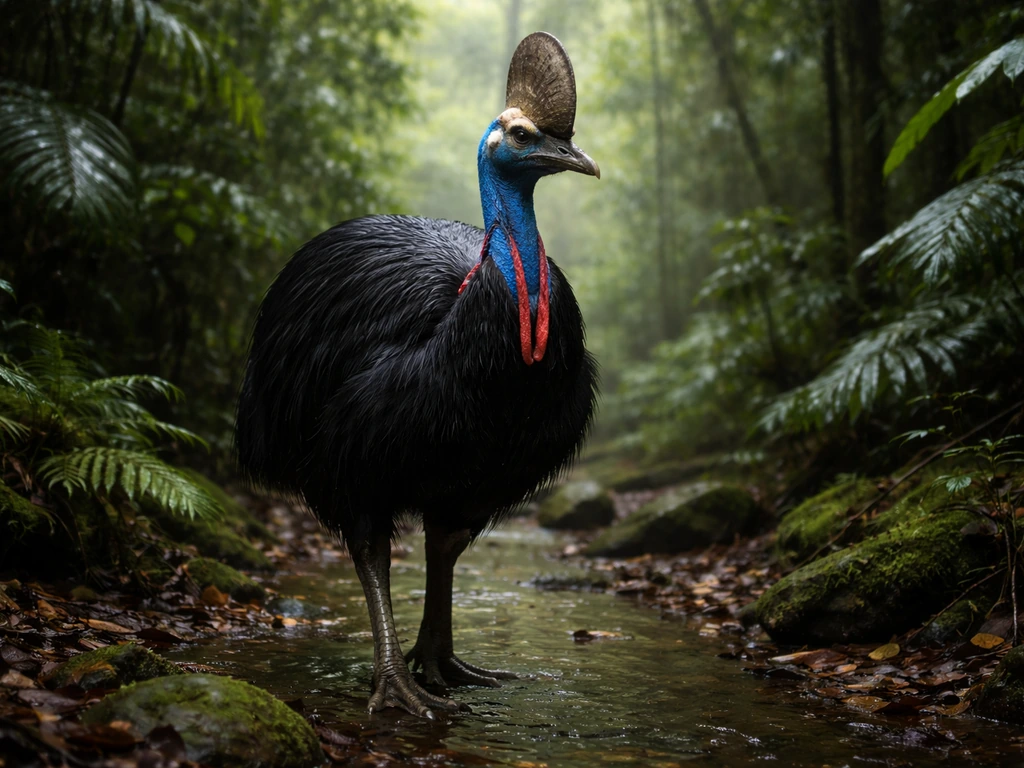
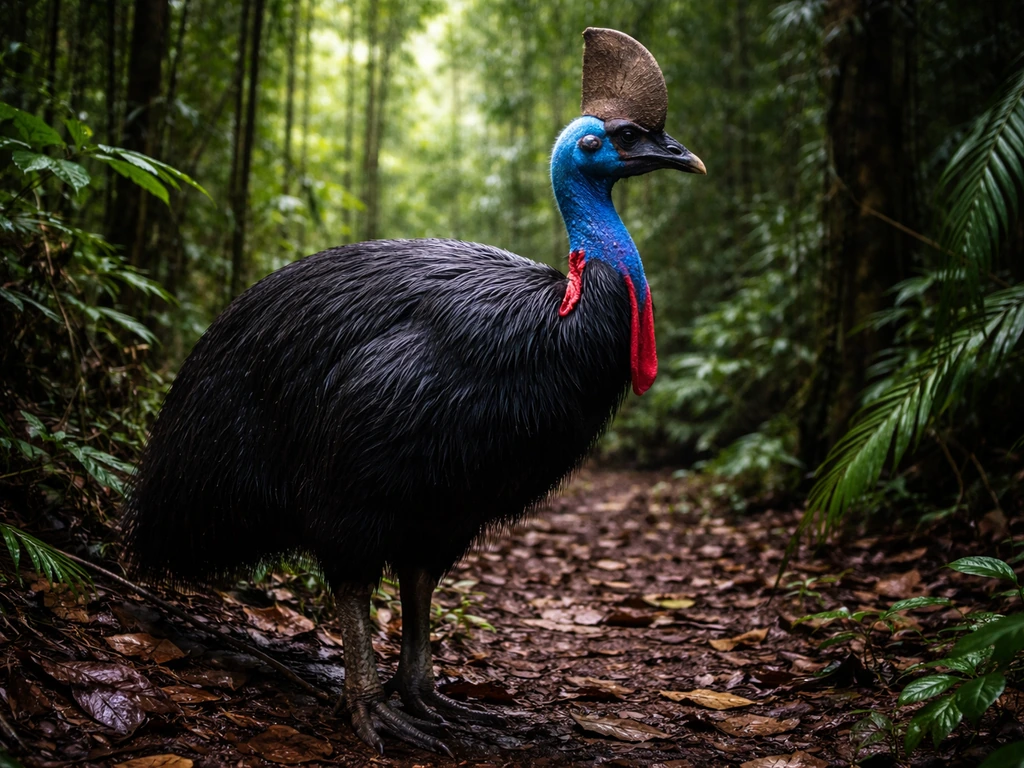
If you have only seen the name and want to picture the bird, here is the short version: a cassowary is one of the largest birds on Earth, capable of weighing over 140 pounds. It cannot fly. Its body is covered in coarse, mostly black feathers, and its most striking feature is a tall, bony casque (a helmet-like crest) that sits on top of its head. It also has vivid blue and red skin on its neck and two fleshy wattles hanging beneath the beak. Its legs are powerful and end in clawed feet that can deliver a genuinely dangerous kick, which is why National Geographic has described it as one of the world's most dangerous birds.
The three living species are the southern cassowary (Casuarius casuarius), the northern cassowary, and the dwarf cassowary. The southern cassowary is the one most people mean when they say 'cassowary.' These birds live in dense tropical rainforests, eat mostly fallen fruit, and are actually important seed dispersers in their ecosystems. They belong to the family Casuariidae, which also includes emus. That family connection is worth remembering because it is one of the main sources of confusion when people look up the bird in Hindi.
The Hindi word: spelling, pronunciation, and usage
The two Devanagari forms you will encounter are कसोवरी and कसौवरी. A third attested variant, कँसौवरी, appears occasionally in Hindi text and uses a nasal marker (chandrabindu) over the first vowel. For everyday writing and language learning, sticking with कसोवरी or कसौवरी is the safest choice since these are the forms most major Hindi dictionaries anchor on.
Pronunciation guide: break it down as ka-sau-va-ree (कसौवरी) or ka-so-va-ree (कसोवरी). The stress sits on the second syllable, just as it does in English 'CAS-so-war-y.' The 'w' sound in English maps to a soft 'v' in Hindi, which is why the Devanagari uses 'व' rather than a 'व/ब' combination. If you are typing in Devanagari on a phonetic keyboard, try typing 'kasauvari' and the input method should give you कसौवरी automatically.
Does the cassowary carry any symbolism in Indian traditions?
Honestly, no. The cassowary does not appear in Hindu mythology, Sanskrit texts, Vedic literature, folk traditions, or devotional symbolism anywhere on the Indian subcontinent. That is not a gap in research; it simply reflects geography. The cassowary is an animal of the Pacific region, particularly New Guinea and northeastern Australia, and Indian civilizations had no contact with it historically. So if you searched for 'cassowary bird meaning in Hindi' hoping to find a spiritual or mythological layer, this is the direct answer: there is none in Indian tradition.
The cassowary does, however, carry deep spiritual significance in the indigenous traditions of New Guinea and parts of Indonesia. Some communities there view cassowaries as reincarnations of female ancestors, and the bird features prominently as a heroic or powerful figure in local mythology. That is the correct cultural context for cassowary symbolism, even though it falls outside Indian tradition.
In Indian bird symbolism, large and powerful birds tend to carry meanings through creatures that are part of the native landscape. The peacock (मोर, mor) is a divine symbol linked to Lord Kartikeya and the monsoon. The crane and the garuda represent watchfulness and divine power.
If you are looking for a spiritual parallel to the cassowary's imposing, forest-dwelling, fearsome-yet-mysterious character, the closest Indian equivalent in terms of symbolic weight might be the large raptor or forest bird archetypes found in Puranic texts. But the cassowary itself is not part of that canon.
Contrast this with birds like the dove (whose Hindi name carries layers of peace symbolism) or the hoopoe (हुदहुद, which carries Sufi and Quranic symbolic meaning), both of which have rich traditional meaning precisely because they are part of the landscape and literature of their home regions. The hoopoe bird meaning in Hindi (हुदहुद) is closely tied to traditional Sufi and Quranic symbolism.
In Hindi, the dove bird is commonly associated with peace and is often identified by its Hindi name that you can look up as part of “dove bird meaning in Hindi. ”.
Common confusions to watch out for
Several confusions come up regularly when people search for cassowary in a Hindi or Indian language context. Here are the ones worth knowing about.
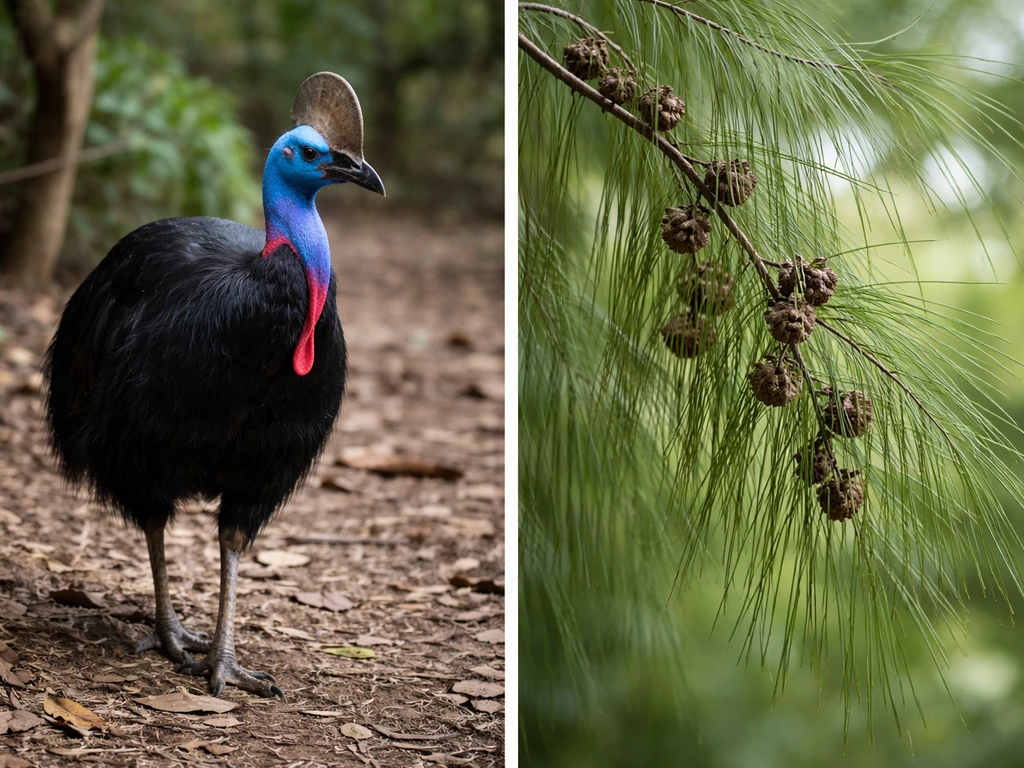
- Cassowary vs. Casuarina: The tree genus Casuarina (she-oak or jhau, झाऊ in Hindi) gets its name from the cassowary because the drooping branchlets resemble the bird's feathers. Merriam-Webster confirms this etymological link. But the plant and the bird are completely unrelated things. If you search 'casuarina meaning in Hindi' and land on cassowary content (or vice versa), this is why.
- Cassowary vs. Emu: Both are large, flightless birds in the family Casuariidae, so they look related and they are. But the emu (Hindi: एमू, emu) lacks the cassowary's distinctive bony casque on the head, has no wattles, and is found across mainland Australia rather than in rainforests. In Hindi dictionaries, they have separate entries: एमू for emu, कसोवरी/कसौवरी for cassowary.
- Cassowary vs. Ostrich: The ostrich (Hindi: शुतुरमुर्ग, shuturmurg) is often the default 'large flightless bird' people think of, but it belongs to a completely different family and is native to Africa. The casque is the clearest visual marker that separates a cassowary from both the ostrich and the emu.
- Cassowary Coast Region: 'Cassowary' also appears as a place name in Queensland, Australia (the Cassowary Coast Region). This can cause confusion in translation searches. When the word appears in a geographic context rather than an ornithological one, the Hindi rendering would still be कसोवरी but used as a proper noun (कसोवरी तट क्षेत्र for Cassowary Coast Region).
How the name looks across Indian languages
Since cassowary is not a native Indian bird, all Indian languages transliterate the English name rather than using a classical root word. The consonant skeleton 'k-s-v-r' (or 'k-s-w-r') is consistent across languages, but the vowel rendering and script differ. Here is a quick cross-language check:
| Language | Script | Transliteration |
|---|---|---|
| Hindi | कसोवरी / कसौवरी | kasovari / kasauvari |
| Marathi | कॅसॉवरी / कसॉवरी | kasovari / kasauvari (similar to Hindi) |
| Gujarati | કેસોરી / કસસોરી | kesori / kassori |
| Punjabi | ਕੈਸਾਓਰੀ / ਕਸਾਓਰੀ | kaisaori / kasaori |
Notice that Marathi stays closest to the Hindi form because both use Devanagari script. Gujarati and Punjabi shift the vowels slightly due to script conventions, but the underlying consonant pattern remains recognizable. This is typical of how non-native bird names travel across Indian languages. Compare this with birds like the kiwi (also a flightless bird with no Indian tradition), which follows the same transliteration pattern, or the condor, where again Indian languages borrow directly from English rather than coining a new term. The kiwi bird meaning in Hindi is similarly described as a small flightless bird, typically referred to by its transliterated name.
Using कसोवरी in Hindi sentences
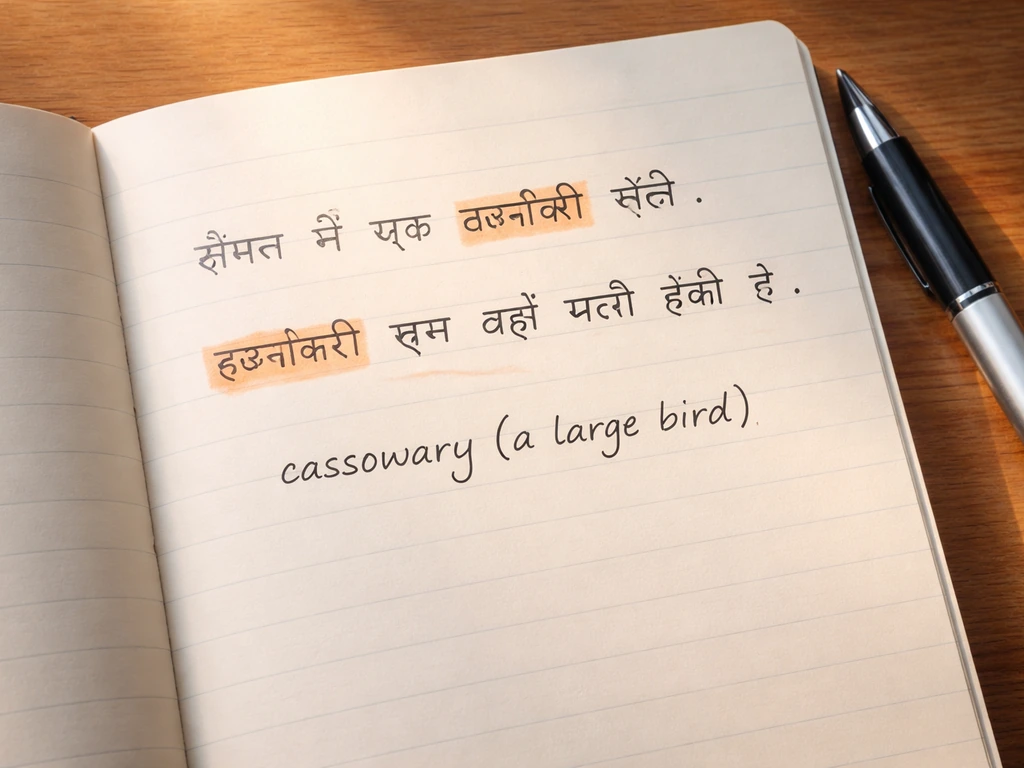
Once you know the word, using it correctly in Hindi is straightforward. Here are a few practical example sentences that cover the most common ways a learner or writer might need to use it:
- कसोवरी एक उड़ान रहित पक्षी है जो ऑस्ट्रेलिया और न्यू गिनी के वर्षावनों में पाया जाता है। (A cassowary is a flightless bird found in the rainforests of Australia and New Guinea.)
- इस पक्षी के सिर पर एक हड्डी की टोपी जैसी संरचना होती है, जिसे 'कैस्क' कहते हैं। (This bird has a bony helmet-like structure on its head, called a casque.)
- कसोवरी दुनिया के सबसे बड़े पक्षियों में से एक है और इसका वजन 60 किलोग्राम से भी अधिक हो सकता है। (The cassowary is one of the world's largest birds and can weigh more than 60 kilograms.)
- हाल के शोध में पाया गया कि कसोवरी का कैस्क पराबैंगनी प्रकाश में चमकता है। (Recent research found that the cassowary's casque glows under ultraviolet light.)
- कसोवरी और एमू एक ही परिवार के पक्षी हैं, लेकिन कसोवरी की पहचान उसके सिर के कैस्क से होती है। (The cassowary and the emu belong to the same family, but the cassowary is identified by the casque on its head.)
Where to verify the Hindi spelling and meaning
If you want to double-check the Devanagari spelling or look at the dictionary definition directly, these are the most reliable resources to consult. Shabdkosh gives you the Devanagari form with a short definition and is the quickest cross-check for the spelling. Hinkhoj provides an English-to-Hindi dictionary entry with the Devanagari rendering and is particularly useful if you want to see the word used in a definition sentence.
Collins Dictionary’s Hindi entry also gives the English-to-Hindi meaning for “cassowary” in a Hindi dictionary context Hinkhoj provides an English-to-Hindi dictionary entry with the Devanagari rendering. For the factual, species-level meaning (what the bird actually is, its size, region, and characteristics), Britannica and Wikipedia's cassowary page are the places to go.
Britannica is especially good for confirming the ratite identity and the casque feature, which are the two details that most often get muddled when people translate large flightless birds across languages.
The bottom line is this: कसोवरी or कसौवरी is your correct Hindi word. If you are wondering about the toucan bird meaning in hindi, you can look it up separately since it is a different bird than a cassowary. It refers to a specific, identifiable bird from the Pacific region, it carries no traditional Indian spiritual meaning, and it is distinct from the emu, the ostrich, and the Casuarina tree (despite the shared etymological root).
If you are also trying to figure out the condor bird meaning in Hindi, look up the Spanish-origin word and its standard Hindi usage since it is different from cassowary. With the example sentences above and the dictionary resources to back you up, you have everything you need to use the term accurately in writing, conversation, or language study.
FAQ
कसोवरी और कसौवरी में कौन सा spelling सही माना जाता है, और कहाँ-कहाँ किस रूप को प्राथमिकता मिलती है?
दोनों ही रूप मानक हैं, पर व्यावहारिक रूप से रोजमर्रा की लिखावट और भाषा सीखने में कसौवरी या कसोवरी में से वही चुनें जो आपके dictionary या पाठ्य-सामग्री में दिए गए रूप से मेल खाता हो. शब्दकोशों में दोनों को एंट्री मिलता है, इसलिए किसी परीक्षा या formal writing में एक ही रूप को लगातार रखना सबसे सुरक्षित रहता है.
कँसौवरी (chandrabindu वाला रूप) किस संदर्भ में मिलता है, क्या यह “गलत” है?
कँसौवरी एक कभी-कभी दिखने वाला रूप है, जिसमें nasal marker की वजह से उच्चारण/ध्वन्यात्मकता का संकेत दिया जाता है. इसे “गलत” मानना उचित नहीं है, लेकिन everyday Hindi लेखन में dictionary-अनुरूप कसोवरी या कसौवरी को प्राथमिकता दें, क्योंकि छंद, कविता या विशेष स्टाइल में ही ऐसे वैरिएंट दिखते हैं.
हिंदी में “cassowary” का मतलब केवल पक्षी ही है या किसी अन्य चीज के लिए भी इस्तेमाल होता है?
सामान्य हिंदी प्रयोग में यह शब्द मुख्यतः उसी पक्षी (genus Casuarius की रैटाइट, flightless bird) के लिए आता है. वैज्ञानिक या शैक्षिक संदर्भों में ही अलग अर्थ की संभावना होती है, पर आम बातचीत, लेखन और अनुवाद में इसका अर्थ पक्षी ही माना जाता है.
अगर मैं बोलने के लिए लिख रहा हूं, तो कसौवरी/कसोवरी का उच्चारण कैसे सही करूँ?
उच्चारण को ka-sau-va-ree (कसौवरी) या ka-so-va-ree (कसोवरी) जैसे टुकड़ों में सोचें. तनाव (stress) सामान्यतः दूसरे syllable पर रहता है, यानी CAS-so-war-y जैसा पैटर्न. de-vanagari typing में phonetic इनपुट उपयोग करें, जैसे “kasauvari”, ताकि script सही रूप में बैठ जाए.
हिंदी में टाइपिंग के समय “व” और “ब” को लेकर लोग गलती क्यों करते हैं, और सही विकल्प क्या है?
English में “w” जैसा sound आता है, पर हिंदी transliteration में इसे सामान्यतः soft “v” की तरह लिया जाता है, इसलिए व वाला रूप ही लिखें. “ब” लिखने से शब्द का ध्वन्यात्मक मिलान बिगड़ सकता है और कुछ लोग उसे किसी और शब्द के रूप में पढ़ सकते हैं.
क्या कसोवरी को “एमू” या “शुतुरमुर्ग” समझ लेना आम गलतफहमी है? इसे कैसे अलग पहचानें?
हाँ, बड़ी flightless birds की वजह से confusion होता है. एमू ऑस्ट्रेलिया की बड़ी दौड़ने वाली पक्षी प्रजाति है, और cassowary के सिर पर tall casque और गर्दन पर चमकीले रंग (नीला-लाल) जैसे संकेत इसे अलग करते हैं. शब्द का सही अर्थ जानने के अलावा, पहचान के लिए casque और रंगीन त्वचा वाले लक्षण याद रखें.
कसोवरी का हिंदी में अनुवाद करते समय क्या मुझे कभी “Casuarius” या species का नाम भी जोड़ना चाहिए?
अगर लेख वैज्ञानिक, शैक्षिक या पहचान-आधारित हो, तो species स्पष्ट करना मददगार होता है. आम उपयोग में “कसोवरी” पर्याप्त है, पर यदि आप southern, northern या dwarf cassowary में से किसी एक की बात कर रहे हैं, तो हिंदी वाक्य में Latin species नाम या “दक्षिणी/उत्तरी” जैसे उपसर्ग जोड़ें.
क्या “cassowary bird meaning in hindi” पूछने पर लोग आध्यात्मिक अर्थ खोजते हैं, तो सही दिशा क्या होनी चाहिए?
अगर खोज का उद्देश्य spiritual symbolism है, तो बताना जरूरी है कि भारतीय (हिंदू/संस्कृत/वैदिक) परंपरा में cassowary का स्थापित संदर्भ नहीं मिलता. सही cultural context न्यू गिनी और इंडोनेशिया की कुछ indigenous परंपराओं में है, इसलिए किसी भारतीय प्रतीक की तरह उसे interpret करने से बचें.
अन्य पक्षी वाले “bird meaning in Hindi” लेखों की तरह, क्या toucan या condor जैसे पक्षियों के साथ cassowary का अर्थ गलती से मिल जाता है?
अक्सर नाम-समानता और translation habits की वजह से लोग mix कर देते हैं. cassowary और toucan दोनों अलग पक्षी हैं, condor अलग origin और species है. सही करने के लिए पहले तस्वीर/प्रजाति देखें, फिर हिंदी शब्द चुनें, क्योंकि तीनों के आकार, क्षेत्र (region) और पहचान-चिह्न अलग हैं.
क्या यह शब्द हिंदी में एकवचन-बहुवचन के साथ बदलता है?
“कसौवरी/कसोवरी” सामान्यतः species noun की तरह व्यवहार करता है और everyday Hindi में plural बनाने के लिए वचन-चिह्न लग सकता है (जैसे कई कसौवरी), पर शब्द की मूल spelling नहीं बदलती. लिखते समय संख्या स्पष्ट करने के लिए “कई” या “दो” जैसे निर्धारक जोड़ना आसान रहता है.