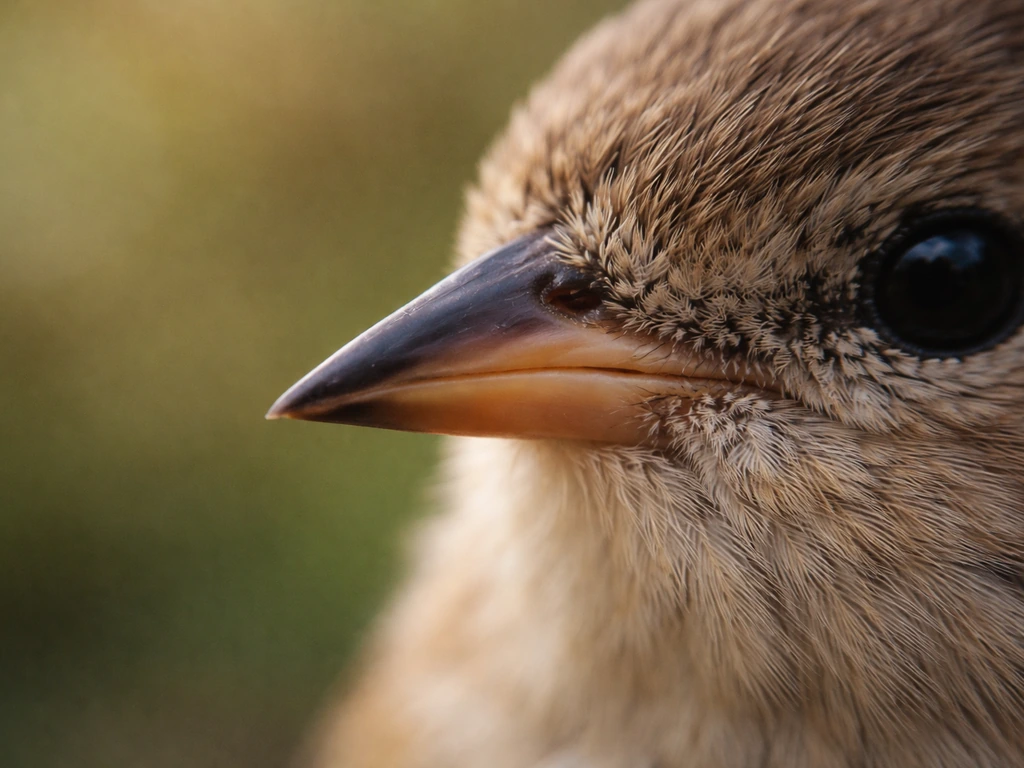
In Hindi, a dove bird is most commonly called कबूतर (kabootar). That is the word you will hear in everyday conversation, find in bilingual dictionaries, and see printed in Hindi bird-name charts. If someone asks you to name a dove in Hindi, कबूतर is the right answer for most practical purposes, and it works in both spoken and written contexts.
Dove Bird Meaning in Hindi: Name and Definition

Rajesh Sharma
3 Apr 2026
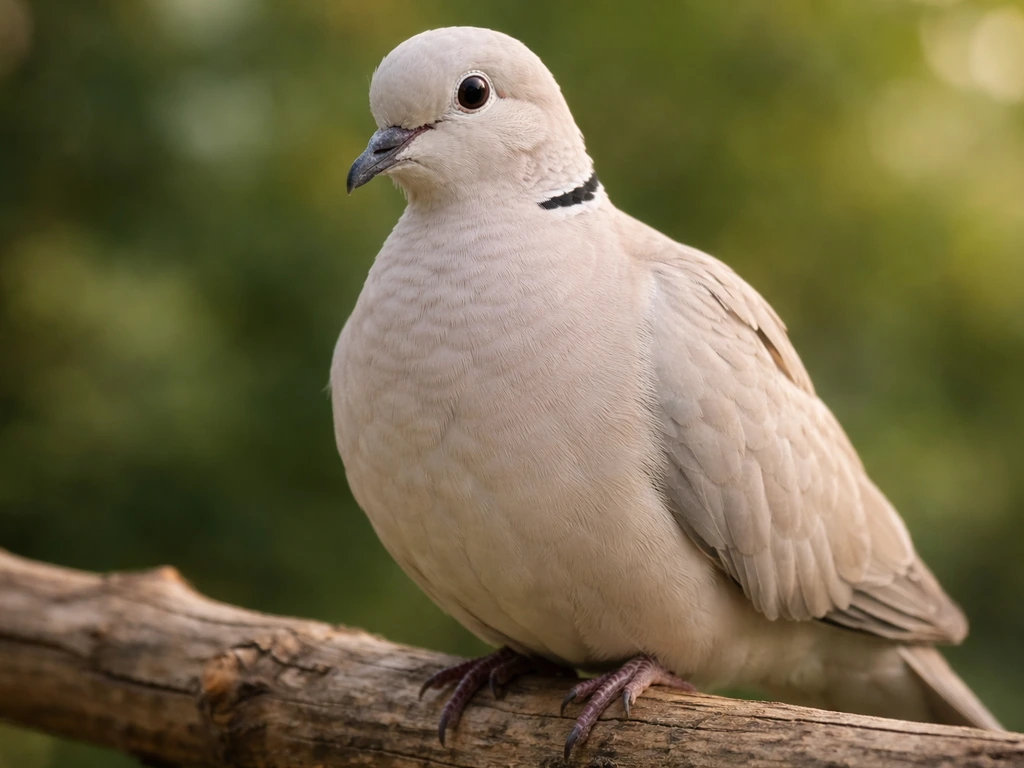
The Hindi name for dove bird
कबूतर (pronounced ka-boo-tar) is the standard Hindi word that maps directly to both dove and pigeon in English. Multiple bilingual sources, from the Brahma Kumaris Murli Shabdavali to Wiktionary entries for the Fiji Hindi variant, list 'kabootar' with the twin English equivalents 'pigeon, dove.' Hindi-to-English bird-name worksheets used in Indian schools consistently show the same mapping: Dove = कबूतर. So whether you are translating a nature book, describing a bird you spotted on a window ledge, or explaining a symbol in a poem, कबूतर is the term that fits.
For very specific species, Hindi media sometimes uses a transliteration alongside the Hindi word. Amar Ujala, for instance, refers to the Emerald Dove (Tamil Nadu's state bird) as 'एमराल्ड डव' (Emerald Dav) in news copy, blending the English name into the text. So you may see 'डव' (dav) used as a shorthand in modern media contexts, but this is a borrowed term, not a native Hindi word. In standard reference or educational use, stick to कबूतर.
Dove meaning in Hindi and English, side by side
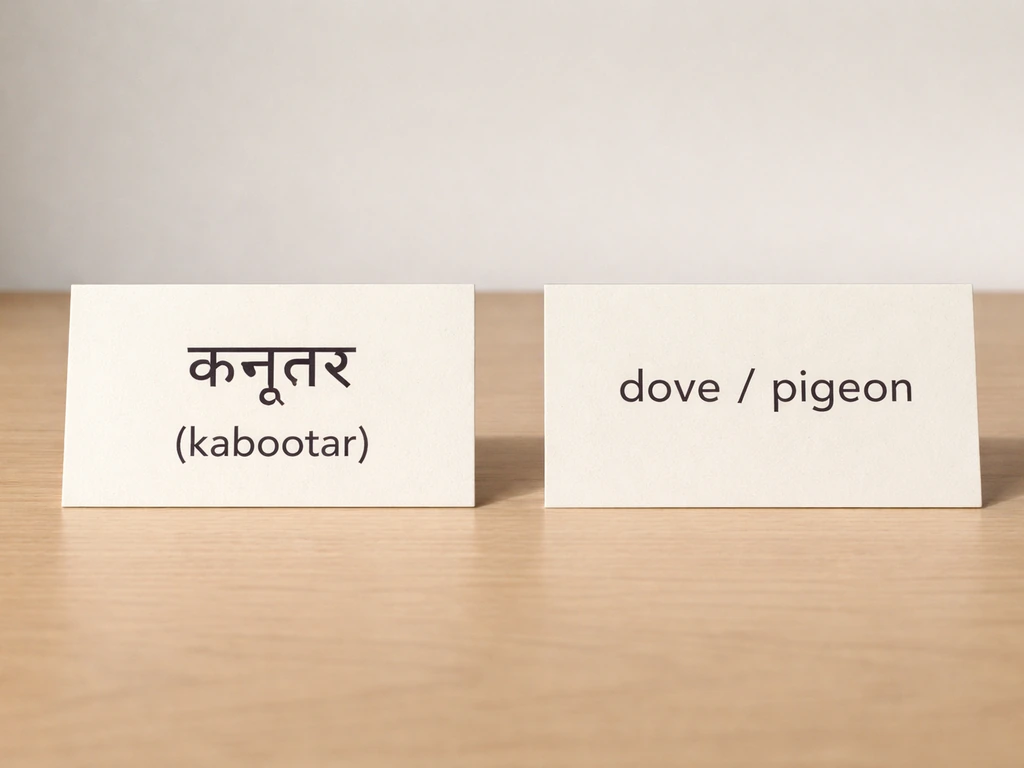
Understanding what 'dove' actually means as a category helps you use the Hindi term with confidence. In English, dove refers to a smaller bird from the family Columbidae, the same family that contains pigeons. Cambridge Dictionary describes it specifically as 'especially the smaller bird of the family Columbidae.' Merriam-Webster ties the bird sense directly to this family as well.
| Term | Language | Meaning / Definition |
|---|---|---|
| Dove | English | A smaller bird of the family Columbidae; often associated with peace |
| कबूतर (kabootar) | Hindi | Pigeon or dove; any bird of the Columbidae family in everyday use |
| डव (dav) | Hindi (transliteration) | Borrowed English term used in modern Hindi media for specific dove species |
| Pigeon | English | Larger bird of the same Columbidae family; same Hindi word कबूतर applies |
The word कबूतर itself has Persian and Farsi roots (kabūtar), which arrived in Hindi through Urdu. This linguistic heritage explains why the same word covers both dove and pigeon: in the Persian tradition, the term was used broadly for all birds of this gentle, non-predatory type, and Hindi absorbed that broad usage rather than inventing two separate words.
Dove vs. pigeon: clearing up the Hindi confusion
The most common source of confusion here is that English draws a soft distinction between 'dove' (usually the smaller, lighter-colored species) and 'pigeon' (usually the larger species), while Hindi uses कबूतर for both. Taxonomically, this makes sense: dove and pigeon belong to the same family, Columbidae. Even at the scientific level, the rock dove (Columba livia) is also commonly called the rock pigeon or common pigeon, which shows how fluid the dove/pigeon boundary really is.
When you need to distinguish a specific dove species in Hindi, the practical approach is to name the species in English and add कबूतर or डव for context. For example: 'Spotted Dove (चित्तीदार कबूतर)' or 'Collared Dove (कॉलर वाला कबूतर).' Bird identification guides and Indian checklists group these under 'Columbidae: Pigeons and Doves,' confirming that the family-level overlap is real and intentional, not an error.
A quick species-level tip: if you are trying to identify whether a bird you saw is specifically a dove and not a larger pigeon, look at the collar, wing pattern, and overall size. Many dove species have a distinct collar ring or spotted patterning that sets them apart from the larger, plainer-looking rock pigeon. This distinction matters for birdwatching and identification, even if the Hindi name stays the same.
Interestingly, this same naming flexibility appears across South Asian languages. Just as Hindi uses one word for both, you will find similar broad-use terms in related languages. If you are curious how non-native birds are handled in Hindi naming conventions, it is worth comparing with other unusual birds, for example, learning about the cassowary bird meaning in Hindi shows how Hindi deals with large, non-indigenous birds that have no traditional native name.
How to use कबूतर in everyday Hindi sentences

Here are natural, practical ways you will encounter and use कबूतर in daily Hindi conversation and writing:
- वह कबूतर शांति का प्रतीक है। (Voh kabootar shanti ka prateek hai.) — That dove is a symbol of peace.
- छत पर कबूतर बैठा है। (Chhat par kabootar baitha hai.) — A dove/pigeon is sitting on the roof.
- कबूतर उड़ाना (kabootar udaana) — to release a dove/pigeon (used literally and metaphorically in idioms).
- सफ़ेद कबूतर (safed kabootar) — white dove, often used in the context of peace ceremonies.
- कबूतरखाना (kabootarkhana) — dovecot or pigeon house; a space where doves/pigeons are kept.
Rekhta Dictionary, a well-known Hindi-Urdu reference, includes several idioms built around 'kabootar,' which reflects how deeply embedded this word is in everyday language and cultural expression. You will also find it in Urdu poetry and classical literature, often representing softness, innocence, or longing. The word is not formal or technical; it is the first word any Hindi speaker would use when pointing to a dove or pigeon.
What the dove means in Indian culture and tradition
Doves carry rich symbolic weight in Indian tradition, though the symbolism often blurs with that of pigeons since the Hindi word is the same. The most prominent association is peace and non-violence, a meaning that runs through both Hindu and broader South Asian culture. The white dove releasing image is strongly connected to peace movements and has been absorbed into Indian iconography as well, especially in post-independence political and cultural expression.
In Hindu mythology, birds in the Columbidae family (kabbuters or doves) appear in several stories as gentle, auspicious creatures. The dove is sometimes associated with love and tenderness, and keeping doves or pigeons has been a traditional practice in Indian households and courts for centuries. The Mughal emperors famously kept pigeons, and that tradition influenced how deeply कबूतर is woven into the literary and cultural fabric of Hindi and Urdu expression.
The symbolic link between doves and peace is also a global one. Globally, doves as symbols appear across cultures and religions, and India has absorbed this symbolism into its own framework, particularly in contexts of prayer, wedding ceremonies (where white birds are sometimes released), and peaceful protest. When you encounter कबूतर in a devotional or literary context, it almost always carries these gentle, positive connotations.
It is interesting to contrast this with birds that carry more powerful or complex symbolic meanings in other traditions. For instance, the condor bird meaning in Hindi represents a completely different symbolic register, associated with strength and death in the Andean world, which helps you appreciate how context-specific bird symbolism really is.
Regional variations worth knowing
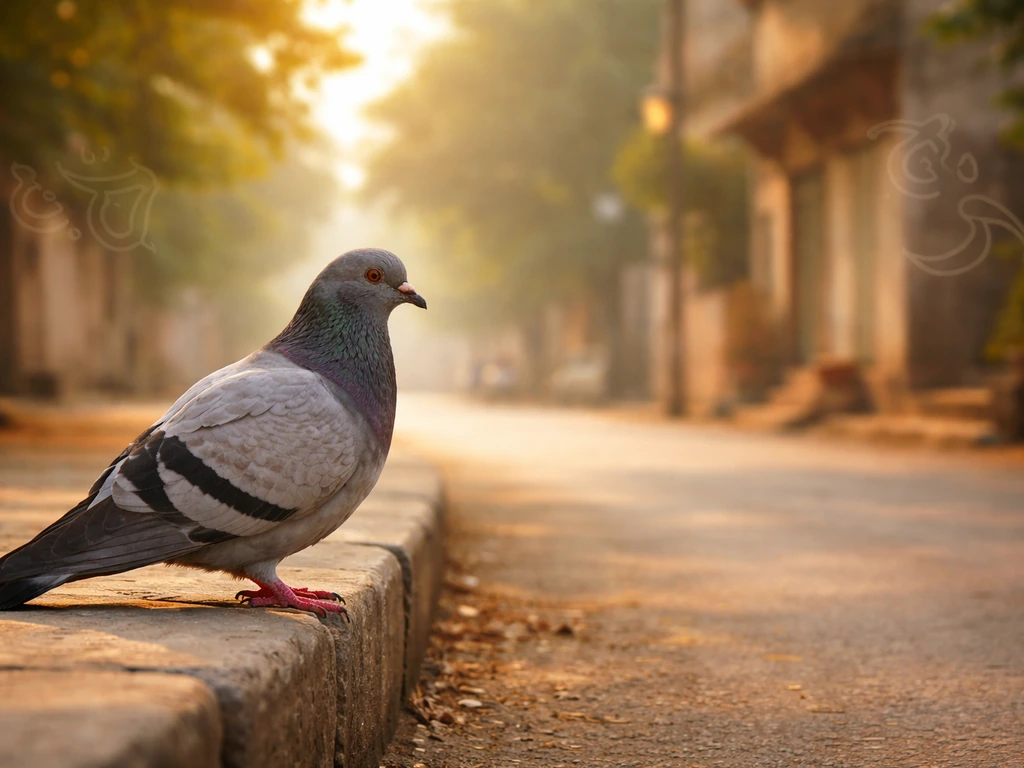
While कबूतर is the dominant Hindi term, it is recognized across multiple Indian languages with minor phonetic variations. In Urdu, the same word is written as کبوتر. In Punjabi, कबूतर is also widely understood. In Marathi, the word 'कबूतर' is used, though 'पारवा' (parava) is another common Marathi term for pigeon/dove.
In Gujarati, 'કબૂતર' (kabutar) follows the same root. Sanskrit uses 'कपोत' (kapota) as the classical term for dove/pigeon, which is the root that appears in many Sanskrit texts and is still used in formal or religious contexts. Sanskrit [कपोत (kapota)](https://kosha. sanskrit.
today/word/sa/%E0%A4%95%E0%A4%AA%E0%A5%8B%E0%A4%A4) is defined as a bird corresponding to dove or pigeon. If you are reading an older religious text or a Sanskrit-influenced poem, you are more likely to encounter 'kapota' than 'kabootar. '
How to verify the term and avoid errors
If you want to double-check your usage or find the right term for a specific dove species, here is a practical approach to confirming spellings and meanings:
- Check a bilingual Hindi-English dictionary first. Collins Hindi-English Dictionary and the Brahma Kumaris Murli Shabdavali both list कबूतर with 'pigeon, dove' as English equivalents, which confirms general usage.
- For species-specific names, search '[species name] Hindi name' along with 'Columbidae' to find the correct transliteration or native Hindi name used in Indian birdwatching communities.
- Cross-reference with official Indian bird checklists, which group entries under 'Columbidae: Pigeons and Doves' and often include regional common names.
- Use Rekhta Dictionary if you want to explore idiomatic or literary uses of कबूतर in Hindi and Urdu contexts.
- If you see 'डव' in a Hindi text, treat it as a transliteration of the English word 'dove' used for a specific species, not as a replacement for the general word कबूतर.
One more thing worth mentioning: the dove/pigeon naming question in Hindi is part of a broader pattern where Hindi uses one word for birds that English separates into two. You see similar situations with other birds. The hoopoe bird meaning in Hindi is a great example of a bird that has a distinct native Hindi name (हुदहुद, hudahud) precisely because it does not fit into any shared category, unlike the dove/pigeon pair.
Quick recap and best next steps
The direct answer: dove bird in Hindi is कबूतर (kabootar). This word covers both doves and pigeons in everyday Hindi, reflecting the shared Columbidae family they both belong to. The Sanskrit classical term is कपोत (kapota), which you will find in religious or literary texts. For specific dove species in modern Hindi media, you may see transliterations like 'एमराल्ड डव,' but कबूतर remains the practical everyday word.
Symbolically, the dove (कबूतर) is associated with peace, gentleness, love, and auspiciousness in Indian tradition. The white dove in particular carries strong peace symbolism, and कबूतर appears in idioms, poetry, and folk sayings with consistently positive and tender connotations.
For your next steps: verify the word in Collins or a Murli Shabdavali-style resource if you need dictionary-level confirmation; look up the specific species name in English followed by 'Hindi naam' if you need a more precise identification; and explore Sanskrit sources if you are working with classical texts. If you enjoy exploring how different birds are named and understood in Hindi, you might find it useful to read about the toucan bird meaning in Hindi or even the kiwi bird meaning in Hindi, both of which show how Hindi handles birds with no native Indian equivalent, which is a very different linguistic challenge from the dove's deeply rooted कबूतर.
FAQ
“Dove” in Hindi means कबूतर (kabootar), but can I use it for both dove and pigeon in everyday speech?
Yes. In most everyday Hindi contexts, कबूतर is understood for both dove and pigeon. If you want to be extra clear to a listener, add an identifying detail like रंग (color) or size, for example “सफेद कबूतर” (white dove/pigeon).
In Hindi writing, should I spell it कबूतर or कबूतर/कबूतर का शुद्ध रूप something else?
Use कबूतर for standard Hindi. Avoid casual variants like “कबूतर” with different vowel choices (for example in social media) if you are writing for school, formal captions, or a dictionary style, since standardization matters more than pronunciation in print.
How do I say a specific dove type in Hindi if कबूतर covers both dove and pigeon?
Use the English species name plus कबूतर for context. For example, “Spotted Dove” becomes “Spotted Dove (चित्तीदार कबूतर)” and “Collared Dove” becomes “Collared Dove (गोल/कॉलर वाला कबूतर)”. This reduces ambiguity for birdwatching or translations.
If I see “डव” (dav) in an article, does it mean dove in Hindi?
“डव” is usually a borrowed shorthand from English “dove” used in modern media, and it may not be as universally understood as कबूतर. For safest everyday communication, prefer कबूतर, especially in conversations with people who may not read English-influenced spellings.
What about the classical term कपोत (kapota), is it interchangeable with कबूतर?
They are related, but they differ in register. कपोत is the Sanskrit-influenced classical form often used in religious or literary contexts, while कबूतर is the standard everyday Hindi word. In a poem or scripture-style line, कपोत fits better, in daily speech, कबूतर fits better.
Why does English separate “dove” and “pigeon,” but Hindi uses one word, कबूतर?
Hindi groups them under one everyday category because both belong to the same bird family (Columbidae), and common usage does not enforce the English size or species boundary. When precision is needed (like for a quiz or identification), rely on a species name or a visible trait, not the generic Hindi word alone.
If I’m identifying a bird I saw, what visual clues help me decide dove vs pigeon even though Hindi name stays कबूतर?
Look for a collar ring, wing pattern, and overall body size. Many doves have more visible neck markings or finer patterning than the typical rock pigeon look. You can still describe the bird in Hindi as “कबूतर” while adding the trait, like “कॉलर वाला कबूतर” (collared type).
Are there any idioms or common usage patterns with कबूतर that I should know before using it in a quote?
Yes, कबूतर appears in everyday Hindi-Urdu idiom and poetic language to suggest softness or innocence. If you are quoting literature, keep the exact surrounding phrase in mind, because idioms can change meaning depending on whether it is used metaphorically or literally (bird vs symbol).
Which Hindi term should I use if the text is about peace symbolism (like “white dove”)?
For peace-related contexts, “सफेद कबूतर” is the most natural choice in Hindi. If you are translating a specific religious or protest-related phrase, keep “white” explicit, since the symbolic impact in many Indian contexts is strongly linked to whiteness.
Next Article
Bird Beak Meaning in Hindi: Chonch, Bill, Pronunciation
Bird beak in Hindi chonch or bill, pronunciation, examples, beak vs bill differences, and figurative Hindi use