Title: Plover Bird Meaning in Hindi: Names, Symbolism and Indian Language Guide Meta description: Learn the Hindi name for the plover bird in Devanagari, plus Sanskrit, Marathi, Punjabi and Gujarati equivalents, cultural symbolism, and where to spot plovers in India.
Plover Bird Meaning in Hindi: Names, Symbolism & ID

Rajesh Sharma
28 Jul 2026
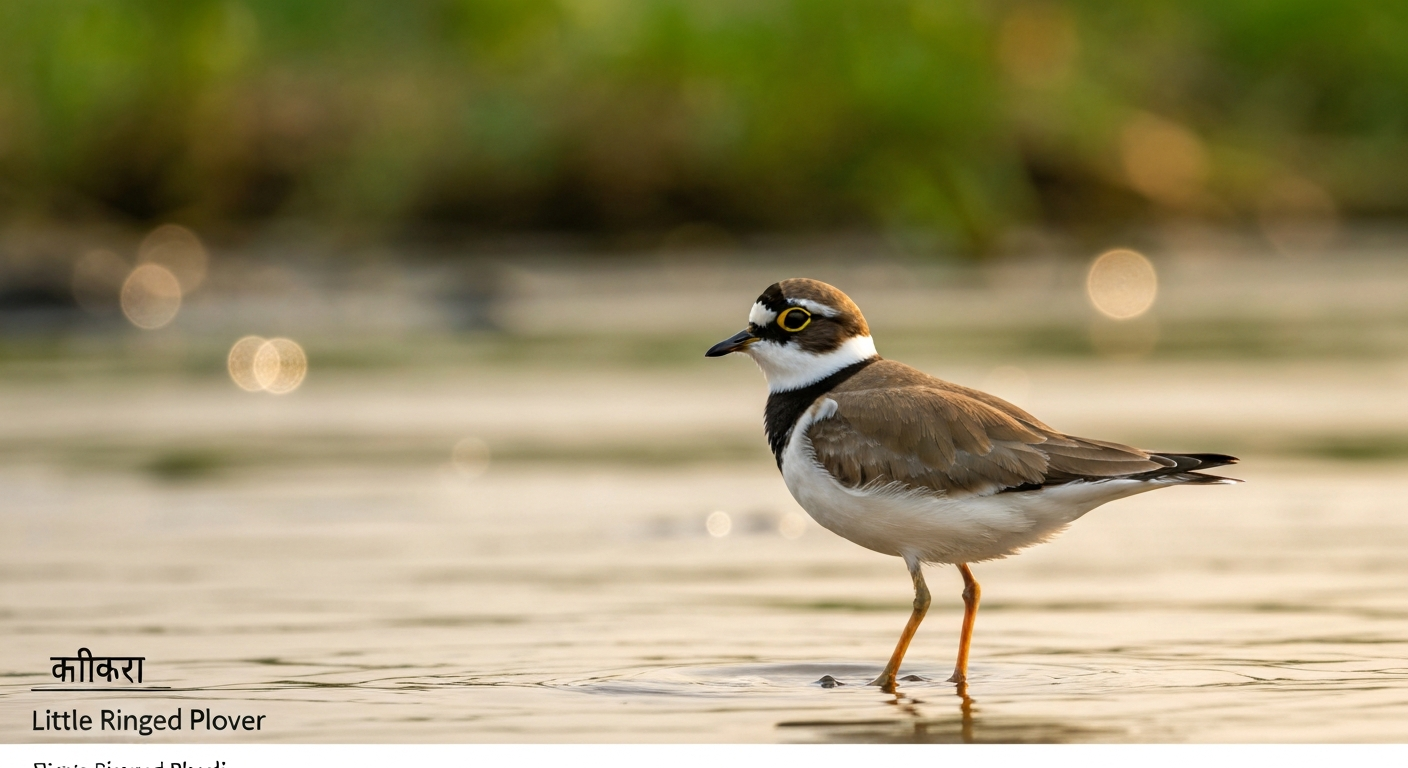
The plover bird is called झिरिया (jhiriyā) in common Hindi usage, particularly for the Little Ringed Plover, the species most widely encountered inland across India. When writing or speaking about plovers as a group, the Devanagari loanword प्लोवर (plovar) is widely understood and appears regularly in Hindi media. These two forms cover most everyday needs: जिरिया for the specific bird you are likely to see along a river or lakeshore, and प्लोवर when referring to the broader family in articles, field guides, or general conversation.
What exactly is a plover?
Plovers are small to medium-sized shorebirds belonging to the family Charadriidae, which also includes dotterels and lapwings. They are compact, round-headed birds with short bills adapted for picking invertebrates off the surface of the ground rather than probing into mud. Most plovers have a distinctive stop-and-run feeding style: they stand still, scan the ground, then dash forward to grab something. You will find them on river sandbars, coastal mudflats, saltpans, and the grassy margins of wetlands. India hosts a good selection of resident, breeding, and migratory species within this family, making the name worth knowing in multiple Indian languages.
Hindi names in Devanagari, romanization and how to say them
The most widely attested Hindi vernacular name for the Little Ringed Plover is झिरिया, romanized as jhiriyā. The word also appears spelled as झिरिआ (jhiriā) in some regional glossaries, and an additional Hindi folk name मर्वा (marvā) is recorded in certain online bird-name resources for the same species. In Hindi news reports from Bihar and other states covering winter bird counts, झिरिया is the name that appears most consistently in print. A regional Hindi news report on the Jhajha winter bird count lists the Little Ringed Plover as झिरिया (jhiriyā).
For pronunciation: the initial झ is the voiced aspirated affricate /d͡ʒʱ/, which sounds like a breathy 'jh' as in 'jh-iriya'. The full word approximates /d͡ʒʱɪɾijaː/ in IPA. Say it in three quick syllables: JHI-ri-yaa, with a slight breathiness on the 'JH' and a lengthened final vowel. The loanword प्लोवर (plovar) is simpler: /ploːʋər/, very close to the English 'plover' but with the 'v' realized as a lighter labio-dental approximant /ʋ/. Both words are straightforward for anyone already reading Devanagari.
Names across Indian languages
One of the most satisfying aspects of researching Indian bird names is seeing how each language tradition has developed its own term, sometimes descriptive, sometimes phonetically evocative. Here is what the plover looks like across the major languages covered on this site.
| Language | Script | Transliteration | Notes |
|---|---|---|---|
| Hindi | झिरिया / प्लोवर | jhiriyā / plovar | jhiriyā = Little Ringed Plover specifically; plovar = general loanword |
| Sanskrit | क्षुद्रपक्षिक | kṣudrapakṣika | Attested in Monier-Williams/Böhtlingk & Roth for a small plover/lapwing-type bird; no single classical term covers all Charadriidae |
| Marathi | केन्टिश चिखल्या / मोठ्या चिखल्या | keṇṭiś cikhlyā / moṭhyā cikhlyā | Kentish Plover / Greater Sand Plover respectively; used in Maharashtra Nature Park educational materials |
| Punjabi | ਪਲੋਵਰ | plovar | Primarily the English loanword rendered in Gurmukhi; regional folk names remain undocumented in accessible sources |
| Gujarati | ઢોંગીલી / ભુલામણી ઢોંગીલી | Ḍhoṃgīlī / Bhulāmaṇī Ḍhoṃgīlī | Names for the Kentish Plover recorded on the Birds of Gujarat portal |
A word of honest caution on the Sanskrit entry: classical Sanskrit literature is rich in bird terminology, and the Cologne Digital Sanskrit Dictionaries do record kṣudrapakṣika (क्षुद्रपक्षिक, literally 'small bird/plover') with glosses pointing toward small lapwing or plover types. However, there is no single high-frequency classical Sanskrit name that maps cleanly onto the modern taxonomic concept of Charadriidae as a whole. Specialist works like 'Birds in Sanskrit Literature' are the best resource for deeper research here. The Marathi names are notably descriptive: cikhlyā relates to 'mud' or 'mudflat', which perfectly captures where you find these birds.
The three plovers you are most likely to meet in India
India's Charadriidae roster is sizeable, but three species dominate birdwatcher lists and Hindi-language bird reports. Each occupies a slightly different niche, which is useful to know both for identification and for understanding which species the folk names actually refer to.
Little Ringed Plover (Charadrius dubius)
This is the plover most Indians encounter most often, and it is the species the Hindi name झिरिया specifically describes. Small at 14 to 17 cm, it has brown upperparts, clean white underparts, a single black breast collar, and its most distinctive feature: a bright yellow orbital ring around the eye. It breeds and holds territories along inland freshwater sites across the subcontinent, including river sandbars, gravel banks, and lakeshores. IUCN status: Least Concern. Note that some authorities now place this species in genus Thinornis rather than Charadrius.
Kentish Plover (Anarhynchus alexandrinus)
The Kentish Plover is a coastal specialist in India, most reliably found on sandy beaches, saltpans, and tidal mudflats. It shares the small, compact plover shape but has an incomplete breast band (appearing as two dark lateral patches rather than a full collar) and shows clear sexual dimorphism in breeding plumage, with the male showing rufous on the crown. In Gujarati it is recorded as ઢોંગીલી (Ḍhoṃgīlī) and in Marathi as केन्टिश चिखल्या. IUCN status: Least Concern globally, though coastal habitat loss is an ongoing pressure in India. Taxonomy note: some authorities now use Anarhynchus alexandrinus rather than Charadrius alexandrinus.
Greater Sand Plover (Anarhynchus leschenaultii)
At roughly 22 to 25 cm, the Greater Sand Plover is noticeably chunkier than either of the above, with a stouter bill and more powerful build. It favours coastal sand and mudflats, saltpans, and occasionally flooded inland fields. In Marathi educational materials it appears as मोठ्या चिखल्या (moṭhyā cikhlyā), meaning roughly 'large mudflat bird'. IUCN status: Least Concern globally, though regional monitoring in East Asia flags coastal habitat pressures for this species.
Quick field guide: how to tell them apart
In the field in India, three features will separate these species quickly: eye-ring presence, breast-band completeness, and overall size. The table below summarises the most useful marks.
| Feature | Little Ringed Plover | Kentish Plover | Greater Sand Plover |
|---|---|---|---|
| Size | 14–17 cm (small) | 15–17 cm (small) | 22–25 cm (medium) |
| Yellow eye-ring | Prominent, bright yellow | Absent or faint | Absent |
| Breast band | Full black collar | Incomplete (side patches only) | Orange-rufous partial band (breeding) |
| Bill | Short, dark | Short, dark, fine | Stouter, dark |
| Legs | Pale flesh/pinkish | Dark grey to blackish | Grey-green to yellowish |
| Preferred habitat | Freshwater: rivers, lake margins | Coastal: sandflats, saltpans | Coastal: mud/sandflats, saltpans |
| IUCN status | Least Concern | Least Concern | Least Concern |
A practical tip: if you see a small plover along a river or freshwater lakeshore in India and it has a vivid yellow ring around each eye, you are almost certainly looking at a Little Ringed Plover, the bird called झिरिया. Move to the coast and lose that eye-ring while gaining an incomplete breast band, and you are probably watching a Kentish Plover. Something significantly larger with a chunkier bill on a tidal mudflat points you toward the Greater Sand Plover.
Cultural symbolism and folklore in Indian tradition
It is important to be upfront here: plovers do not occupy the same prominent space in classical Indian mythology and iconography that birds like the peacock, crane, swan (haṃsa), or crow do. You will not find plovers centrally featured in the Mahabharata or Ramayana the way certain other birds are. That said, the broader Charadriidae family, which includes lapwings, does appear in vernacular tradition, and the boundary between 'lapwing' and 'plover' in older Indian folk language was not always the same as modern taxonomy draws it.
The red-wattled lapwing (Vanellus indicus), a close relative in the same family, is perhaps the most culturally present Charadriid in India. It is known in Hindi as टिटहरी (ṭiṭharī) and has a documented place in folk belief: its distinctive 'did-he-do-it' call is widely noticed and its habit of nesting on open ground near human habitation has generated observational lore across many states. While ṭiṭharī is not a plover in the strict modern sense, its cultural presence tells us that this bird family was noticed and commented upon in Indian folk tradition, even if the smaller plovers were less celebrated by name.
In Sanskrit poetic tradition, shorebirds of sandy riverbanks appear in landscape descriptions (particularly in descriptions of river ghats, pilgrimage routes, and seasonal settings). The general category of kūla-pakṣī (shore birds, birds of the bank) appears in classical poetry to evoke riverside atmosphere, and plovers would have been part of this observed natural world even where not named individually. The Sanskrit term kṣudrapakṣika does appear in lexicons for a small plover-like bird, confirming some degree of taxonomic awareness, but elaborate mythological narratives specifically about plovers are not well documented in accessible Sanskrit sources.
Spiritual and omen interpretations across Indian regions
Indian folk ornithology assigns omens and spiritual significance to many birds, and shorebirds are no exception, though the evidence for plover-specific beliefs is thinner than for high-profile species. What follows reflects documented or plausibly attested regional views, with honest notes on uncertainty.
In several North Indian rural traditions, the appearance of small wading birds at a river crossing or near a water source before a journey was considered auspicious, associated with the blessing of water deities and safe passage. This general class of belief likely extended to plovers seen on riverbanks, though attributing it specifically to झिरिया rather than to shorebirds collectively would be an overstatement. In coastal Gujarat and Maharashtra, where the Kentish Plover is a familiar sight on salt pans and beaches, the birds are observed but no specific omen tradition tied to this species has been documented in the sources consulted for this entry.
The broader principle in Shastra-based bird omen traditions (śakuna śāstra) is that the direction from which a bird calls, its behavior at specific times of day, and its proximity to the home can all carry meaning. Small ground-nesting shorebirds that run rather than fly when disturbed are sometimes interpreted as signs of caution or discretion in folk readings. However, I want to be careful not to over-attribute here: systematic documentation of plover-specific omens in verifiable Indian folk sources is sparse, and readers with a research interest in this area would need to consult regional śakuna texts directly. Where plovers share habitat with the culturally prominent टिटहरी (ṭiṭharī/lapwing), the two birds' behaviors are sometimes read together in folk observation.
Hindi phrases, folk names and place-name connections
The name झिरिया itself is evocative in Hindi: the root suggests something small, quick, and twittering, which maps well onto the bird's character. The variant मर्वा (marvā) recorded in some glossaries for the same species may reflect regional dialect usage in specific states, though its distribution and etymology are not fully documented. The loanword प्लोवर has entered mainstream Hindi journalism and is used in wildlife coverage, bird-count reports, and educational materials without modification, following the common Hindi pattern of adopting English bird names directly into Devanagari for species with no widely established vernacular name.
In terms of place names, plovers and their close lapwing relatives do appear in village and wetland names across India, though attributing a specific toponym directly to the plover (as opposed to the better-known ṭiṭharī/lapwing) requires case-by-case research. Wetlands bearing names related to shorebirds in general are common enough that the pattern is worth noting for local birdwatchers and cultural researchers exploring their own regions.
Where and when to see plovers in India
The Little Ringed Plover is one of India's most reliable and widespread shorebirds. It is present year-round at suitable inland sites and is a genuine breeding resident at many locations. Look for it on exposed sandy or gravelly riverbanks along the Ganga, Yamuna, Chambal, Godavari, and their tributaries, as well as at reservoir margins, gravel pits, and open mudflats around wetlands. The species is active and approachable, making it a good introduction to the plover family for anyone new to Indian birdwatching. Spring and early summer are good times to watch breeding behavior.
The Kentish Plover is best sought on the coasts, particularly along the Gujarat coastline, the Rann of Kutch margins, the Goa and Karnataka sandy beaches, and the tidal flats of the Sundarbans region. It is most common as a wintering and passage visitor, with numbers peaking between October and March. The Greater Sand Plover follows a similar coastal and passage pattern, often mixing with Kentish Plovers on the same tidal flats and saltpans, which makes direct size comparison in the field possible and very useful for identification.
- Little Ringed Plover: inland rivers, lake shores, gravel banks nationwide; year-round, breeds spring/summer
- Kentish Plover: coastal sandflats, saltpans, Rann of Kutch, Gujarat and western coasts; peak Oct–Mar
- Greater Sand Plover: coastal mudflats and tidal areas, often with Kentish Plover; wintering and passage Oct–Mar
- Best general sites: Rann of Kutch (Gujarat), Chilika Lake (Odisha), Pulicat Lake (Andhra Pradesh/Tamil Nadu), Chambal riverbanks (Madhya Pradesh/Rajasthan), Vedanthangal (Tamil Nadu)
- All three species are IUCN Least Concern globally, though coastal habitat loss from development and salt-pan conversion is a real pressure on Kentish and Greater Sand Plover populations in India
How plovers compare with other shorebirds on this site
If you are building your knowledge of Indian bird names and symbolism, plovers fit into an interesting middle ground: more culturally visible than some obscure waders, but less mythologically prominent than the great symbolic birds of Indian tradition. See the related entry on magpie bird meaning in Hindi for the Hindi name, cultural notes, and regional usage for magpies. For contrast, the flamingo carries a vivid visual symbolism and is well documented in cultural contexts across western India, and the pelican has its own documented linguistic and symbolic trail in Indian languages. For a related entry, see the pelican bird meaning in Hindi which traces that species' linguistic and symbolic trail in Indian languages. For more on the flamingo's cultural and linguistic significance, see Flamingo bird meaning in Hindi (fb3d3251-6474-472b-a374-40da0b22d42b). Birds with mythological depth like the phoenix sit at the opposite extreme, commanding rich narrative traditions across multiple cultures. Plovers are, in a sense, the everyday working birds of Indian waterways: ecologically important, linguistically named, but not yet celebrated in the way that their relatives the peacock or the crane are. That makes them a rewarding subject for language learners and birdwatchers who want to go beyond the obvious entries. For related vocabulary and symbolic meanings, see our guide to bird of paradise meaning in Hindi for the Devanagari name and cultural notes.
Comparing ground-dwelling shorebirds also reveals interesting naming patterns: the partridge, another ground bird with a distinct Hindi name, follows a similar trajectory of clear vernacular naming without major mythological elaboration, while the pheasant occupies a more decorated cultural space thanks to its striking plumage. For a deeper look at the pheasant's Hindi name and cultural significance, see the pheasant bird meaning in Hindi entry. For the partridge's Hindi name and detailed meanings, see partridge bird meaning in Hindi. Plovers, like the goldfinch or the magpie, tend to be named carefully in Indian languages but interpreted spiritually through regional folk tradition rather than classical canon.
A quick reference summary
| Category | Detail |
|---|---|
| Primary Hindi name (Little Ringed Plover) | झिरिया (jhiriyā) |
| General Hindi loanword (all plovers) | प्लोवर (plovar) |
| Sanskrit (lexicon attestation) | क्षुद्रपक्षिक (kṣudrapakṣika) |
| Marathi (Kentish Plover) | केन्टिश चिखल्या (keṇṭiś cikhlyā) |
| Marathi (Greater Sand Plover) | मोठ्या चिखल्या (moṭhyā cikhlyā) |
| Gujarati (Kentish Plover) | ઢોંગીલી (Ḍhoṃgīlī) |
| Punjabi | ਪਲੋਵਰ (plovar) — loanword |
| Family | Charadriidae |
| Key Indian species | Little Ringed Plover, Kentish Plover, Greater Sand Plover |
| IUCN status (all three) | Least Concern (global) |
| Best time to see (coastal species) | October to March |
| Little Ringed Plover availability | Year-round at inland freshwater sites |
FAQ
What is the standard Hindi name for 'plover' and how is it written and pronounced in Devanagari?
Common Hindi forms: प्लोवर (loanword from English: plover) and regional vernacular झिरिया / झिरिआ (romanization: jhiriyā / jhiria). Pronunciation guidance (approximate IPA): प्लोवर ≈ /ploːʋər/ (romanization: plover / plovar); झिरिया ≈ /d͡ʒʱɪɾijaː/ (romanization: jhiriyā). Use प्लोवर when using an English loanword; use झिरिया for many local field reports referring to Little Ringed Plover.
What are equivalent names in Sanskrit, Marathi, Punjabi and Gujarati (script + transliteration)?
Sanskrit: क्षुद्रपक्षिक (kṣudrapakṣika) — a general classical term glossed as 'small plover/shorebird' (used as a lexical equivalent rather than a one‑to‑one taxonomic name). Marathi: केन्टिश चिखल्या (keṇṭish cikhlyā) — used regionally for Kentish Plover; मोठ्या चिखल्या (moṭhyā cikhlyā) for Greater Sand Plover (regional educational materials). Punjabi (Gurmukhi): ਪਲੋਵਰ / ਝਿਰੀਆ (plovar / jhirīā) — loanword and vernacular forms are used in Punjabi reports; romanizations: plovar, jhiria. Gujarati: પ્લોવર (plovar) and local names like ઢોંગીલી / ભુલામણી ઢોંગીલી (ḍhōṅgīlī / bhulāmaṇī ḍhōṅgīlī) for Kentish Plover are attested on state bird portals.
What is the scientific identity (family/genus) of plovers and which Indian species should be covered?
Plover family: Charadriidae (plovers, dotterels, lapwings). Common Indian species to highlight: Kentish Plover — Charadrius/Anarhynchus alexandrinus; Little Ringed Plover — Charadrius/Thinornis dubius (often listed as C. dubius); Greater Sand Plover — Charadrius/Anarhynchus leschenaultii. Note: IOC and other authorities have made genus‑level changes in this group; verify the current checklist (IOC/eBird) when publishing.
How can readers identify these plover species in the field (short ID notes and habitat)?
Little Ringed Plover: small (14–17 cm), brown upperparts, white underparts, single thin black breast/collar band, brown cap, distinct bright yellow eye‑ring; favours freshwater shores, river sandbars, gravel pits. Kentish Plover: small, coastal and inland sandflats/saltpans, incomplete or faint breast‑band, sexual dimorphism in breeding plumage; check leg/bill colour and face pattern. Greater Sand Plover: larger (≈22–25 cm), stouter bill, chunkier build, favours coastal mudflats, sandflats and saltpans. Use eye‑ring, bill shape, leg colour and habitat to separate species.
Where and when can visitors see plovers in India?
Little Ringed Plover: widespread along rivers, lakeshores, reservoirs and gravel bars across India; commonly seen in breeding season at inland freshwater sites (spring–summer) and year‑round as resident/migrant. Kentish and Greater Sand Plover: best along coastal sandflats, mudflats, estuaries and saltpans — especially on west and east coasts and major wetlands during winter and migration periods. Local birding checklists and wetland surveys give best site‑level timings.
What is the conservation status of these plovers?
Globally (IUCN): Little Ringed Plover and Kentish Plover are assessed as Least Concern; Greater Sand Plover is also Least Concern globally. Conservation notes: coastal habitat loss, disturbance at breeding sites and wetland degradation cause local pressures — monitor regional assessments and local red‑lists for site‑specific concerns.
Next Article
Pelican Bird Meaning in Hindi: Name, Significance & Facts
पेलिकन का हिंदी नाम, वैज्ञानिक जानकारी, भारतीय प्रजातियाँ व सांस्कृतिक‑मिथक संक्षेप में।