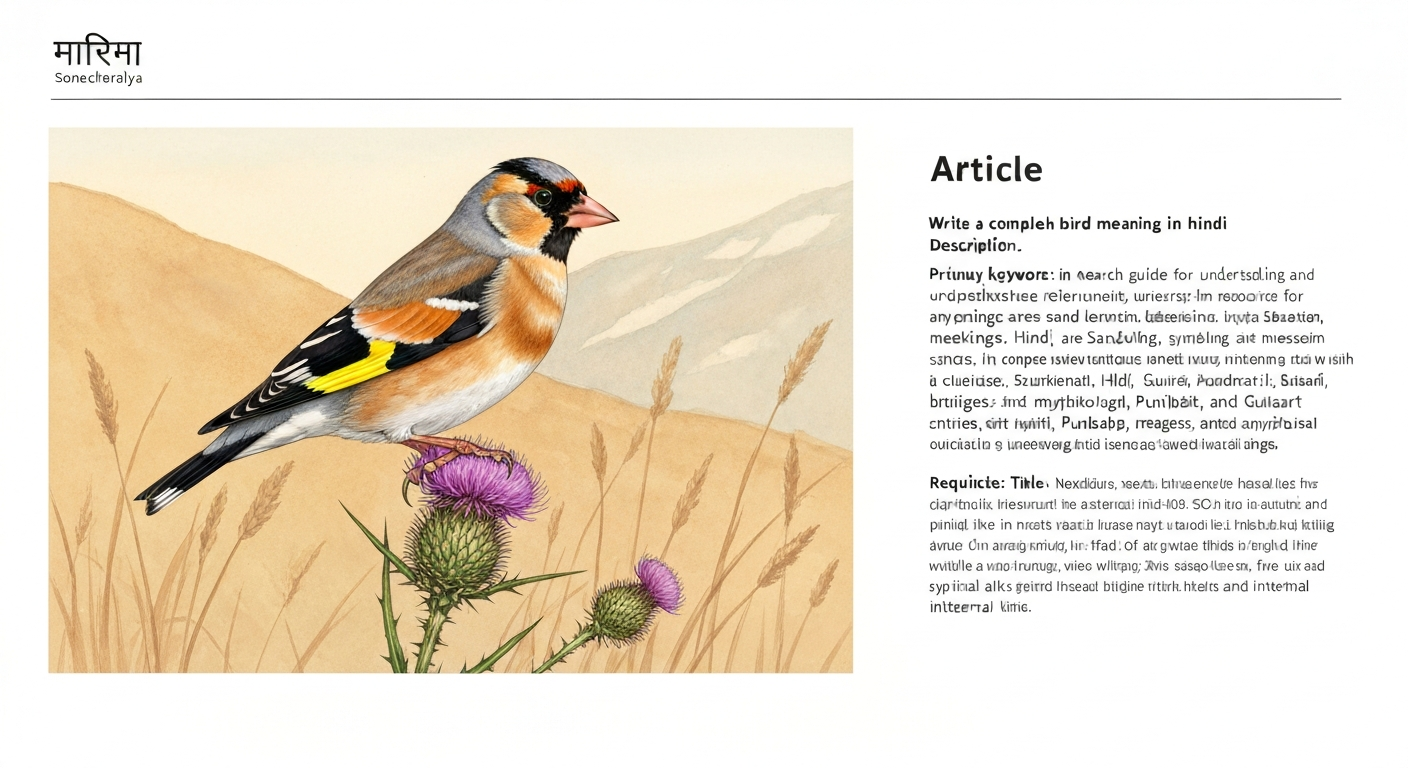
In Hindi, the goldfinch is most commonly called सोनचिरैया (Sonacharaiya) or सोनकिरी (Sonkiri), names that translate loosely to 'golden bird' or 'golden sparrow', a direct nod to the bird's vivid yellow wing-bars and warm buff plumage. The species you are most likely to encounter in northern India and the Himalayan foothills is technically the Grey-crowned Goldfinch (Carduelis caniceps), which was split from the European Goldfinch (Carduelis carduelis) in recent taxonomy. Both the Hindi names and the cultural associations discussed in this article apply to this India-relevant form.
Goldfinch Bird Meaning in Hindi: Names, Symbolism & ID

Rajesh Sharma
12 Jul 2026
At a Glance: Goldfinch Meaning in Hindi
- Primary Hindi name: सोनचिरैया (Sonacharaiya) — meaning 'golden bird'
- Also known as: सोनकिरी (Sonkiri), हिरामन चिड़िया (Hiraman Chidiya) in some regional usages
- Sanskrit root name: सुवर्णचटक (Suvarna-Chatak) — 'golden sparrow/finch'
- Scientific name: Carduelis caniceps (Grey-crowned Goldfinch) — the form found in India
- Family: Fringillidae (true finches)
- IUCN status: Least Concern (Carduelis carduelis sensu lato / caniceps)
- Where found in India: Himalayan foothills, Kashmir, Himachal Pradesh, Uttarakhand, and northwest India in winter
- Cultural resonance: associated with joy, brightness, and melodic song in Indian folk traditions
Hindi Names in Devanagari, Romanization, and Pronunciation
The most widely used Hindi name for the goldfinch is सोनचिरैया, romanized as Sonacharaiya and pronounced roughly as 'So-nah-chi-rye-yah' (stress on the second syllable, 'nah'). The word combines सोन (son, meaning gold) with चिरैया (chiraiya, the everyday Hindi word for a small bird or sparrow). Together, the compound means quite literally 'the golden little bird,' which suits the goldfinch perfectly given its striking yellow and black wing-patches and warm russet face.
A shorter colloquial variant is सोनकिरी (Sonkiri), pronounced 'Son-ki-ree,' used in parts of Uttar Pradesh and Bihar. Some older Hindi and Urdu-influenced texts use the term ज़र्द चिड़िया (Zard Chidiya), from the Persian-Urdu zard meaning yellow, so 'the yellow bird.' In Kashmir, older vernacular usage recorded in colonial-era references includes the name 'Shaira,' though this is regional and not standard Hindi. For written Hindi and formal reference, सोनचिरैया remains the clearest and most recognisable choice for most readers.
Names Across Indian Languages
The table below brings together the goldfinch's names across five major Indian languages. Where established published names exist (from sources such as Salim Ali's 'The Book of Indian Birds,' Avibase vernacular compilations, and regional field guides), those are used. For related common bird names, including pheasant bird meaning in Hindi, consult the linked vernacular reference (867e745a-d263-43d8-a2f5-66c03ef979aa). Where a direct published vernacular is not confirmed, the entry notes the closest descriptive name or marks it as 'not formally standardized,' to avoid passing on unverified names as authoritative.
| Language | Script | Romanization | Literal Meaning / Notes |
|---|---|---|---|
| Hindi | सोनचिरैया / सोनकिरी | Sonacharaiya / Sonkiri | Golden bird / golden sparrow; most widely used Hindi names |
| Sanskrit | सुवर्णचटक | Suvarna-Chatak | Golden sparrow/finch; suvarna = gold, chatak = small bird |
| Marathi | सोनचिमणी | Sonachimni | Golden sparrow; son = gold, chimni = sparrow/small bird |
| Punjabi | ਸੋਨਾ ਚਿੜੀ / ਜ਼ਰਦ ਚਿੜੀ | Sona Chidi / Zard Chidi | Golden bird / yellow bird; zard from Persian-influenced Punjabi |
| Gujarati | સોન-ચકલી | Son-Chakali | Golden sparrow; son = gold, chakali = sparrow/small finch |
A pattern you will notice immediately is that nearly every Indian language reaches for its word for gold (son, suvarna, zard) to name this bird. That consistency across Hindi, Sanskrit, Marathi, Punjabi, and Gujarati is itself a window into how strongly the goldfinch's visual identity, those brilliant yellow wing-bars, shaped its naming across the subcontinent. Regional field guides and BNHS publications, particularly Salim Ali's 'Book of Indian Birds,' remain the most reliable first port of call for verifying these vernaculars before use in formal writing. For related vernacular entries, see the plover bird meaning in Hindi.
Scientific Name, Taxonomy, and Conservation Status
The goldfinch you are most likely to see in India is the Grey-crowned Goldfinch, Carduelis caniceps (Vigors, 1831). Until relatively recently, this was treated as a subspecies of the European Goldfinch (Carduelis carduelis), but the IOC World Bird List and eBird Science have both recognized it as a full species based on differences in head plumage pattern, genetics, and range. The split matters for Indian readers and birdwatchers: when you look up Indian records on eBird India, you should search for Carduelis caniceps specifically rather than Carduelis carduelis, since many older records may need updating under the newer taxonomy.
Taxonomy: Order Passeriformes, Family Fringillidae, Genus Carduelis. The Grey-crowned Goldfinch belongs to the carduelis complex, which also includes several Central Asian and Himalayan finches. Its closest relatives within the genus are the other 'goldfinch' taxa of Europe, the Middle East, and Central Asia, making it part of a well-studied group with good quality life-history data available through the Handbook of the Birds of the World (HBW) and BirdLife International species accounts.
For conservation status, Carduelis carduelis sensu lato (including caniceps) is listed as Least Concern on the IUCN Red List (BirdLife International, IUCN Red List assessments). The global population is large and not believed to be declining rapidly enough to approach threatened thresholds. BirdLife International authors the IUCN accounts for this group, and the BirdLife species factsheet (available through the BirdLife DataZone and HBW Alive) is the recommended source for up-to-date population trend data and range maps. Within India, the species is protected under Schedule IV of The Wild Life (Protection) Act, 1972 (as amended), which means capturing, keeping, selling, or trading goldfinches in India is a punishable offense. The consolidated schedule text is publicly available from the Ministry of Environment, Forest and Climate Change.
What Does a Goldfinch Look Like: Identification Tips
The Grey-crowned Goldfinch is a small, slender finch, roughly 12 to 13 centimetres in length and weighing around 14 to 19 grams. It is one of the most visually striking birds in its size class once you get your eye in. The face is the first thing to look for: a bold red-and-white face pattern on the European form becomes a plainer grey-crowned appearance in Carduelis caniceps, hence its English name. The wings are the real standout: broad, brilliant yellow wing-bars flash dramatically in flight against a black and white wing pattern.
The back and flanks are warm buff-brown, the underparts paler, and the rump is white, clearly visible when the bird takes off. The bill is fine and pointed, typical of seed specialists, and pale pinkish-ivory in colour. In the Grey-crowned form, the grey head (lacking the vivid red face of the European Goldfinch) and the otherwise identical body and wing pattern are the key ID features separating it from its close relative. Both sexes look similar, though males tend to have a slightly more extensive red facial patch in populations where that feature occurs, and the yellow wingbar is equally striking in both.
Quick ID Checklist
- Size: small finch, 12–13 cm, roughly sparrow-sized but more slender
- Wing-bars: broad, brilliant yellow — the single most obvious field mark
- Head: grey crown (Carduelis caniceps); red, black, and white face in European form
- Back: warm buff-brown; rump white and visible in flight
- Bill: fine, pale pinkish-ivory, suited to extracting seeds from thistles and teasel
- Tail: black with white spots at tips of outer feathers
- Flight: undulating and light, showing yellow wing-bars prominently with every wingbeat
Photos for Identification
For identification photographs, I recommend consulting the Macaulay Library (Cornell Lab of Ornithology) using the search terms 'Carduelis caniceps' or 'Grey-crowned Goldfinch.' The Macaulay Library holds locality-tagged images from Indian states including Himachal Pradesh, Uttarakhand, and Jammu and Kashmir, and many are available under defined usage licenses that can be cited in publications. A good identification image should show the bird perched in good light, displaying both the grey head and the yellow wing-bars clearly. A second image showing the bird in flight or foraging on a thistle-like plant illustrates both the white rump and the wing-bar pattern simultaneously, which helps readers lock in the identification. The BirdLife / HBW species factsheet also includes plumage plates useful for separating Carduelis caniceps from similar small finches.
Call, Song, and Behaviour: Identifying the Goldfinch by Sound
The goldfinch has one of the most liquid and musical calls of any Indian finch. The contact call is a bright, tinkling 'tickelit' or 'twit-twit-twit,' a fast, rippling series of notes that carries well in open scrub and woodland edges. Once you learn it, it is one of the easiest bird sounds to pick out from a flock of mixed finches moving through Himalayan foothills in winter. The song is a rapid, twittering jumble of these call notes woven together with trills and musical phrases, typically delivered from a prominent perch on a thorny bush or tall weed stem.
For audio, xeno-canto (xeno-canto.org) is the best open-access resource for field recordings of Carduelis carduelis and Carduelis caniceps. The site's species page includes multiple recordings from India and the broader Himalayan region, complete with sonograms that you can read visually even before pressing play. The Macaulay Library at Cornell also holds curated, citable recordings. When embedding or citing audio in a publication, always note the xeno-canto record ID (e.g., XC followed by the record number) and the recording's Creative Commons license.
Seasonal Behaviour Notes
In India, goldfinches are primarily winter visitors and altitudinal migrants. eBird India data shows the highest concentration of records from October through March, when birds descend from higher Himalayan elevations into foothills, valleys, and the plains of northwest India. During this period they are often seen in small flocks, sometimes alongside other finches such as linnets and rosefinches, foraging on weed seeds, thistles, and grass heads. Nesting in the Indian subcontinent occurs at higher elevations in the Himalayas during the summer months, with JBNHS (Journal of the Bombay Natural History Society) records documenting breeding in Kashmir and Himachal Pradesh. Clutch sizes are typically four to six eggs, and the cup-shaped nest is built in trees or shrubs, constructed by the female from plant fibres and moss, lined with plant down and feathers.
Goldfinch Symbolism and Spiritual Meaning in Indian Culture
The goldfinch does not carry the heavyweight mythological status of a bird like the phoenix or the peacock in Indian tradition, but that is part of what makes tracing its cultural significance genuinely interesting. Its symbolism in the Indian context is woven from everyday observation and poetic tradition rather than grand religious narrative. For a comparison of how other birds are named and symbolically interpreted in Hindi, see the article on the pelican bird meaning in Hindi. The bird's gold colouring has long made it a metaphor for brightness, joy, and prosperity in the folk poetry of north India. In vernacular literature and traditional Hindi poetry, a bird called सोनचिरैया is often invoked as an image of fleeting beauty, a creature precious precisely because it is small, golden, and free. For a related discussion of naming and symbolism for another visually striking species, see bird of paradise meaning in Hindi.
In the broader Hindu symbolic framework, gold (suvarna) is deeply auspicious: it is associated with Lakshmi, the goddess of wealth and good fortune, and with the sun's life-giving energy. A bird whose name literally means 'golden' would naturally carry some of that auspiciousness in popular imagination, even if the goldfinch is not specifically named in classical Sanskrit texts the way the swan (hamsa) or the cuckoo (kokila) are. Readers should note that specific goldfinch symbolism in Indian religious texts is limited, and regional folk associations vary considerably. Where you encounter claims about deep Sanskrit or Vedic goldfinch symbolism, treat them with caution unless a specific text is cited.
One area where goldfinch symbolism is more clearly documented is Sufi and Urdu poetry, particularly in the Punjab and northwest India, where yellow birds (ज़र्द परिंदे in Urdu-Hindi) appear as symbols of the beloved's golden presence or of the soul's longing. The bird's song also feeds into this: in Hindi and Urdu poetic tradition, the singing bird is a consistent emblem of the lover speaking freely, and the goldfinch's notably musical call makes it a natural candidate for such imagery.
Regional and Religious Variations Worth Noting
In Kashmir, the goldfinch (locally Shaira in older vernacular records) is associated in folk memory with the gardens and meadows of the valley, and its song with the arrival of spring. Kashmiri poetry occasionally uses the golden bird as a symbol of home and natural beauty. In Marathi folk tradition, the सोनचिमणी (Sonachimni) is mentioned in rural songs about the fields and harvests, again linking the gold-coloured bird to prosperity and the land's bounty. These associations are grounded in local oral tradition and should be understood as folk symbolism rather than codified religious doctrine.
Goldfinch in Hindi: Usage, Idioms, and Sample Sentences
While the goldfinch does not feature in a large canon of fixed Hindi idioms the way common birds like the crow (कौआ) or parrot (तोता) do, its Hindi name does appear in poetic and everyday contexts. Here are some illustrative examples of how the name and concept appear in natural Hindi usage. For a comparable treatment of vernacular names and cultural meanings, see partridge bird meaning in hindi which covers the partridge's Hindi names and folk associations.
- वह सोनचिरैया की तरह चहचहाती है। (Voh Sonacharaiya ki tarah chahachahati hai.) — She chatters/sings like a goldfinch. Used to describe someone with a sweet, musical voice.
- बगीचे में सोनकिरी आ गई, मानो सोना बिखर गया हो। (Bagiiche mein Sonkiri aa gayi, maano sona bikhar gaya ho.) — The goldfinch came to the garden, as if gold had been scattered everywhere. A poetic description of the bird's appearance.
- सोनचिरैया तो उड़ चली, बस उसकी चहचहाहट याद रही। (Sonacharaiya to ud chali, bas uski chahachahahat yaad rahi.) — The golden bird flew away; only its song remained in memory. Used metaphorically for beauty or joy that passes quickly.
- उसकी आवाज़ में सोनकिरी की मिठास थी। (Uski aawaaz mein Sonkiri ki mithaas thi.) — There was the sweetness of a goldfinch in her voice. A compliment in poetic Hindi.
These examples reflect natural spoken and written Hindi usage. In formal or literary Hindi, you are more likely to encounter सोनचिरैया in verse and creative writing, while Sonkiri is the more colloquial, everyday spoken form. In poetry, the golden bird often stands in for beauty that is both vivid and transient, a recurring theme in the ghazal and doha traditions of north India.
Etymology and Regional Name Variants
The Hindi word सोनचिरैया breaks down neatly: सोन (son) is the everyday Hindi form of Sanskrit suvarna, meaning gold, and चिरैया (chiraiya) is a rustic, affectionate term for a small bird, cognate with the Sanskrit chirika and related to chirping sounds. The compound is transparently descriptive and follows a common Hindi naming convention for birds, where the most striking visual feature (colour, crest, tail shape) becomes the name. The Gujarati सोन-चकली and Marathi सोनचिमणी follow exactly the same logic: gold plus the local word for a small sparrow-like bird.
Historical colonial-era field guides, including materials preserved in the Internet Archive and the Biodiversity Heritage Library, record variants such as 'Sonar Pakhi' (Bengali, meaning golden bird) and the Kashmiri 'Shaira' for this species. These names appear in works like 'Garden and Aviary Birds of India' and in early JBNHS papers. While these historical names are interesting for etymology and regional linguistic history, they should be cross-checked against modern BNHS vernacular lists and Avibase before being used as current standard names, since usage has evolved and some colonial-era vernaculars were inconsistently assigned.
Where to See Goldfinches in India: Birdwatching Tips
The best places to look for the Grey-crowned Goldfinch in India are the Himalayan foothills and the valleys of the northwest. eBird India data points to reliable records from Jammu and Kashmir (particularly the Kashmir Valley and Ladakh), Himachal Pradesh (Kullu, Shimla, Spiti), and Uttarakhand (Uttarkashi, Chamoli, Nainital districts). See the blank" rel="noopener noreferrer">European Goldfinch (eBird species page) for contemporary, state-level occurrence maps, seasonal reports and aggregated observation notes essential for mapping where Carduelis carduelis / Carduelis caniceps have been recorded in India. See eBird India, maps, hotspots and checklist database (use for regional distribution, seasonality and hotspots) for hotspot maps, checklists and observer notes for these states blank" rel="noopener noreferrer">eBird India — maps, hotspots and checklist database (use for regional distribution, seasonality and hotspots). During winter, birds move into lower elevations and can occasionally be found in Punjab and the Gangetic plain, though these lowland sightings are less frequent.
The best time to look is from late October through February. Goldfinches favour open country with scattered trees, scrubby hillsides, weed patches (particularly thistles and teasel-like plants), orchard edges, and areas with tall seed-bearing grasses. They are often easiest to find by ear: the rippling, tinkling call of a small flock passing overhead is a very recognizable sound once you have heard it. Using eBird India's hotspot pages for states like Himachal Pradesh and Jammu and Kashmir will show you the specific locations, elevation ranges, and months with the most observations, along with trip reports and locality-tagged photos from local birdwatchers.
Practical Tips for Finding Goldfinches
- Search eBird India for 'Carduelis caniceps' to find recent, location-specific records and seasonal frequency charts
- Focus on elevations between 1,500 and 3,500 metres in summer; drop to 500–1,500 metres in winter
- Look for thistle, teasel, and other tall weed patches: goldfinches are seed specialists and rarely far from these plants
- Listen for the tinkling contact call — a fast 'tickelit' or rippling trill — to locate flocks before you see them
- Check mixed finch flocks in winter: goldfinches often associate with linnets, twites, and rosefinches
- Use the Macaulay Library's locality search for India to preview what the species looks like in Indian light conditions before your trip
- Remember: the bird is protected under Schedule IV of the Wild Life (Protection) Act, 1972 — photography and observation only, no handling or trapping
How the Goldfinch Compares to Other Colourful Birds in Indian Tradition
It is worth placing the goldfinch in context alongside some of the other visually striking birds covered in this reference. The flamingo, for example, carries far more weight in Sanskrit and Hindu iconography, associated with the swan-flamingo conflation in some traditions, while the pheasant group (which includes the spectacularly plumaged Indian pheasants) occupies a prominent place in Himalayan and Central Asian mythology. The goldfinch is more modest in its cultural footprint, but what it lacks in mythological grandeur it makes up for in the warmth of everyday folk association: the little golden bird that arrives with winter, sings from the thistle patch, and departs in spring. For readers interested in how other birds with strong visual identities are named and symbolised in Hindi and Indian languages, the magpie, plover, partridge, and pelican each offer their own fascinating linguistic and cultural profiles in Indian tradition.
Key Sources and Where to Verify Further
- Grimmett, Inskipp and Inskipp, 'Birds of the Indian Subcontinent' (Bloomsbury/Helm) — standard field guide for identification, measurements, and India distribution
- Salim Ali, 'The Book of Indian Birds' (BNHS/OUP) — authoritative vernacular name lists for Hindi and regional Indian languages
- BirdLife International / HBW species factsheet for Carduelis carduelis and Carduelis caniceps — conservation status, IUCN category, biology
- IOC World Bird List (latest edition) — taxonomic treatment and species split (caniceps vs carduelis)
- eBird India (ebird.org/india) — occurrence maps, seasonal data, hotspots, and trip reports for Indian states
- Macaulay Library, Cornell Lab of Ornithology — field photographs and audio recordings with usage licenses
- Xeno-canto (xeno-canto.org) — open-access field recordings and sonograms for Carduelis caniceps/carduelis
- The Wild Life (Protection) Act, 1972 (as amended), Schedule IV — legal protection status within India
- Avibase (avibase.bsc-eoc.org) — cross-language vernacular name compilations for verification
- JBNHS (Journal of the Bombay Natural History Society) — primary nesting and natural history observations from the Indian subcontinent
FAQ
Which field guide(s) should I cite for authoritative identification and India distribution of the goldfinch?
Use Grimmett, Inskipp & Inskipp's Field Guide to Birds of the Indian Subcontinent (Bloomsbury/Helm) as the primary India-focused field guide for identification, measurements, sexual dimorphism, seasonal plumage and state-level distribution. Cite specific plates and species text for Indian records.
Where can I get detailed species biology, plumage plates and long-form life history?
Use HBW / BirdLife species accounts (Handbook of the Birds of the World / BirdLife DataZone) for comprehensive biology, subspecies treatment and global range maps. The BirdLife PDF species factsheet is citable and integrates IUCN data.
Which sources are best for contemporary occurrence maps and recent Indian records?
Use eBird (global and eBird India) for up-to-date, state- and hotspot-level occurrence maps, seasonal reports and aggregated observer notes. eBird checklists and hotspot pages are essential when writing "where to see" and seasonality guidance.
Where can I source high-quality photos and audio/video for identification and embedding?
Use the Macaulay Library (Cornell Lab of Ornithology) for curated, high-resolution photographs and recordings, and xeno-canto for open-access field recordings and sonograms. Cite specific media IDs and respect file licenses.
How should I handle bird vocalizations (calls and song) in the article?
Reference xeno-canto recordings (with example recording IDs) and Macaulay Library sonograms to describe calls and songs. Where possible link to or embed playable recordings and provide sonogram images with source credit.
What taxonomic references are required, especially regarding recent splits relevant to India?
Consult the IOC World Bird List and recent eBird/IOC species-updates that document the European vs Grey-crowned (Carduelis caniceps) treatments. Use these checklists to explain which taxon the Indian records likely represent and note any taxonomic uncertainty with citations.
Next Article
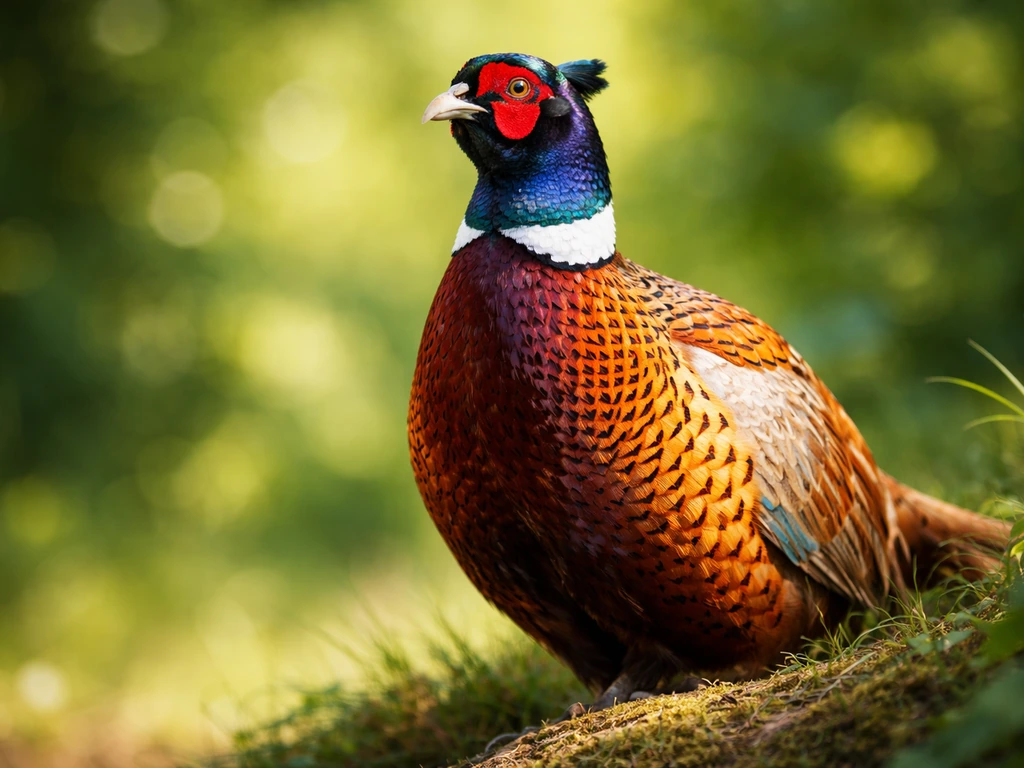
Pheasant Bird Meaning in Hindi: Name, Symbolism, and Usage
Pheasant bird ka Hindi meaning, naam, sahi shabd, aur rang, sunderta, alertness symbolism ka arth.