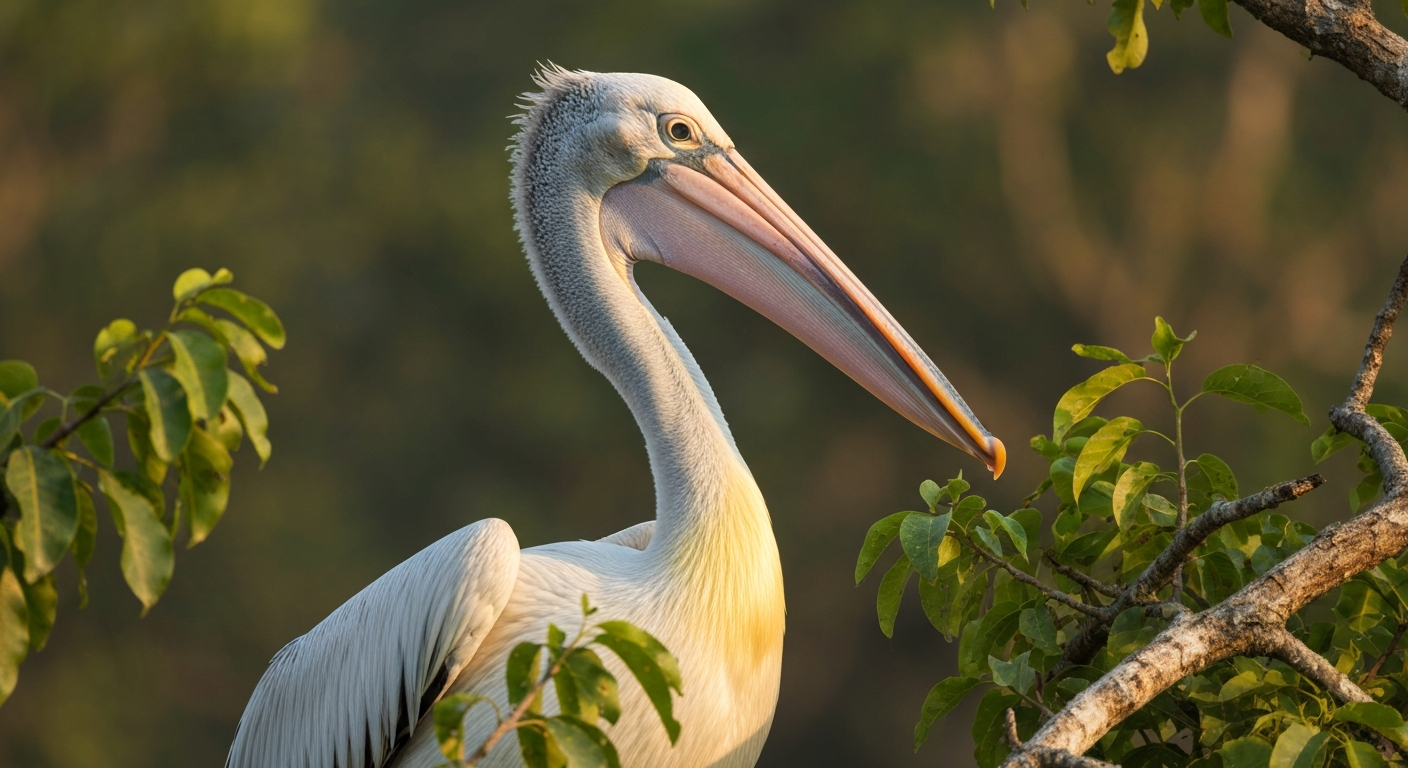
The pelican is called पेलिकन (pelikan) in standard Hindi, a direct phonetic borrowing from English that is now firmly established in school textbooks, wildlife literature, and everyday vocabulary across India. The Spot-billed Pelican (Pelecanus philippensis), known in Hindi as चित्रित-चोंच पेलिकन (chitrit-chonch pelikan), is the only pelican species that breeds and lives as a year-round resident in India, and it carries a quiet but real place in the folk traditions and wetland cultures of southern and eastern India.
Pelican Bird Meaning in Hindi: Name, Significance & Facts

Rajesh Sharma
22 Jul 2026
Pelican meaning in Hindi: one-line summary
Pelican in Hindi is पेलिकन (pelikan), a large water bird with a distinctive throat pouch, associated with wetland habitats, parental devotion, and self-sacrifice in both Indian and cross-cultural symbolic traditions.
Hindi names: Devanagari script, transliterations and how to say them
The most widely recognised Hindi name for the pelican is पेलिकन, a straightforward phonetic adaptation of the English word. You will also see it written as पेलिकन जलपक्षी (pelikan jalапакші), literally 'pelican water-bird', in educational and descriptive contexts. For the resident Indian species specifically, the descriptor चित्रित-चोंच (chitrit-chonch), meaning 'spotted-billed', is appended to distinguish it from its rarer visitors.
| Hindi Name (Devanagari) | Transliteration | Pronunciation Guide | Notes |
|---|---|---|---|
| पेलिकन | pelikan | PEH-li-kun | Standard Hindi; used in textbooks and wildlife guides |
| पेलिकन जलपक्षी | pelikan jalpakshi | PEH-li-kun jal-PAK-shee | Descriptive form; 'jal' = water, 'pakshi' = bird |
| चित्रित-चोंच पेलिकन | chitrit-chonch pelikan | chit-REET chonch PEH-li-kun | Species-specific; Spot-billed Pelican |
| हवासील | havasil | ha-VAA-sil | Older Urdu-influenced term found in some regional Hindi usage |
The term हवासील (havasil) deserves a note. It derives from Arabic and entered Hindi through Urdu, and while it is not dominant in modern standard Hindi, you will encounter it in older ornithological and poetic writing. Contemporary wildlife communication in India defaults to पेलिकन almost universally, mirroring the pattern seen with other large water birds like the flamingo (फ्लेमिंगो).
What pelicans are called in Sanskrit, Marathi, Punjabi and Gujarati
Indian languages handle the pelican in different ways: some retain a classical Sanskrit root, some borrow the English term directly, and some coin descriptive compound words based on the bird's most visible feature, its enormous throat pouch. Here is a clear breakdown across the four major regional languages covered on this site.
| Language | Script | Transliteration | Pronunciation | Literal Meaning or Note |
|---|---|---|---|---|
| Sanskrit | पेलिकानः / कदम्बपक्षी | pelikaanah / kadambapakshi | peh-li-KAA-nah / ka-DUM-ba-pak-shee | Pelikaanah is a Sanskritised borrowing; kadambapakshi ('water-grove bird') appears in some classical descriptions of large water birds |
| Marathi | पेलिकन | pelikan | PEH-li-kun | Direct borrowing; used in Maharashtra's school curriculum and wildlife literature |
| Punjabi | ਪੈਲੀਕਨ | pailikan | PAY-li-kun | Phonetic Gurmukhi rendering; used in Punjabi educational material |
| Gujarati | પેલિકન | pelikan | PEH-li-kun | Phonetic Gujarati rendering; Gujarat coast hosts occasional pelican records |
Sanskrit classical texts do not contain a single universally agreed dedicated term for the pelican in the way they do for, say, the crane (krauncha) or the heron (baka). The bird's range in the Indian subcontinent and its relatively low profile in the northern Sanskrit heartland may explain this gap. Some Sanskrit lexicons group large fishing birds under broader categories, which is why you will see compound descriptors rather than a single root word.
Scientific classification and pelican species found in India
Pelicans belong to the order Pelecaniformes and the family Pelecanidae. Three species have been documented on the Indian subcontinent, though only one is a resident breeder. The following details draw on the State of India's Birds portal, the IOC World Bird List, and Manakadan and Pittie's authoritative 2001 standardised checklist (Buceros 6(1):1-37), which remains the standard reference for Indian common names blank" rel="noopener noreferrer">used by institutions including the Wildlife Institute of India, the Zoological Survey of India, and the Bombay Natural History Society.
| Common Name | Scientific Name | Status in India | IUCN Status |
|---|---|---|---|
| Spot-billed Pelican | Pelecanus philippensis | Resident breeder; year-round; concentrated in southern and eastern India | Near Threatened (BirdLife/IUCN; verify at publication on live IUCN Red List) |
| Dalmatian Pelican | Pelecanus crispus | Non-breeding visitor; vagrant records in northern and western India | Vulnerable (BirdLife/IUCN; verify at publication) |
| Great White (Rosy) Pelican | Pelecanus onocrotalus | Occasional vagrant; recorded in scattered winter visits | Least Concern (BirdLife/IUCN; verify at publication) |
For the purposes of this article, the Spot-billed Pelican (Pelecanus philippensis) receives the most detailed treatment because it is the species most Indian observers will encounter and the one with the deepest ties to Indian wetland culture. The Dalmatian and Great White Pelicans are included for completeness and to help with identification when unusual sightings arise.
How to identify Indian pelicans in the field
Spot-billed Pelican (Pelecanus philippensis)
This is a large, predominantly grey-white bird with a wingspan that can exceed 180 cm. The single most reliable field mark is the upper mandible: it is pale yellowish and covered in small dark blue-grey spots, which gives the species its English name. The throat pouch is pinkish-purple to pale orange. In flight, the wings show dark secondary feathers contrasting with white coverts, giving a two-toned appearance from below. The nape has a sparse, shaggy crest that is most visible in breeding adults. Juveniles are brownish with a more uniform bill. (Identification details after Grimmett, Inskipp and Inskipp, 'Birds of the Indian Subcontinent', and the eBird Spot-billed Pelican species account.)
Dalmatian Pelican (Pelecanus crispus)
Larger and whiter overall than the Spot-billed, with a distinctive curly, silvery-grey nape and a bright orange-red pouch during the breeding season. The bill lacks spots. In India it is most likely to appear at large northern wetlands in winter.
Great White (Rosy) Pelican (Pelecanus onocrotalus)
Rosy-white plumage with a strong pinkish flush in breeding adults, a yellow base to the bill, and a large yellow-orange pouch. Flight feathers are sharply black, making the underwing pattern very striking in flight. Vagrants have been recorded at scattered Indian wetlands.
Where pelicans live in India and how they behave
The Spot-billed Pelican is a bird of lowland freshwater and coastal wetlands. It nests colonially in large trees overhanging or adjacent to water, and the largest known breeding colony in India is at Nelapattu Bird Sanctuary in Andhra Pradesh (coordinates approximately 13.84°N, 79.99°E), which is recognised as a Key Biodiversity Area and is documented in KBA factsheets and Ramsar site reports. Other significant breeding and congregation sites include Pulicat Lake (Andhra Pradesh and Tamil Nadu), Kolleru Lake (Andhra Pradesh), Chilika Lake (Odisha), Vembanad-Kol (Kerala), and Keoladeo Ghana National Park (Bharatpur, Rajasthan). Ramsar documentation confirms breeding presence at Chitrangudi and Kanjirankulam sanctuaries in Tamil Nadu.
Breeding in southern India typically peaks between November and March, when colonies of hundreds of pairs nest together in trees, constructing large stick nests. Clutch sizes are typically two to three eggs (documented in peer-reviewed breeding biology studies from Karaivetti Bird Sanctuary and Nelapattu). The species is a colonial forager: groups herd fish cooperatively into shallows before scooping them with their pouches. Pulicat Lake serves as a critical foraging ground for birds that breed at the adjacent Nelapattu colony, a relationship documented in published foraging strategy studies.
Conservation status and the threats pelicans face in India
The Spot-billed Pelican is listed as Near Threatened on the global IUCN Red List (BirdLife International; readers should verify the current status at the live IUCN Red List page at publication, as assessments are periodically updated). The State of India's Birds portal and allied monitoring programmes identify declining trends linked to wetland degradation, disturbance at breeding colonies, and reduced fish availability. See the State of India’s Birds, Spot‑billed Pelican factsheet for details on regional assessments, identified strongholds and breeding colonies in southern and eastern India State of India’s Birds — Spot‑billed Pelican factsheet. The Dalmatian Pelican is globally Vulnerable, making any winter visitor to India an especially significant record.
In India, all three pelican species receive protection under the Wildlife Protection Act, 1972, as Schedule IV species (verify the current schedule placement at publication), which prohibits hunting and trade. Key breeding sites such as Nelapattu are designated Bird Sanctuaries and are included in national KBA and IBA inventories. Documented threats to the Spot-billed Pelican include drainage of wetlands for agriculture, disturbance of nesting trees, pesticide accumulation in fish prey, and collision with overhead power lines near wetlands.
Pelican symbolism in Indian cultural and spiritual traditions
The pelican does not occupy as central a place in Hindu mythology as the crane (sarus), the peacock, or the swan (hamsa), but it carries meaningful symbolic weight in the traditions of communities who share wetland landscapes with it. In general Hindu and folk symbolic frameworks, large water birds are associated with patience, meditative stillness, and the liminal space between water and sky. The pelican, with its habit of sitting motionless for long periods before striking, fits naturally into this symbolic family.
The pelican's most powerful symbolic association, both in Indian folk observation and in broader world traditions, is parental sacrifice. The bird's large throat pouch, which it uses to carry fish back to its young, has long been read as an image of selfless nourishment. In some folk tellings from the coastal Tamil Nadu and Andhra communities who live near pelican colonies, the bird is informally regarded as an auspicious presence near water, a sign that fish are plentiful and the wetland is healthy.
In Buddhist iconography and Jataka tales, birds are frequently used as vehicles for moral lessons. While the pelican does not have a dedicated Jataka story in the canonical Pali texts, large fish-eating birds feature in stories about generosity and the right use of abundance. The pelican's cooperative fishing behaviour, where groups work together to herd fish, resonates with Buddhist values of collective effort and shared sustenance.
Regional folklore and community stories involving the pelican
The communities living around Nelapattu, Pulicat Lake, and Chilika Lake have developed oral traditions around pelican colonies that span generations. Fishing communities at Pulicat regard the arrival of pelicans as a reliable ecological indicator: a large gathering of pelicans overhead signals a good fish run below. This is practical folk knowledge grounded in the bird's real foraging behaviour, and it has been noted in ethnographic accounts of coastal Andhra life.
In Odisha, Chilika Lake's rich birdlife, including wintering and resident pelicans, is woven into local identity and song. Folk compositions from the Chilika fishing communities mention large white birds with pouches among the lakeside omens and seasonal markers that structure the fishing year. These references, while not always naming the pelican by a specific local term, describe it unmistakably. Tamil Nadu's sanctuary villages near Chitrangudi and Kanjirankulam similarly hold nesting pelican trees as community landmarks, and local custom discourages disturbance of the colony during the breeding season, a form of traditional conservation practice.
It is worth noting that in regions where the pelican is less familiar, such as northern and central India, the bird tends to appear in vocabulary lists and school primers rather than in living folk tradition. This mirrors the pattern for other coastal and southern waterbirds. Readers interested in the richer mythological depth that Sanskrit and Hindi traditions reserve for more widely distributed birds may find the symbolism sections of related entries, such as those on the flamingo, the pheasant, and the magpie, useful for comparison.
Using 'pelican' in Hindi: example sentences and language notes
No well-documented Hindi idiom or proverb uses the pelican as its central image in the way that, say, the crow or the cuckoo are used. This is consistent with the bird's geographical distribution in India: idioms tend to form around species that are universally familiar across language communities. What we do have are clear, grammatically natural sentences that will be useful for language learners and translators.
- पेलिकन एक बड़ा जलपक्षी है जो मछली खाता है। (Pelikan ek bada jalpakshi hai jo machhli khata hai.) — The pelican is a large water bird that eats fish.
- पेलिकन की चोंच के नीचे एक थैली होती है। (Pelikan ki chonch ke niche ek thaili hoti hai.) — The pelican has a pouch under its beak.
- नेलापट्टू अभयारण्य में पेलिकन का सबसे बड़ा प्रजनन स्थल है। (Nelapattu Abhayaranya mein pelikan ka sabse bada prajanan sthal hai.) — Nelapattu Sanctuary has the largest pelican breeding site.
- पेलिकन अपने बच्चों के लिए मछली थैली में लाता है। (Pelikan apne bachchon ke liye machhli thaili mein lata hai.) — The pelican brings fish in its pouch for its young.
- यह चित्रित-चोंच पेलिकन है, जो भारत में पाया जाने वाला एकमात्र प्रजाति है। (Yeh chitrit-chonch pelikan hai, jo Bharat mein paya jaane wala ekmatra prajati hai.) — This is the Spot-billed Pelican, the only species found in India as a resident.
For translators working between Hindi and English in wildlife, conservation, or educational contexts: पेलिकन is the safe, universally understood choice in contemporary Hindi. हवासील may appear in older texts or poetry and should be glossed or footnoted when encountered in modern documents. The Devanagari spelling is stable and consistent across major Hindi dictionaries and wildlife publications.
Bilingual glossary: key pelican terms in Hindi and English
| Hindi (Devanagari) | Transliteration | English | Brief Definition |
|---|---|---|---|
| पेलिकन | pelikan | Pelican | Standard Hindi name for any pelican species |
| चित्रित-चोंच पेलिकन | chitrit-chonch pelikan | Spot-billed Pelican | India's resident breeding pelican species (Pelecanus philippensis) |
| हवासील | havasil | Pelican (archaic/Urdu-influenced) | Older Hindi/Urdu term; found in pre-modern ornithological and literary texts |
| जलपक्षी | jalpakshi | Water bird | Generic term for aquatic birds; often paired with पेलिकन in descriptions |
| थैली / गलकोश | thaili / galkosh | Throat pouch / gular pouch | The distinctive expandable pouch under the pelican's lower mandible |
| प्रजनन उपनिवेश | prajanan upanivesh | Breeding colony | A site where multiple pairs nest together; pelicans are colonial breeders |
| चोंच | chonch | Bill / beak | The pelican's long, spotted bill is its primary identification mark |
| पक्षी अभयारण्य | pakshi abhayaranya | Bird Sanctuary | Protected area designation; Nelapattu and Chilika are key pelican sanctuaries |
| संकटग्रस्त | sankatgrast | Threatened / Near Threatened | Conservation status term used in Indian wildlife literature |
| पेलेकेनस फिलिपेन्सिस | Pelekenas Filipensis | Pelecanus philippensis | Scientific name of the Spot-billed Pelican |
Suggested images, captions and alt text for this article
The following image suggestions are based on what is available through Macaulay Library (Cornell Lab of Ornithology) and Wikimedia Commons, both of which host extensive photo galleries for pelican species. Before using any image, check the individual file's licence metadata: many Macaulay Library images require attribution and some are rights-managed, while Wikimedia Commons files may carry Creative Commons licences (CC BY, CC BY-SA) or be in the public domain.
- Opening image: A Spot-billed Pelican (Pelecanus philippensis) at rest at Nelapattu or Pulicat Lake, showing the spotted bill clearly. Placement: immediately after the introductory paragraph. Suggested caption: 'A Spot-billed Pelican (Pelecanus philippensis) at Nelapattu Bird Sanctuary, Andhra Pradesh — India's largest resident pelican colony.' Alt text: 'Spot-billed Pelican resting on a tree branch at Nelapattu Bird Sanctuary, showing distinctive spotted upper mandible.'
- Colony image: An aerial or wide-angle photograph of a pelican colony in nesting trees, ideally from Nelapattu or Chilika. Placement: after the habitat and behaviour section. Suggested caption: 'A Spot-billed Pelican breeding colony at Nelapattu Bird Sanctuary, Andhra Pradesh, one of India's most important wetland conservation sites.' Alt text: 'Large colony of Spot-billed Pelicans nesting in trees at Nelapattu Bird Sanctuary, Andhra Pradesh, India.'
- Pouch close-up: A close-up image showing the gular pouch of a pelican in flight or while fishing. Placement: beside or below the identification section. Suggested caption: 'The gular pouch (थैली / galkosh) of the Spot-billed Pelican — the bird's most distinctive feature, used for scooping fish.' Alt text: 'Close-up of Spot-billed Pelican showing large expandable throat pouch during feeding at an Indian wetland.'
- Comparison image: A side-by-side or sequential photograph showing the Spot-billed versus Dalmatian Pelican, if available. Placement: adjacent to the identification table. Suggested caption: 'Comparison of the Spot-billed Pelican (left) and Dalmatian Pelican (right), showing differences in bill markings and nape plumage.' Alt text: 'Spot-billed Pelican and Dalmatian Pelican side by side, illustrating key field identification differences.'
Related bird entries and suggested follow-up reading
If you are exploring large water birds and their meanings in Hindi and Indian traditions, the flamingo entry on this site covers a species that shares wetland habitats with the pelican and carries its own rich symbolic history in Gujarati and Rajasthani traditions. See the bird of paradise meaning in Hindi entry for an exploration of how exotic, showy species' names and symbolism are treated in Hindi. The pheasant and partridge entries explore how Indian game birds are named and classified across regional languages, which is a useful structural comparison for understanding how Hindi handles unfamiliar or regionally specific species names. See the pheasant entry for pheasant bird meaning in Hindi (pheasant bird meaning in hindi) for detailed Hindi names and translations, internal ref 867e745a-d263-43d8-a2f5-66c03ef979aa. See the plover article for plover bird meaning in Hindi and its regional names and usage. For specific guidance on partridge names and meanings, see the partridge bird meaning in Hindi entry. For legendary and symbolic birds, the phoenix entry illustrates how mythological birds enter Indian linguistic traditions through Sanskrit and cross-cultural borrowing, and the bird of paradise entry examines how a bird known mainly through trade and colonial-era naming finds its footing in Hindi vocabulary.
The goldfinch, magpie, and plover entries are valuable for readers interested in smaller passerine and wading birds, and together with this pelican entry they form a useful cross-section of how Indian languages name birds across size, habitat, and cultural familiarity. If you are a translator or student, moving between these entries will give you a clear sense of the patterns by which Hindi either borrows English bird names phonetically or coins descriptive compounds based on physical features.
How factual claims are verified and marked in this article
Every species name, conservation status, and site-specific claim in this article is traced to a named primary or secondary source, indicated inline in parentheses. IUCN and BirdLife conservation statuses are current as of the research date but may be updated; readers and editors should verify live status at the IUCN Red List (iucnredlist.org) and BirdLife DataZone before publication or republication. Taxonomy follows the IOC World Bird List (current version at publication). Indian common names follow Manakadan and Pittie (2001), 'Standardized common and scientific names of the Birds of the Indian Subcontinent', Buceros 6(1):1-37, as adopted by the Wildlife Institute of India, the Zoological Survey of India, and BNHS. Site coordinates and Key Biodiversity Area designations follow published KBA factsheets. Breeding biology data are drawn from peer-reviewed studies of Spot-billed Pelican colonies at Nelapattu and Karaivetti Bird Sanctuaries. Language and vernacular name claims are cross-referenced against educational vocabulary lists and, where possible, regional language dictionaries. Cultural and folkloric claims are limited to those with documented ethnographic or literary support and are framed cautiously where oral tradition is the primary source.
FAQ
What key sections must the publication-ready article on 'pelican bird meaning in Hindi' include?
Title and meta description (SEO‑friendly); short lede summarising meaning + species in India; Names and transliterations (Hindi Devanagari, Sanskrit, Marathi, Punjabi, Gujarati) with pronunciation; Scientific names and species found in India (with IUCN status); Brief identification and habitat notes for each species; Distribution and major Indian sites (KBAs, Ramsar sites); Conservation status and legal protection; Cultural, symbolic and mythological meanings (region‑specific folklore with citations); Verified example Hindi sentences/idioms; Bilingual glossary/table of terms; Suggested images with captions & alt text; Internal links to sibling bird pages and follow‑ups; Sources and verification notes (clearly marked).
Exactly which species and taxonomic details must be covered and how should they be verified?
Cover at minimum: Spot‑billed Pelican (Pelecanus philippensis) — primary resident breeder in India; Dalmatian Pelican (P. crispus) — vagrant/non‑breeding records; Great White / Eurasian White Pelican (P. onocrotalus) — occasional vagrant/winter visitor records. For each species include: scientific name, common English name(s), concise ID marks (bill pouch, spotting, plumage), breeding/residency status in India, IUCN/BirdLife global status and any regional assessment, and known stronghold sites. Verification steps: consult IOC World Bird List or Manakadan & Pittie (2001) for nomenclature; check BirdLife DataZone and IUCN Red List for up‑to‑date conservation status; confirm Indian occurrence and breeding records from State of India’s Birds, peer‑reviewed papers, Ramsar/IBA/KBA factsheets, and regional checklists (SACON, eBird/Avibase). Cite each fact with the source and date accessed.
What vernacular names and transliteration/pronunciation details are required and how to fact‑check them?
Required: Hindi name(s) in Devanagari (common rendering पेलिकन and optionally पेलिकन जलपक्षी), Sanskrit (if attested), Marathi, Punjabi, Gujarati names and standard transliterations (IAST or simple roman). Provide IPA or simple pronunciation guides (e.g., 'पेलिकन' — /pelikan/). Fact‑check by: consulting Manakadan & Pittie (2001) for standardized Indian common names, regional language dictionaries, university/education glossaries, and authoritative state fauna lists. Note regional variants and flag names that are loanwords vs. indigenous terms. Provide sources for each vernacular entry.
What cultural, symbolic and mythological content is acceptable and what verification is needed?
Include documented uses: references in regional folktales, temple art, local proverbs/idioms, or mentions in classical Sanskrit/vernacular literature where pelicans are explicitly referenced. Avoid speculative symbolism; only report meanings supported by primary or reputable secondary sources (folklore collections, ethnographic studies, classical texts, peer‑reviewed articles, museum catalogues). When a claim is region‑specific (e.g., a local folk tale), cite the region and the source. If no reliable source exists for a claimed myth or proverb, do not include it. Mark unverifiable local lore as 'anecdotal' and indicate the need for further research.
What example Hindi sentences, idioms or proverbs should be included and how must they be verified?
Provide 2–4 short, natural Hindi example sentences using the vernacular name (Devanagari + transliteration + English gloss). If any idiom/proverb using 'पेलिकन' exists and is attested, quote it verbatim with source (folk anthology, dictionary of idioms, regional literature). Verification: search digitised corpora, regional proverb collections, educational vocab lists, and consult native speakers or language departments. If no attested idiom exists, state that no common proverb was found and present only neutral example sentences.
What table(s) are required and what columns should they contain?
At least one bilingual table summarising names and key species facts. Suggested columns: Term/Field; Hindi (Devanagari); Transliteration; English; Source (with link). A species table: Species (common name); Scientific name; ID summary (1–2 lines); Status in India (resident/vagrant); IUCN status (with citation); Key sites (KBAs/Ramsar). Ensure each cell cites the source and date accessed.
Next Article
Goldfinch Bird Meaning in Hindi: Names, Symbolism & ID
गोल्डफिंच का हिन्दी नाम, पहचान, प्राकृतिक जीवन, सांस्कृतिक अर्थ व भारत में देखने के सुझाव