
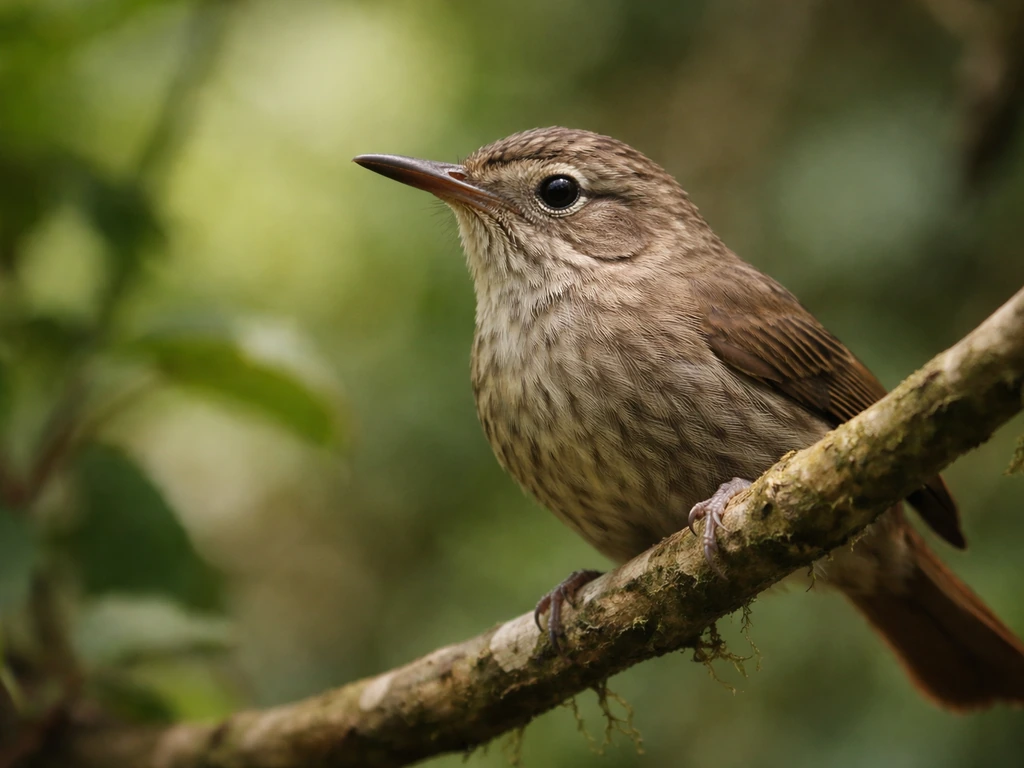
Xenops is a genus of small, insect-eating passerine birds belonging to the ovenbird family Furnariidae. In Hindi, there is no single established common name for Xenops the way there is for, say, a sparrow (गौरैया, gauraiyā) or a crow (कौआ, kauā). The closest practical way to refer to any Xenops species in Hindi is as a descriptive phrase: for example, "झीना-चोंच वनपक्षी" (jhīnā-conc vanapakṣī) for the Slender-billed xenops, meaning roughly "slender-billed forest bird." If you searched this term hoping to find a crisp one-word Hindi name, there genuinely isn't one in standard use, because Xenops birds are native to the Americas, not the Indian subcontinent, and Indian ornithological tradition has simply never needed to name them.
Xenops Bird Meaning in Hindi: Name, Pronunciation, Species

Rajesh Sharma
21 Jun 2026
First: "Xenops" the bird vs. other things called Xenops

Before going further, it is worth being clear about what "Xenops" actually refers to, because the word shows up in a few unrelated contexts. You may have come across Xenops as a software or CTO services company (xenops.dev), or as a registered business name like Xenops Technologies Private Limited. These have absolutely nothing to do with birds. In the natural world, Xenops (confirmed by structured taxonomy databases like Wikidata and Avibase) is specifically a genus of birds, placed in Order Passeriformes and Family Furnariidae. So whenever you see "Xenops" in a birding, Hindi language, or Indian cultural context, you are always talking about this bird genus, not a tech firm or any other entity.
Which Xenops bird do people usually mean?
The genus Xenops contains several species, and most people searching for "xenops bird" are likely referring to one of the five most widely documented ones. Here is a quick overview of the main species so you can narrow down which one applies to your query:
| English Name | Scientific Name | Primary Range |
|---|---|---|
| Slender-billed Xenops | Xenops tenuirostris | Bolivia, Brazil, Colombia, Ecuador, Peru, Venezuela |
| Northern Plain Xenops | Xenops mexicanus | Mexico and Central America |
| Amazonian Plain Xenops | Xenops genibarbis | Amazon basin, South America |
| Atlantic Plain Xenops | Xenops minutus | Atlantic Forest, eastern South America |
| Streaked Xenops | Xenops rutilans | Costa Rica and Trinidad south to Bolivia and northern Argentina |
If you encountered this bird in a field guide, a nature documentary, or a taxonomy exercise, the Streaked Xenops (Xenops rutilans) and the plain xenops group tend to be the most commonly illustrated. For the purposes of Hindi naming and cultural discussion, the genus as a whole is treated together, since no individual species has a standalone Hindi name.
Hindi meaning, translation, and how to say it

The word "Xenops" itself comes from Greek roots, not Sanskrit or any Indo-Aryan language, so it carries no intrinsic Hindi meaning. The generic Hindi word for bird is पक्षी (pakṣī, pronounced roughly "puk-SHEE"), and for a forest or woodland bird you would say वनपक्षी (vanapakṣī, "vun-puk-SHEE"). In Hindi bird nomenclature, a descriptive name is typically built around a key physical feature plus the category noun. For Xenops, the most physically distinctive trait is the thin, upturned bill, so a working descriptive translation might be:
- झीना-चोंच पक्षी (jhīnā-conc pakṣī) — "thin-billed bird"
- पतली-चोंच वनपक्षी (patlī-conc vanapakṣī) — "slender-billed forest bird"
- धारीदार वनपक्षी (dhārīdār vanapakṣī) — "streaked forest bird" (more appropriate for Xenops rutilans)
None of these are official names published by the Bombay Natural History Society or the Zoological Survey of India, simply because Xenops does not occur in India and no Indian body has had reason to formally name it. These are practical descriptive translations that a Hindi speaker or a language learner could use naturally in conversation or writing. In everyday Hindi usage, you might simply say "Xenops पक्षी" (Xenops pakṣī) and that would be perfectly understood in a birding or academic context, much the same way Hindi speakers use scientific genera names for many non-Indian species.
How bird names are built in Hindi and Sanskrit
Understanding the logic behind Hindi bird names helps you work out a reasonable Hindi equivalent for any bird, including Xenops. Indian bird names follow a few consistent patterns, rooted in Sanskrit-derived vocabulary: If you are wondering what a bird is called in Sanskrit, that same general logic of Sanskrit-derived naming patterns is what this article uses when building a descriptive Hindi equivalent Sanskrit bird-name structure.
- Feature-based naming: A bird's most prominent feature becomes its name. The crane is बगुला (bagulā) partly for its gait; the woodpecker is कठफोड़वा (kaṭhaphoṛvā), meaning literally "one who breaks/pecks wood." For Xenops, its thin upturned bill would naturally anchor any Hindi descriptor.
- Habitat reference: वन (van, "forest") is commonly prefixed for woodland birds. This is why a Xenops equivalent would logically carry वन or वनपक्षी.
- Color or pattern markers: धारीदार (dhārīdār, "streaked") and चितकबरा (citkabarā, "spotted/mottled") are standard adjectives used for patterned birds across Hindi, Marathi, and Gujarati alike.
- Sanskrit roots for formal usage: In more scholarly or Sanskrit-influenced registers, पक्षिन् (pakṣin) or विहग (vihag) are used for "bird," and compound descriptors follow Sanskrit sandhi rules. For example, "slender-billed" could be rendered as तनुचञ्चु (tanu-cañcu) in Sanskrit, combining तनु (tanu, "slender") and चञ्चु (cañcu, "beak").
This kind of naming logic is directly comparable to how bird names work for other less-familiar species covered on this site. The chatak bird, for instance, carries deeply embedded Hindi and Sanskrit associations because it is native to the subcontinent. Xenops, coming from the Americas, simply lacks that biographical depth in Indian linguistic tradition.
Cultural and symbolic meaning in Indian traditions
There is no established symbolic or spiritual meaning for the Xenops bird in Hindu, Buddhist, Jain, or Indian folk traditions. That is not a gap in this article; it is just the honest reality. Xenops birds have never lived in the Indian subcontinent, so they have never entered the mythology, folk poetry, or religious iconography that shapes Indian bird symbolism. Some people also search online about whether the so-called "opium bird" is real in Hindi, but there is no reliable ornithological basis for it is opium bird real in hindi. It would be misleading to invent or approximate a meaning here.
What you can do, if you are approaching this from a symbolic or spiritual angle, is draw on the general archetype that Xenops fits into: it is a small, secretive, insectivorous woodland bird with streaked plumage and a habit of creeping along bark and branches. In Indian tradition, small forest birds that move quietly through trees are often associated with themes of diligence, patience, and concealment. The broader category of "vana-pakṣī" (forest bird) carries connotations of renunciation, natural living, and closeness to the divine in texts like the Ramayana, where the forest itself is sacred ground. Some Indian spiritual traditions also associate birds that probe bark and hidden spaces with the quality of inner inquiry, seeking what is not immediately visible.
If you are researching Indian bird symbolism more broadly, birds like the kite (चील, cīl) carry distinct mythological weight in Vedic and Puranic texts, and the chatak (चातक) is deeply embedded in Hindi poetry as a symbol of longing and devotion. These are worth exploring alongside your Xenops research, because they show how Indian tradition assigns spiritual meaning specifically to birds it knows intimately.
How to confirm exactly which Xenops bird you mean

If you encountered a Xenops in a field guide, heard the name in a documentary, or are trying to identify a bird you saw (perhaps while traveling in the Americas), here is a practical step-by-step approach to pin down the exact species and find the right Hindi descriptor for it:
- Start with the family check: All true Xenops birds belong to Family Furnariidae (ovenbirds) and Order Passeriformes. If the bird you are researching is placed in a different family, it is not a Xenops, even if the common name sounds similar.
- Use Avibase for genus-level confirmation: Avibase's Xenops genus page lists every species in the genus with taxonomy, range maps, and subspecies. Cross-reference the species name you have against this list.
- Match the range to the species: Since each Xenops species has a distinct geographic range (see the table above), your location at the time of sighting is a strong identifier. A bird seen in Mexico is almost certainly Xenops mexicanus; one seen in the Amazon basin is likely Xenops genibarbis or Xenops minutus.
- Use the bill shape as a visual key: Xenops birds have a distinctively upturned, chisel-like bill. If the bill curves upward at the tip and the bird is creeping along branches or bark, that is a strong visual confirmation you are looking at a Xenops.
- For Hindi queries, frame your search correctly: In Hindi-language search engines or birding forums, try searching for the English species name followed by पक्षी (pakṣī), e.g., "Streaked Xenops पक्षी" or "Xenops tenuirostris हिंदी नाम." This surfaces any regional Hindi names that may exist in local naturalist communities, even if they are not formally published.
- Cross-check with the Zoological Survey of India or regional field guides: For any bird you want to name correctly in Hindi, the ZSI and BNHS publications are the most authoritative Indian sources. Since Xenops is not found in India, these will not have an entry, but they are the right benchmark to confirm the absence of an official Hindi name.
Using the term correctly in everyday Hindi
If you need to talk about Xenops in Hindi, whether in a classroom, a nature writing piece, or a translation exercise, the most natural and accurate approach is to retain the genus name as a proper noun and add the Hindi bird category noun after it. So you would say: "Xenops एक वनपक्षी है जो दक्षिण अमेरिका में पाया जाता है" (Xenops ek vanapakṣī hai jo dakṣiṇ Amerīkā meṃ pāyā jātā hai), meaning "Xenops is a forest bird found in South America. For example, blank" rel="noopener noreferrer">Streaked xenops occurs from Costa Rica and Trinidad south to Bolivia and northern Argentina. " This is exactly how Hindi scientific writing handles foreign genera, and it keeps your usage precise without forcing an artificial native name onto a bird that simply does not have one in the Indian tradition.
The broader takeaway here is that not every bird carries a Sanskrit soul or a folk legend attached to it, and that is perfectly fine. Part of what makes Indian bird terminology rich is that the names which do carry deep meaning, like the chatak, the kite, or the birds described in Sanskrit texts, carry that meaning because generations of poets, priests, and farmers actually lived alongside those birds. Xenops, a quiet bark-creeper of the Amazonian forests, belongs to a different story entirely, but now you have the tools to name it, describe it, and place it correctly in any Hindi language or cultural context you need.
FAQ
xenops bird meaning in hindi, is there a one-word name I can use?
No, there is not a widely accepted single-word Hindi common name for the Xenops genus. The practical options are either “Xenops पक्षी” (Xenops pakṣī) or a descriptive phrase built from the key trait (like bill shape) plus the category noun (वनपक्षी/वन-बर्ड style usage).
What is the most natural Hindi way to write “xenops bird” in a sentence?
Use Xenops as a proper noun in Latin script, then add the Hindi noun for bird. For example, “Xenops एक वनपक्षी है” keeps meaning clear and avoids inventing a “native” Hindi name that speakers would not recognize.
Does the word “Xenops” have any Hindi meaning by translation?
“Xenops” itself has no intrinsic Hindi meaning because it is a scientific generic name derived from Greek. So you are not supposed to translate “Xenops” into an Indo-Aryan word, instead you describe it using Hindi bird-category vocabulary like पक्षी or वनपक्षी.
How should I handle Hindi naming if I am not sure which Xenops species it is?
If you want a species-level descriptor, first identify which Xenops you saw using location and physical clues, then attach a Hindi adjective for the distinguishing trait. Without confirming the species, any detailed Hindi descriptor you choose (for example bill width or streak pattern) can be misleading.
Is “Xenops पक्षी” enough for general readers, or should I add a descriptor?
In everyday conversation, “Xenops पक्षी” is likely to be understood in a birding or academic setting. If you are writing for a general audience, add a short descriptive qualifier like “झीना-चोंच” (for slender-billed type) to reduce confusion.
Are there any Hindu or Buddhist meanings for xenops birds in Hindi?
No reliable spiritual or symbolic meaning is established in major Indian traditions for Xenops specifically, because Xenops does not historically occur in the Indian subcontinent. If you want a “symbolic” reading, treat it as an interpretive archetype (small, secretive woodland insect-eater), not as documented tradition.
Is the so-called “opium bird” actually xenops, or related to it?
If someone asks about “opium bird” in Hindi, don’t map it to Xenops. The article notes there is no reliable ornithological basis for that claim, so the correct step is to verify the species name from credible bird identification context rather than forcing a connection.
How do I know whether “Xenops” in Hindi context is about the bird or a company?
Be careful not to confuse Xenops bird discussions with companies or services using the same name. If you see xenops.dev or “Xenops Technologies,” that refers to non-bird entities, so your Hindi translation approach should depend on whether the context is ornithology or business.
Any tips for writing Xenops in Hindi script with correct grammar?
When you use Latin-script scientific names in Hindi text, keep the genus spelling consistent and then add the Hindi grammatical particles around it. For example: “Xenops एक…” rather than mixing different spellings, which can confuse readers during identification exercises.
What is the best way to avoid misidentifying Xenops when I am in India or another region?
If your goal is identification while traveling, rely on field marks plus geography first, then choose the Hindi descriptor. Xenops occurs in the Americas, so if you are in India, the bird you’re seeing is almost certainly not Xenops, even if someone online suggested it.
Next Article
What Is Bird Called in Sanskrit? Meaning and Pronunciation
Sanskrit word for bird, spelling and pronunciation, plus related Hindi and tips to avoid confusing bird types