
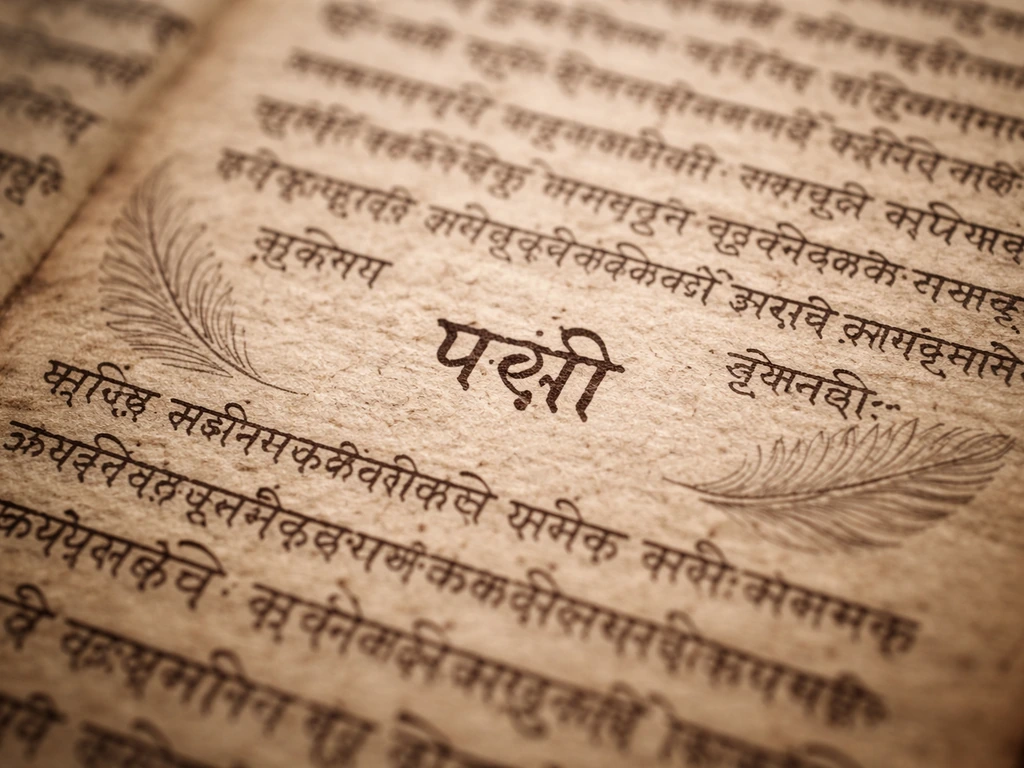
The Sanskrit word for 'bird' is पक्षी (pakṣī). Pronounced roughly as 'puk-SHEE' (with a retroflex 'sh' sound, not the soft English 'sh'), it is the standard generic term for bird across classical Sanskrit texts. If you have seen पक्षी in Hindi, it is literally the same word, inherited directly from Sanskrit with no change in spelling or core meaning. So the xenops bird meaning in Hindi is not a different Sanskrit “bird” term like pakṣī, but a specific bird name you can translate in context the same word.
What Is Bird Called in Sanskrit? Meaning and Pronunciation

Rajesh Sharma
9 Jun 2026
The direct Sanskrit word for 'bird'
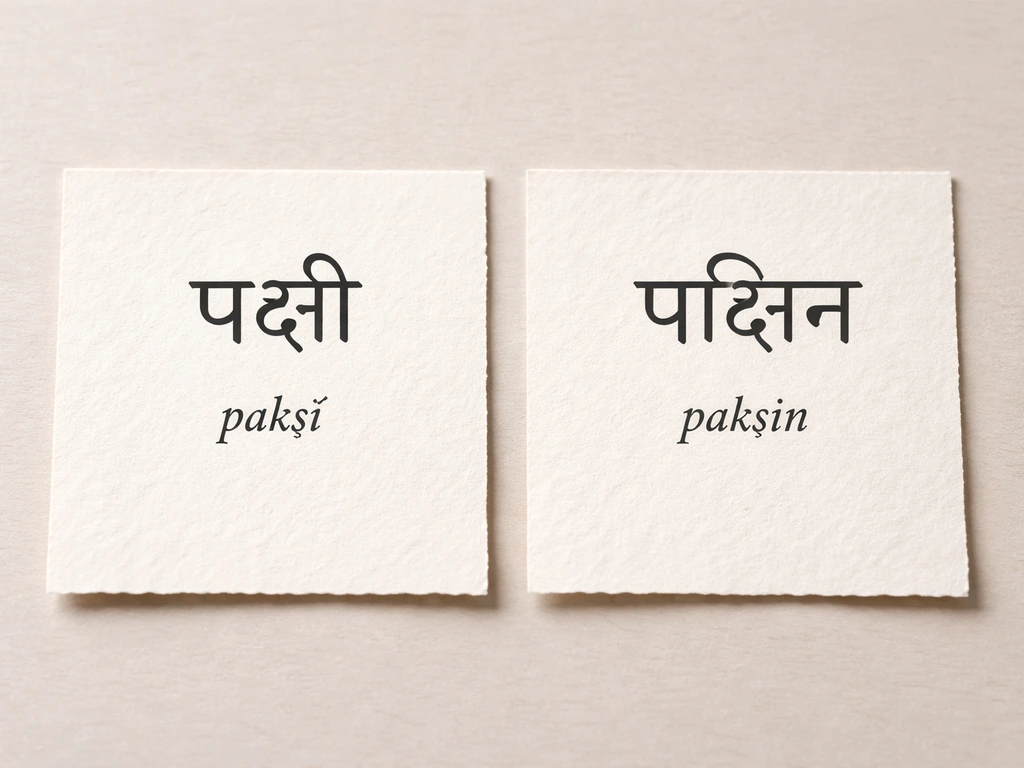
Sanskrit gives you two closely related forms to know: पक्षी (pakṣī) and पक्षिन् (pakṣin). Both come from the root पक्ष (pakṣa), which means 'wing.' So at its most literal, a pakṣī is simply 'a winged one.' The Monier-Williams Sanskrit dictionary, the standard academic reference, defines pakṣin as 'a winged creature, more particularly a bird.' The feminine form is पक्षिणी (pakṣiṇī), meaning a female bird. For everyday use and most language learning purposes, पक्षी (pakṣī) is the headword you want.
Technically, the term is broad enough to cover any winged animal, not just birds in the modern ornithological sense. Classical Sanskrit texts occasionally use it for winged insects or mythical flying beings too. But in practice, whenever you encounter पक्षी in a sentence without additional context, it almost always means bird.
How to spell and pronounce it correctly
The trickiest part of pakṣī for most learners is the consonant ṣ, written ष in Devanāgarī. This is not the soft 'sh' sound you hear in English words like 'ship.' It is a retroflex consonant, meaning you curl your tongue back toward the roof of your mouth to produce it. Think of a heavier, deeper 'sh' that comes from further back in the mouth. The IPA transcription is /pək.ʂiː/ (or /pɐk.ʃiː/ in some Hindi realizations), and the final ī is a long vowel, held slightly longer than a short 'i.'
| Script | Transliteration (IAST) | Approximate Pronunciation | Notes |
|---|---|---|---|
| पक्षी | pakṣī | puk-SHEE (retroflex sh) | Standard Sanskrit and Hindi form |
| पक्षिन् | pakṣin | puk-SHIN | Nominative/dictionary base form |
| पक्षिणी | pakṣiṇī | puk-shi-NEE | Feminine form (female bird) |
A very common mistake is substituting the palatal ś (श) for the retroflex ṣ (ष), which gives you 'pakśī' instead of 'pakṣī.' The two sounds are distinct in Sanskrit and Hindi. Sanskrit has three sibilants: s (स), ś (श, palatal), and ṣ (ष, retroflex). The ṣ in pakṣī is always the retroflex one. Getting this right makes a noticeable difference if you are chanting, reciting, or speaking with a Sanskrit teacher.
General 'bird' vs. specific bird names

Pakṣī is your umbrella word. Once you move beyond 'bird' in general, Sanskrit gets very specific, and those specific names carry their own cultural weight. The peacock, for instance, is मयूर (mayūra), one of the most sacred birds in Hindu tradition and associated with Lord Kartikeya. The swan is हंस (haṃsa), a word so philosophically loaded that the title Paramahaṃsa ('supreme swan') became an honorific for enlightened teachers. The crow is काकः (kākaḥ), the parrot is शुक (śuka), and the divine eagle-like mount of Vishnu is the legendary गरुड (Garuḍa), a proper noun that started as a bird category and became a deity.
So if someone asks you what the Sanskrit word for bird is, pakṣī is the right answer. But if you are reading a Sanskrit text or mythology and encounter a bird reference, it is worth checking whether the author meant pakṣī generically or was using a specific bird name with its own symbolic meaning. If you are asking whether something like “opium bird” is real in Hindi, the key is to identify the exact bird term being used and its Sanskrit roots pakṣī generically. The Mundaka Upanishad's famous 'two birds on a tree' metaphor (verses 3.1.1-3.1.2) is a perfect example where the word for bird is used as a spiritual allegory for the individual soul and the universal self, not a zoological observation. Advaitam and Science identifies blank" rel="noopener noreferrer">the “two birds” metaphor as occurring in Mundaka Upanishad (citing verses 3.1.1 to 3.1.2), illustrating how “bird” terms in Sanskrit function metaphorically in religious philosophy.
How 'bird' is said across Hindi and other Indian languages
Because so many Indian languages descend from or were shaped by Sanskrit, the word for bird looks and sounds recognizably similar across the region. Hindi पक्षी is a direct inheritance. Marathi uses the same form, पक्षी (pakṣī), sometimes written as paksi in romanized Marathi. Punjabi has adapted it to ਪੰਛੀ (paṉchī), which is a borrowing from Sanskrit पक्षिन् (pakṣin) with local phonological changes. Wiktionary’s entry notes that paksi/paksi traces back to Sanskrit पक्षिन् (pakṣín), supporting the transliteration path learners often use for these Hindi and Punjabi spellings blank" rel="noopener noreferrer">Sanskrit पक्षिन् (pakṣin) with local phonological changes. Gujarati uses પંખી (pankhī), again rooted in the same Sanskrit base. If you already know the word in Hindi, you are essentially already working with the Sanskrit form.
| Language | Word | Script | Pronunciation (approx.) |
|---|---|---|---|
| Sanskrit | pakṣī / pakṣin | पक्षी / पक्षिन् | puk-SHEE / puk-SHIN |
| Hindi | pakṣī | पक्षी | puk-SHEE |
| Marathi | pakṣī / paksi | पक्षी | puk-SHEE |
| Punjabi | paṉchī | ਪੰਛੀ | pun-CHEE |
| Gujarati | pankhī | પંખી | pun-KHEE |
The Punjabi and Gujarati forms show how the retroflex cluster kṣ softens or shifts in different phonological environments, but the root meaning stays the same. This kind of cross-language tracing is useful if you are studying more than one Indian language at once, because seeing the same Sanskrit root show up across Hindi, Marathi, and Punjabi reinforces both vocabulary and pronunciation.
Birds in Sanskrit culture and symbolism
In Sanskrit literary and religious tradition, birds are rarely just birds. The generic word pakṣī appears in philosophical texts, poetry, and scripture as a vehicle for deeper meaning. The haṃsa (swan) came to symbolize the liberated soul, the ability to discern truth from illusion (legend says a swan can separate milk from water). Garuda became the vahana of Vishnu, representing divine speed, power, and protection. The peacock mayūra is tied to rain, beauty, and grace, and its feather adorns images of Krishna. Even the crow kāka plays a practical ritual role in śrāddha ceremonies (ancestor rites), where crows are believed to carry offerings to departed ancestors.
This is why learning the word pakṣī opens a door rather than closing one. Once you know the generic term, you start noticing how specific bird names carry whole traditions with them. The chataka bird, for example, is celebrated in Sanskrit and Hindi poetry for drinking only rainwater, making it a metaphor for devotion and purity. In English, the chataka bird is commonly referred to as the chataka bird itself or described as a rain-drinking bird. Knowing that pakṣī is the umbrella term helps you spot when a text or conversation shifts from the general to the symbolic.
Looking up specific bird names in Sanskrit
Once you have pakṣī down, the natural next step is finding Sanskrit names for specific birds. Here are the most reliable approaches:
- Use Kosha.App: This is a modern search interface that maps English meanings to Sanskrit headwords and inflected forms. Search 'bird,' 'crow,' 'parrot,' or any specific bird in English and it pulls up the Sanskrit headwords with Devanāgarī spelling and transliteration.
- Check Wisdomlib: It draws directly from the Cologne Digital Sanskrit Dictionaries (including Monier-Williams) and gives structured, citable definitions. Good for confirming both meaning and grammatical form.
- Use Sanskritdictionary.org or Sanskritdictionary.com: Both support IAST and Devanāgarī input and show definition-level detail, including usage examples from classical texts.
- For cross-language confirmation, use Wiktionary: Many bird entries trace the etymology back to Sanskrit roots, which helps you see how the word travelled from Sanskrit into Hindi, Marathi, or Punjabi.
- For cultural and mythological context, look up specific birds on Wisdomlib under their Sanskrit headwords (e.g., 'mayura' for peacock, 'hamsa' for swan, 'shuka' for parrot) to see how they appear in texts like the Mahabharata, Puranas, or Upanishads.
A quick reference to start with: peacock is मयूर (mayūra), swan is हंस (haṃsa), crow is काकः (kākaḥ), parrot is शुक (śuka), and the divine eagle of Vishnu is गरुड (Garuḍa). Each of these has a rich symbolic history well beyond its ornithological identity, which is exactly why Sanskrit bird vocabulary is worth exploring systematically rather than just translating word by word.
FAQ
When should I use पक्षी (pakṣī) versus पक्षिन् (pakṣin)?
Use पक्षी (pakṣī) for “bird” in general, and use पक्षिन् (pakṣin) when a text emphasizes the idea of “winged creature” or a specific description of a winged being. In most beginner reading, पक्षी is the safer default unless the sentence context clearly points to a particular type or descriptive usage.
How can I confirm I have the correct retroflex ṣ (ष) when reading the word?
In Devanāgarī, ष always represents the retroflex ṣ sound. If you want to self-check, look at the letter after प (pa), it should be ष (not श). Romanization can vary, but the presence of ष in the script is the most reliable way to avoid the common pakśī versus pakṣī mix-up.
Can पक्षी (pakṣī) mean something other than a literal bird in Sanskrit writing?
Yes, Sanskrit texts can use pakṣī metaphorically, even when discussing “two birds” or moral lessons. The key is to read whether the surrounding lines treat the bird as an allegory (soul, discernment, liberation) rather than a literal animal in a natural setting.
If I know the Hindi word पक्षी, do I already know Sanskrit properly?
If you only know the word in Hindi, the good news is the spelling usually stays the same when written in Devanāgarī (Hindi पक्षी, Sanskrit पक्षी). The extra step is pronunciation, because Sanskrit requires the retroflex ṣ (ष) rather than the palatal ś (श).
What is the best way to transliterate पक्षी (pakṣī) for accurate pronunciation?
For transliteration, don’t rely on English “sh” spelling. A practical choice is to include an explicit marker for the retroflex sound, for example pakṣī (with ṣ) instead of pakshi. This helps your pronunciation stay consistent even if the exact IPA realization differs slightly by region.
In Sanskrit, should I always translate a bird name as just “bird”?
When you see a specific bird name, treat it as its own vocabulary item, not as “bird” plus some extra meaning. For example, मयूर (mayūra) is peacock as a known term with cultural symbolism, so translating it as “bird” loses the intended reference.
Are bird words like गरुड (Garuḍa) always used as generic nouns, or can they be proper names?
Not necessarily. Some bird words in Sanskrit are regular common nouns, but names like गरुड (Garuḍa) function as proper nouns and mythological figures. If the word appears with titles, genealogies, or as an object of devotion, assume it is being used as a named entity.
How do I know whether a “bird” reference is literal or symbolic in a passage?
A quick reading test is to check whether the sentence uses pakṣī as a subject in a descriptive line about wings, flight, or general bird behavior, versus using it in a moral or philosophical comparison. If it’s general description, the literal meaning fits best, if it’s comparison or lesson, expect allegory.
Next Article
What Is Kite Bird Called in Hindi Meaning and Types
Kite bird meaning in Hindi with common names, types, disambiguation tips, and brief kite-bird symbolism context.