
The chatak bird (चातक, cātaka) is called the Pied Cuckoo or Jacobin Cuckoo in English. Its scientific name is Clamator jacobinus (Boddaert, 1783). This is the identification you will find in Salim Ali's classic 'The Book of Indian Birds' and in modern databases like BirdLife International and GBIF. Salim Ali's The Book of Indian Birds lists vernacular names 'Papiya' and 'Chatak' for the Pied Crested Cuckoo (Clamator jacobinus) The Book of Indian Birds — Salim Ali (entry: Pied Crested / Clamator jacobinus). The bird is also sometimes called the Pied Crested Cuckoo because of the bold black-and-white crest it carries. So if someone asks you 'chatak bird meaning in English,' the direct answer is: Pied Cuckoo or Jacobin Cuckoo, Clamator jacobinus.
What Is the Chatak Bird Called in English? Identification & Meaning

Proposed title and meta description
Title option 1: What Is Chatak Bird Called in English? Pied Cuckoo, Jacobin Cuckoo and Its Meaning
Title option 2: Chatak Bird in English: Name, Meaning, and Cultural Significance (Hindi चातक)
Meta description (158 characters): Chatak (चातक) in English is the Pied Cuckoo or Jacobin Cuckoo (Clamator jacobinus). Learn its names across Hindi, Sanskrit, Marathi, Punjabi, and Gujarati.
Identification: English names and scientific name
The bird known in Hindi and Sanskrit as चातक (chātaka) maps most reliably onto Clamator jacobinus, a medium-sized brood-parasitic cuckoo in the family Cuculidae. Modern ornithological consensus, backed by multiple Indian field guides and global biodiversity databases, treats this species as the primary referent of the traditional 'chatak' name. You will encounter three English names in the literature: Pied Cuckoo, Jacobin Cuckoo, and Pied Crested Cuckoo. All three refer to the same bird. 'Pied' describes its black-and-white plumage, 'Jacobin' is a historical European term referencing Dominican monks whose hood the bird's crest supposedly resembles, and 'Pied Crested' simply combines both features.
Older Sanskrit lexica, including the Monier-Williams Sanskrit-English Dictionary, recorded the species under the historical synonym Cuculus melanoleucus, which is now a junior synonym folded into Clamator jacobinus. That historical detail is worth knowing if you encounter older texts or glossaries. The IUCN and BirdLife International currently list this species as Least Concern, with a very large range spanning sub-Saharan Africa and South Asia.
One important caveat: a small number of early naturalists disputed this identification. The early 20th-century Bengali naturalist Satya Churn Law argued that the bird traditionally called 'chatak' in Bengali poetic contexts could be the Common Iora (Aegithina tiphia), a small, bright greenish-yellow bird he had observed drinking dew and spray. Additionally, regional checklists from Assam and West Bengal occasionally map 'chatak' or 'চাতক' to small skylarks like Alauda gulgula (Small Skylark) or Mirafra assamica (Assam Bush Lark). These are genuine regional variations in vernacular usage, not errors. The dominant ornithological and literary consensus, however, remains Clamator jacobinus.
How the name sounds across Indian languages
One of the things I find most useful on this site is laying out the exact form a bird's name takes across different Indian languages, because the spelling and pronunciation shift just enough to cause confusion. The chatak is a good example of a bird with a remarkably consistent name across Sanskrit-derived languages, reflecting how deeply the classical cātaka image is embedded in Indian literary culture.
| Language | Name / Script | Pronunciation guide | Literal or common gloss |
|---|---|---|---|
| Sanskrit | चातक (cātaka) | chaa-ta-ka | The rain-drop drinker; bird said to subsist on raindrops |
| Hindi | चातक (chātak) | chaa-tak | Chatak; the Pied Cuckoo; monsoon-herald bird |
| Marathi | चातक (chātak) | chaa-tak | Same usage; the Pied/Jacobin Cuckoo |
| Punjabi | ਚਾਤਕ (chātak) | chaa-tak | Chatak; same classical resonance in Punjabi poetry |
| Gujarati | ચાતક (chātak) | chaa-tak | Chatak; the pied cuckoo; rain-related symbolism retained |
The near-identical form of the name across five languages underlines that this is fundamentally a Sanskritic lexical item that passed directly into the modern Indo-Aryan languages without significant phonological change. The classical dictionaries of Apte and the Amarakosha both record cātaka as a standard Sanskrit bird name, and both link it to rain. If you are exploring related terminology, the broader picture of Sanskrit bird vocabulary is worth looking at separately.
What the bird looks like and sounds like
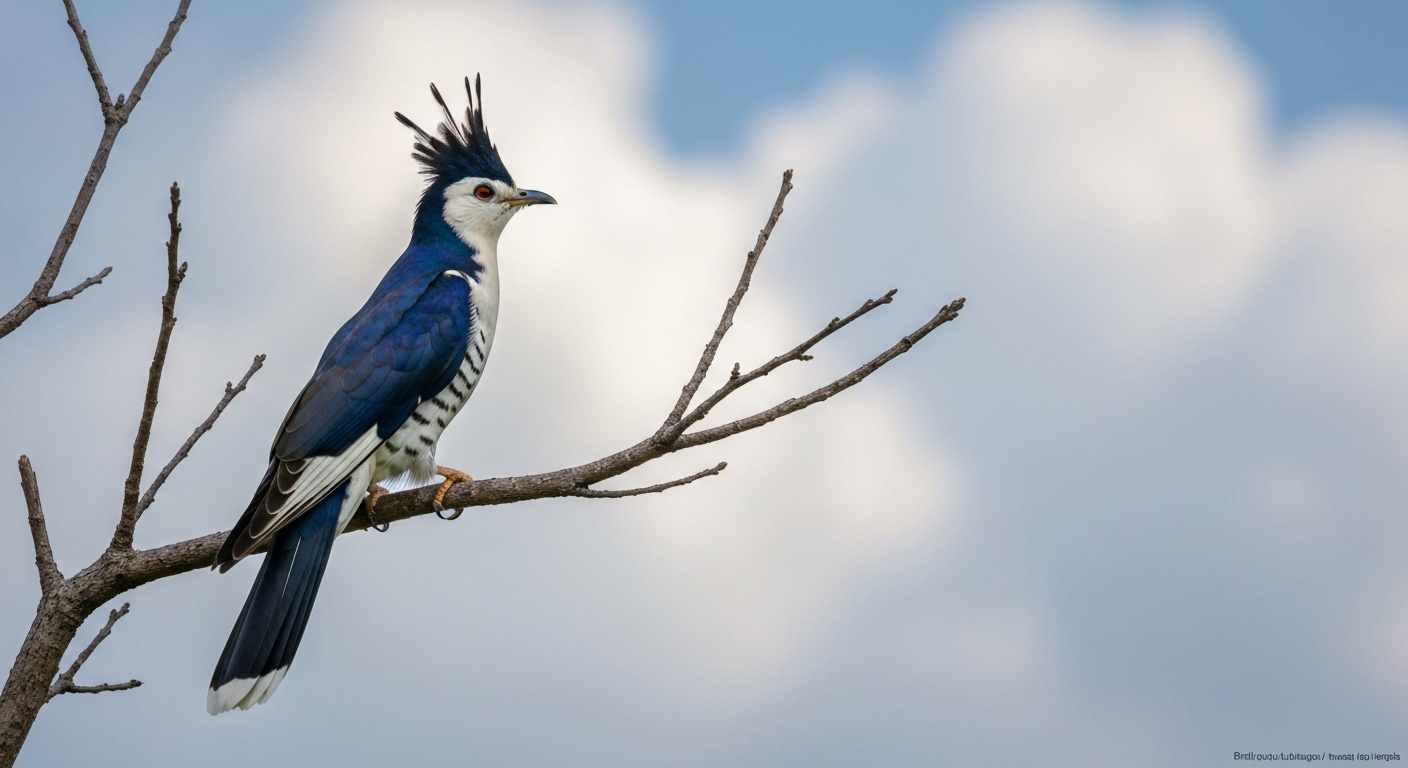
Clamator jacobinus is a striking bird once you know what to look for. Adults measure roughly 33 centimetres (about 13 inches) from bill tip to tail, making it a medium-sized cuckoo, noticeably larger than a Common Cuckoo. The plumage in the nominate race is sharply two-toned: the upperparts, wings, and crest are glossy blue-black, while the underparts are clean white. The tail is long, graduated, and tipped with white spots that flash when the bird moves. The crest itself is the most distinctive feature: a pointed, upstanding black crest that the bird can raise or flatten, giving it a dramatic silhouette.
There is also a dark morph in which the underparts are brownish-black rather than white, found mainly in Africa. Indian birds are almost entirely the white-bellied form. Juveniles are browner and less crisply patterned than adults, which can briefly confuse new birders.
The call is loud, far-carrying, and repetitive: Salim Ali described it as a 'piu-piu-pee-pee-piu' sequence, delivered insistently and often from a prominent perch. It is one of those calls you hear before you see the bird. In fact, for many people across northern India, that loud, persistent call arriving just ahead of the monsoon is the defining sensory signature of the chatak. Verified recordings are available in the Macaulay Library at Cornell Lab of Ornithology for anyone who wants to confirm identification by sound.
Where the chatak lives: range and habitat
Clamator jacobinus has a wide range that stretches across sub-Saharan Africa and the Indian subcontinent, with some populations in Arabia and Sri Lanka. In India, it is a partial migrant: birds breeding in the Indian subcontinent typically arrive just before or at the onset of the southwest monsoon (roughly May to June in northern India) and depart after the breeding season. GBIF occurrence records and eBird data show it distributed across peninsular India, the Indo-Gangetic plains, Rajasthan, and into the Himalayan foothills, with sightings peaking in the monsoon months. GBIF collates occurrence records and maps for Clamator jacobinus that document its distribution across South Asia and sub‑Saharan Africa (GBIF species page: Clamator jacobinus, taxonomy & occurrence) GBIF species page: Clamator jacobinus — taxonomy & occurrence (supports range/distribution).
Habitat preferences include open woodland, scrub forest, thorny bushes, agricultural edges, and gardens. It is not a forest-interior species; it favours semi-open landscapes where its host species (mainly babblers in India, especially Large Grey Babbler and Common Babbler) are also present. Peer-reviewed habitat-suitability modelling using the MaxEnt algorithm has specifically examined how the Jacobin Cuckoo's distribution correlates with moisture and vegetation variables linked to the monsoon, providing a scientific basis for the traditional cultural observation that this bird heralds the rains.
Behaviour, feeding, and breeding
Like many cuckoos, Clamator jacobinus is a brood parasite: it lays its eggs in the nests of other birds and leaves them to raise its chicks. In India, the primary host species are babblers (Turdoides species). What makes this cuckoo unusual among brood parasites is that its chick does not evict the host's eggs or young, so the host ends up raising both its own chicks and the cuckoo chick together. This is relatively rare behaviour in brood parasites and has attracted scientific attention.
Feeding is mainly on caterpillars and large insects, including hairy caterpillars that most birds avoid. It hunts by moving actively through bushes and trees, often dropping to the ground. During the monsoon months, when insect activity peaks, food is abundant and timing the breeding season to coincide with the rains is a practical ecological strategy. This tight correlation between the bird's arrival, calling behaviour, and the onset of rains is almost certainly what embedded the chatak so firmly in Indian cultural consciousness as a rain-associated bird.
The rain mythology: what poets and proverbs say
This is where the chatak moves from ornithology into something richer and more complex, and it is important to be clear: the belief that the chatak drinks only raindrops and refuses all other water is a literary and cultural motif, not an observed biological fact. For a related linguistic-myth question, see Is the 'opium bird' real in Hindi? which examines another culturally loaded bird name and its literal versus literary meanings. No scientific study has documented Clamator jacobinus drinking exclusively from falling rain or cloud moisture. The Pied Cuckoo drinks water normally, as other birds do. But as a poetic image, the idea is extraordinarily powerful and ancient.
The Monier-Williams Sanskrit-English Dictionary defines cātaka explicitly as 'a bird said to subsist on rain-drops' and cross-references it to classical texts including Kalidasa's Meghaduta (The Cloud Messenger), the Raghuvamsha, and the Abhijnanasakuntalam. In the Meghaduta, the cloud is implored to release rain partly as an act of mercy toward the waiting chatak. The bird becomes a symbol of longing, of thirst, of devoted waiting for something that only comes from above.
The poet Bhartrhari, in his Niti-Shataka, addresses the chatak directly in a verse that begins: 'रे रे चातक सावधान मनसा...' (Re re chataka, savadhan manasa..., O Chatak, with careful mind...), counselling the bird not to beg from every cloud, since not every cloud brings rain. The verse uses the chatak as a vehicle to teach discernment: do not petition everyone indiscriminately for what only the worthy can give. This became one of the most widely quoted bird-metaphors in classical Sanskrit poetry.
In Hindi literary tradition and folk proverbs, the chatak is invoked to describe someone who waits in faithful longing, whether for a beloved, for God, or for relief. The phrase 'chataka ki tarah tarasna' (to yearn like a chatak) is used to describe desperate, single-pointed longing. The bird is understood to have no pride, no alternative plan, and no second choice: it waits for rain or it dies of thirst. That image of dignified, unwavering longing is what made the chatak indispensable to classical poets across Sanskrit, Hindi, Urdu, and Punjabi traditions.
It is worth noting that this kind of symbolic layering, where a real bird's behaviour is mythologized into something beyond biology, is a recurring feature of Indian bird tradition. A similar dynamic plays out with other culturally loaded birds, including the kite (cheel) in Hindi tradition, which carries its own symbolic weight quite separate from its biological behaviour. If you’re also wondering what is kite bird called in Hindi, the common kite is called 'cheel' in Hindi.
How to tell the chatak from similar birds in the field
In the field, Clamator jacobinus is actually one of the more straightforward Indian cuckoos to identify once you have the key features fixed in mind. The biggest confusion is usually with the Common Hawk-Cuckoo (Hierococcyx varius, the 'Brain-fever Bird') or, less commonly, with the Asian Koel (Eudynamys scolopaceus). Here is what to focus on.
| Feature | Chatak / Pied Cuckoo (Clamator jacobinus) | Asian Koel (Eudynamys scolopaceus) | Common Hawk-Cuckoo (Hierococcyx varius) |
|---|---|---|---|
| Size | ~33 cm; medium | ~43 cm; larger | ~34 cm; similar |
| Upperparts colour | Glossy blue-black | Male all black; female brown-barred | Grey-brown with rufous barring |
| Underparts colour | Clean white (Indian birds) | Male black; female barred/streaked | Whitish with heavy brown streaks |
| Crest | Prominent pointed black crest | None | None |
| Tail markings | White tips on graduated tail | Plain dark tail | Broad dark and pale bands |
| Call | Loud, repetitive piu-piu-pee-pee | Rising 'ko-EEL' or wailing crescendo | Rising 'brain-fe-ver' crescendo |
| Typical habitat | Open scrub, agricultural edges | Gardens, wooded areas near crows | Forest and dense woodland |
The erected black crest is your best single field mark. No other commonly encountered Indian cuckoo has that combination of bold crest, black-and-white pied plumage, and white tail tips. If you see a crest, white belly, and hear the persistent 'piu-piu' call, you are looking at the chatak. The bird often perches prominently and calls loudly, especially during the monsoon season, so it rewards patient watching near scrub or agricultural land.
A note on regional name variation
As I mentioned under the identification section, the word 'chatak' is not always used uniformly across India. In parts of Assam and West Bengal, government biodiversity documents and environmental impact assessments have recorded 'Chatak' as a local name for the Small Skylark (Alauda gulgula) in regional checklists. This kind of vernacular overlap is normal and worth knowing if you are consulting local EIA reports or regional bird lists rather than national field guides. The classical and widely dominant identification remains Clamator jacobinus, but if you are doing fieldwork in northeastern India and encounter the name in an official document, it is worth checking which species the list actually means. This kind of regional ambiguity is also something to keep in mind when exploring other vernacular bird names on this site.
Image suggestions
- Adult Clamator jacobinus perched on a bare branch showing the erect black crest and clean white underparts: caption 'The chatak (चातक) or Pied Cuckoo (Clamator jacobinus), India's legendary rain herald. Image: Wikimedia Commons, category Clamator jacobinus.'
- Close-up of the black crest raised, showing the white tail-tip pattern: caption 'The pointed black crest is the chatak's most reliable field mark. Photo via Wikimedia Commons.'
- A comparison image or plate showing the chatak alongside the Asian Koel for size and plumage contrast: caption 'Telling the chatak from the Koel: plumage and size differences in two common Indian cuckoos.'
- A manuscript or miniature painting illustrating the chatak in a classical Indian art context (public domain): caption 'The chatak as depicted in classical Indian visual tradition, symbolising longing and devotion.'
Putting it all together
The chatak is the Pied Cuckoo (Clamator jacobinus), a real, identifiable bird with a loud call, a sharp crest, and a genuine biological habit of arriving just before the monsoon. That ecological timing gave the bird its cultural life: ancient poets took the observation that this bird calls as the rains approach and transformed it into a metaphor of thirst, longing, and faithful waiting that persisted across centuries of Sanskrit, Hindi, Punjabi, and Gujarati literature. The name cātaka is among the most consistently preserved Sanskrit bird names across modern Indian languages, appearing in essentially the same form from Sanskrit through to contemporary Hindi, Marathi, Punjabi, and Gujarati. Whether you are a language learner trying to decode a classical verse, a birdwatcher trying to name a black-and-white crested cuckoo, or a cultural enthusiast tracing a proverb back to its source, the answer starts with this one bird: the chatak, Clamator jacobinus, the Pied Cuckoo of the Indian monsoon. For a different species' vernacular translation, see xenops bird meaning in Hindi.
FAQ
Search‑oriented title and meta description
Title: What is the 'Chatak' (चातक) Bird Called in English? — Identification, Name & Meaning. Meta description (≤160 chars): Chatak (चातक) is commonly identified with the Pied/Jacobin Cuckoo (Clamator jacobinus). ID, folklore, names and pronunciation explained.
Quick answer (direct lead)
Quick answer: In most modern Indian ornithological sources, the bird called 'chatak' (चातक) is identified with the Pied or Jacobin Cuckoo — English names: Pied Cuckoo or Jacobin Cuckoo; scientific name: Clamator jacobinus. Note: classical literature uses 'chātaka' as a poetic symbol (rain‑seeking bird) and regional vernaculars sometimes map the name to other species.
Clear, evidence‑backed identification (common English name(s) and scientific name)
Identification: Common English names — Pied Cuckoo; Jacobin Cuckoo. Scientific name — Clamator jacobinus (Boddaert, 1783). Sources: BirdLife Data Zone, GBIF, Salim Ali (The Book of Indian Birds), Macaulay Library recordings and modern field guides equate vernacular 'chatak' with Clamator jacobinus in many regions.
Concise physical description and distinguishing field marks
Physical description: Medium‑sized cuckoo (~34–38 cm including tail). Breeding male: black head, white belly, conspicuous white wing patches on otherwise dark plumage; crest often raised; long graduated tail with white tips. Female and non‑breeding/immature plumages may show barred or rufous morphs. Distinguishing field marks: strong black‑and‑white contrast, white wing panel visible in flight, crest, long tail and slender cuckoo silhouette; distinctive 'piu‑piu…' call helps confirmation (audio available in Macaulay Library).
Range and habitat
Range & habitat: Clamator jacobinus is a partial migrant across much of sub‑Saharan Africa and the Indian subcontinent; in India it is best known as a pre‑monsoon migrant arriving in many regions before rains. Habitats: open woodland, scrub, farmland edges and gardens. IUCN/BirdLife list it as Least Concern with a large range; occurrence records available via GBIF and India Biodiversity Portal.
Typical behavior and the rain‑related folklore
Behavior vs folklore: Observed behavior — cuckoo is brood‑parasitic (lays eggs in other species’ nests), often seen in pairs or small groups during migration, vocal before and during breeding season; arrival timing often correlates with pre‑monsoon moisture. Folklore/literary motif — classical Sanskrit and later poets depict the 'chātaka' as a bird that waits for and 'drinks only raindrops' from clouds, symbolizing longing for the rain; this is a poetic motif rather than a strictly observed feeding habit. Some ecological studies show arrival timing correlates with moisture variables, offering a biological basis for the rain association, but the literal idea of a bird subsisting only on raindrops is literary.