The most widely used Hindi word for albatross is अल्बाट्रॉस (pronounced al-baa-tross), which is a direct phonetic borrowing from English. In the literal, ornithological sense, Hindi dictionaries also describe it as एक बड़ा समुद्री पक्षी, meaning 'a large seabird.' When people use 'albatross' figuratively, as a burden or a curse you cannot shake off, the closest Hindi rendering is बोझ (bojh), which means a heavy load or burden. HinKhoj's Hindi lexical listing gives “Albatros/albatross” the Hindi meaning बोझ (bojh). So if you came here for a quick answer: अल्बाट्रॉस is the bird, and बोझ is the symbolic weight it represents.
Albatross Bird Meaning in Hindi: Name, Symbol, Usage

Rajesh Sharma
1 May 2026

The Hindi word for albatross
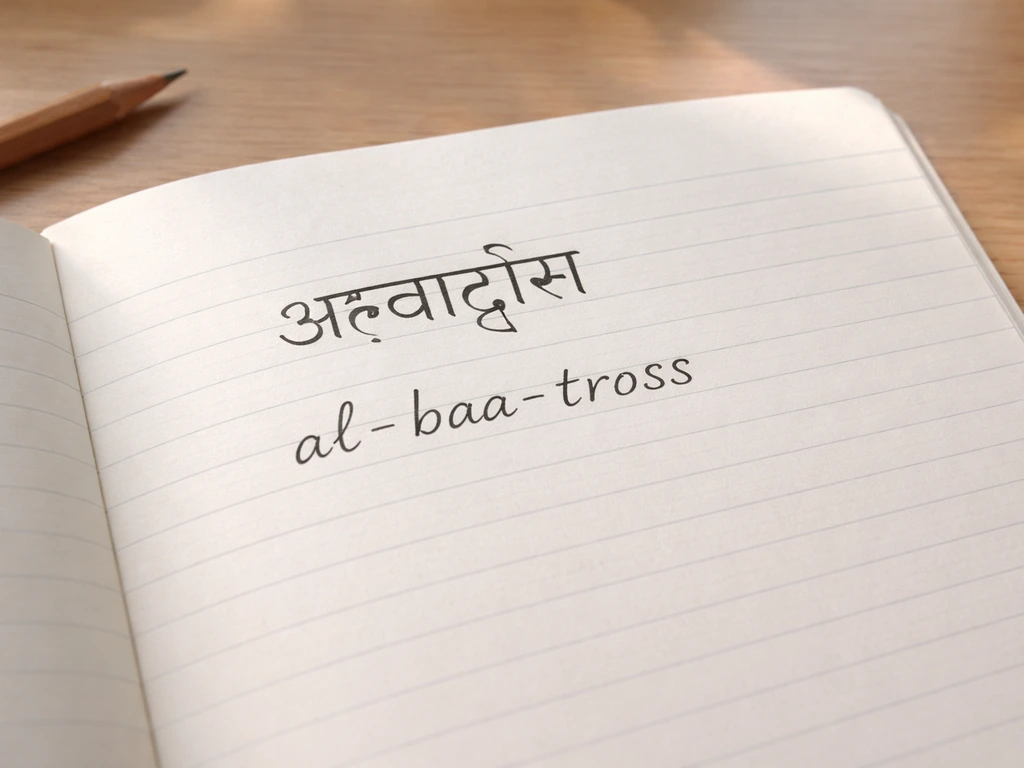
Hindi does not have a centuries-old native word for the albatross the way it does for, say, the peacock (मोर, mor) or the crane (सारस, saras). The albatross is a Southern Ocean and North Pacific bird, far outside the geographic and cultural range of the Indian subcontinent, so the language simply absorbed the English name as a loanword. The standard transliteration is अल्बाट्रॉस. That said, if you look across different Hindi dictionaries, you will notice a handful of variant spellings.
| Spelling in Devanagari | Transliteration | Notes |
|---|---|---|
| अल्बाट्रॉस | al-baa-tross | Most common standard form in modern Hindi dictionaries |
| अल्बाट्रोस | al-baa-tros | Alternate, drops the nasal vowel marker |
| ऐल्बट्रास | ail-bat-raas | Seen in some older English-Hindi dictionaries |
| ऐल्बट्रॉस | ail-bat-ross | Variant found in ShabdKhoj and HinKhoj listings |
| एल्बेट्रॉस | el-be-tross | Less common, closer to a European pronunciation |
For practical purposes, अल्बाट्रॉस is the form you should use in writing and the one a Hindi-speaking reader will most readily recognize. The other variants are not wrong, they are just reflections of how different dictionaries have tried to capture an English sound in Devanagari script. If you are writing for a general Hindi audience, stick with अल्बाट्रॉस.
Pronunciation, spelling, and how to write it correctly
Breaking अल्बाट्रॉस down by syllable makes it much easier: अल् (al) + बाट् (baat) + रॉस (ross). The stress falls on the first syllable, just as in English. The ॉ vowel mark (the inverted-e sound) is key here. It is the same sound used in words borrowed into Hindi like डॉक्टर (doctor) or कॉफी (coffee). If you drop that mark and write अल्बाट्रोस instead, it still gets understood, but the first spelling is more precise.
In everyday typed Hindi, especially on mobile phones, people sometimes simplify and write albatross in Roman script within a Hindi sentence, switching between scripts mid-sentence. This is common in urban, educated Hindi writing and is perfectly acceptable in informal contexts. But in a formal document, a school project, or literary writing, अल्बाट्रॉस in Devanagari is the right call.
The albatross as a burden: what the metaphor means and how Hindi speakers express it

The figurative sense of 'albatross' comes from Samuel Taylor Coleridge's 1798 poem The Rime of the Ancient Mariner, in which a sailor kills an albatross (considered a good omen by seafarers) and is forced to wear the dead bird around his neck as punishment. SparkNotes explains that in The Rime of the Ancient Mariner the Mariner is made to wear the albatross around his neck, and later is "disburden[ed]" when the bird falls away wear the dead bird around his neck. Over time, 'an albatross around your neck' became a fixed English idiom meaning a burden, a source of guilt, or a liability you cannot escape. Hindi has no equivalent idiom rooted in albatross imagery, because the bird itself has no native cultural footprint in India.
However, Hindi speakers and writers who want to express this idea have a rich vocabulary for burden and unavoidable trouble. The word बोझ (bojh) is the most direct: it means a physical or emotional load. You will also hear गले का हार (gale ka haar), literally 'a garland around the neck,' used sarcastically to describe something that was once seen as an honor but has become an unwanted responsibility. Another option is सिर पर भार (sir par bhaar), meaning 'a weight on the head,' which conveys the same suffocating sense of obligation.
Hindi sentences that capture the albatross metaphor
Here are some practical example sentences showing how the albatross concept works in Hindi, both as a direct transliteration and through equivalent native expressions.
- यह पुराना कर्ज उसके गले का अल्बाट्रॉस बन गया है। (Yah puraana karz uske gale ka albatross ban gaya hai.) — 'This old debt has become an albatross around his neck.'
- उसकी विफलता उसके लिए एक बड़ा बोझ बन गई। (Uski vifaltaa uske liye ek badaa bojh ban gayi.) — 'His failure became a great burden for him.' (This is the native Hindi equivalent of the same idea.)
- वह ज़िम्मेदारी उसके सिर पर भार की तरह थी। (Vah zimmedaari uske sir par bhaar ki tarah thi.) — 'That responsibility hung over him like a dead weight.'
- अंग्रेज़ी में 'albatross' का मतलब एक बड़ा समुद्री पक्षी भी है और एक ऐसा बोझ भी जिससे पीछा नहीं छूटता। (Angrezi mein 'albatross' ka matlab ek badaa samudri pakshi bhi hai aur ek aisa bojh bhi jisse peechhaa nahin chhootaa.) — 'In English, albatross means both a large seabird and a burden you cannot escape.'
The third and fourth sentences are particularly useful if you are explaining the English metaphor to a Hindi-speaking friend or writing a cultural note in Hindi. They bridge the gap between the English literary reference and a natural Hindi understanding without forcing an awkward transplant of the English idiom.
Does the albatross appear in Indian mythology or tradition?
Honestly, no, not directly. Indian mythology is extraordinarily rich in bird symbolism. The Garuda (गरुड़), the divine eagle-like vehicle of Lord Vishnu, dominates Hindu tradition. The Hamsa (हंस), often translated as swan or goose, is deeply embedded in Sanskrit literature and Vedantic philosophy as a symbol of wisdom and the pure soul. The Chakravak (चकवाक), a ruddy shelduck, is a classical symbol of devotion and separation in Sanskrit poetry. Even mythical birds like Jatayu and Sampati from the Ramayana carry enormous symbolic weight. For those interested in legendary birds across traditions, the broader world of mythical bird symbolism in Hindi and Sanskrit is a fascinating parallel conversation. If you are also curious about the mythical bird meaning in Hindi, you can explore how Indian traditions interpret legendary birds.
The albatross does not feature in any of these traditions. This is simply a matter of geography and ecology: these birds live far from the Indian Ocean's familiar shorelines and were entirely unknown to ancient Indian civilizations. The 'albatross as burden' metaphor entered Hindi through the influence of English literature in the colonial and post-colonial period. When a Hindi writer or speaker uses the albatross metaphor today, they are consciously borrowing a Western literary concept, much the same way English borrows Sanskrit concepts like karma or dharma. It is a cultural import, not a native symbol.
That said, the idea of a self-inflicted curse or an unavoidable consequence of a past action resonates deeply in Indian philosophical thought, particularly through the concept of karma (कर्म). If you wanted to explain the albatross metaphor to someone steeped in Hindu tradition, you could draw a parallel: the sailor's killing of the albatross and the inescapable burden that follows is structurally similar to how karmic debt (कर्म का बोझ, karma ka bojh) works. It is not a perfect equivalence, but it is a culturally meaningful bridge.
How the albatross compares to other birds in this cultural context
Birds like the heron, harrier, halcyon, and oriole all have varying degrees of presence in Indian linguistic and cultural tradition. If you are also looking for the halcyon bird meaning in hindi, the Hindi explanation often depends on whether you mean the mythical “halcyon days” idea or the bird species linked with the kingfisher. Heron meaning in Hindi also comes up often when people search for bird meanings, so you can confirm the exact Hindi word you need. The oriole bird meaning in Hindi will depend on which oriole name you are using, such as the common Hindi term पीलक. The heron (बगुला, bagulaa) is well-established in Hindi and even carries idiomatic baggage (बगुला भगत means a hypocrite pretending to be holy). The halcyon appears in Sanskrit as a concept linked to the kingfisher and peaceful, prosperous times. The oriole has direct Hindi names like पीलक (peelak). The albatross stands apart from all of these because it has no native Indian name, no folk story, and no Sanskrit root. Its entry into Hindi is purely modern and purely through the English literary tradition.
How to make sure you have the right translation
Bird-name translations can go wrong in predictable ways, and albatross is a good example of the traps to watch for. Here is how to verify you are working with the correct term.
- Check whether the source distinguishes between the literal bird and the figurative meaning. A good Hindi dictionary entry for albatross will list both: the ornithological sense (एक बड़ा समुद्री पक्षी, a large seabird) and the figurative sense (बोझ, a burden). If your source only gives you one meaning, it may be incomplete.
- Watch out for generic 'seabird' substitutions. Some translators, finding no native Hindi word, just write समुद्री पक्षी (samudri pakshi), which means 'seabird' generically. That is technically accurate but not specific. If species precision matters, insist on the transliterated अल्बाट्रॉस.
- Cross-check the spelling variant. If you see ऐल्बट्रास or एल्बेट्रॉस in a source, do not assume it is a different bird. These are all attempts to phonetically render the same English word, just by different transliterators.
- Use multiple dictionaries. ShabdKhoj, HinKhoj, and the Oxford English-Hindi Dictionary are reliable starting points. If all three give you the same core meaning, you can be confident.
- For scientific or ornithological contexts, the albatross belongs to the family Diomedeidae. Any Hindi scientific text should mention this family name if it is being precise, rather than just using a generic Hindi label.
- If you are writing for a regional audience, note that Marathi, Punjabi, and Gujarati also lack native words for this bird and would similarly use a transliteration of 'albatross' in formal writing.
The bottom line: if someone gives you only one Hindi word for albatross and it is neither a transliteration of the English word nor the phrase एक बड़ा समुद्री पक्षी, be skeptical. The albatross is a bird that Hindi has named by adoption, not by heritage, and the translation should reflect that honesty.
FAQ
albatross bird meaning in hindi, in one line, what should I write?
Write “अल्बाट्रॉस” for the bird, and “बोझ” if you are referring to the idiom-like figurative meaning of an unavoidable burden.
What is the difference between albatross as a bird vs albatross as a metaphor in Hindi?
As a bird you use “अल्बाट्रॉस” (or describe it as “एक बड़ा समुद्री पक्षी”), for metaphorical use you switch to burden terms like “बोझ”, “गले का हार” (sarcastic unwanted responsibility), or “सिर पर भार” (suffocating obligation).
Is “अल्बाट्रोस” (missing the vowel mark) acceptable?
It will still be understood, but “अल्बाट्रॉस” is more accurate because the vowel sign “ॉ” matches the intended sound used in many English loanwords (like डॉक्टर, कॉफी).
How do I decide between Devanagari “अल्बाट्रॉस” and Roman “albatross” in a Hindi sentence?
For informal messages, either is fine even if scripts mix, but for school, formal writing, or publishing use the Devanagari “अल्बाट्रॉस” consistently to match standard readability expectations.
If I search in Hindi, will dictionary translations ever give me a wrong word?
They can, especially if the source only provides a “meaning” without clarifying whether it is literal (bird) or figurative (burden). Always check whether it is describing a seabird or translating the metaphor into “बोझ” style wording.
Is there any native Sanskrit or mythology term for the albatross in Hindi?
Not in the way terms like हंस or गरुड़ are native. Albatross is geographically and culturally outside the traditional Indian bird-symbol footprint, so Hindi adopts the English name rather than using an older indigenous term.
What Hindi phrase should I use if I want to say “an albatross around my neck” specifically?
A natural Hindi equivalent is not one fixed phrase with the same albatross imagery. The closest options are “मेरे गले का हार” (often with a bitter or sarcastic tone) or “मेरे सिर पर भार” depending on whether you want guilt/responsibility (gले) or suffocating obligation (सिर).
Can I replace “बोझ” with another word like “भार” in all cases?
You can often, but tone changes. “बोझ” feels heavier and more emotional or inescapable, while “भार” can sound more formal or literal (a load/weight). Choose based on whether the line is about feelings or duty.
How should I transliterate it in writing if I must type in Roman script only?
Use “albatross” in Roman script to avoid confusion, but keep consistent capitalization and spelling across the text (don’t switch to variants like “albatros”) so readers can reliably map it to “अल्बाट्रॉस”.
What common mistake should I avoid when using albatross meaning in Hindi?
Don’t assume one Hindi word automatically covers both senses. “अल्बाट्रॉस” is literal (bird), while figurative uses need burden or responsibility vocabulary like “बोझ”, “गले का हार”, or “सिर पर भार”.
Next Article
Bird Beak Meaning in Hindi: Chonch, Bill, Pronunciation
Bird beak in Hindi chonch or bill, pronunciation, examples, beak vs bill differences, and figurative Hindi use