
In Hindi, the oriole is most commonly called पीलक (Pilak). That single word is your answer for most practical purposes, whether you are looking up a bird name, reading a nature guide, or trying to understand a reference in a Hindi text. The albatross bird meaning in Hindi is unrelated to the oriole, since they are completely different birds. The Indian Golden Oriole (Oriolus kundoo) is the species most people in India mean when they say 'oriole,' and Salim Ali's classic 'The Book of Indian Birds' lists 'Peelak' (पीलक) as its standard Hindi name. Some sources, particularly BNHS field reports, also use स्वर्ण पिलक (Swarna Pilak), meaning 'golden Pilak,' to be more precise about the species.
Oriole Bird Meaning in Hindi: Name, Literal Sense, Symbolism

Rajesh Sharma
16 Jun 2026
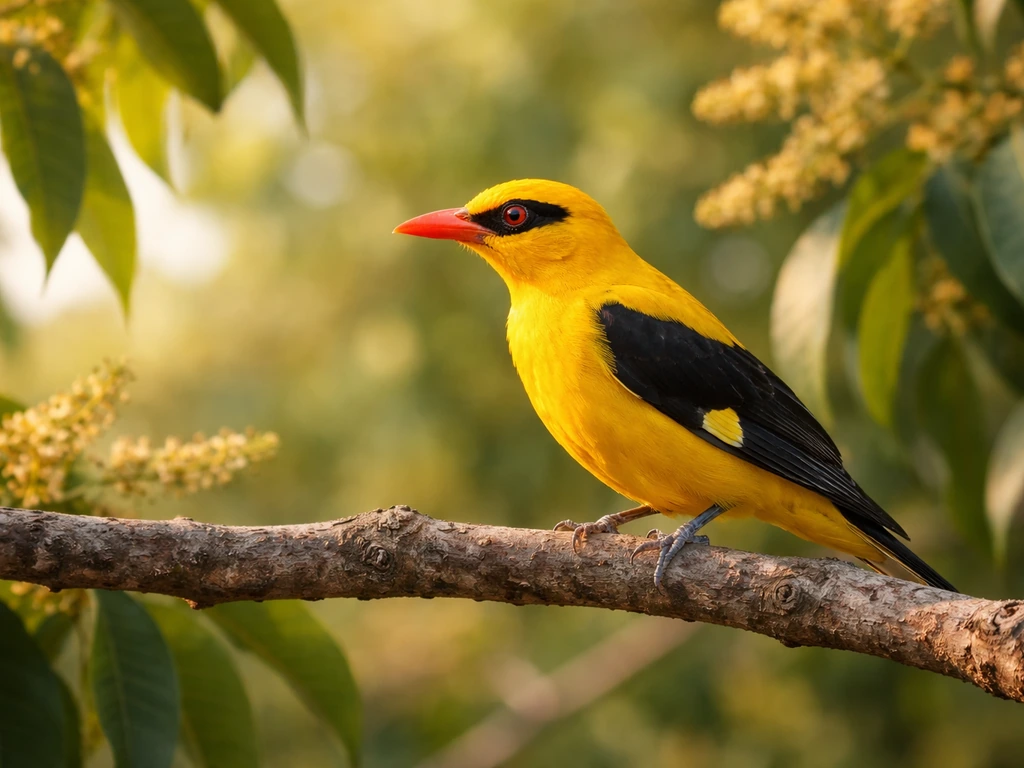
Hindi name for oriole across Indian languages
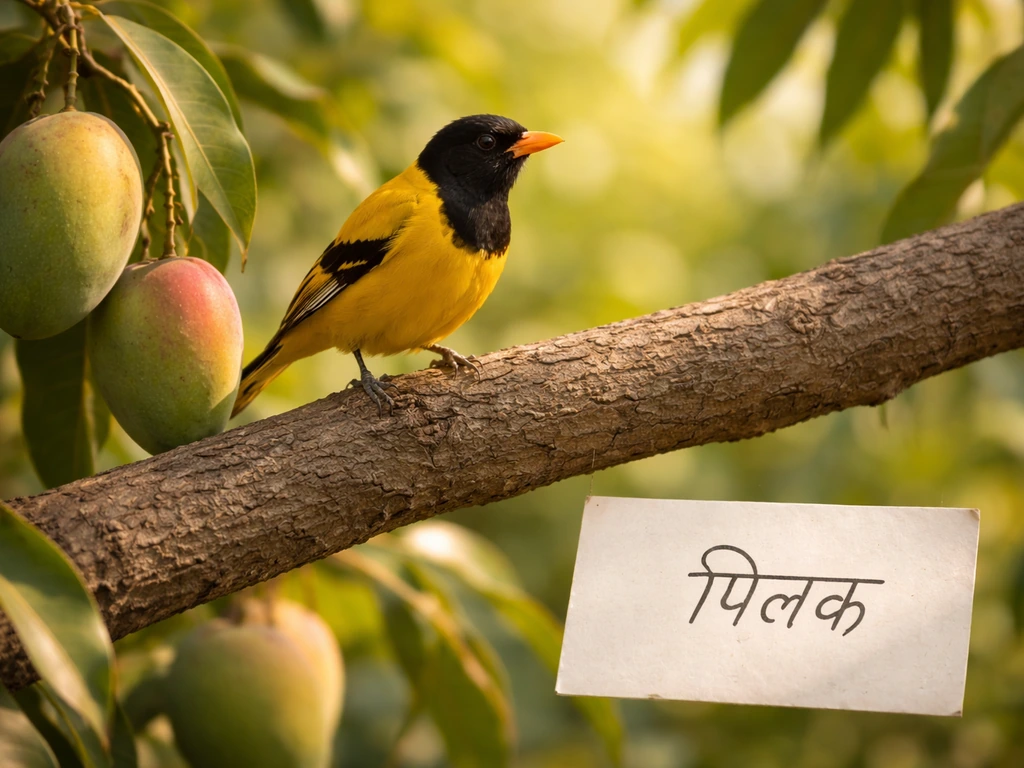
पीलक (Pilak) is the most widely recognized Hindi name for the oriole, and it has a beautifully logical etymology: the word connects directly to the bird's defining feature. Hindi dictionaries like Hindwi define पीलक as 'a yellow-colored bird with a melodious voice,' which is exactly the oriole. The Amarkosh classical lexicon lists synonyms including आम्रपक्षी (Aamrapakshi), meaning 'bird of the mango tree,' which reflects the oriole's strong association with mango groves where it loves to feed and sing. That name alone tells you a lot about how Indian culture has observed and categorized this bird for centuries.
Across other Indian languages, the naming logic stays consistent but the words shift. Here is a quick cross-language reference that is useful if you are working with regional texts or talking to birdwatchers outside the Hindi belt.
| Language | Name for Oriole | Literal Meaning / Notes |
|---|---|---|
| Hindi | पीलक (Pilak) / स्वर्ण पिलक (Swarna Pilak) | Yellow bird / Golden Pilak (BNHS scientific usage) |
| Bengali | বেনেবউ (Benebou) / হলদি পাখি (Haldi Pakhi) | Merchant's wife / Turmeric bird |
| Marathi | हळद्या (Haldya) | Turmeric-colored one |
| Sanskrit | आम्रपक्षी (Aamrapakshi) | Bird of the mango tree |
| English transliteration | Pilak / Peelak | Used in field guides and ornithology reports |
The Bengali name Benebou (merchant's wife) and the Marathi/Hindi turmeric references both point to the same thing: the bird's vivid golden-yellow plumage. Different regions just used different yellow touchstones from daily life, whether it was turmeric (haldi) sitting in every kitchen or the gold jewelry worn by a merchant's bride. The VNIT avifauna report also lists 'Haldya' and 'Peelak' side by side as local names, confirming these are in active regional use, not just archaic literary terms.
What 'Pilak' actually refers to as a bird
When someone says पीलक in a Hindi-speaking region, they almost always mean the Indian Golden Oriole (Oriolus kundoo), a migratory songbird that arrives in India from Central Asia. The male is a stunning golden yellow with black wings and eye stripe, and its liquid fluting call is one of the most distinctive sounds of North Indian summers. The female is a more muted olive-yellow, which occasionally confuses beginner birdwatchers. This species is formally recognized with the scientific name Oriolus kundoo, and it is distinct from the European Golden Oriole (Oriolus oriolus), though the two look very similar and were once treated as the same species.
The other oriole you will regularly encounter in India is the Black-hooded Oriole (Oriolus xanthornus), which stays as a resident bird rather than migrating. Its Hindi name is टोपीदार पीलक (Topidar Pilak), meaning 'capped Pilak,' referring to the distinctive black hood on its head. In some regional Hindi usage and birding communities, you may also hear it called हल्दी पाखी (Haldi Pakhi) or बनिया बहू (Baniya Bahu), names borrowed from Bengali folk tradition. Britannica के अनुसार, ओरियोल (Oriolus, family Oriolidae) Old World में लगभग 30 प्रजातियों के लिए प्रयुक्त होता है, और India में मिलने वाली European या type species Golden oriole (Oriolus oriolus) पूर्व की ओर Central Asia और India तक पाई जाती है। Black-hooded Oriole (Oriolus xanthornus). So if you see 'Pilak' in a text without qualification, it generally refers to the golden species, while 'Topidar Pilak' specifies the black-hooded one.
Cultural symbolism of the oriole in India
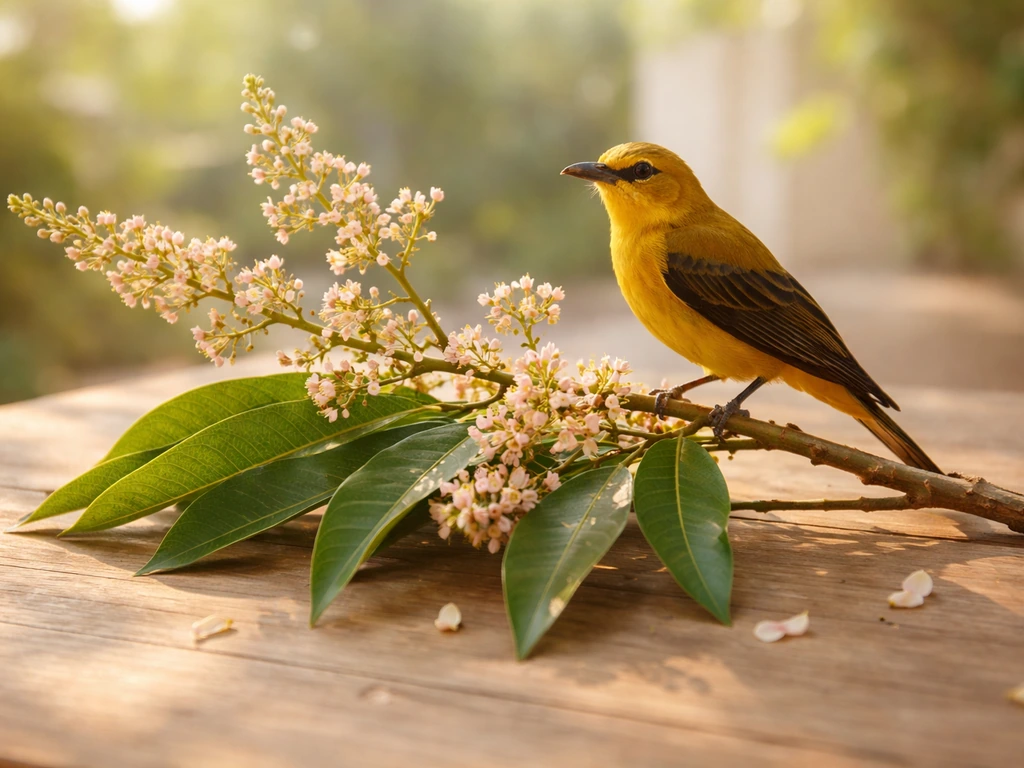
The oriole in Indian culture is first and foremost a symbol of spring and the mango season. Its Sanskrit name, Aamrapakshi, the bird of the mango tree, is not just a botanical observation. The oriole's arrival in mango groves in late spring coincides with flowering and fruiting, so the bird became a living signal of seasonal abundance and renewal. This connection made the oriole a recurring motif in classical Sanskrit poetry and later in Hindi and Urdu verse, where the mango grove setting, the cuckoo's call, and the oriole's song together evoke romantic longing and the sweetness of the season.
The bird's color is equally symbolic. Gold and yellow carry strong positive associations in Indian culture: prosperity, auspiciousness, and the divine. The oriole's golden body made it a natural symbol of good fortune and brightness. In many parts of North and Central India, seeing an oriole near your home or garden is considered a good sign, particularly in spring, when it signals that the season's blessings are arriving. The bird's musical voice reinforces this: a beautiful, clear song was read as an auspicious sound rather than an ill omen.
Spiritual and mythological meaning of the oriole
The oriole does not have a dedicated chapter in the major Puranic texts the way birds like the crow, the peacock, or the eagle do. However, it carries spiritual weight through association. In classical Indian thought, birds with melodious voices and golden or luminous plumage were linked to purity, divine presence, and the transmigration of souls. A golden bird singing in a sacred tree was an auspicious omen that signaled divine blessing or the arrival of a virtuous soul.
In folk tradition, particularly in Bengal and parts of eastern India, the Black-hooded Oriole has a fascinating spiritual dimension through a well-known folk tale. The story tells of a merchant's young wife who was mistreated by her mother-in-law, smeared with turmeric paste, blackened with soot, and made to suffer. A goddess took pity on her and transformed her into a bird, forever marked with the yellow of turmeric and the black of the soot on her hood. This is the origin story given for both the name Benebou (merchant's wife) and Haldi Pakhi (turmeric bird). The folk tale layers the bird with themes of divine justice, feminine suffering, and spiritual transformation, giving the oriole a weight that goes well beyond its visual beauty.
In terms of omens, the oriole is generally read as a positive presence. Its arrival is associated with prosperity and warmth, and its song near a home in the morning is considered favorable in many regional folk beliefs. Unlike crows, owls, or certain other birds that carry mixed or negative symbolism in Indian tradition, the Pilak sits firmly in the category of auspicious birds. This contrasts interestingly with birds like the heron or harrier, whose symbolism in Hindi tradition is more ambiguous or context-dependent.
The oriole in Indian literature, art, and folk expression
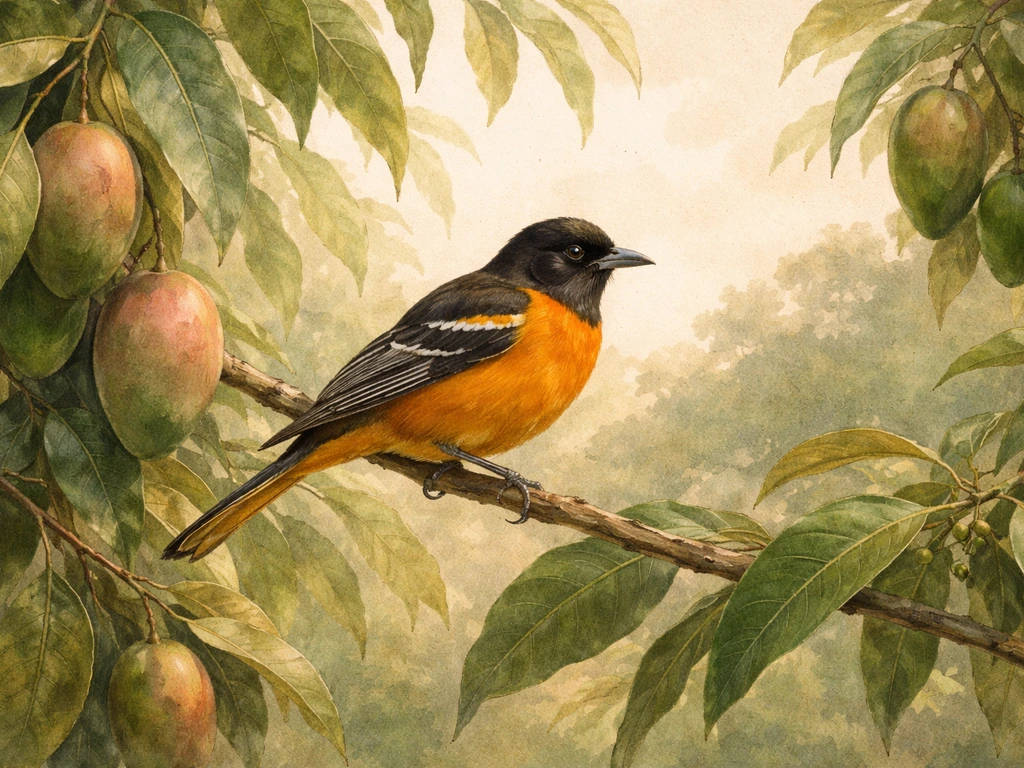
In classical Sanskrit and Hindi poetry, the oriole appears as a companion to the mango grove scene, one of the standard backdrops for romantic and devotional verse. The Aamrapakshi singing in the mango blossoms is a literary shorthand for spring's arrival, the season of Holi, and themes of longing and reunion. Kalidasa and later poets used bird calls and bird imagery in this way, with the oriole's song placed alongside the koyal (Indian cuckoo) to create a soundscape of seasonal beauty.
In folk songs across Rajasthan, Uttar Pradesh, and Bihar, the Pilak appears as a messenger figure: a bride separated from her home, a lover waiting for news, or a soul in transit between worlds. The bird's migratory nature made it a natural metaphor for separation and return. In Barahmasa poetry (songs describing the twelve months), the spring months are frequently marked by the arrival of the Pilak and the koyal as signs that the harsh season is over. Visually, the oriole's yellow and black coloring appears in folk embroidery and textile motifs, particularly in Bengal and Odisha, where the Benebou folk tale keeps the bird's image alive in craft traditions.
Oriole vs. similar birds: do not mix these up
The most common identification confusion in India happens between the Indian Golden Oriole and the Common Iora, or between the oriole and the yellow race of the Indian White-eye. All three are small-to-medium yellow birds. The practical rule: the oriole is larger (roughly 24 cm), has bold black markings on the wings and around the eye, and has a distinctly loud, fluting call. If the yellow bird you are looking at is smaller than a myna and has no strong black contrast, it is probably not a Pilak.
The second confusion is between the two oriole species themselves: Indian Golden Oriole (Oriolus kundoo) versus Black-hooded Oriole (Oriolus xanthornus). The golden oriole has yellow covering most of its head with just a black eye stripe; the black-hooded oriole has its entire head and throat covered in black, leaving the body golden yellow. In terms of Hindi names, the golden oriole is simply पीलक (Pilak), while the black-hooded one is specifically टोपीदार पीलक (Topidar Pilak).
A third potential confusion worth mentioning is the halcyon, which also has colorful plumage and a prominent place in Indian ornithological and symbolic vocabulary. The halcyon (a type of kingfisher) and the oriole are completely different families, but both have vivid coloring and appear in literary and mythological contexts across Indian traditions. If you have come across the word in a classical text, checking whether it is referring to a mango-grove songbird or a river-dwelling bird will quickly tell you which one the author meant.
| Bird | Hindi Name | Key Visual Markers | Symbolic Association |
|---|---|---|---|
| Indian Golden Oriole (Oriolus kundoo) | पीलक (Pilak) | Golden yellow, black eye stripe, black wings | Spring, prosperity, auspiciousness |
| Black-hooded Oriole (Oriolus xanthornus) | टोपीदार पीलक (Topidar Pilak) | Golden body, fully black head and throat | Folk tales, divine justice, turmeric symbolism |
| Common Iora | शकर खोरा / शकरखोरा | Smaller, yellow-green, no bold black contrast | Minimal mythological symbolism |
| European Golden Oriole (Oriolus oriolus) | पीलक / यूरोपीय पीलक | Very similar to Oriolus kundoo, migratory visitor | Linked to Eurasian traditions, less Indian lore |
How to use 'Pilak' in a Hindi sentence or name
If you are a language learner or someone who encountered this word in a text and wants to know how to use it naturally, here are a few practical patterns. पीलक is a masculine noun in Hindi. You would say 'वह पीलक बड़ा सुंदर था' (Voh Pilak bada sundar tha) for 'That oriole was very beautiful,' or 'आम के बाग में पीलक बोल रहा था' (Aam ke baag mein Pilak bol raha tha) for 'The oriole was calling in the mango grove.' The second sentence is almost a classical literary image in itself, which gives you a sense of how deeply embedded this bird is in the Hindi landscape of spring.
For names and cultural references: पीलक appears in some traditional Indian names for children or places, typically evoking beauty and musical voice. स्वर्ण पिलक (Swarna Pilak) is the more formal, BNHS-approved name you would use in a scientific or educational context. If you are writing about Indian bird symbolism, translating a folk tale, or annotating a classical poem, the safest and most accurate move is to use पीलक for the golden oriole and always clarify the species (Oriolus kundoo) if precision matters, since the family includes several species found in India. NCBI Taxonomy Browser पर Oriolus kundoo के taxonomic record को verify करके इसकी scientific identification सुनिश्चित की जा सकती है।.
One last practical note: if someone asks you what 'oriole' means in Hindi and you want to give a quick, correct answer, say पीलक (Pilak), pronounced roughly as 'PEE-lak,' with the stress on the first syllable. That is the word Salim Ali used, that is what BNHS field reports use, and that is what a Hindi-speaking birdwatcher anywhere in North or Central India will recognize immediately.
FAQ
“Oriole bird meaning in Hindi” का सबसे सही एक लाइन जवाब क्या होगा?
ज्यादातर संदर्भों में “ओरिओल” के लिए Hindi में पीलक (Pilak) लिखा और बोला जाता है, खासकर Indian Golden Oriole (Oriolus kundoo) के लिए। अगर लिखते समय स्पष्टता चाहिए, तो पीलक के साथ “(कुंडू)” या “Oriolus kundoo” जोड़ दें।
अगर पीलक शब्द बिना किसी और जानकारी के दिखे, तो क्या हमेशा वही Golden Oriole मानना चाहिए?
हाँ, हिंदी बोलने वाले क्षेत्र में सामान्यतः पीलक से Indian Golden Oriole ही समझा जाता है। लेकिन अगर उसी लाइन में “capped” जैसा संकेत या “टोपीदार” लिखा हो, तो वह Black-hooded Oriole के लिए होता है।
टोपीदार पीलक (Topidar Pilak) को जल्दी कैसे पहचानें?
फील्ड-आइडेंटिफिकेशन में सबसे बड़ा संकेत सिर और गले पर लगभग पूरा काला/गहरा रंग है, जबकि बाकी शरीर पीला रहता है। Golden Oriole में काली धार मुख्यतः आंख के आसपास “eye stripe” जैसी दिखती है, सिर पर पूरा काला हुड नहीं होता।
“स्वर्ण पीलक” किस स्थिति में इस्तेमाल करते हैं?
स्वर्ण पीलक (Swarna Pilak) अधिक सटीक या औपचारिक रूप से Indian Golden Oriole को refer करने के लिए बोला जाता है, खासकर रिपोर्ट, शिक्षा या पहचान से जुड़े टेक्स्ट में। सामान्य बातचीत में लोग अक्सर सिर्फ “पीलक” कहते हैं।
क्या “Oriolus” प्रजाति लिखते समय मुझे दोनों ओरिओल प्रजातियों में अंतर स्पष्ट करना जरूरी है?
अगर आपका उद्देश्य सिर्फ अर्थ बताना नहीं बल्कि पहचान देना है, तो हाँ। Indian Golden Oriole के लिए Oriolus kundoo और Black-hooded Oriole के लिए Oriolus xanthornus लिखने से गलतफहमी कम होती है, क्योंकि दोनों दिखने में काफी मिल सकते हैं।
ऑरिओल और “Iora” या Yellow White-eye में फर्क कैसे तय करूं?
एक व्यावहारिक नियम यह है कि Oriole आमतौर पर आकार में बड़ा (लगभग 24 cm के आसपास) और इसके पंखों तथा आंख के आसपास स्पष्ट काला-कॉन्ट्रास्ट वाला पैटर्न होता है। बहुत छोटे, बिना मजबूत काले मार्किंग वाले पीले पक्षी अक्सर ओरिओल नहीं होते, Yellow White-eye जैसे पक्षी हो सकते हैं।
हिंदी में पीलक शब्द का व्याकरण कैसा है, मैं वाक्य कैसे बनाऊं?
पीलक आमतौर पर masculine noun की तरह चलता है, इसलिए “वह पीलक… था/है” या “आम के बाग में पीलक बोल रहा था/बोल रहा है” जैसे वाक्य प्राकृतिक लगते हैं। अगर आप postpositions जोड़ें, तो standard Hindi grammar उसी noun के अनुसार रखें।
क्या शास्त्रीय या लोकगीतों में “पीलक” हमेशा Golden Oriole ही होता है?
अधिकांश मामलों में संदर्भ mango grove, आम के बाग और वसंत की “songbird” थीम से Golden Oriole की तरफ इशारा करता है। फिर भी अगर टेक्स्ट में “टोपी”, “capped” या चरित्रानुसार काला हुड वाला संकेत मिले, तो Black-hooded Oriole वाला अर्थ भी हो सकता है।
अगर किसी कविता में “halcyon” शब्द मिले तो मुझे क्या सावधानी रखनी चाहिए?
halcyon एक अलग तरह का पक्षी (आमतौर पर kingfisher family) हो सकता है, ओरिओल नहीं। टेक्स्ट का दृश्य-संदर्भ देखिए, अगर नदी/जल के पास का वर्णन है तो halcyon की संभावना बढ़ती है, mango-grove songbird वाली imagery हो तो ओरिओल अधिक संभव है।
क्या “oriole” का ओमेन या symbolism हमेशा positive ही माना जाता है?
हां, हिंदी लोकविश्वास में पीलक को आमतौर पर auspicious माना जाता है, खासकर सुबह या वसंत में दिखने पर। लेकिन अगर किसी इलाके की लोक-परंपरा में पक्षियों के अर्थ अलग तरह से बताए गए हों, तो स्थानीय संदर्भ को प्राथमिकता दें।
Next Article
Albatross Bird Meaning in Hindi: Name, Symbol, Usage
अल्बाट्रॉस का हिंदी नाम और उच्चारण, पक्षी अर्थ व बोझ वाला प्रतीक अर्थ दोनों को उदाहरणों सहित समझें