Title: Grouse Bird Meaning in Hindi: Translation, Pronunciation, and Indian Equivalents Meta description: Learn what 'grouse' means in Hindi, how to say it, its regional names in Sanskrit, Marathi, Punjabi and Gujarati, and which Indian birds come closest.
Grouse Bird Meaning in Hindi: Translation, Pronunciation & Context

Rajesh Sharma
30 Jul 2026
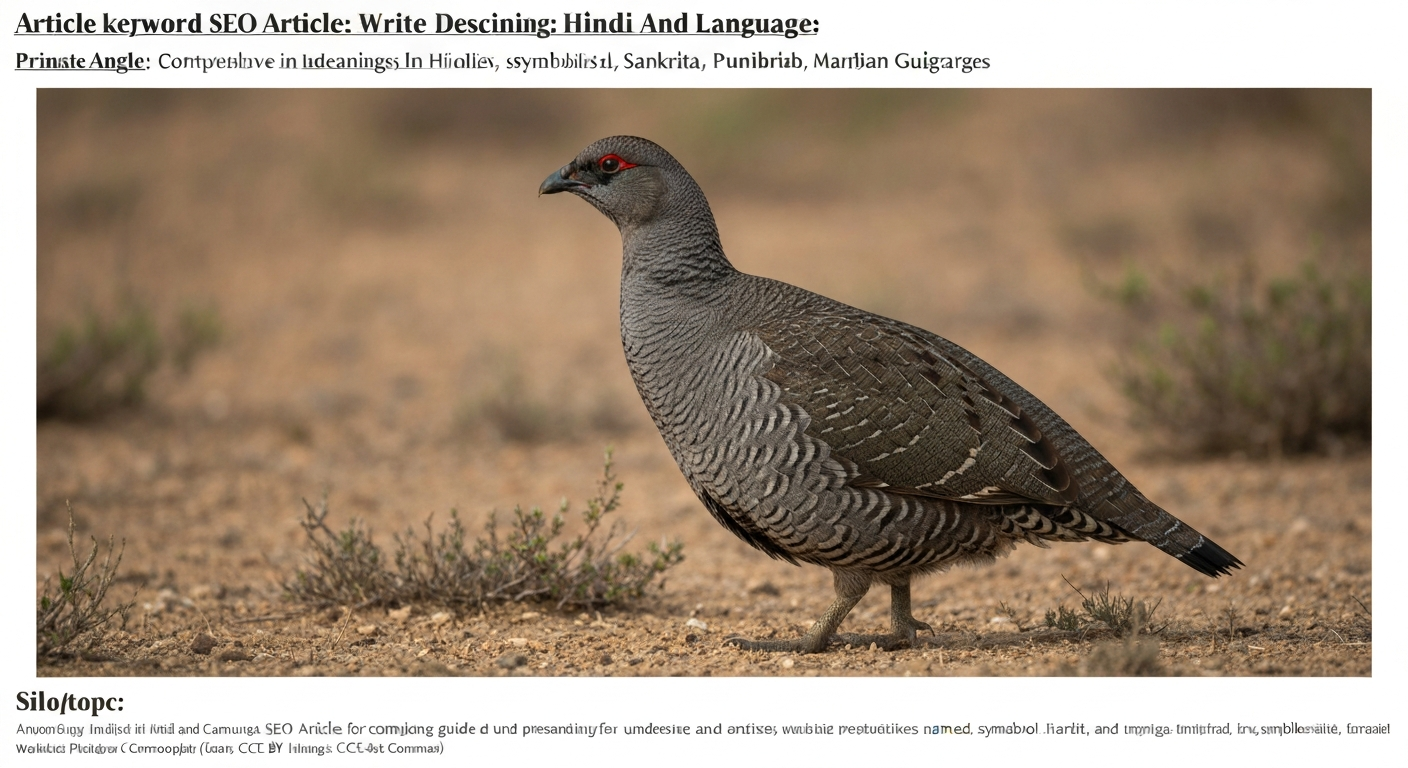
The most direct Hindi equivalent for 'grouse' (the bird) is तीतर (tītar), the same word used for partridge. Because true grouse do not live in India, Hindi speakers naturally reach for तीतर when they need to name this bird, since grouse and partridges belong to the same broad family of ground-dwelling game birds and share a very similar look and lifestyle. If someone asks you what a grouse is in Hindi, तीतर is the word to use, and Collins English–Hindi dictionary backs that gloss.
At a Glance: Quick Translation and Pronunciation
| Feature | Detail |
|---|---|
| English word | Grouse (bird) |
| English pronunciation (IPA) | /ɡraʊs/ (rhymes with 'house') |
| Standard Hindi translation | तीतर |
| Transliteration (IAST) | tītar |
| Hindi IPA | /t̪iː.t̪əɾ/ |
| Part of speech | Noun (masculine) |
| Secondary Hindi sense (to grouse = complain) | शिकायत करना (shikāyat karnā) |
| Noun form of complaint sense | शिकायत (shikāyat) |
One small but important note: 'grouse' in English carries two very different meanings. The bird sense is what most people searching this topic want, and तीतर covers it cleanly. The informal English sense of 'to grouse' means to complain or grumble, and here Hindi uses शिकायत करना (shikāyat karnā). Keep those two uses separate and you will never confuse a reader.
Standard Hindi Translations, Transliterations, and How to Say Them
The primary Hindi word is तीतर, transliterated as tītar in IAST (International Alphabet of Sanskrit Transliteration). To break it down phonetically: the first syllable 'tī' is a long 'ee' sound, like the English word 'tea', and the second syllable 'tar' rhymes with 'but' in standard Hindi pronunciation, not with the English 'tar'. The full Hindi IPA reads /t̪iː.t̪əɾ/, where t̪ represents a dental 't' (tongue touching the teeth, softer than the English retroflex version). If you are learning Hindi from scratch, a reliable way to approximate it is: 'TEE-tur', with the stress on the first syllable. For native‑speaker pronunciation audio of English 'grouse' and Hindi तीतर, consult Forvo and HowToPronounce respectively Forvo — 'grouse' (audio); HowToPronounce — 'तीतर' audio resources.
For the complaint sense, शिकायत (shikāyat) is the noun and शिकायत करना (shikāyat karnā) is the verb phrase. Shikāyat comes from Arabic via Urdu and is perfectly standard in everyday Hindi. You will hear it constantly on the street, in news, and in offices. So if a colleague says 'he is always grousing', you would render that as 'वह हमेशा शिकायत करता रहता है' (vah hamesha shikāyat kartā rahtā hai).
What Exactly Is a Grouse? And Its Nearest Indian Relatives
Grouse are medium-to-large ground-dwelling birds classified within the subfamily Tetraonini, part of the larger pheasant family Phasianidae. They are built for cold climates: stocky bodies, feathered legs and feet (in many species), and a diet that leans heavily on buds, shoots, berries, and insects. The best-known species include the Red Grouse of the British moorlands, the Capercaillie of northern European forests, and the Ruffed Grouse of North America. All of them are what ornithologists call Holarctic birds, meaning they are native to the temperate, boreal, and subarctic zones of the Northern Hemisphere. Standard references report grouse as native to the temperate and subarctic regions of the Northern Hemisphere (Holarctic) and not regular members of the Indian (Indomalayan) lowland avifauna Standard references report grouse as native to the temperate and subarctic regions of the Northern Hemisphere (Holarctic) and not regular members of the Indian (Indomalayan) lowland avifauna.. Reliable distribution data from IUCN, BirdLife, and eBird confirms that no true grouse species has an established wild population within India's political boundaries. They simply do not live here.
That absence is why Hindi does not have a dedicated indigenous word for grouse. Instead, Indian languages use words for the ground game birds that are actually present. The closest ecological equivalents you will encounter in the field across the Indian subcontinent include the Grey Francolin (Ortygornis pondicerianus, called तीतर in Hindi), the Chukar Partridge (Alectoris chukar, चकोर / chakora), the Common Quail (Coturnix coturnix, बटेर / bater), and the magnificent Himalayan Monal (Lophophorus impejanus, मोनाल / monal). Of these, the Koklass Pheasant (Pucrasia macrolopha), found in the Himalayan forests, is worth a special mention: some modern Galliformes phylogenies place koklass close to the grouse-plus-turkey clade, making it the taxonomically nearest relative of grouse that actually lives on Indian soil.
When an Indian field guide, a translation, or a popular article needs to explain what a grouse looks like to a Hindi-speaking audience, the usual strategy is to describe it as 'a large तीतर of cold countries' or 'Europe's version of the तीतर'. That is a fair and practical approximation.
Names and Equivalents in Sanskrit, Marathi, Punjabi, and Gujarati
Because grouse are not native to South Asia, none of the regional languages has developed an exclusive term for the bird the way English or Russian has. What each language does have is a rich vocabulary for its own local game birds, and those words serve as natural stand-ins when the grouse needs to be named or described.
Sanskrit
The Sanskrit root for partridge is तित्तिर (tittira), listed in Monier–Williams as meaning 'partridge' and clearly the etymological ancestor of modern Hindi तीतर (tītar). Classical Sanskrit texts use tittira to refer to the grey partridge and similar game birds known in ancient India. When translating 'grouse' into Sanskrit for academic or ritual contexts, tittira is the accepted gloss, with the understanding that it covers the partridge-francolin-grouse type rather than a single zoological species.
Marathi
In Marathi, the grey francolin and related partridges are commonly called तीतर (tītar), the same phonetic form as Hindi, reflecting the shared Sanskrit root. You may also encounter कावळा-तीतर or regional variant names in Maharashtra's bird checklists, but for a general translation of 'grouse', तीतर is what a Marathi speaker would naturally say and understand.
Punjabi
Punjabi uses ਤਿੱਤਰ (tittar) for the partridge/francolin, pronounced very similarly to the Hindi form. The grey francolin is one of the most culturally significant birds in Punjab, celebrated in folk songs and rural poetry. When a Punjabi speaker encounters the word 'grouse' in a translation or wildlife documentary, ਤਿੱਤਰ (tittar) is the natural equivalent that comes to mind.
Gujarati
In Gujarati, the partridge is called તેતર (tetar), again a close phonetic cousin of the Hindi and Marathi forms. Regional bird checklists from Gujarat, including resources from the India Biodiversity Portal, use tetar for Francolinus and Ortygornis species. As with the other languages, tetar functions as the working Gujarati equivalent when grouse is translated.
| Language | Word / Script | Transliteration | Literal meaning |
|---|---|---|---|
| Hindi | तीतर | tītar | Partridge / grouse (game bird) |
| Sanskrit | तित्तिर | tittira | Partridge (classical root) |
| Marathi | तीतर | tītar | Partridge / francolin |
| Punjabi | ਤਿੱਤਰ | tittar | Partridge / francolin |
| Gujarati | તેતર | tetar | Partridge / francolin |
A caveat worth stating clearly: these are functional translation equivalents, not taxonomically precise labels. A zoologist writing a scientific paper about grouse in India would specify the species in Latin. In everyday language, travel writing, subtitling, and cultural commentary, these regional words are the right choices.
Symbolism, Mythology, and Literary Meaning in Indian Contexts
The तीतर occupies a genuine and affectionate place in Indian cultural life, even if the grouse itself is foreign. In Hindu tradition, the तित्तिर (tittira) appears in ancient texts including the Rigveda and the Atharvaveda, where it is named among birds and associated with the earth, with dawn sounds, and with the energy of the forest floor. The Tittiri branch of the Yajurveda school actually takes its name from a legend involving sages who took the form of partridges (तित्तिर) to receive lost Vedic knowledge from the sun.
In folk and rural traditions across North India and Punjab, the तीतर / ਤਿੱਤਰ is a symbol of alertness and survival. Its loud, penetrating call is described as a good omen in some communities, heralding rain or the end of a drought. In Punjabi folk poetry, the tittar's call in the fields at dawn evokes the mood of rural longing and seasonal change. The bird's reputation as sharp-eyed and difficult to catch has made it a metaphor for cleverness or elusive good fortune in proverbial speech.
As a game bird, the तीतर also carries themes of the hunt, and by extension themes of courage, skill, and the cycle of life and death that runs through Vedic and Puranic literature. Hunting narratives in texts like the Mahabharata feature galliform birds in forest scenes, reinforcing the image of the तीतर as a creature of wild, untamed space. If you extend this symbolism to the grouse (the European ecological twin of the titar), the cultural resonance transfers naturally: a hardy, wild, ground-dwelling bird that rewards patience and skill.
In modern Hindi literature and cinema, शिकायत (the complaint meaning of 'grouse') is far more frequently encountered than the bird meaning. Songs, dialogues, and poetry are full of the word: it carries a slightly plaintive, even poetic tone in Hindi, unlike its blunter English equivalent.
Simple Hindi Example Sentences
| Hindi sentence | Transliteration | English translation |
|---|---|---|
| जंगल में एक तीतर बोल रहा था। | Jangal mein ek tītar bol rahā thā. | A grouse/partridge was calling in the forest. |
| तीतर एक जमीन पर रहने वाला पक्षी है। | Tītar ek zamīn par rahne vālā pakshī hai. | The grouse is a ground-dwelling bird. |
| यूरोप में तीतर को 'ग्राउज़' कहते हैं। | Yūrop mein tītar ko 'grouse' kahte hain. | In Europe, the grouse/partridge is called 'grouse'. |
| वह हर बात पर शिकायत करता रहता है। | Vah har bāt par shikāyat kartā rahtā hai. | He keeps grousing/complaining about everything. |
| उसकी शिकायत सुनने वाला कोई नहीं था। | Uskī shikāyat sunne vālā koī nahīn thā. | There was no one to listen to his grouse/complaint. |
| तीतर की आवाज़ सुबह बहुत सुरीली लगती है। | Tītar kī āvāz subah bahut surīlī lagtī hai. | The grouse's/partridge's call sounds very melodious in the morning. |
How to Tell Them Apart: Grouse, Partridge, Quail, Pheasant, and Thrush Compared
One of the most common points of confusion when researching Indian bird names is that several English words, including grouse, partridge, quail, and pheasant, all get translated into overlapping Hindi and regional-language vocabulary. Adding the thrush into the comparison is useful because it is a completely different kind of bird, a passerine songbird rather than a game bird, yet its English name occasionally turns up in searches alongside game-bird names. The table below sets out the key differences at a glance.
| Bird | Hindi name | Size | Habitat | Found in India? | Key field feature |
|---|---|---|---|---|---|
| Grouse (Tetraonini) | तीतर (tītar) — borrowed gloss | Medium-large (30–90 cm) | Moorland, boreal forest, tundra | No (Holarctic only) | Feathered legs/feet; stocky; cryptic plumage |
| Grey Francolin / Partridge | तीतर (tītar) | Small-medium (28–32 cm) | Scrub, farmland, dry grassland | Yes (widespread) | Streaked brown; loud cackling call |
| Chukar Partridge | चकोर (chakora) | Medium (32–35 cm) | Rocky hillsides, open slopes | Yes (Himalayas, NW India) | Red bill and legs; bold black face bar |
| Common Quail | बटेर (bater) | Small (16–18 cm) | Grassland, crop fields | Yes (widespread migrant) | Tiny; buff-streaked; rarely seen |
| Pheasant / Koklass | कोकलास (koklās) | Large (55–61 cm) | Dense Himalayan forest | Yes (Himalayan range) | Long tail; crested; male iridescent |
| Thrush (Turdidae) | कस्तूरा / कस्तूरी (kastūrā) | Small-medium (20–29 cm) | Woodland, gardens, scrub | Yes (several species) | Spotted breast; melodious song; passerine |
If you are trying to identify a bird you have seen in India and are wondering whether it could be a grouse, the honest answer is almost certainly not. Any medium-sized, ground-running, brown-speckled bird you spot across most of India is far more likely to be the Grey Francolin (तीतर), a quail (बटेर), or a Chukar Partridge (चकोर). For Himalayan trekkers, the Koklass Pheasant and Himalayan Monal are possible sightings and are much more closely related to grouse than anything in the plains.
Image Suggestions for This Article
Good images are essential for identification articles. Below are suggestions for each species, with recommended caption text and licensing guidance. For all Wikimedia Commons images, use only files marked CC BY-SA or CC BY, and always credit the photographer and source in the caption.
- Red Grouse (Lagopus lagopus scotica): Look for a Wikimedia Commons file such as 'Red Grouse (Lagopus lagopus scoticus) (1).jpg' by Charles J Sharp (CC BY-SA 4.0). Suggested caption: 'Red Grouse (Lagopus lagopus scotica), the classic moorland game bird of Britain — called तीतर in Hindi translation. Photo: [Photographer name], Wikimedia Commons, CC BY-SA 4.0.'
- Grey Francolin / Indian Partridge (Ortygornis pondicerianus): Search Wikimedia Commons for 'Grey Francolin' images; many are available under CC BY-SA. Suggested caption: 'Grey Francolin (Ortygornis pondicerianus), India's own तीतर and the closest everyday equivalent to the grouse for Hindi speakers. Photo: [Photographer name], Wikimedia Commons, CC BY-SA 4.0.'
- Chukar Partridge (Alectoris chukar): Well-documented on Wikimedia Commons. Suggested caption: 'Chukar Partridge (Alectoris chukar), known as चकोर (chakora) in Hindi, found on rocky Himalayan slopes. Photo: [Photographer name], Wikimedia Commons, CC BY-SA 4.0.'
- Common Quail (Coturnix coturnix): Widely photographed; several CC-licensed images on Wikimedia Commons. Suggested caption: 'Common Quail (Coturnix coturnix), called बटेर (bater) in Hindi — the smallest of India's ground game birds. Photo: [Photographer name], Wikimedia Commons, CC BY-SA 4.0.'
- Koklass Pheasant (Pucrasia macrolopha): Search Wikimedia Commons or eBird media for this Himalayan species. Suggested caption: 'Koklass Pheasant (Pucrasia macrolopha), known as कोकलास (koklās) — the Himalayan bird phylogenetically closest to the grouse family. Photo: [Photographer name], Wikimedia Commons, CC BY-SA 4.0.'
- Thrush (e.g., Tickell's Thrush Turdus unicolor): Available on Wikimedia Commons. Suggested caption: 'Tickell's Thrush (Turdus unicolor), a passerine songbird — not related to grouse despite the confusion between these English bird names. Photo: [Photographer name], Wikimedia Commons, CC BY-SA 4.0.'
A practical licensing reminder: always check the specific file's license on Wikimedia Commons before publishing. CC BY-SA licenses require attribution and that derivative works use the same license. CC BY licenses require attribution only. Avoid files marked 'All Rights Reserved' or those with no clear license statement.
Common Confusions and Related Bird Names Worth Knowing
People searching for 'grouse bird meaning in Hindi' sometimes land here after confusing 'grouse' with other bird names that sound vaguely similar in English. A few worth addressing directly: 'gull' is a seabird (मछलीमार / machhlīmār or सीगल / sīgal in Hindi) and has nothing to do with ground game birds. For specific Hindi translations and usage notes for 'gull', see gull bird meaning in hindi which lists terms like मछलीमार and सीगल. 'Cull bird' is not actually a species name at all but a term from poultry and livestock management for a bird removed from a flock due to poor productivity or health. 'Swallow' is a small, fast aerial insectivore (अबाबील / abābīl in Hindi) that is again a completely different family. For the Gujarati name and meaning of the swallow (the bird), see swallow bird meaning in Gujarati. For the Hindi meaning of 'swallow' (the bird), see our page on swallow bird in Hindi meaning.
The thrush comparison in the table above is also worth a brief note here. Thrushes (family Turdidae) are melodious songbirds of woodland and garden, and their Hindi name कस्तूरा (kastūrā) sounds nothing like तीतर. Yet thrush and grouse are frequently looked up together, possibly because both are mid-sized brown birds associated with European wildlife. If you are looking up the thrush specifically in Indian languages, that is a topic covered separately on this site. The cuckoo (कोयल / koyal) is another bird with a rich and completely distinct symbolic tradition in Hindi and Sanskrit literature.
Further Reading and Recommended Resources
For anyone who wants to go deeper, a few reliable starting points: Collins English–Hindi Dictionary is the most accessible bilingual source for checking the तीतर gloss and the shikāyat translation. Monier–Williams Sanskrit–English Dictionary (available free online via Cologne Digital Sanskrit Dictionaries) is the authoritative source for the tittira root. For identification and distribution of Indian game birds, Richard Grimmett, Carol Inskipp, and Tim Inskipp's Birds of South Asia (Helm Field Guides) is the standard reference. The ENVIS Bulletin on Galliformes of India from the Wildlife Institute of India gives detailed coverage of India's ground game birds in their ecological and conservation context. For distribution verification and field identification, eBird (ebird.org) and the BirdLife DataZone provide species maps and sighting records updated in near real time. The India Biodiversity Portal is the best source for confirmed vernacular names across Indian languages, including Marathi, Gujarati, and Punjabi.
FAQ
What primary lexicographic sources should I cite for English→Hindi translations and senses of 'grouse' (bird vs. complain)?
Cite reputable bilingual and monolingual dictionaries that distinguish senses: Collins English–Hindi Dictionary (entry for 'grouse' giving तीतर / tītar and complaint senses), Oxford/Lexico or Oxford Advanced Learner’s Dictionary (IPA and senses /ɡraʊs/), and Hindi learner dictionaries or portals such as Shabdkosh/HinKhoj for colloquial example sentences. These provide authoritative headwords, glosses and standard IPA/transliteration.
Which resources provide reliable Hindi headwords, transliteration and pronunciation guidance for तीतर (tītar)?
Use Wiktionary for Standard Hindi headword, IAST transliteration and IPA (/t̪iː.t̪əɾ/), supplemented by native‑speaker audio from Forvo or HowToPronounce to validate spoken forms. For formal transliteration rules cite IAST/ISO or common learner systems used by dictionaries.
What ornithological sources are needed to describe what a 'grouse' is (natural history, taxonomy, and Holarctic distribution)?
Use primary ornithology references: Animal Diversity Web and Cornell Lab of Ornithology (All About Birds) for species‑level natural history (morphology, behavior, habitat); Handbook of the Birds of the World and peer‑reviewed phylogenetic studies (e.g., Kimball et al., persons on Galliform phylogeny) for taxonomy; and the IUCN/BirdLife/Grouse Specialist Group (Grouse Action Plan) for conservation and global status. These sources justify statements that true grouse (Tetraonini) are Holarctic and not typical in India.
How can I verify and support the claim that 'true' grouse are generally absent from India and what local birds are best presented as 'nearest equivalents' for Indian readers?
Verify absence of native Tetraonini in India using distribution/occurrence databases: IUCN Red List and BirdLife species factsheets, GBIF occurrence maps and eBird distribution maps for Tetraonini genera (Tetrao, Lagopus, Bonasa, Dendragapus). For nearest Indian equivalents, consult regional Galliformes references—Grimmett, Inskipp & Inskipp (Birds of South Asia), the WII/ENVIS 'Galliformes of India' bulletin, and species pages on eBird/IUCN (e.g., Chukar Alectoris chukar, Grey Francolin, Coturnix quails, koklass pheasant)—and cite these when saying “partridge/quail/francolin/pheasant are the familiar Indian analogues.”
Which sources support a note that koklass pheasant (Pucrasia macrolopha) is 'grouse‑like' and occurs in Himalayan India?
Cite BirdLife DataZone species factsheet for Koklass Pheasant (Pucrasia macrolopha) and peer‑reviewed habitat/phylogeny studies (e.g., PMC articles on koklass and modern Galliform phylogenies) that discuss its phylogenetic affinity to grouse/turkey clades. Use these to justify describing koklass as a Himalayan, grouse‑like phasianid rather than a true grouse.
What authoritative sources should I use to list vernacular equivalents in Sanskrit, Marathi, Punjabi, and Gujarati?
For Sanskrit roots use Monier–Williams and Cologne Digital Sanskrit dictionaries (entries such as तित्तिर / tittira). For modern regional names use India Biodiversity Portal, regional state biodiversity checklists, Grimmett et al. (Birds of South Asia) and authoritative regional field guides or state forest/biodiversity portals to confirm Marathi, Punjabi and Gujarati common names. Cite each regional source for the specific vernacular form used.
Next Article
Cull Bird Meaning in Hindi: Translation, Species & Symbolism
Is 'cull' the verb or a bird? Hindi translation, Devanagari script, regional equivalents, ID & cultural notes.