The kite bird is called घार (ghār) in Marathi. That single word, pronounced with a breathy 'gh' and a long 'aa' vowel, covers what ornithologists call the Black Kite (Milvus migrans), the dark, fork-tailed raptor you see wheeling over every Indian city, village market, and riverbank. If you are a language learner, a cultural researcher, or simply someone who just heard the word and wants to know exactly what it means, you are in the right place.
Kite Bird Meaning in Marathi: Name Pronunciation & Symbolism

Rajesh Sharma
21 Jul 2026
Quick answer: Marathi names for the kite bird
The primary Marathi common name recorded in the Marathi Vishwakosh (the authoritative Marathi encyclopaedia) for Milvus migrans is घार (ghār). You will also encounter longer descriptive forms in Marathi ornithological and literary writing.
- घार — ghār (the standard, everyday word; used across Maharashtra)
- सामान्य घार — sāmānya ghār (lit. 'common kite'; used in naturalist writing to distinguish the species from other raptors)
- साधी घार — sādhī ghār (lit. 'plain/simple kite'; another descriptive variant)
- नागरी घार — nāgarī ghār (lit. 'urban/city kite'; reflects the bird's familiarity around human settlements)
- कापशी घार — kāpaśī ghār (a regional variant name)
- मोरघार — moraghar (a compound name, less widely used)
For everyday conversation and writing, घार is all you need. The longer forms appear mainly in species lists, field guides, and encyclopaedia entries where precision matters.
How to pronounce घार correctly
The IPA transcription for घार in Marathi is /ɡʱaɾ/. Let me break that down into something a learner can actually use. The 'gh' here is not like the English 'gh' in 'ghost', it is a voiced aspirated velar stop, meaning you produce a 'g' sound while simultaneously releasing a puff of breath. Think of the difference between 'go' and a breathier 'gho' where you can feel air on your palm. The ā is a long vowel, held roughly twice as long as a short 'a'. The final 'r' (ɾ) is a light alveolar tap, like the flipped 'r' in Spanish 'pero', not the drawn-out English 'r'.
- Start with the 'gh' cluster: say 'g' and let air flow through at the same time — voiced and aspirated
- Hold the 'aa' vowel (ā) for a full beat: ghaa — not a short 'a' as in 'cat'
- Finish with a quick, flicked 'r': ghaar
- In IAST/ISO-15919 academic transliteration it is written ghār, where ā signals the long vowel
- Stress is light and falls on the single syllable — Marathi monosyllables carry natural weight on the vowel
A useful memory trick: imagine saying 'ghar' (घर, the Marathi/Hindi word for 'house') but stretching the vowel, ghār. The two words sound close enough that this comparison sticks. The kite bird, in fact, makes itself very much at home (ghar) near human habitation, so the mnemonic even makes cultural sense.
Scientific name and field identification of the Black Kite
The Black Kite carries the scientific name Milvus migrans (Boddaert, 1783), and it is the species behind घार in Marathi. The India Biodiversity entry Milvus migrans govinda, India Biodiversity (common names: Small Indian Kite, Common Pariah Kite) lists 'Black Kite', 'Pariah Kite'/'Common Pariah Kite', and 'Small Indian Kite' as vernacular English names and notes that the older name 'Pariah kite' is still encountered in Indian literature though its usage is contested for social reasons Milvus migrans govinda — India Biodiversity (common names: Small Indian Kite, Common Pariah Kite). Globally, BirdLife International and the IUCN treat Milvus migrans as a single wide-ranging species, though some taxonomic treatments split off the African yellow-billed form. In the Indian subcontinent, two subspecies are most relevant.
- Milvus migrans govinda — the 'Small Indian Kite' (historically also called 'Pariah Kite' in older English literature, a name now increasingly avoided due to its caste-derived connotations). This subspecies is resident across the subcontinent and is the bird most people mean when they say घार in Maharashtra.
- Milvus migrans lineatus — the 'Black-eared Kite', a winter visitor arriving from Central and Northern Asia. GPS-telemetry research published by the Wildlife Institute of India has tracked these migrants making high-elevation crossings of the Himalayas.
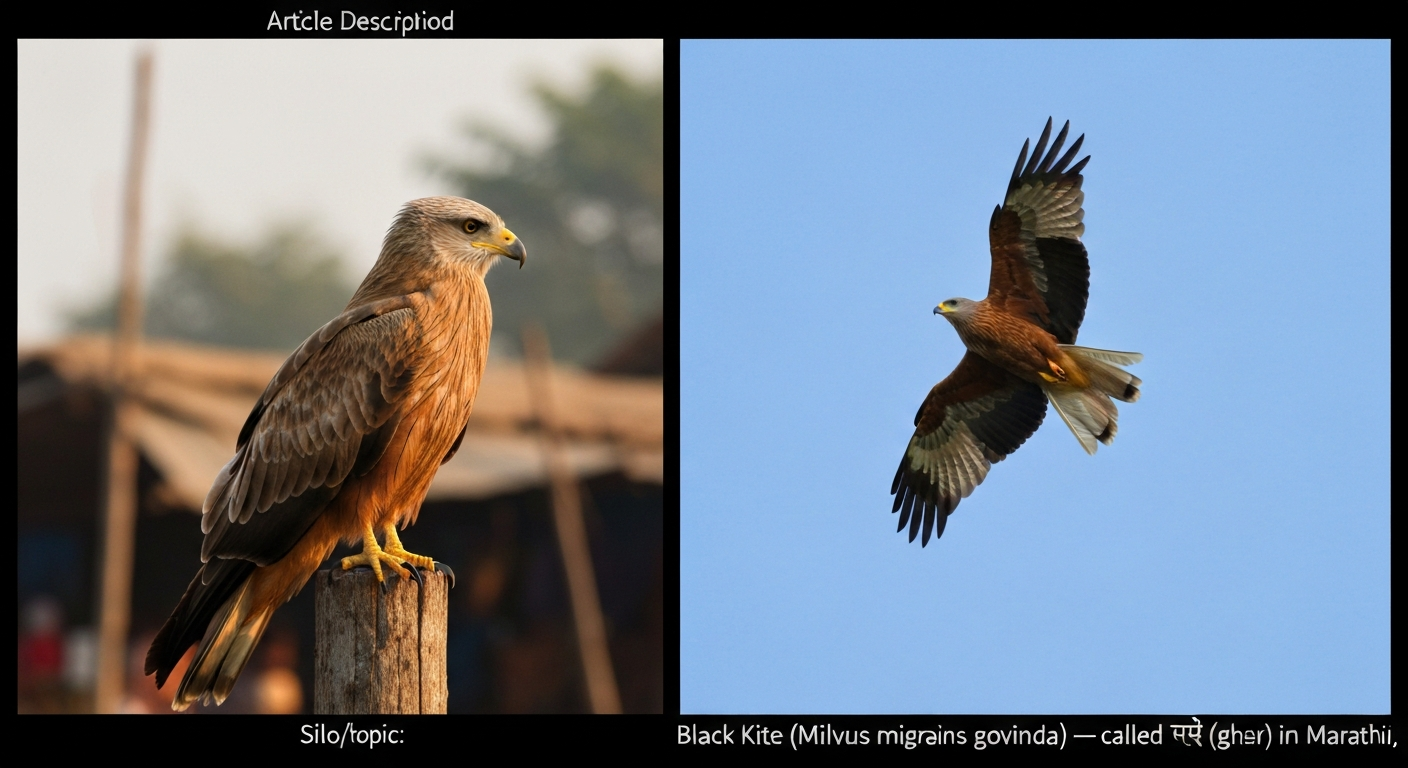
Visually, the Black Kite is a medium-to-large accipitrid raptor: dark rufous-brown overall with a paler, often lightly streaked head and neck. Field‑identification summaries in major Indian field guides describe these key marks for Milvus migrans in South Asia (see Field Guide to Birds of the Indian Subcontinent, Grimmett, Inskipp & Inskipp (Helm/Bloomsbury) (species account & ID notes)) Field Guide to Birds of the Indian Subcontinent — Grimmett, Inskipp & Inskipp (Helm/Bloomsbury) (species account & ID notes). Its most reliable field mark is the shallowly forked tail, which flexes and twists constantly in flight. The long, angled wings show a pale crescent or panel at the base of the primaries on the underwing. The cere (the fleshy patch at the base of the bill) and gape are yellow. Total length runs about 44 to 66 cm, wingspan 120 to 155 cm, and body mass roughly 560 to 940 g, with the resident govinda subspecies tending toward the smaller end. Its call is a distinctive mewing or whistling scream, recordings from across India are archived in the Macaulay Library at Cornell (for example ML173067961 recorded at WII Dehradun, and ML220833251 from Bengaluru) and on Xeno-canto, both searchable by species and location.
Black Kite vs other kites and similar raptors: a comparison
| Bird (English / Marathi) | Scientific name | Length / Wingspan | Key plumage | Tail shape | Range in India | Call character |
|---|---|---|---|---|---|---|
| Black Kite / घार (ghār) | Milvus migrans | 44–66 cm / 120–155 cm | Dark rufous-brown; pale streaked head | Shallow fork, flexes in flight | Widespread resident + winter visitor | Mewing, drawn-out whistle/scream |
| Brahminy Kite / श्वेतमस्तक घार | Haliastur indus | 44–52 cm / 110–125 cm | White head and breast; chestnut body | Rounded (no fork) | Coasts, rivers, wetlands — widespread | Mewing, higher-pitched than Black Kite |
| Black-shouldered Kite / काळ्या खांद्याचा घार | Elanus caeruleus | 31–37 cm / 77–92 cm | Pale grey-white overall; black shoulder patches | Slightly notched, nearly square | Open grassland, cultivation | Soft, piping whistle |
| Red Kite | Milvus milvus | 60–70 cm / 175–195 cm | Rufous-orange with grey head; white wing patches | Deep fork | Absent in India (Western Palearctic) | Long wavering mew |
| Shikra (often confused by beginners) | Accipiter badius | 26–30 cm / 52–66 cm | Grey above, barred rufous-white below | Rounded, slightly notched | Widespread — forest and urban edges | Sharp, repetitive 'ti-tu' |
The tail is your fastest field separator: the Black Kite's forked, twisting tail is unique among common Indian raptors. The Brahminy Kite is equally familiar but unmistakable once you see its brilliant white head against a chestnut body. If you are also exploring a sibling entry on this site about the Black Kite in Marathi with a focused subspecies breakdown, that entry goes deeper into govinda identification and range maps. For another relevant comparison, see what is bat bird called in marathi.
Photo and illustration suggestion
Suggested image: A close-to-medium-distance photograph of a Black Kite (Milvus migrans govinda) perched on a wooden post or low branch, showing the rufous-brown plumage, pale head, yellow cere, and the slight fork visible in a partially spread tail. A second panel or inset showing the bird in soaring flight against a clear sky, with the forked tail and pale underwing crescent visible, would make a strong identification pair.
- Suggested caption: 'Black Kite (Milvus migrans govinda) — called घार (ghār) in Marathi — perched near a village market in Maharashtra. Note the pale, lightly streaked head and the shallow fork at the tail tip.'
- Suggested alt text: 'Black Kite bird known as ghaar in Marathi, perched on a wooden post showing rufous-brown plumage and forked tail'
Cultural, religious, and symbolic meanings in Marathi, Hindi, and Sanskrit
The घार occupies an interesting cultural space in Maharashtra and across the broader Indian tradition, it is not a bird of great spiritual prestige like the peacock or the eagle, but it is deeply woven into the fabric of everyday life, folklore, and omen-reading precisely because it is so ubiquitous.
Omens and folk beliefs
In Marathi folk tradition, the kite's behaviour is read as an omen in several contexts. A घार circling low over a house or crying insistently near a settlement is sometimes interpreted as a warning of approaching trouble or illness, a belief shared across several North and Central Indian communities. Conversely, in agricultural communities, a kite hovering and diving over a field was simply a sign of rodent activity and served as a practical ecological indicator rather than a supernatural warning. The line between omen and observation in rural Indian culture is deliberately fluid, and the kite sits comfortably in both registers.
Vedic and Sanskrit associations
In Sanskrit, the kite (broadly, birds of the Milvus/raptor family) appears under the term śyena (श्येन), a word that also covers hawks and falcons in older texts. The śyena is mentioned in the Rigveda in the famous hymn (RV 4.26–27) where it steals the Soma plant from heaven for humanity, a mythological role that invests the hawk/kite family with associations of speed, daring, and sacred transgression. The Vedic fire altar shaped like a flying bird (śyena-citi) draws on this imagery. However, scholars are careful to note that Sanskrit śyena is a broad category, and the specific mapping to Milvus migrans versus other raptors requires care: the word covers eagles, hawks, and falcons across different textual contexts.
Idiomatic and proverbial uses
The Marathi word घार appears in everyday speech as a metaphor for opportunistic or predatory behaviour, much as English speakers use 'hawk' or 'vulture' in idiom. Someone who swoops in to take advantage of a situation may be compared, colourfully, to a घार. The image of the kite's characteristic soaring and sudden dive is also used in Marathi poetry and folk songs to evoke surveillance, freedom of movement, or the unsettling quality of a watchful, patient presence overhead. A related note for learners coming from sibling topics on this site: the Marathi phrase 'early bird' (as in 'the early bird catches the worm') translates idiomatically rather than literally, the concept exists in Marathi proverbs but uses different bird imagery. That dedicated entry on early bird meaning in Marathi has a full breakdown of those idiomatic parallels.
Names across Indian languages: Hindi, Sanskrit, Punjabi, and Gujarati
One of the most useful things about studying bird names across Indian languages is seeing where terms converge (often reflecting a shared Sanskrit or Prakrit root) and where they diverge (reflecting regional ecology, folk naming, or loan words). The kite is a good case study in that convergence.
| Language | Name (script) | Romanization | Notes |
|---|---|---|---|
| Marathi | घार | ghār | Standard name; Marathi Vishwakosh-verified for Milvus migrans |
| Hindi | चील / चिल | cīl / chil | Most widely used Hindi common name; also spelled चिल. Used across North India colloquially. |
| Sanskrit | श्येन | śyena | Classical Sanskrit term covering kites, hawks, and some falcons; appears in Rigveda |
| Gujarati | ઘાર / ચીલ | ghār / chīl | Gujarati uses both a cognate of the Marathi ghār and the Hindi-influenced chīl; regional variation exists |
| Punjabi | ਚਿੱਲ | chill | Punjabi uses a form cognate with Hindi chil; also pronounced 'chil' in rural Punjab dialects |
| Bengali (reference) | চিল | chil | Included for cross-reference; close to Hindi/Punjabi form, widely recognized across eastern India |
The Hindi चील (chil/cīl) and Marathi घार (ghār) are the two names a learner is most likely to encounter in Indian media, literature, and conversation. They refer to the same bird, Milvus migrans, but come from different regional naming traditions. The Hindi word chil has an onomatopoeic quality; listen to the bird's drawn-out mewing call and you can hear why. The Marathi ghār, by contrast, is more likely derived from a root related to the bird's distinctive descent or dive. In practice, across Maharashtra, you will hear both: urban Marathi speakers in Mumbai or Pune with exposure to Hindi media sometimes use chil, while traditional Marathi usage firmly favours घार.
Clearing up common confusions from sibling topics
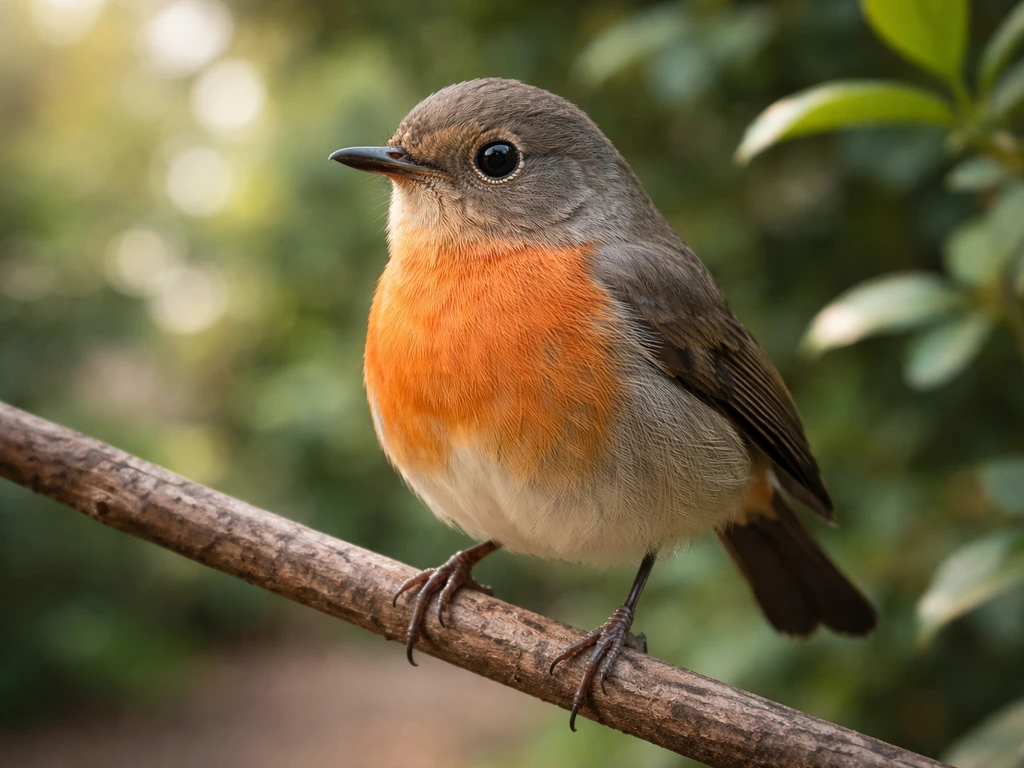
If you arrived here while searching across related topics on this site, a few quick clarifications are worth making. The bater bird in Marathi refers to the quail (family Phasianidae), a small ground-dwelling bird with no relation to the kite; the confusion arises only because both are bird-name searches. The robin bird in Marathi refers to Old World robins or the Indian Robin (Copsychus fulicatus), a completely different passerine. For the robin bird meaning in Marathi, see the related article on robin bird meaning in Marathi. And if you have seen the 'what is bat bird called in Marathi' query: the bat (Chiroptera) is a mammal, not a bird, and in Marathi is called वटवाघूळ (vaṭavāghuḷ), the 'bat bird' framing is a common search mistake. None of these overlap with घार.
Practical tips for learners: how to remember घार and where to see one
Remembering घार is genuinely easy because you almost certainly do not need to go far to see the bird it names. The Black Kite (Milvus migrans govinda) is one of the most abundant raptors on earth, and in Indian cities it is practically a street bird. Mumbai, Pune, Nagpur, and virtually every town in Maharashtra have resident kite populations. Look up near any meat market, fish wharf, or large open rubbish dump and you will see and hear them. Once you watch a घार twist its forked tail mid-soar to adjust its glide angle, you will never forget either the bird or the word.
- Memory link: connect घार (ghār) with घर (ghar, 'home/house') — the kite makes itself at home everywhere. Stretch the vowel: ghar becomes ghār.
- Pronunciation practice: record yourself saying /ɡʱaɾ/ and compare with Milvus migrans recordings on Xeno-canto or Macaulay Library — hearing the bird while saying its Marathi name reinforces both.
- Context drill: use the word in a simple sentence — 'ती घार आकाशात उडत आहे' (tī ghār ākāśāt uḍat āhe) — 'That kite is flying in the sky.' Simple present tense, easy to remember.
- Cross-check with Hindi: if you already know चील (chil) in Hindi, remember that the Marathi equivalent shifts to घार — same bird, different regional name tradition.
- Where to see one: any large open-air market, riverbank, or coastal area in Maharashtra. Dawn and dusk are peak activity times; midday thermals bring them up high in spectacular soaring flocks.
FAQ
SEO title and meta description for an article on 'kite bird meaning in Marathi'
Title: "Kite (Bird) in Marathi — Name, Pronunciation, ID & Cultural Meaning" Meta description: "Learn the Marathi name घार (ghār), pronunciation, ID tips for the Black Kite (Milvus migrans), plus symbolism and idioms."
What is the correct Marathi common name(s) for the kite (Black Kite) and how is it transliterated?
Primary Marathi name: घार IAST/academic transliteration: ghār (घ = gh, आ = ā, र = r) Common local/compound variants recorded in Marathi sources: सामान्य घार, साधी घार, नागरी घार, कापशी घार, मोरघार (source: मराठी विश्वकोश — https://marathivishwakosh.org/69251/).
How do I pronounce घार (ghār) in Marathi? Any IPA guidance for learners?
Pronunciation tip: aspirated voiced velar + long a + tapped r. Approximate English cue: 'ghaar' with a voiced aspirated G (like Hindi/Marathi घ), long ‘aa’ as in 'father', and a short tapped r. IPA commonly given: /ɡʱaɾ/ (sources: Marathi Vishwakosh; Wiktionary — https://marathivishwakosh.org/69251/, https://en.wiktionary.org/wiki/%E0%A4%98%E0%A4%BE%E0%A4%B0). Use IAST/ISO‑15919 for academic romanization (आ -> ā) — https://www.scriptsource.org/entry_detail/uid/g8w4snzcy5.
What is the scientific name and basic identification summary for the Black Kite found in India?
Scientific name: Milvus migrans (Boddaert, 1783). Key ID points (South Asia): medium accipitrid 44–66 cm long, wingspan ~120–155 cm; overall dark rufous‑brown; often pale/streaked head in some races; tail shallowly forked (variable); long pointed wings with a pale crescent/patch on underwing primaries; yellow cere; agile, twisting flight with frequent shallow wing‑beats and soaring (field guide summary: Grimmett, Inskipp & Inskipp; BirdLife/IUCN factsheet — https://www.bloomsbury.com/, https://birdlifedata.blob.core.windows.net/sub-global/1101861_milvus_migrans.pdf).
How is the Black Kite in India split into subspecies or forms, and which ones am I likely to see?
India commonly records: • Milvus migrans govinda — the resident/semi‑resident 'Small Indian kite' (often urban/commensal). • Milvus migrans lineatus — northern/central Asian migrants that winter in parts of India. Subspecies differences include size, head streaking, and tail fork depth; migration across the Himalaya is documented by GPS telemetry (Scientific Reports / WII study — https://pmc.ncbi.nlm.nih.gov/6326925/, India Biodiversity notes — https://indiabiodiversity.org/species/show/257538).
How to distinguish the Black Kite from similar raptors (comparison highlights)?
Quick comparison: • Brahminy Kite (Haliastur indus): white head/breast and rounded tail — not forked. • Black‑shouldered Kite (Elanus caeruleus): much paler, slim, white underside and different silhouette. • Red Kite (Milvus milvus): paler/rufous tones, deeper forked tail and different underwing pattern. Field guides (Grimmett et al.) give these separation notes; see also regional species accounts (e.g., Wikipedia/BirdLife cross‑refs). For measurements and ranges see compiled data (length 44–66 cm, wingspan 120–155 cm; mass c. 560–940 g) (sources: field guides; BirdForum compilation — https://www.bloomsbury.com/, https://www.birdforum.net/opus/Black_Kite).
Next Article
Robin Bird Meaning in Marathi: Name, Pronunciation, Symbolism
रॉबिन पक्षाचे मराठीत नाव, उच्चार, अर्थ आणि हिंदी तुलना, तसेच भारतातील कोणती प्रजाती ते स्पष्ट करणारे.