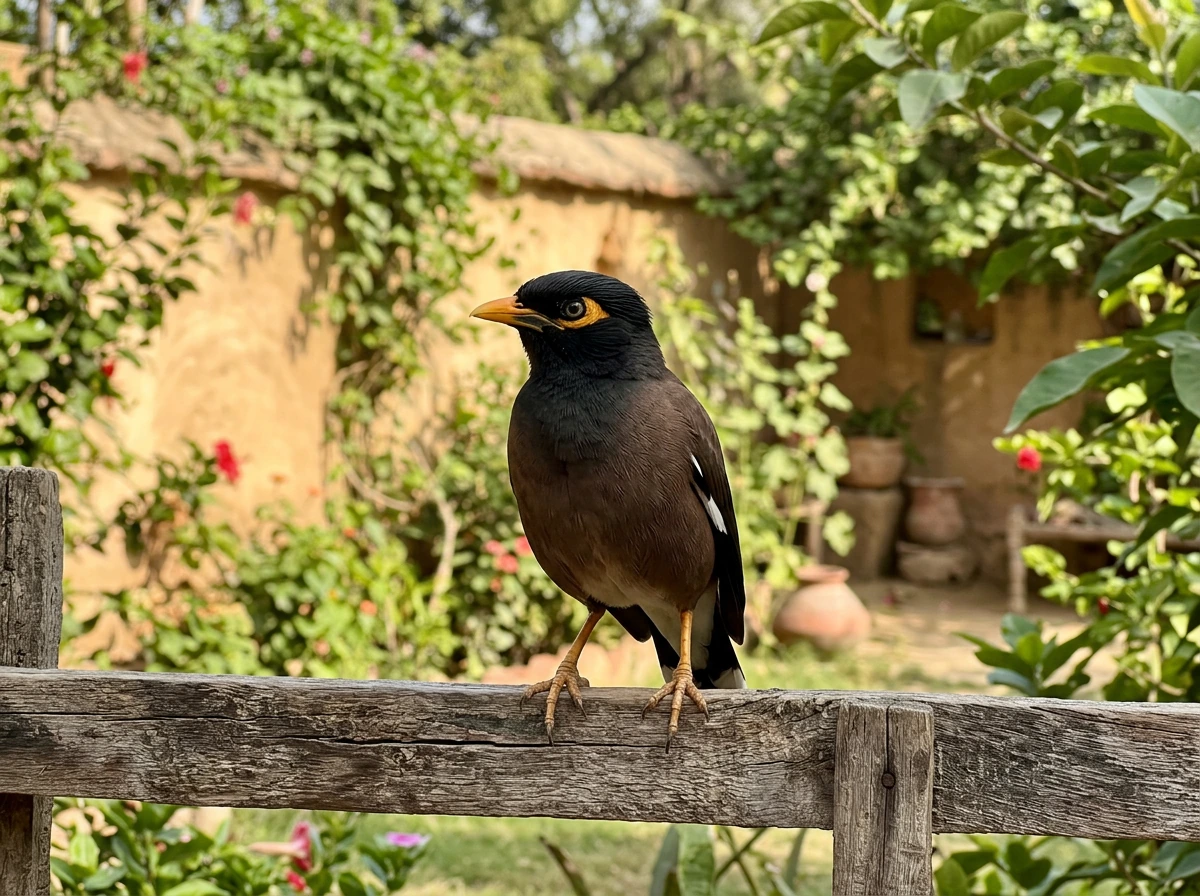
The Hindi word for myna bird is मैना (romanized as mainā, pronounced roughly as "MY-naa"). rhea bird meaning in hindi That is the direct answer. rhea bird meaning in hindi Whether you have seen the English spelling "myna" or "mynah," both words are actually borrowed from this Hindi term, so in a sense the English word is already wearing its Hindi meaning on its sleeve. In English, the same bird is most commonly called the Common Myna (scientific name: Acridotheres tristis), and it is also referred to as the Indian Myna in everyday usage.
Myna Bird in Hindi Meaning and English Name Guide

Rajesh Sharma
23 Mar 2026
The Hindi word, spelled out properly
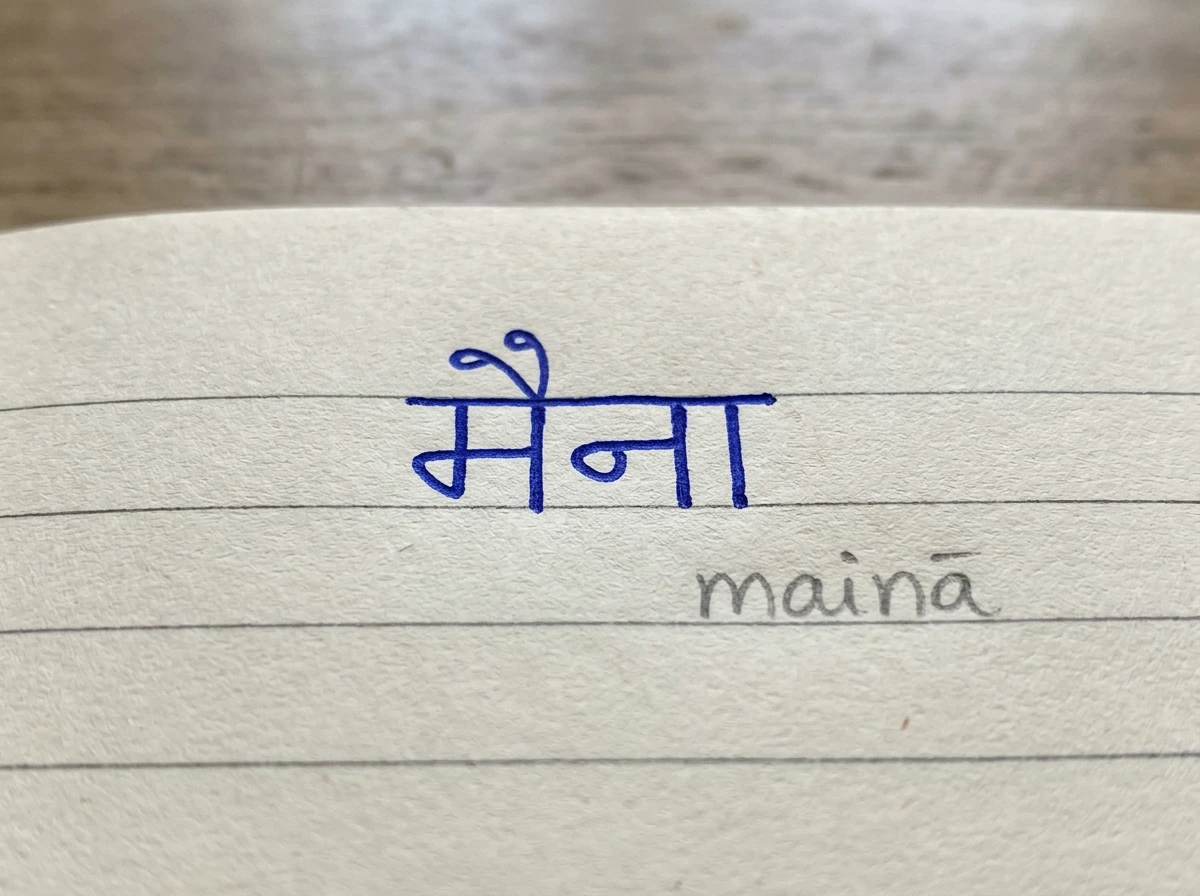
In Devanagari, the word is written मैना. The romanized transliteration is mainā, with a long "a" at the end. You will also encounter the fuller local form देसी मैना (desī mainā), which literally means "desi (local/Indian) myna" and is used across many parts of North India to distinguish the familiar neighbourhood bird from less common species. In Sanskrit and classical Hindi literary traditions, the bird is also known as सारिका (sārikā), a name that carries a more refined, poetic register and turns up in classical literature and Prakrit texts. But in everyday Hindi conversation, मैना is the word almost everyone uses.
What the English name actually means
The English word "myna" did not originate independently. It is a direct borrowing from Hindi मैना, which means the translation runs in an interesting circle: if you look up "myna" in English hoping to find what it means in Hindi, the answer is that the English word is the Hindi word, just in Latin script. The formal English common name for the most familiar species is "Common Myna," and it refers specifically to Acridotheres tristis, a large, confident bird in the starling family (Sturnidae). The name "Indian Myna" is used interchangeably in English, particularly outside South Asia, where people want to signal the bird's geographic origin.
Myna vs. mynah: why both spellings exist

If you have seen the bird written as both "myna" and "mynah" and wondered which is correct, both are. The spelling "mynah" is a fully established English dictionary headword, listed in Merriam-Webster and given its own pronunciation entry in the Cambridge Dictionary. Wikipedia's article on mynas explicitly notes the spelling variation, explaining that "myna" is also spelled "mynah." The reason for the split is historical. When Hindi words were first transcribed into English during the colonial period, different scribes used different conventions to represent the final vowel sound of मैना. Some wrote "myna," others added an "h" to signal the long "a" sound, giving "mynah." Both stuck, and today modern global bird checklists, including those following the Clements standard, tend to use "myna" as the standardized English group name, though "mynah" remains perfectly valid and widely recognized.
Which myna are we actually talking about?
Here is where things get slightly more layered. The Hindi word मैना is used generically, the way an English speaker might say "sparrow" to mean any small brown bird. In reality, the myna group (family Sturnidae) includes several distinct species, and Hindi speakers apply the base word मैना to more than one of them, usually with a descriptive prefix to specify which one. The three most commonly encountered species in India, along with their Hindi names, are listed below.
| English Name | Scientific Name | Hindi Name (Devanagari) | Romanization |
|---|---|---|---|
| Common Myna | Acridotheres tristis | मैना / देसी मैना | mainā / desī mainā |
| Jungle Myna | Acridotheres fuscus | जंगली मैना | janglī mainā |
| Bank Myna | Acridotheres ginginianus | गंगा मैना | Gangā mainā |
When someone says मैना with no prefix, they almost always mean the Common Myna, the one you see strutting around parks, railway platforms, and rooftops across the subcontinent. The Jungle Myna and Bank Myna are distinct species with their own official Hindi descriptors, and authoritative Indian conservation and forest department documents map these names explicitly. So while मैना is the go-to word, paying attention to what comes before it tells you which bird is actually being discussed.
How to confirm which bird you are looking at
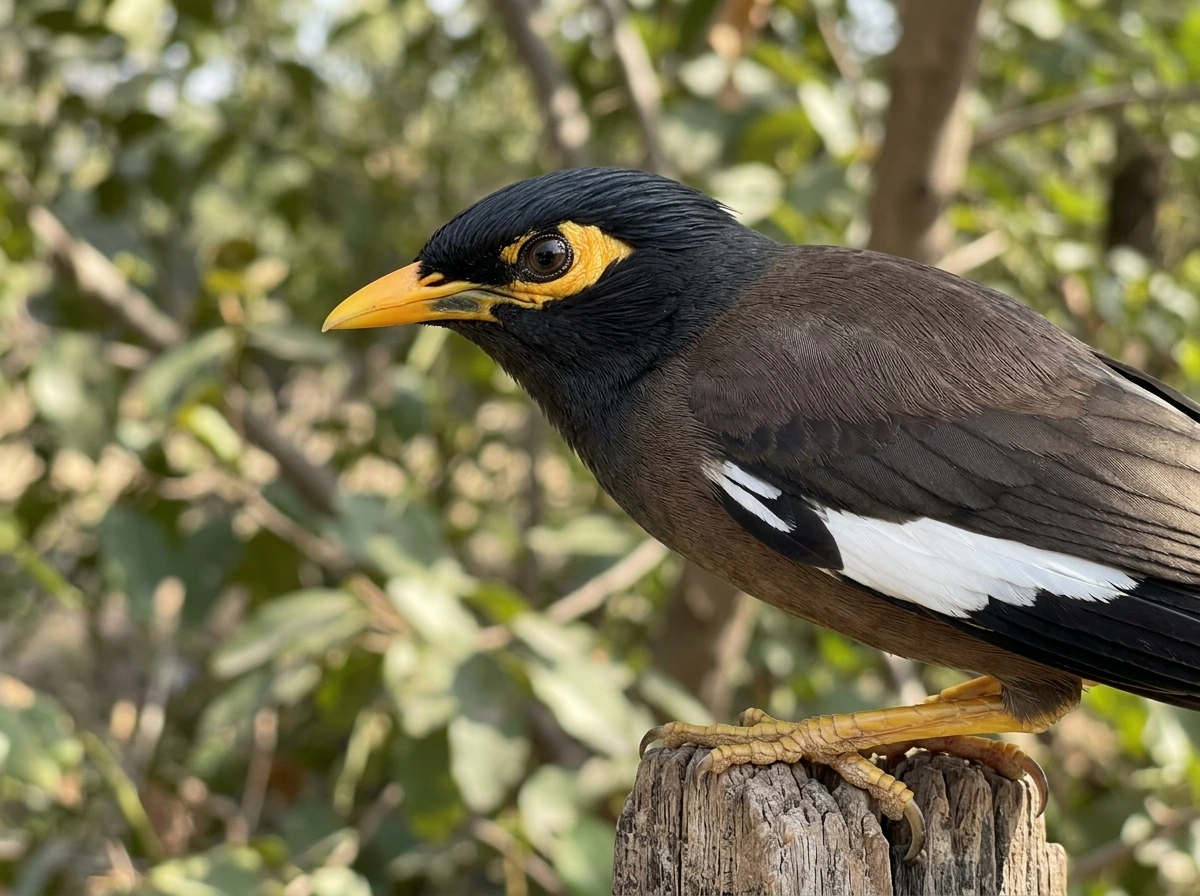
If you are trying to match a photo or a name you heard to the correct species, the fastest approach is to check a few physical markers and cross-reference with a bilingual bird resource or a tool like eBird.
Identifying the Common Myna (मैना / Acridotheres tristis)
- Large, stocky bird with a black head and brown body
- Bright yellow-orange bill, yellow legs, and a distinctive bare yellow patch of skin around and behind each eye
- Bold white wing patches that flash clearly in flight
- Loud, varied calls; often seen in pairs or small groups near human settlements
If the bird you are looking at matches those points, you are looking at the Common Myna (मैना). For the Jungle Myna (जंगली मैना), the key difference is a tuft of upright feathers at the base of the bill and a generally darker overall appearance with a less prominent bare eye patch. The Bank Myna (गंगा मैना) is paler, with a distinctive red-orange bare patch around the eye rather than yellow. Once you know what to look for, telling them apart in the field is actually quite manageable.
For a photo-based verification, upload the image to eBird's species identification tool or run it through a bird ID app like Merlin (Cornell Lab). Search under the English name "Common Myna" or "Jungle Myna," then cross-check the Hindi name given in the species sheet to confirm you have the right bird. Indian biodiversity checklists and Wikimedia Commons species pages also carry Devanagari names alongside the scientific name, which makes them useful bilingual references.
The myna in Indian culture and language
The मैना is one of the most culturally loaded birds in the Indian tradition, which explains why it has its own rich vocabulary across Indian languages. In Hindi folk culture and classical literature, the myna is celebrated for its ability to mimic human speech, and trained mynas were historically kept as companion birds in households across North India. The Sanskrit name सारिका (sārikā) appears in classical poetry and in stories from the Panchatantra tradition, where the clever, talkative myna often acts as a messenger or confidant.
Symbolically, the Common Myna is associated with companionship and auspiciousness. Seeing a pair of mynas together is considered a good omen in many regional folk traditions across the Hindi belt, somewhat similar to how certain Western traditions read the sighting of a single crow versus a pair. The bird's boldness around humans and its sharp vocalization have also made it a metaphor for a clever, quick-tongued person in Hindi idiom. The phrase "मैना की तरह बोलना" (to speak like a myna) is used colloquially to describe someone who talks a great deal, charmingly and without hesitation, this is also where people often ask about the <placeholder>dead bird meaning in hinduism</placeholder> in relation to myna symbolism.
Across other Indian languages, the equivalents are close in sound and spelling, reflecting the shared linguistic heritage. In Marathi, the bird is called मैना (same spelling, same sound). In Punjabi, you will hear ਮੈਨਾ (mainā in Gurmukhi script). In Gujarati, the word is મેના (menā), a slight vowel shift but clearly the same root. This cross-language consistency is unusual for bird names in the subcontinent, and it underscores just how deeply the Common Myna is woven into the shared cultural fabric of South Asia.
If you are exploring related bird meanings in Indian languages, the same kind of bilingual naming pattern appears across many species. For example, understanding how birds like the crane are named in Hindi follows a similar logic of Sanskrit roots combining with regional adaptations, something covered in other entries on this site. The myna is a particularly good starting point because its name is one of the rare cases where the Hindi word literally became the English word, making the translation almost self-evident once you know the connection.
FAQ
If I ask for the meaning of “myna” in Hindi, do people always mean the same bird species?
In Hindi, मैना (mainā) is the base word, but in everyday speech लोग usually mean Common Myna when they say only मैना. For Jungle Myna and Bank Myna, Hindi speakers typically add a prefix, like जंगली मैना or गंगा मैना, so the prefix is the practical clue when you want the exact species.
Is “myna” or “mynah” the correct English spelling for the Hindi मैना?
The spelling you see depends on transliteration choices for the long “a” sound in मैना. Both myna and mynah are used in English, so if you are searching, try both spellings, especially in regional bird groups, older field notes, or non-standard blogs.
How should I write the “myna bird” name in Hindi script, and what Roman spelling works best?
If you need the Hindi script for writing or searching, use मैना. If you are using a search engine in Roman letters, the most effective form is mainā with the long “a” at the end (you may also see maina without the macron), because Hindi bird pages often accept both.
Does “Common Myna” or “Indian Myna” always mean the same thing as “myna” in English?
In English, “Common Myna” and “Indian Myna” are commonly used for Acridotheres tristis. However, “myna” alone in English can be used loosely, so if you want to avoid confusion, pair the English name with the Hindi name or the scientific name when checking references.
Why can “मैना” sound generic in Hindi, and how do I avoid misidentifying the bird?
The word मैना is sometimes applied generically, similar to how “sparrow” might be used loosely in casual conversation. If you are trying to confirm a particular bird from a photo, do not rely only on the spoken name, check distinctive traits like the bill base tuft (Jungle Myna) or the eye patch color (Bank Myna).
What is the simplest step-by-step method to match a myna photo to the correct Hindi name?
If your goal is identification from a picture, a quick workflow helps: first decide if it is Common Myna versus Jungle Myna versus Bank Myna using the field markers (tuft at bill base, overall darkness, eye patch color). Then verify by comparing the Hindi name shown in the species sheet with the English name you selected in a bird ID tool.
When someone mentions मैना in a conversation, are they usually referring to the bird or to symbolism?
Across Hindi cultural usage, “मैना” is strongly tied to the bird’s association with mimicry and talkativeness, so idioms like speaking “like a myna” use the bird as a metaphor. That means symbolic meaning can show up even when the speaker is not talking about species-level details.
What common mistakes lead people to mix up Common Myna, Jungle Myna, and Bank Myna?
If you want to distinguish between similar species, prioritize stable physical cues rather than behavior alone. For example, the Jungle Myna tuft and the Bank Myna eye patch are more reliable than song quality or general boldness, which can overlap across mynas.
If my source is Marathi, Gujarati, or Punjabi, does the name still map to the Hindi मैना meaning?
Yes, you may encounter related names across nearby languages with similar pronunciation, like Marathi मैना or Gujarati मेना. If your source text is not in Hindi, treat the script as a clue to pronunciation, then map it back to the shared root idea of myna before jumping to a species.
Next Article
Dead Bird Meaning in Hinduism: Omens, Karma, and What to Do
Explore dead bird meaning in Hinduism: omens, karma and ancestors, plus what to do safely, respectfully, and by context.