
The Hindi word for crow is कौआ (kauā), also spelled कौवा (kauvā). Both forms are correct and widely used in everyday Hindi. If you trace the word back further, you land in Sanskrit, where the crow is काक (kāka), a root that echoes across nearly every Indian language from Marathi to Gujarati to Punjabi. The crow is one of the most linguistically, culturally, and ornithologically documented birds on the subcontinent, and once you start pulling at the threads of its name, you find mythology, omens, idioms, and ecology woven tightly together.
Crow Bird Meaning in Hindi: Names, Pronunciation & Culture

Rajesh Sharma
27 Jul 2026
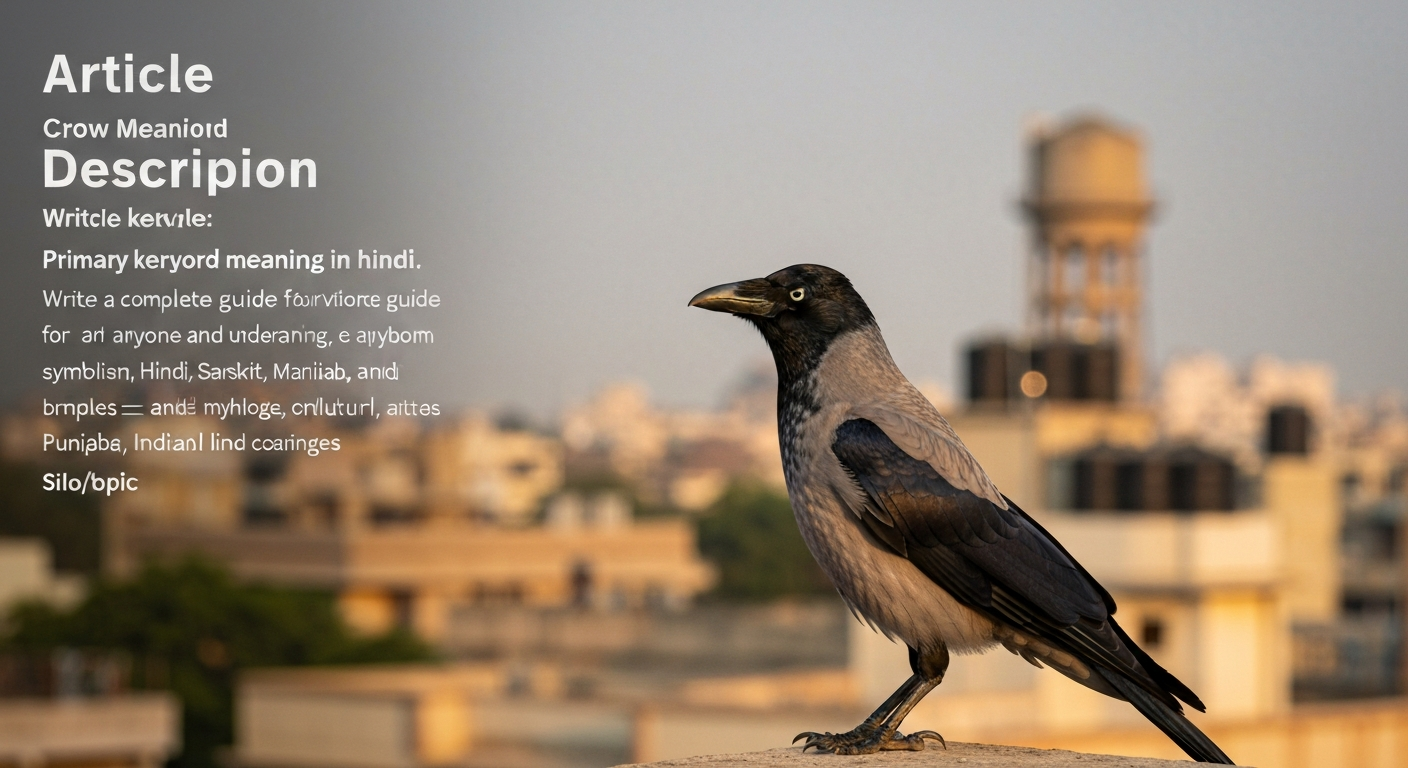
At a glance: crow in Hindi
| Feature | Detail |
|---|---|
| Hindi name | कौआ (kauā) / कौवा (kauvā) |
| Sanskrit root | काक (kāka) |
| Part of speech | Masculine noun |
| Common species in India | House Crow (Corvus splendens), Large-billed Crow (Corvus macrorhynchos / C. culminatus) |
| Family | Corvidae |
| Symbolic role | Ancestor messenger (pitru paksha), omen bird, trickster figure |
| Found in | All of India, year-round resident |
Hindi names in Devanagari: spelling, transliteration, and pronunciation
The primary Hindi lemma is कौआ. In IAST (International Alphabet of Sanskrit Transliteration), the standard academic system, this is written kauā. In the Hunterian system, which is the Government of India's conventional romanization and the one you will encounter most often in official place-names and older texts, it is rendered as kauā or kauwā. The ISO-15919 standard, used in library cataloguing, produces the same essential form.
For pronunciation, break कौआ into two syllables: kau (rhymes with the English word 'cow') plus ā (a long, open 'aah' sound). Put them together: KAU-aa, with emphasis on the first syllable. The variant कौवा (kauvā) adds a soft 'v' between the two vowel sounds, giving KAU-vaa. Both are equally natural in spoken Hindi. If you want to hear a native speaker, Forvo hosts user-recorded Hindi pronunciations of कौआ that are very helpful for getting the exact vowel length right.
- कौआ — IAST: kauā — pronounced: KAU-aa (two syllables, stress on first)
- कौवा — IAST: kauvā — pronounced: KAU-vaa (with a light 'v' sound in the middle)
- The final ā is always a long vowel; avoid shortening it to a quick schwa
- Both spellings appear in dictionaries, newspapers, and everyday speech — neither is wrong
What the crow is called across Indian languages
One of the things I find most satisfying about this bird is how clearly its name family shows the reach of Sanskrit through the Indo-Aryan languages. The Sanskrit root काक (kāka) is the ancestor of the Gujarati and Punjabi forms, while Hindi's कौआ follows a slightly different phonological path. Here is the full cross-linguistic picture.
| Language | Script | Transliteration | Pronunciation guide |
|---|---|---|---|
| Hindi | कौआ / कौवा | kauā / kauvā | KAU-aa / KAU-vaa |
| Sanskrit | काक | kāka | KAA-ka (both syllables even) |
| Marathi | कावळा | kāvaḷā | KAA-va-laa (three syllables) |
| Punjabi | ਕਾਂ / ਕਾਗ / ਕਾਉਂ | kāṃ / kāg / kāuṃ | KAAN / KAAG / KAA-um |
| Gujarati | કાગડો | kāgḍo | KAA-g-do (retroflex 'ḍ') |
Marathi कावळा (kāvaḷā) uses a retroflex lateral (ḷ), a sound that does not exist in standard Hindi or English, produced by curling the tongue back to touch the roof of the mouth. Gujarati કાગડો (kāgḍo) derives transparently from Sanskrit kāka with a retroflex ḍ, and Wiktionary's Gujarati entry confirms the declension and derivation. In Punjabi, ਕਾਂ is the clipped colloquial form you will hear most often; ਕਾਗ is the more literary Punjabi cognate of Sanskrit kāka.
Scientific name, taxonomy, and Indian species
Crows belong to the genus Corvus, family Corvidae, order Passeriformes. In India, two species are the ones you encounter in daily life. The House Crow, Corvus splendens, is the slim, grey-necked bird that perches on your rooftop and raids your lunch. The Large-billed Crow complex, Corvus macrorhynchos sensu lato, is all-black and larger, more often seen in forests and wooded areas. Within peninsular India and Sri Lanka, this complex includes what some authorities now treat as a separate species, the Indian Jungle Crow, Corvus culminatus, supported by mitochondrial genome and phylogeographic studies. The India checklist maintained by Praveen, Jayapal, and Pittie (Indian BIRDS) and Avibase both acknowledge culminatus as the relevant peninsular taxon. blank" rel="noopener noreferrer">Praveen, Jayapal & Pittie: A checklist of the birds of India (Indian BIRDS) lists Indian Corvus entries and treats peninsular forms such as Corvus culminatus as distinct.
| Common name | Scientific name | Hindi name | Key trait |
|---|---|---|---|
| House Crow | Corvus splendens | कौआ (kauā) | Grey neck and throat, urban/coastal |
| Large-billed / Jungle Crow | Corvus macrorhynchos | जंगली कौआ (jaṅglī kauā) | All glossy black, heavier bill, forest edge |
| Indian Jungle Crow | Corvus culminatus | भारतीय जंगली कौआ | Peninsular/southern India form, sometimes split |
Identification: what crows look like
The House Crow (Corvus splendens) measures roughly 40 to 43 cm from bill tip to tail. Its most useful field mark is the grey neck, nape, and upper breast, which contrast sharply with the black wings, tail, face, and belly. The bill is slender relative to a raven or Large-billed Crow. Grimmett, Inskipp, and Inskipp (Birds of the Indian Subcontinent) describe it as 'strongly synanthropic', meaning it is almost inseparable from human settlement. You find it in every Indian city, town, fishing village, and port.
The Large-billed Crow (Corvus macrorhynchos / C. culminatus) is noticeably larger at 46 to 59 cm. It is entirely glossy black with a thick, arched bill that looks almost too heavy for its head. In the field you will not see any grey. It favours forest edges, wooded hills, and orchard belts rather than dense urban cores, though it does visit villages. The India Biodiversity Portal's species summary for Corvus macrorhynchos confirms these measurements and the all-black plumage as the key distinguishing feature from the House Crow.
Calls and vocalizations: how to recognize a crow by ear
The House Crow produces a familiar, slightly nasal 'kaaa' or 'kaw' call that most people in Indian cities have grown up hearing without thinking about it. Field accounts describe the pitch as relatively high for a crow, and the call is often delivered in rapid sequences when the bird is alarmed or competing for food. The Large-billed and Indian Jungle Crow give a deeper, more resonant 'caa' or 'caw' that carries further and sounds noticeably more bass-heavy. This vocal difference is documented in field guides and in the taxonomic literature on the macrorhynchos complex and is useful for distinguishing the two species in the field. Field accounts and recordings note that Large‑billed and Jungle Crows have deeper, more resonant calls than House Crows, a feature used as a diagnostic character in regional keys and taxonomic literature blank" rel="noopener noreferrer">Field accounts and recordings note that Large‑billed and Jungle Crows have deeper, more resonant calls than House Crows, a feature used as a diagnostic character in regional keys and taxonomic literature.. The xeno-canto archive holds CC-licensed recordings for both Corvus splendens and Corvus culminatus (including recording XC19736 for the Indian Jungle Crow) that give you a direct comparison.
It is worth noting that the Hindi word कौआ almost certainly evolved as an echoic or onomatopoeic word. Kau, the first syllable, mirrors the 'kaw' sound the bird makes. This is not unique to Hindi: you can hear the same sound-imitation logic in काक (kāka), in Marathi कावळा, and even in the English 'caw'. The crow, in a real sense, named itself.
Behaviour, habitat, and range
Feeding and social behaviour
Crows are omnivores with a talent for opportunism. House Crows follow fishing boats, raid markets, steal food from other birds, and cache scraps for later. They are highly social and form loose flocks that roost communally, sometimes in thousands. Their intelligence is well-documented: they recognise individual human faces, use tools in experimental settings, and pass information across generations within a flock. In Indian urban ecology, the House Crow is one of the most successful bird species precisely because of this adaptability.
Nesting
House Crows nest in loose stick-and-twig cups placed in trees, on building ledges, and on electricity towers. Nesting season in northern India is broadly April to June, though it can extend earlier in coastal south India. Both parents share incubation and chick-rearing duties. The nests are notoriously flimsy in construction but placed at heights that reduce predator access.
Range and habitat
Corvus splendens is a year-round resident across the entire Indian subcontinent, extending from coastal areas deep inland. It is particularly dense along coastlines and river towns. The Large-billed Crow complex has a broader altitudinal and habitat range, reaching into forested hills and lower Himalayas, while C. culminatus is concentrated in peninsular and southern India. Both species are resident, non-migratory birds.
Crow symbolism and cultural meaning in Indian tradition
The crow carries more symbolic weight in Indian culture than almost any other common bird. In Hindu tradition, the most important role is its association with pitru paksha, the fortnight dedicated to ancestors. It is widely believed that ancestors (pitru) return to earth in the form of crows, and feeding crows during this period, an act called kak bali or crow offering, is a common ritual practice across Hindu communities. If a crow accepts the food, it is traditionally interpreted as the ancestor receiving the offering. This belief is documented in texts connected to shradh (ancestral rites) and is still widely observed across north and south India.
In Hindu iconography, the crow is the vahana (vehicle) of Shani, the deity associated with the planet Saturn. Because Shani governs karma, discipline, and obstacles in Jyotisha (Vedic astrology), the crow by extension carries connotations of fate and consequences. Offering food to crows on Saturdays is a common folk practice believed to appease Shani and ease hardship.
The crow also appears as a trickster and wise figure in the Panchatantra and Hitopadesha, the ancient Sanskrit collections of fables. The most famous crow story is arguably 'The Crow and the Pitcher', where a thirsty crow drops pebbles into a narrow-mouthed vessel to raise the water level. The Panchatantra's crow characters are typically clever, strategic, and occasionally cunning to the point of deception. The Sanskrit term kākamimāṃsā ('crow deliberation') refers, in classical usage, to a style of argument that scrutinises every angle before committing, a nod to the bird's reputation for sharp observation.
Omens and folk beliefs
In folk belief, a crow cawing persistently near your home is commonly interpreted as a sign that guests are arriving soon. This omen is so embedded in Indian culture that the Hindi idiom 'काग बोले, मेहमान आए' (kāg bole, mehmān āe, meaning 'when the crow calls, guests come') is understood without explanation across generations. Conversely, a crow cawing on a rooftop at certain times and in certain directions carries inauspicious readings in some regional traditions. These beliefs vary considerably by region and community.
Sanskrit poetry and literary references
Classical Sanskrit poets used the crow both as a foil and as a symbol of base cunning when contrasted with the swan (hansa). The phrase 'kakasya iva drishti' ('like a crow's gaze') describes someone who looks sharply from one side, because crows turn their heads to view objects with one eye at a time rather than facing them directly. This very specific behavioural observation was recorded in Sanskrit texts centuries before modern ornithology described the same monocular vision habit.
Hindi idioms and sample sentences for language learners
Learning the idioms around a word is often the fastest route to genuine fluency. Here are the most commonly used crow-related expressions in Hindi, with literal and functional translations.
| Hindi idiom / phrase | Transliteration | Literal meaning | Functional meaning |
|---|---|---|---|
| काग बोले, मेहमान आए | kāg bole, mehmān āe | When the crow calls, guests come | A crow cawing means visitors are on their way |
| कौए की चाल | kauā kī cāl | The crow's gait/walk | Used for someone who tries to imitate others awkwardly |
| न कौआ न हंस | na kauā na haṃs | Neither crow nor swan | Someone who belongs to neither group; an in-between figure |
| कौए को हंस बनाना | kauā ko haṃs banānā | To turn a crow into a swan | Attempting an impossible transformation |
| कौए उड़ाना | kauā uṛānā | To shoo crows away | Colloquially: wasting time on pointless activity |
| काले कौए जैसा | kāle kauā jaisā | Like a black crow | Very dark-complexioned (colloquial, sometimes pejorative — use with awareness) |
For simple reference sentences: 'वह कौआ पेड़ पर बैठा है' (vah kauā peṛ par baiṭhā hai) means 'That crow is sitting on the tree.' 'कौए बहुत चालाक होते हैं' (kauā bahut cālāk hote haiṃ) means 'Crows are very clever.' These two sentences cover the bird both as a singular noun and in a general plural sense, which helps with Hindi noun inflection practice.
How crows compare to ravens, rollers, and vultures
Because this site covers ravens, rollers, and vultures as separate entries, it is worth drawing sharp lines between the crow and these commonly confused or linguistically related birds. In India, ravens are less common than crows but genuinely present in the Himalayas and arid northwest; rollers are completely unrelated despite sharing a dark plumage in parts; and vultures are sometimes confused with large crows by beginners.
| Feature | Crow (कौआ) | Raven | Indian Roller | Vulture |
|---|---|---|---|---|
| Hindi name | कौआ / कौवा | काला कौआ / रेवन | नीलकंठ (nīlkaṇṭh) | गिद्ध (giddh) |
| Size | 40–59 cm (species dependent) | 55–67 cm | 30–34 cm | 85–120 cm |
| Plumage | Black, or black + grey (House Crow) | All glossy black, iridescent | Brilliant blue and turquoise | Brown, black, pale, with bare head/neck |
| Bill | Moderate, slightly curved | Large, heavy, curved | Moderate, slightly hooked | Very heavy, hooked for tearing flesh |
| Flight | Steady, flapping | Soaring, acrobatic tumbles | Acrobatic, rolling display flights | Soaring on thermals, rarely flapping |
| Habitat | Urban, forest edge, coast | Mountains, cliffs, desert | Open country, forest edges | Cliffs, open plains, near carcasses |
| Family | Corvidae | Corvidae | Coraciidae | Accipitridae |
| Cultural note | Ancestor/omen bird | Less prominent in Indian lore | Sacred to Shiva (nīlkaṇṭh) | Associated with death, impurity in some traditions |
The raven is the crow's closest relative in this group, both sitting in Corvidae, and in Hindi the distinction is not always sharp in everyday speech. For the Hindi term and cultural notes on the raven, see the raven bird meaning in Hindi entry. Many people call large crows 'ravens' in casual English, but ornithologically they are separate species. The Indian Roller is called नीलकंठ (nīlkaṇṭh) and is sacred in a very different context, associated with Shiva and released during Dussehra in some regions. For the roller bird meaning in Hindi, see the entry on the Indian Roller (नीलकंठ, nīlkaṇṭh). The vulture (गिद्ध, giddh) is considerably larger and is a raptor, not a passerine, sharing with the crow only the association with death in popular imagination.
A note on 'crone bird': a common search misspelling
If you searched for 'crone bird meaning in Hindi' and landed here, you may have intended 'crow'. In English, 'crone' means an old woman and has no ornithological meaning. It is simply a misspelling or misremembering of 'crow'. The Hindi word you are looking for remains कौआ (kauā). There is a separate entry on this site that addresses the 'crone bird' search term directly for anyone who wants more detail on that confusion.
Human-crow relationships, urban ecology, and conservation
The House Crow is not a bird in need of conservation concern. It is, if anything, one of India's most overabundant species in urban areas, and in some island ecosystems outside India (parts of East Africa, the Maldives, Mauritius) it has been introduced and become invasive, outcompeting native birds. Within India, the relationship between humans and crows is one of deep mutual adaptation. Crows benefit from human food waste, open markets, and the structural complexity of buildings. Humans benefit from crows' role as urban scavengers cleaning up organic waste.
Where crows do face pressure in India is through the loss of large nesting trees in rapidly expanding cities. The replacement of old, tall trees with ornamental planting reduces suitable nest sites. Crows also suffer secondary poisoning when they scavenge animals that have been killed using non-steroidal anti-inflammatory drugs (particularly diclofenac), the same pharmaceutical that drove the catastrophic collapse of Indian vulture populations, though crows are far less vulnerable than vultures. The practical conservation note here is less about protecting crows and more about not poisoning the food chain they are part of.
Images and media worth exploring
For high-quality photographs and recordings, Wikimedia Commons and the Macaulay Library (via eBird) both hold substantial collections for Corvus splendens and Corvus macrorhynchos. Individual image licenses vary, so check each file before reuse. Macaulay Library records typically require attribution to Cornell Lab of Ornithology. The xeno-canto archive, where recordings carry Creative Commons licenses, is the best free source for call comparisons between House Crow and Indian Jungle Crow. If you want a quick visual comparison of crow versus vulture or crow versus raven, the India Biodiversity Portal's species pages carry field photographs taken in the subcontinent, which is more useful than European or North American reference images.
FAQ
Which authoritative linguistic sources are required to document the Hindi word for “crow” and its correct spelling and lemma?
Primary sources: modern Hindi dictionaries and lexica (e.g., Wiktionary / standard Hindi–English dictionaries) that list the lemma कौआ (alternative कौवा) with Devanagari spelling. Secondary needs: a Sanskrit lexicon (Monier‑Williams) to show the classical root काक (kāka) and its relationship to modern forms. Cite: Wiktionary entry for कौआ; Monier‑Williams Sanskrit‑English Dictionary (entry काक).
What transliteration and pronunciation standards should be cited and used?
Use academic reversible schemes (IAST or ISO‑15919) for scholarly transliteration and note the Hunterian system as India’s conventional romanization. Provide a simple audio‑ready pronunciation guide (e.g., kau‑ā where 'au' ≈ /ɔː/ or /au/ depending on reader) and point to native‑speaker recordings (Forvo) and field audio (xeno‑canto) for authentic samples. Cite: Devanagari transliteration references (IAST/Hunterian) and Forvo for recorded pronunciations.
Which regional language names must be included and what sources support them?
Include attested vernacular lemmas and script forms with transliteration: Sanskrit काक (kāka); Marathi कावळा (kāvḷā); Punjabi forms (examples: ਕਾਂ / ਕਾਗ / ਕਾਉਂ — cite regional lexica); Gujarati કાગડો (kāgḍo). Support these with regional dictionary/Wiktionary entries and cross‑linguistic lexica. Cite: Wiktionary pages for कावळा and કાગડો, and standard regional dictionaries where available.
What ornithological/taxonomic sources and specific facts are required for species identification and scientific names?
Authoritative field guides and checklists: Grimmett, Inskipp & Inskipp (Birds of the Indian Subcontinent) for ID, field marks, calls and range; the India checklist (Praveen, Jayapal & Pittie) for regional taxonomy and accepted names. Include scientific names and common Indian species: Corvus splendens (House Crow) and Corvus macrorhynchos sensu lato (Large‑billed/Jungle Crow), noting that peninsular Indian forms are often treated as Corvus culminatus. Provide measurable field traits: size ranges (approx. 40–43 cm for House Crow; 46–59 cm for Large‑billed/Jungle Crow), grey neck in many House Crow races vs. all‑black and larger bill in Large‑billed/Jungle Crows, and habitat/use (synanthropic vs. more forest/edge). Cite: Grimmett et al.; Praveen et al.; India Biodiversity Portal species pages.
What molecular/taxonomic evidence should be referenced regarding the macrorhynchos/culminatus split?
Reference peer‑reviewed phylogenetic/mitochondrial genome studies that report genetic structure within the Corvus macrorhynchos complex and support recognition of Indian lineages (e.g., culminatus). Cite the indicated PMC mitochondrial genome/phylogeny paper and note that some checklists/Avibase treat culminatus as the peninsular Indian taxon. Provide cautious wording (supported by molecular evidence) rather than definitive unilateral taxonomic statements. Cite: PMC phylogeny paper; Avibase entry for Corvus culminatus; Praveen et al. checklist.
Which acoustic and media repositories are authoritative for call samples and images, and what licensing checks are required?
Recommended repositories: xeno‑canto for field recordings (check individual CC licenses), Macaulay Library / eBird media and Wikimedia Commons for photos and videos. Always check each item’s license/credit requirements before embedding or reuse. Cite: example xeno‑canto recording (XC19736), Macaulay/eBird media search, and Wikimedia Commons guidelines.
Next Articles
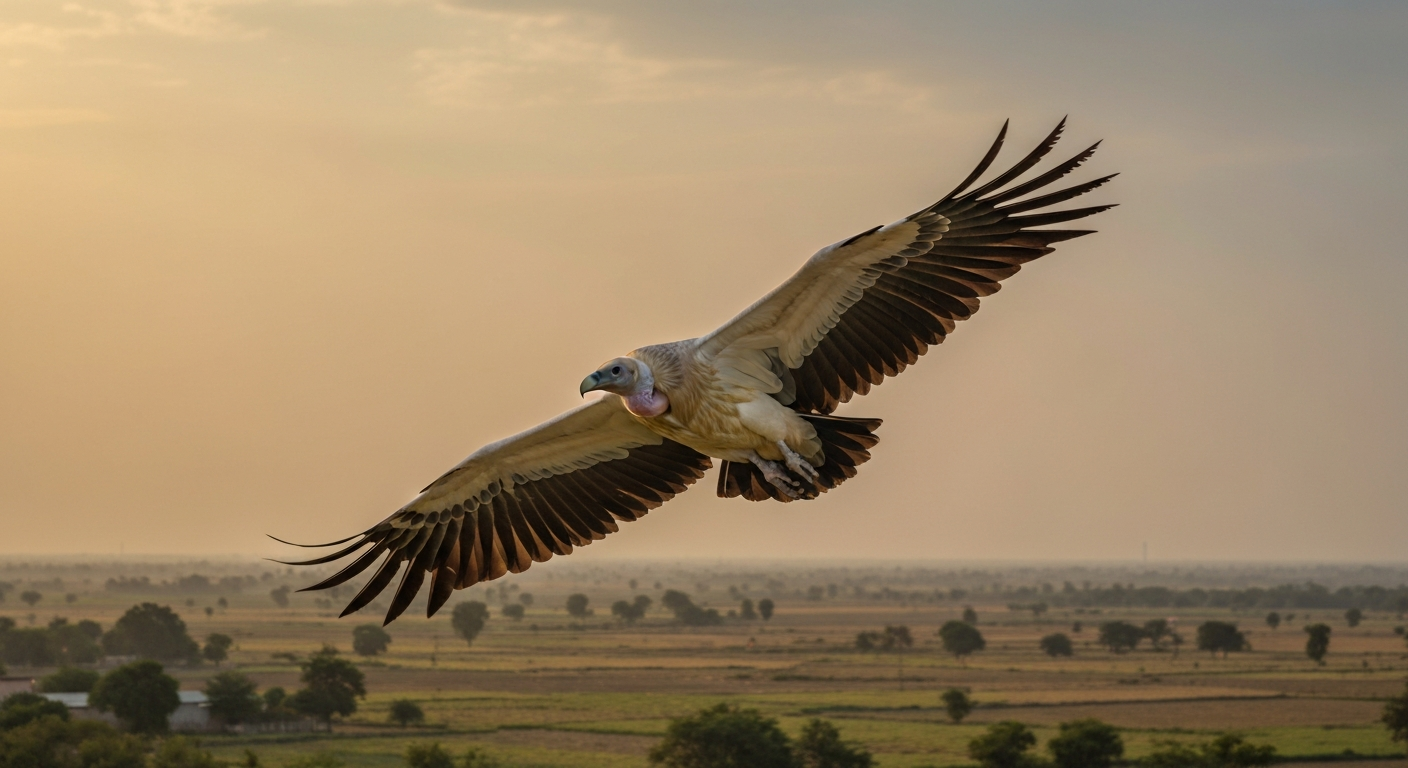
Vulture Bird Meaning in Hindi: Names, Symbolism & Facts
Vulture bird meaning in Hindi: शब्द (गिद्ध), transliteration, pronunciation, regional terms, species, symbolism & how to
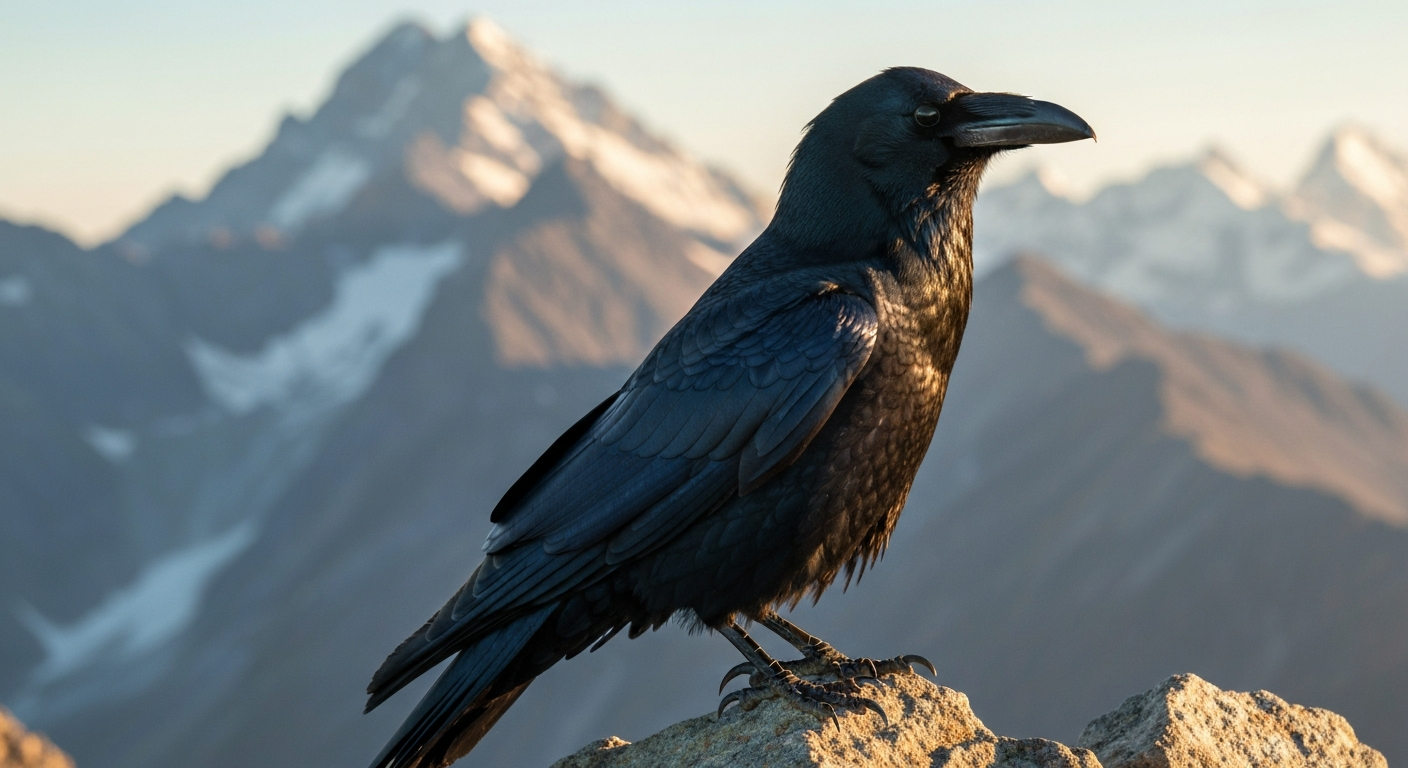
Raven Bird Meaning in Hindi: Translation, Symbolism, IDs
Raven meaning in Hindi, 'कौवा' (Corvus): identification, Sanskrit roots, myths, regional names & translation tips.
Bird Beak Meaning in Hindi: Chonch, Bill, Pronunciation
Bird beak in Hindi chonch or bill, pronunciation, examples, beak vs bill differences, and figurative Hindi use