
The Hindi word for vulture is गिद्ध (giddh). That is the form you will find in standard dictionaries, bilingual learning resources like Shabdkosh, and everyday Hindi usage. Variants like गिध and गीध do appear in regional speech and older texts, but गिद्ध is the accepted headword and the spelling to use in writing. For related vocabulary, see crone bird meaning in hindi for a comparison with similar bird terms.
Vulture Bird Meaning in Hindi: Names, Symbolism & Facts

Rajesh Sharma
23 Jul 2026
How to say गिद्ध: pronunciation guide
The IPA transcription of गिद्ध in standard modern Hindi is /ɡɪd̪d̪ʱ/. See Wiktionary: गिद्ध, IPA pronunciation (/ɡɪd̪d̪ʱ/) for the standard IPA mapping used in modern Hindi entries Wiktionary: गिद्ध — IPA pronunciation (/ɡɪd̪d̪ʱ/). Breaking that down: the initial sound is a hard 'g' as in 'get', followed by a short 'i' sound as in 'bit', and then a geminate (doubled) dental 'd' with aspiration at the end, giving a breathy 'dh' quality. The word is one syllable and ends abruptly on that aspirated stop. There is no long vowel in the standard pronunciation, the 'i' is short. A rough English approximation would be 'giddh', with the final 'dh' sounding like the 'dh' in 'adhere' but clipped. For audio, platforms like Forvo carry crowd-recorded Hindi pronunciations and are a reliable way to calibrate your ear before using the word in conversation.
Vulture in Sanskrit, Marathi, Punjabi, and Gujarati
The Hindi word गिद्ध did not appear out of nowhere. It descends from the Sanskrit गृध्र (IAST: gṛdhra), recorded in Monier-Williams and other classical Sanskrit lexica as the standard word for vulture. From gṛdhra, the word passed through Prakrit as giddha and then spread into the modern Indo-Aryan languages with slight sound shifts in each. In Punjabi the standard Gurmukhi headword for vulture is ਗਿੱਧ (giddh). The family resemblance across the languages below is unmistakable.
| Language | Script | Transliteration | Notes |
|---|---|---|---|
| Sanskrit | गृध्र | gṛdhra (IAST) | Classical root; used in Vedic and epic literature including the Ramayana |
| Hindi | गिद्ध | giddh | Standard modern form; the primary dictionary headword |
| Marathi | गिधाड | gidhāḍ | Standard Marathi noun; the retroflex ending '-āḍ' is a typical Marathi marker |
| Punjabi | ਗਿੱਧ | giddh | Written in Gurmukhi; recorded in Punjabi lexica including Mahan Kosh |
| Gujarati | ગીધ / ગીધડું | gīdh / gīdhḍũ | ગીધ is the base form; ગીધડું adds a diminutive/colloquial suffix |
Vulture species found in India
India hosts a surprisingly diverse set of vulture species, ranging from the familiar large Gyps vultures of the plains to the spectacular Himalayan Griffon soaring over mountain passes. Here are the key species you are likely to encounter in literature, field guides, or conservation discussions.
| Common English Name | Scientific Name | Quick Note |
|---|---|---|
| White-rumped Vulture | Gyps bengalensis | Once the most abundant vulture on earth; now Critically Endangered after catastrophic diclofenac-driven declines |
| Indian Vulture (Long-billed Vulture) | Gyps indicus | Breeds on cliffs and rocky outcrops across peninsular India; Critically Endangered |
| Slender-billed Vulture | Gyps tenuirostris | Found mainly in the foothills of the Himalayas and northeast; Critically Endangered |
| Himalayan Griffon | Gyps himalayensis | A massive high-altitude vulture; breeds on Himalayan cliffs and descends to plains in winter |
| Egyptian Vulture | Neophron percnopterus | Smaller, white-and-black bird; widespread across India including cities and farmland |
| Cinereous (Black) Vulture | Aegypius monachus | Rare winter visitor; one of the largest flying birds by wingspan |
| Bearded Vulture (Lammergeier) | Gypaetus barbatus | Distinctive rusty-orange plumage; specialist bone-dropper found in high Himalayas |
What vultures actually look like and how they live
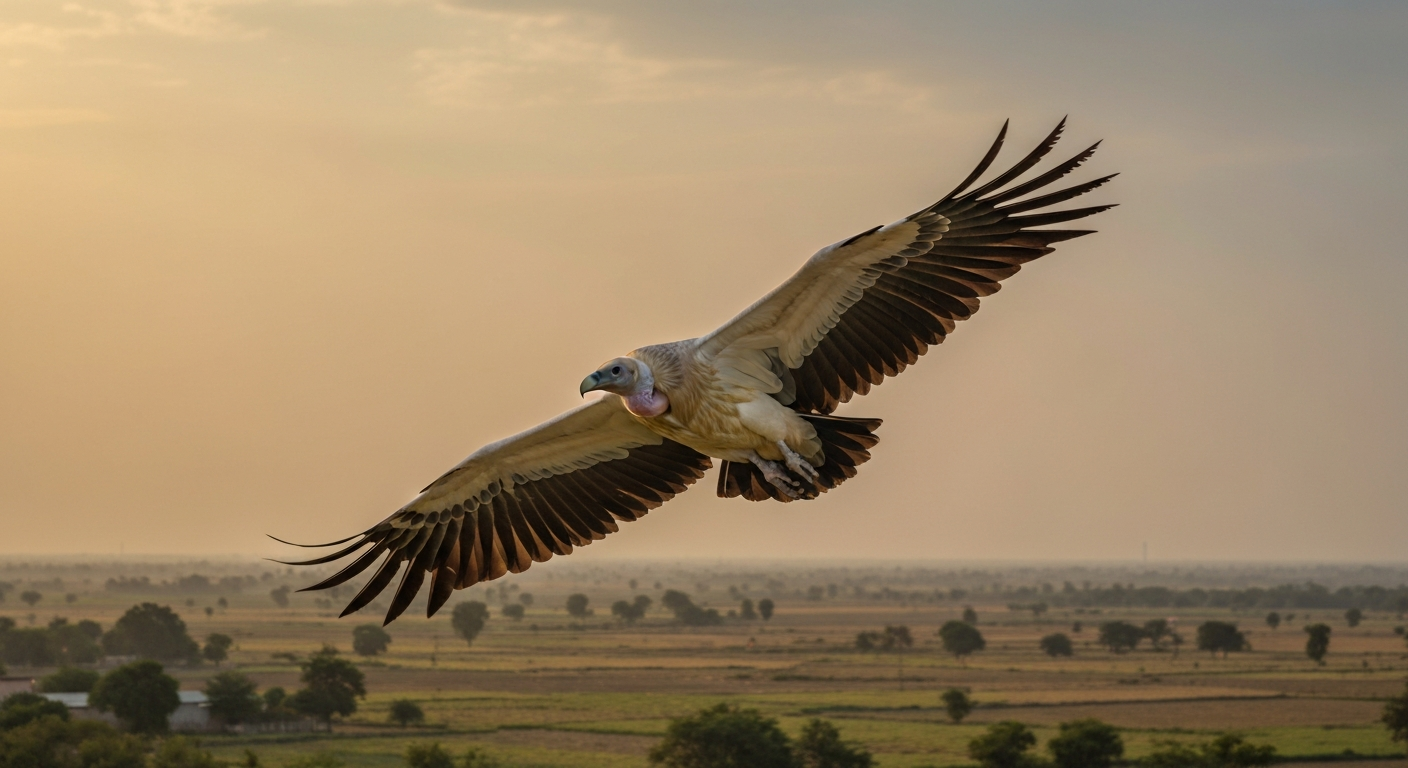
Vultures in India are large, heavy-bodied birds built for soaring, not speed. The Gyps species that dominate Indian skies have broad, fingered wings that spread between 180 and 260 centimetres, a bare or lightly downed neck, and a hooked bill adapted for tearing into tough hide. Their pale or brownish plumage, hunched resting posture, and bald-looking heads make them visually distinctive once you know what to look for. The Himalayan Griffon is the largest, while the Egyptian Vulture is much smaller and more agile, with a yellow face and white-and-black patterning that sets it apart entirely.
Diet is the defining characteristic of the group. All Indian vultures are obligate scavengers, meaning their diet consists almost entirely of carrion. They locate carcasses by sight rather than smell (unlike New World vultures), and they often gather in large, competitive groups at kills. This diet made them ecologically irreplaceable as a sanitation service across the subcontinent for millennia. Habitat-wise, different species occupy different niches: Gyps vultures favour open countryside, farmland, and cliff faces for nesting; the Himalayan Griffon nests on Himalayan ledges; the Egyptian Vulture is comfortable in semi-urban areas and near human settlements.
Vultures in Indian mythology and culture
Of all the birds in Indian tradition, the vulture holds a particularly dignified place in mythology, which is striking given how negatively the bird is viewed in many other cultures. The most celebrated vulture figures in Indian literature are Jatayu and Sampati, the two eagle-vulture brothers from the Ramayana. When Ravana abducts Sita, it is Jatayu, the aged vulture king, who intercepts the demon king's flying chariot and fights bravely to protect her. He is mortally wounded in the battle. Rama finds the dying Jatayu and mourns him with the grief he would show a father, performing his last rites personally, an act that elevates the bird to a figure of devotion, self-sacrifice, and loyalty in Hindu tradition. Sampati, Jatayu's elder brother, later assists Rama's army by using his sharp long-distance vision to spot Sita's location in Lanka.
The Sanskrit name for the vulture, गृध्र (gṛdhra), carries connotations of greed or intense desire in classical literature, because the root gṛdh relates to yearning or craving. This dual identity, the noble protector Jatayu alongside the Sanskrit gṛdha connoting covetousness, captures the complexity of the bird's symbolic position in Indian thought. In folk tradition, vultures circling overhead were read as omens, often connected to death or imminent conflict, which gave the bird a presence in everyday interpretive culture even among those with no knowledge of the Ramayana references.
In Parsi (Zoroastrian) funerary tradition, which has a significant presence in cities like Mumbai, vultures played a direct and sacred role. The Towers of Silence (dokhmas) were designed to have the bodies of the deceased consumed by vultures, a practice rooted in the belief that earth, fire, and water must not be polluted by the dead. The collapse of vulture populations in the 1990s caused a profound crisis for this community, since without vultures the system could not function as intended. This is a powerful illustration of how deeply the fate of these birds is woven into living Indian religious practice, not just mythology.
Hindi idioms and everyday usages involving गिद्ध
The vulture has worked its way into Hindi figurative speech in ways that reflect how the bird is popularly perceived: as a patient, watchful, opportunistic creature waiting to benefit from another's misfortune. Understanding these idioms helps learners engage with colloquial Hindi more naturally.
- गिद्ध दृष्टि (giddh dṛṣṭi): literally 'vulture's gaze' or 'vulture-eyed'; used to describe someone who watches keenly for an opportunity or who has sharp, predatory eyes fixed on something they want. You might hear it said of a businessman watching a rival's troubles, or of someone scanning for an advantage.
- गिद्धों की तरह मंडराना (giddhon kī tarah maṇḍrānā): 'to circle like vultures'; used when a group of people hover around someone or something, waiting to pick at the remains — a deal, an inheritance, a struggling business.
- गिद्ध नज़र रखना (giddh nazar rakhnā): 'to keep a vulture's eye on something'; similar to giddh dṛṣṭi but implies ongoing surveillance with acquisitive intent.
- In everyday speech, calling someone a गिद्ध (giddh) is an insult implying they are greedy, opportunistic, and wait for others to fail before swooping in for personal gain.
Vulture vs. crow, raven, roller, and other birds: how to tell them apart
Learners of Hindi bird vocabulary sometimes conflate गिद्ध with birds like the crow (कौआ, kauā), the raven (काला कौआ or रेवेन), or the Indian Roller (नीलकंठ, nīlakaṇṭha). The confusion is understandable because all are associated with death, omens, or mythology in different cultural contexts, and the crow and raven in particular share some symbolic overlap. See 'raven bird meaning in Hindi' for the Hindi term, translation, and usage for raven. The differences in reality, however, are stark. For the Hindi translation and usage of the roller (the bird), see roller bird meaning in Hindi.
- Size: Vultures are massively larger than crows or ravens. A White-rumped Vulture weighs around 3.5 to 7.5 kg with a wingspan up to 260 cm. A House Crow weighs roughly 280 to 400 g. There is no realistic visual confusion in the field.
- Flight style: Vultures soar in wide, lazy thermals with barely a wingbeat for minutes at a time. Crows and ravens flap actively and fly in direct or bounding patterns.
- Neck: Vultures have bare or downy necks adapted for reaching inside carcasses without matting feathers. Crows and ravens have fully feathered heads and necks.
- Diet: Vultures eat almost exclusively carrion. Crows and ravens are omnivores that eat insects, grains, scraps, eggs, and occasionally carrion as a supplement — they are not primarily scavengers.
- The Indian Roller (नीलकंठ, associated with Shiva worship and auspicious sightings) is a medium-sized, brilliantly blue-and-turquoise bird. It shares no physical or behavioral trait with vultures and is mentioned here only because both appear in religious and symbolic contexts that learners sometimes cross-reference.
- Hindi vocabulary comparison: vulture is गिद्ध (giddh), crow is कौआ (kauā), raven does not have a fully standardized separate Hindi term and is often called काला कौआ (kālā kauā, 'black crow') or raven directly, and the Indian Roller is नीलकंठ (nīlakaṇṭha).
Conservation: why India's vultures collapsed and what is being done
The story of India's vulture crisis is one of the most dramatic wildlife collapses ever documented. In the 1980s, Gyps bengalensis (White-rumped Vulture) was considered among the most numerous large birds of prey on earth. By the mid-1990s, populations had crashed by over 95 percent. Scientists, led by Oaks and colleagues in a landmark 2004 paper in Nature, identified the cause: veterinary diclofenac, a common anti-inflammatory drug given to livestock. When vultures fed on the carcasses of treated animals, even tiny residues caused fatal kidney failure (visceral gout) within days. The drug was so widely used that it contaminated carcasses across the entire subcontinent.
The Indian government banned veterinary diclofenac for animal use in 2006, following the scientific evidence and sustained pressure from conservation organisations including BNHS (Bombay Natural History Society), RSPB, and BirdLife International. The safer alternative meloxicam was promoted as a substitute. Conservation programs established Vulture Safe Zones, areas where the use of diclofenac in livestock is actively monitored and reduced to create refuge feeding grounds. Captive breeding programs have been running for several Gyps species with the goal of eventual reintroduction. Recovery is slow: Critically Endangered status still applies to Gyps bengalensis, Gyps indicus, and Gyps tenuirostris as of current IUCN assessments.
What you can do if you care about vultures
- Report vulture sightings to platforms like eBird India or the BNHS citizen science programs — distribution data directly supports conservation planning.
- If you keep livestock or are a farmer, ask your veterinarian specifically for meloxicam rather than diclofenac for pain management in cattle and buffalo.
- Support or follow the work of SAVE (Saving Asia's Vultures from Extinction), the RSPB India program, and BNHS, which coordinate most of the ground-level recovery work.
- Spread awareness about the Jatayu conservation narrative — framing vulture protection within the Ramayana context resonates powerfully with communities across India.
FAQ
What primary lexical sources should I consult to give accurate Hindi and regional names for 'vulture' (Devanagari, transliteration, variants)?
Use established bilingual and monolingual dictionaries and lexica: Wiktionary, Shabdkosh, regional lexica for Marathi, Punjabi, Gujarati, and authoritative print dictionaries (e.g., Mahan Kosh for Punjabi). For Sanskrit headwords use Monier‑Williams / SanskritDictionary.org. Record headword in Devanagari/Gurmukhi/Gujarati script, provide transliteration (Hunterian or simplified for Hindi; IAST for Sanskrit), and note common variants (e.g., Hindi गिद्ध, variants गिध/गीध). Include citations/links for each entry.
Which transliteration and pronunciation standards should I use and cite for SEO and learner clarity?
Cite IAST (academic/Sanskrit), ISO 15919 (script transliteration reference) and the Hunterian or simplified romanization for Hindi learners. Provide short IPA transcriptions for learner pronunciation (use Wiktionary IPA as a starting point) and, where possible, link/embed native audio from Forvo or institutional archives. Document which convention you used for each language entry.
What etymological and historical sources are required to explain the word history (Sanskrit → modern reflexes)?
Cite Monier‑Williams/SanskritDictionary.org for Sanskrit गृध्र (gṛdhra), plus etymology notes from Wiktionary and comparative Indo‑Aryan resources showing the pathway gṛdhra → गिद्ध → modern reflexes (Hindi, Marathi, Punjabi, Gujarati). Use peer‑reviewed or authoritative etymological works where available and reference the specific pages.
Which ornithological and species references are needed for accurate species notes (English + scientific names) for vultures in India?
Use BirdLife International species factsheets, IUCN Red List accounts, Avibase, and regional checklists (e.g., Birds of India, BNHS publications). List species occurring in India with common and scientific names (e.g., Gyps bengalensis — White‑rumped vulture), distribution, and link to each species' BirdLife/IUCN page for status and range maps.
What authoritative biology references should I consult for appearance, diet, and habitat summaries?
Use species accounts and field guides (BirdLife, IUCN, Avibase, Birds of South Asia field guides), peer‑reviewed ecology papers where relevant, and reputable natural history texts. Summarize typical plumage/size, scavenging diet, habitat preferences (open country, cliffs, human‑modified landscapes) citing those sources.
Which scientific studies and conservation documents are required to explain vulture declines and current conservation status?
Cite key peer‑reviewed studies establishing causes of decline (e.g., Oaks et al. 2004 — diclofenac in Nature; Green et al. 2004 modeling), IUCN Red List assessments for each species, BirdLife DataZone, and conservation program pages (SAVE consortium, RSPB, BNHS) describing policy responses (diclofenac ban, meloxicam, Vulture Safe Zones, captive breeding). Include dates and links to policy documents and program summaries.