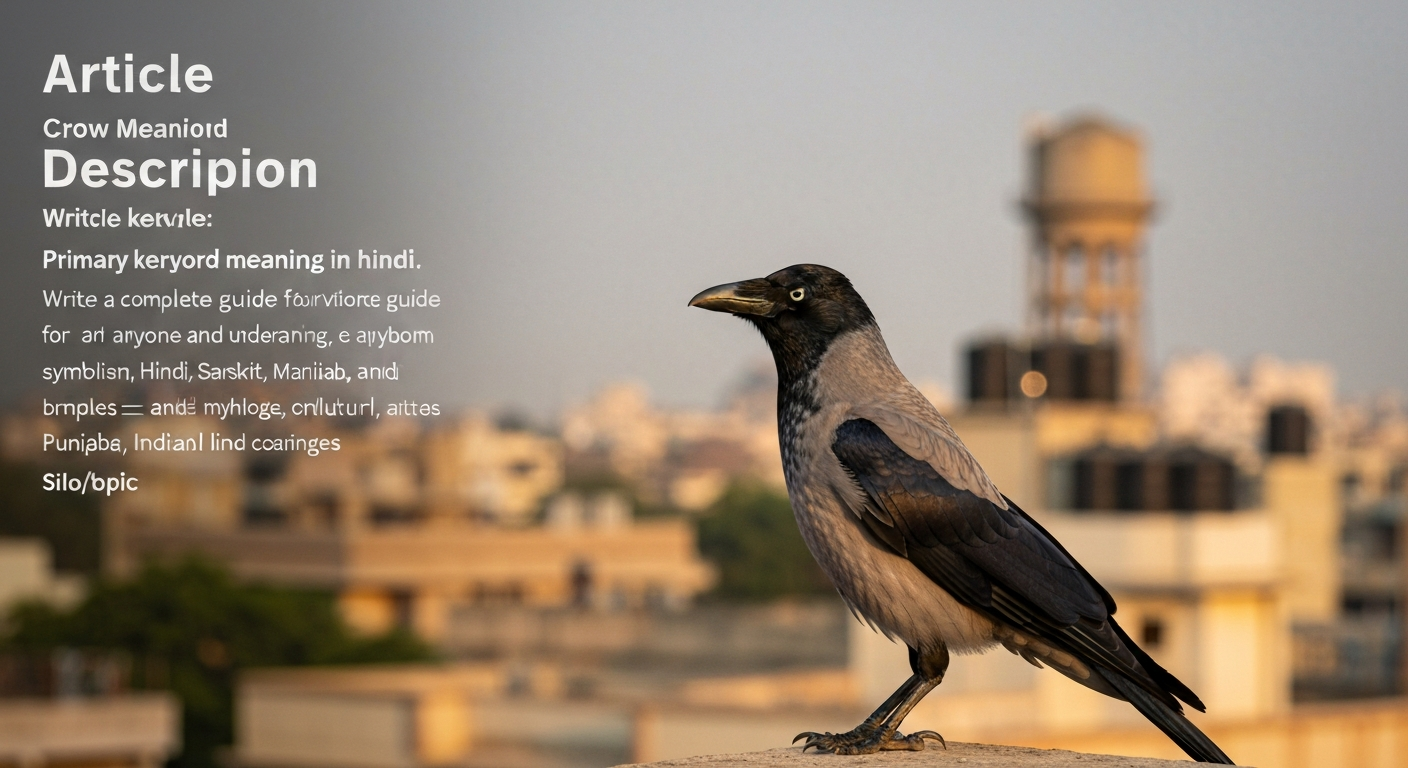
There is no bird called a 'crone' in English or in any Indian language. 'Crone' is a standard English word meaning an old or withered woman, and no major dictionary, field guide, or ornithological checklist lists it as a bird name. If you searched for 'crone bird meaning in Hindi,' you almost certainly meant one of five birds whose English names sound close or whose descriptions overlap: crow, crane, raven, Indian roller, or vulture. See Crow, Wikipedia (background on common Corvus species and common usage) for background on crows, a highly visible Corvus species often intended when people search for similar-sounding bird names Crow — Wikipedia (background on common Corvus species and common usage). This article works through each of those candidates, gives you their correct Hindi and regional-language names with pronunciation, explains their cultural and mythological meanings in Indian traditions, and helps you pin down exactly which bird you had in mind.
Crone Bird Meaning in Hindi: Crow, Raven, Crane Explained

What people actually mean by 'crone bird'
When a term turns up in search queries but does not match any real bird name, the most useful thing to do is treat it as a phonetic near-miss and work out which real bird name the query is pointing toward. 'Crone' shares enough sounds and letters with 'crow,' 'crane,' and 'raven' that any of them could be the intended target, depending on whether you heard the word spoken aloud, misread it, or typed quickly. The roller and the vulture are included because they are prominent black or large birds in South Asian landscapes that often come up in searches about ominous or symbolic birds in Hindi.
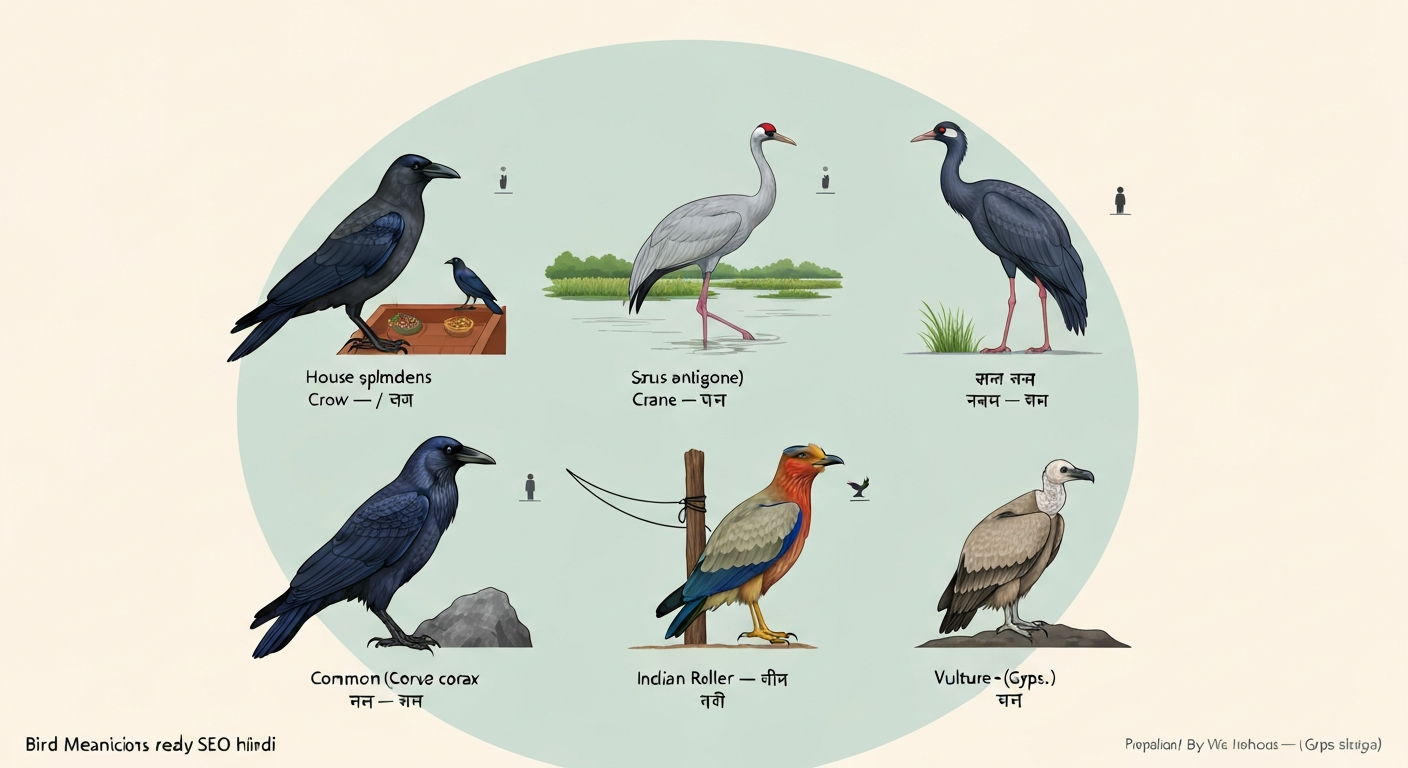
Five plausible intended birds are listed below, each with a short reason why it fits the 'crone' query.
- Crow (Corvus splendens, the House Crow): 'crow' and 'crone' are one letter apart and phonetically close, making this the single most likely intended bird. Crows are the most visible urban bird across the Indian subcontinent and generate the most Hindi-language search interest.
- Crane (Grus antigone, the Sarus Crane): the vowel sounds in 'crane' and 'crone' are very similar, especially when spoken quickly or with a regional accent. Cranes are prominent in Sanskrit poetry and Indian mythology, which drives cultural searches.
- Raven (Corvus corax): ravens are often conflated with crows in both English and Indian contexts; someone researching a large black bird in northern India or the Himalayas may arrive at 'crone' from 'raven' via a phonetic drift.
- Indian Roller (Coracias benghalensis): the roller's Hindi name नीलकंठ (nīlakaṇṭha) is deeply embedded in Hindu symbolism, and its English name 'roller' can sound unfamiliar; a reader who encountered the bird as a 'colorful crow-like bird' might search using an approximate term.
- Vulture (Gyps spp. and relatives): large, dark, circling birds are frequently grouped with crows in informal descriptions; the mythological prominence of the vulture in the Rāmāyaṇa makes it a likely cultural search target.
Quick comparison: the five candidate birds
| English Name | Primary Hindi Name | Script | Symbolism Keywords |
|---|---|---|---|
| Crow (House Crow) | Kauā / Kauvā | कौआ / कौवा | ancestors, omens, intelligence, Shani, death |
| Crane (Sarus Crane) | Sāras | सारस | devotion, love, fidelity, poetic sorrow, fertility |
| Raven | Kāg / Kauā (large) | काग / कौआ | mystery, prophecy, darkness, northern landscapes |
| Indian Roller | Nīlakaṇṭha | नीलकंठ | Vijaya Dashami luck, Vishnu, auspiciousness, Shiva |
| Vulture | Giddh | गिद्ध | death, purification, Jatayu, Rāmāyaṇa, sacrifice |
Names across five Indian languages: how each bird is spoken and written
The transliterations below follow the IAST (International Alphabet of Sanskrit Transliteration) convention for Sanskrit forms and ISO 15919 for modern Indic scripts. Pronunciation notes are approximate guides for English speakers; IPA forms are drawn from Wiktionary entries where available.
Crow
| Language | Name | Script | Pronunciation Guide |
|---|---|---|---|
| Hindi | Kauā / Kauvā | कौआ / कौवा | KOW-aa (rhymes with 'now' + 'aa') |
| Sanskrit | Kāka | काक | KAA-ka (long first vowel) |
| Marathi | Kāvḷā | कावळा | KAA-vla (short 'vla' at end) |
| Punjabi | Kāṃ / Kāg | ਕਾਂ / ਕਾਗ | KAANG (nasal) / KAAG |
| Gujarati | Kāgo | કાગો | KAA-go |
Crane (Sarus Crane)
| Language | Name | Script | Pronunciation Guide |
|---|---|---|---|
| Hindi | Sāras | सारस | SAA-ras (stress on first syllable) |
| Sanskrit | Krauñca / Sārasa | क्रौञ्च / सारस | KROWN-cha / SAA-ra-sa |
| Marathi | Sāras | सारस | SAA-ras (same as Hindi) |
| Punjabi | Sāras / Kurjā | ਸਾਰਸ / ਕੁਰਜਾ | SAA-ras / KOOR-jaa |
| Gujarati | Sāras | સારસ | SAA-ras |
The Sanskrit क्रौञ्च (krauñca) deserves a note: it appears at the very opening of the Valmiki Rāmāyaṇa as the bird whose killing by a hunter moved the sage Valmiki to compose the first śloka. The word is often translated as 'heron' or 'crane,' and scholars still debate the exact species, but most classical lexica lean toward a large wading bird in the crane family.
Raven
| Language | Name | Script | Pronunciation Guide |
|---|---|---|---|
| Hindi | Kāg / Kauā (large crow) | काग / कौआ | KAAG / KOW-aa |
| Sanskrit | Kāka (generic corvid) | काक | KAA-ka |
| Marathi | Kāvḷā (generic) | कावळा | KAA-vla |
| Punjabi | Kāg | ਕਾਗ | KAAG |
| Gujarati | Kāgo | કાગો | KAA-go |
Raven as a species distinct from crow is not a common concept in traditional Indian bird naming. The Common Raven (Corvus corax) does occur in the Himalayas, but most Indian languages use the same root word (kāka, kāg, kauā) for large black corvids in general. Modern ornithological texts sometimes use रेवन (revan) as a direct transliteration, but this is not a folk or classical term. For a concise explanation of raven bird meaning in Hindi and the common Hindi names used for ravens, see raven bird meaning in Hindi.
Indian Roller
| Language | Name | Script | Pronunciation Guide |
|---|---|---|---|
| Hindi | Nīlakaṇṭha | नीलकंठ | NEE-la-kanth (stress on NEE) |
| Sanskrit | Nīlakaṇṭha | नीलकण्ठ | NEE-la-KAN-tha |
| Marathi | Nīlakaṇṭha | नीलकंठ | NEE-la-kanth |
| Punjabi | Nīl Kaṇṭh / Chās | ਨੀਲ ਕੰਠ / ਚਾਸ | NEEL-kanth / CHAAS |
| Gujarati | Nīlakaṇṭho | નીલકંઠો | NEE-la-kanth-o |
Vulture
| Language | Name | Script | Pronunciation Guide |
|---|---|---|---|
| Hindi | Giddh | गिद्ध | GIDH (short 'i', breathy 'dh') |
| Sanskrit | Gṛdhra | गृध्र | GRIH-dhra (retroflex 'dh') |
| Marathi | Gidhadh / Gridhra | गिधाड / गृध्र | gee-DHAAD / GRIH-dhra |
| Punjabi | Giḍḍh | ਗਿੱਧ | GIDH |
| Gujarati | Gīdh | ગીધ | GEEDH (long vowel) |
Cultural meanings, mythology, omens, and proverbs
Crow: ancestors, Saturn, and the art of the omen
The crow holds a uniquely dense symbolic position in Indian culture. For more on the crow's symbolism and its names in local tongues, see our guide on crow bird meaning in Hindi. In Hindu tradition, the crow is associated with Shani (Saturn) and is considered a vehicle (vahana) of Shani Dev in some regional practices, which is why people leave food offerings for crows on Saturdays in many parts of North India. More broadly, the crow is the messenger of Yama, the god of death, and is ritually central to shraddha (ancestral rites): in many Hindu households, food prepared for deceased ancestors is first offered to a crow before the rites are considered complete. A crow cawing near the house is widely interpreted as a signal that a guest is about to arrive, an omen so well-known that it appears in a common Hindi proverb: 'Kaagā kāṃ re kaagā, tū khā mat merā māns' (O crow, do not eat my flesh) from the Kabir tradition, which uses the crow as a symbol of worldly appetite contrasting with spiritual surrender. It is worth flagging that specific omen interpretations vary significantly by region and family tradition, so attributions to a single pan-Hindu rule are uncertain.
Crane: love, sorrow, and the birth of Sanskrit poetry
The crane's role in Indian culture is anchored by one of the most famous origin stories in world literature. In the Valmiki Rāmāyaṇa (Bālakāṇḍa 2.9-15), the sage Valmiki witnesses a hunter kill one of a pair of krauñca birds engaged in mating. Moved by grief at the surviving bird's cry, Valmiki spontaneously utters the first śloka (verse) in Sanskrit literature, a moment considered the birth of kavya (high literary poetry). This makes the crane the bird of poetic grief and devotional love. Separately, the Sarus Crane (सारस, Grus antigone) is a symbol of fidelity because the birds mate for life; in folk tradition, a Sarus that loses its mate is said to pine to death. In Punjabi folk poetry, the crane (sometimes called kurjā, ਕੁਰਜਾ) is a messenger to the beloved, a theme recurring in Punjabi love poetry. Some traditions also associate the crane with fertility and prosperity in rural settings across Uttar Pradesh and Rajasthan.
Raven: northern omens and the limits of distinction
Because Indian folk tradition does not sharply distinguish ravens from crows, the raven carries most of the same symbolic weight described above for the crow. In Himalayan communities, particularly in Kashmir, Himachal Pradesh, and Ladakh where Common Ravens (Corvus corax) genuinely occur, large black corvids are associated with mystery, prophecy, and harsh winters. Some Kashmiri traditions treat a raven calling at dusk as a foreboding sign. However, the honest note here is that classical Sanskrit and Hindi literary traditions do not preserve a clear raven-specific symbolism separate from kāka (crow) symbolism; most raven symbolism in an Indian context is either borrowed from Central Asian or Himalayan folk practice or is simply the crow tradition applied to a larger bird.
Indian Roller: auspiciousness, Vishnu, and Dussehra luck
The Indian Roller's Hindi name नीलकंठ (nīlakaṇṭha) directly means 'blue-throated,' which is also one of the names of Shiva (who drank poison and retained it in his throat, turning it blue). This double association with both Vishnu (the bird's blue color is read as Vaishnava) and Shiva gives the Indian Roller a remarkably rich religious identity. Seeing a Roller, especially on Vijaya Dashami (Dussehra), is considered highly auspicious across many parts of India, most notably in Maharashtra, Karnataka, and Andhra Pradesh. In some regions, people would go out specifically to spot the bird on that day, treating the sighting as a blessing before a new venture. The bird's spectacular tumbling display flight (which gave it the English name 'roller') only adds to its dramatic, attention-grabbing presence in folklore. For the bird commonly called the Roller, see roller bird meaning in Hindi for its Hindi names, cultural meanings, and identification notes. Importantly, the Indian Roller is designated the state bird of Odisha, Karnataka, and Telangana, reflecting its deep cultural embedding in peninsular India.
Vulture: Jatayu, purification, and contested omens
The vulture's symbolic standing in Indian tradition is shaped almost entirely by the figure of Jatayu in the Rāmāyaṇa. Jatayu, a noble vulture-king, attempts to stop the demon Ravana from abducting Sita and is mortally wounded. His death is one of the most poignant episodes in the epic; Rama performs Jatayu's last rites, an act of remarkable dignity given that the bird is not a human. This story elevates the vulture from a simple carrion-feeder to a figure of loyal sacrifice. In contrast, folk omens about vultures are often negative: a vulture circling above a house or sitting on a rooftop is widely seen as a death omen. The Sanskrit word gṛdhra also gives rise to the adjective 'greedy' in derived forms, so vultures carry a dual identity: mythologically noble (Jatayu) but popularly inauspicious. It is worth noting that Indian vulture populations have collapsed since the 1990s due to diclofenac poisoning, so modern encounters with vultures in India are now rare. See vulture bird meaning in Hindi for common Hindi names (giddh, gṛdhra) and their cultural meanings.
Quick ID guide: what does the bird actually look like?
If you saw a bird and are trying to work out which one you are researching, these short field notes should help you narrow it down quickly.
House Crow (Corvus splendens)
- Appearance: medium-sized (about 42 cm), all-black except for a distinctly grey neck, nape, and breast; bill is slender compared to other crows.
- Call: a harsh, nasal 'kaaw kaaw,' often repeated; gregarious and noisy in groups.
- Habitat: almost exclusively near human habitation, towns, cities, markets, fishing villages; ubiquitous across the Indian subcontinent from sea level to about 2,000 m.
Sarus Crane (Grus antigone)
- Appearance: the tallest flying bird in the world at up to 180 cm; grey body with a striking red head and upper neck; long legs trail behind in flight.
- Call: a loud, trumpeting 'kar-rr-rr' that carries over great distances; pairs often call in unison.
- Habitat: wetlands, flooded fields, and agricultural plains of northern and central India (Uttar Pradesh, Rajasthan, Gujarat, Madhya Pradesh); generally absent from the coasts and far south.
Common Raven (Corvus corax)
- Appearance: noticeably larger than a House Crow (about 64 cm), entirely glossy black with a heavy, arched bill and a wedge-shaped tail visible in flight.
- Call: a deep, resonant 'cronk' or 'pruk' rather than a crow's sharp 'caw'; also produces soft gurgling sounds.
- Habitat: restricted in India to high-altitude zones: the western Himalayas (Kashmir, Ladakh, Himachal Pradesh) and some higher ridges; rarely seen in the plains.
Indian Roller (Coracias benghalensis)
- Appearance: stocky, about 33 cm, with a brown back and spectacular turquoise-blue wings and rump that flash brilliantly in flight; rufous-washed breast; thick black bill.
- Call: a harsh 'kaak' or 'chak' often given in flight; also produces rolling, rasping calls during the breeding season.
- Habitat: open country, agricultural land, roadsides, dry deciduous woodland; common throughout the Indian subcontinent except dense forests and high elevations; often seen perched on wires and fence posts.
Vulture (Long-billed Vulture / White-rumped Vulture, Gyps spp.)
- Appearance: very large (80-95 cm), broad wings with fingered tips; bare, pale or pinkish head and neck; brown-black body plumage; soars in wide circles on thermals.
- Call: largely silent away from colonies; hisses and grunts at carcasses.
- Habitat: historically widespread across South Asia at carcass sites, cliff roosts, and open country; now critically endangered and rarely seen; cliff-nesting colonies persist in a few locations in Rajasthan, Madhya Pradesh, and the Deccan plateau.
Decision checklist: which bird were you actually looking for?
Go through these questions in order. The first 'yes' answer points you to the most likely bird.
- Was the bird entirely or mostly black, medium-sized, and seen in a town or city? If yes: you are looking at a crow (कौआ, kauā). Read the crow section above.
- Was the bird very large (taller than a person's waist when standing), grey with a red head, and seen in or near a wetland or farm field in northern India? If yes: Sarus Crane (सारस, sāras).
- Was the bird large and entirely glossy black with a deep, resonant 'cronk' call, seen in a Himalayan setting above 2,000 m? If yes: Common Raven (काग, kāg).
- Did the bird have brilliant blue wings that flashed in flight, was it roughly pigeon-sized, and were you in open countryside or near a road? If yes: Indian Roller (नीलकंठ, nīlakaṇṭha).
- Was the bird very large, soaring in slow circles high overhead, with broad fingered wings and a bare head, possibly near a carcass or cliff? If yes: Vulture (गिद्ध, giddh).
- Did you encounter 'crone bird' in a written or spoken text in Hindi, Sanskrit, or a regional Indian language? If yes: check whether the original word was काग, कौआ, क्रौञ्च, नीलकंठ, or गिद्ध, then match that to the section above.
- Did you hear someone say the word aloud and are unsure of the spelling? Say it out loud slowly. If it sounds like 'crow,' it is कौआ; if it sounds like 'crane,' it is सारस; if it sounds like 'crone-tha' or 'neel,' it is likely नीलकंठ.
Suggested images for this article
The following image recommendations are provided as editorial guidance. All photographs used must be properly licensed (Creative Commons with appropriate attribution, public domain, or original commissioned work). Always check the specific license of any image before publishing and provide full attribution as required by the license terms.
| Subject | Recommended Shot | Suggested Caption | Alt Text |
|---|---|---|---|
| House Crow (Corvus splendens) | Close-up of a perched House Crow showing the grey neck against the black body, ideally on a rooftop or market wall in an Indian urban setting | House Crow (कौआ, kauā) perched in an Indian city. Note the grey neck that distinguishes it from all-black corvids. | House Crow with grey neck and black plumage perched on a wall in an Indian town |
| Sarus Crane (Grus antigone) | A pair of Sarus Cranes in a wetland or flooded field, showing their full height and red heads, ideally in morning light | Sarus Crane pair (सारस, sāras) in a northern Indian wetland. These birds mate for life, a trait celebrated in Sanskrit poetry. | Pair of tall grey Sarus Cranes with red heads standing in a flooded Indian field |
| Common Raven (Corvus corax) | A raven perched on a rock or bare branch in a Himalayan landscape, showing the heavy bill and glossy all-black plumage | Common Raven (काग, kāg) in a high-altitude Himalayan setting. Ravens are not often distinguished from crows in Indian folk tradition. | Large all-black Common Raven with heavy curved bill perched on a rock in a Himalayan landscape |
| Indian Roller (Coracias benghalensis) | Indian Roller in flight or just taking off, showing the brilliant blue wing patches against the brown body | Indian Roller (नीलकंठ, nīlakaṇṭha) in flight, revealing its iconic blue wings. Spotting this bird on Dussehra is considered highly auspicious. | Indian Roller bird in flight showing vivid turquoise-blue wing patches against brown body over open Indian countryside |
| Vulture (Gyps species) | A Long-billed or White-rumped Vulture soaring with wings spread against a clear sky, or perched at a cliff nest site | Indian vulture (गिद्ध, giddh) soaring on thermals. Mythologically associated with Jatayu of the Rāmāyaṇa, these birds are now critically endangered. | Large brown Indian vulture soaring with broad fingered wings spread wide against a blue sky |
For sourcing images, Wikimedia Commons has a substantial collection of Indian bird photographs under Creative Commons licenses. eBird media pages also link to licensed photographs for each species. Avoid using images pulled directly from Google Image Search without verifying the license, as many bird photographs are rights-reserved.
FAQ
What does the search phrase “crone bird meaning in Hindi” usually mean?
Most often this is a misspelling or phonetic error. "Crone" is an English word meaning an old woman/witch and is not an established bird name in major dictionaries. People typing "crone bird" are likely asking about a similarly sounding or commonly-seen bird in South Asia (crow, crane, raven, roller, or vulture). This inference follows from the absence of any avian sense for "crone" in standard lexica and the high visibility of those birds in Indian contexts (see Cambridge/Oxford dictionaries and regional bird references).
Which bird species are the most likely intended when someone types “crone bird”? Give short reasons.
Top candidates: 1) Crow (Corvus spp., e.g., House Crow Corvus splendens) — very common in towns; "crone" could be a typo for "crow." 2) Crane (e.g., Sarus Crane Grus antigone) — "crane" and "crone" are similar by spelling and sound. 3) Raven (large Corvus species) — ravens/crows are often confused and the words are close. 4) Indian Roller (Coracias benghalensis) — visually distinctive, sometimes mis-typed if the searcher mis-heard the name. 5) Vulture (Gyps spp. and others) — culturally important in India (Jatayu myth), and "crone" might be a corruption of local names. The choice depends on context (black urban bird → crow/raven; long-legged tall bird → crane; brightly colored roadside bird → roller; large scavenger → vulture).
What are the authoritative Hindi and regional names, transliterations, and pronunciation help for these candidate birds?
Provided below are common names, Romanization, and simple pronunciation guides (Standard Hindi IPA where readily available). Transliteration follows IAST/standard practice for clarity. 1) Crow — Hindi: कौआ / कौवा (kauā / kauvā). Pronunciation (Hindi IPA approx.): /kəu̯.ʋɑː/; Sanskrit: कपोत is different (pigeon) — for crow classical Sanskrit uses काक (kāka). Marathi: कोका (kokā) or कावळा (kāvaḷā) for some corvids. Punjabi: ਕਾਂ (kāṁ) or ਕਾਖ (kākh) in dialects. Gujarati: કાગડો (kāgaḍo) or કાંવો (kāṁvo). 2) Crane (Sarus) — Hindi: सारस (sāras) [SAH-ruhs]; Sanskrit: क्रौञ्च (krauñca, IAST krauñca) used in classical texts. Marathi: सारस (sāras). Punjabi: ਸਰਸ (saras). Gujarati: સારસ (sāras). 3) Raven — Hindi: कौवा / काग (kauvā / kāg) used variably for large corvids; Sanskrit: काक (kāka) often covers crow/raven. Marathi: गवळ (gavaḷ) or कावळा (kāvaḷā) for corvids. 4) Indian Roller — Hindi: नीलकंठ / नीलकण्ठ (nīlakaṇṭha, "neelkanth"); Pronunciation approx.: /niːləkənʈʰ/; Marathi: नीलकंठ (nīlakaṇṭha); Punjabi/Gujarati commonly use नीलकंठ / નીલકંઠ transliterations. 5) Vulture — Hindi: गिद्ध (giddh) pronounced /ɡɪd̪d̪ʰ/; Sanskrit root गृध्र (gṛdhra); Marathi: गिद्ध (giddh); Punjabi: ਗਿਧ (gidh); Gujarati: ગિદ્ધ (giddh). Note: local dialects vary; monocultural or district names may differ. Where precise IPA for a regional form is needed, consult a regional dictionary or pronunciation audio resource (Wiktionary entries often provide IPA and audio).
How can I tell which bird the searcher likely meant — quick ID tips?
Use immediate visual/context cues: - Black, medium-sized, often in urban areas, gregarious, noisy: likely a crow (House Crow, Corvus splendens). - Very large, long-legged, tall with loud trumpeting calls near wetlands/fields: likely a crane (Sarus or other cranes). - Large, bulky black corvid with deep croaks, often solitary or in small groups: possible raven or large Corvus species. - Bright blue/purple patches, often perched on wires, bold in flight showing blue wing patches: Indian Roller. - Very large, broad-winged, bald-headed birds circling above carcasses or cliffs: vultures (गिद्ध). Photographs or a short description (size, color, call, behavior, habitat) will nail the ID.
Summarize cultural and mythological meanings and common omens/proverbs in Indian traditions for these birds (with caution/ citations).
Brief cultural notes (sources: Sanskrit epics, regional folklore, and ethnographic summaries): - Crow (कौआ / काक): often a household and omen bird; offerings made to crows on Shraddha days; associated with ancestors (Pitṛs) in Hindu practice (see ritual texts and ethnographic sources). - Crane (सारस / क्रौञ्च): literary symbol of longing and asceticism in Sanskrit and later poetry; Sarus Crane appears as auspicious in parts of Indian literature. - Raven/crow family (Corvus spp.): frequent in proverbs linking cunning, resourcefulness, or inauspicious omens in some contexts — usage varies regionally. - Indian Roller (नीलकंठ): associated with courtship displays and, in some folk belief, good luck; also admired for bright colors (popular in folk art). - Vulture (गिद्ध): powerful mythic figures (e.g., Jatayu and Sampati in the Rāmāyaṇa) — vultures can be respected mythic helpers or associated with death/carrion. Note: proverbs and omens vary widely by region and community; some beliefs are positive (vultures as messengers in epic narratives) and others negative (vultures as death-omens). Where precise proverbs are cited, consult primary texts (Ramayana passages for Jatayu) or regional proverb collections — cultural claims should be attributed locally rather than assumed universal.
Can you give a compact comparison table of the candidate birds (English name, likely Hindi name, symbolism keywords)?
Compact comparison (text form): - Crow — Hindi: कौआ / कौवा (kauā, kauvā). Symbolism keywords: ancestors (pitṛs), omens, intelligence, nuisance/urban. - Crane (Sarus) — Hindi: सारस (sāras). Keywords: longevity, fidelity, auspicious, poetic symbol. - Raven — Hindi: कौवा / काग (kauvā / kāg). Keywords: strength, mystery, in some places ill-omen; often conflated with crow. - Indian Roller — Hindi: नीलकंठ (nīlakaṇṭha). Keywords: colour, luck/beauty, display. - Vulture — Hindi: गिद्ध (giddh). Keywords: carrion, death/transition, mythic heroes (Jatayu). This table is a succinct guide: exact symbolism and valuation can flip by region or community — cite local sources for specific proverbs or rituals.
Crow Bird Meaning in Hindi: Names, Pronunciation & Culture
Crow bird meaning in Hindi: Devanagari, transliteration, pronunciation, related Indian names, ID, symbolism and usage.