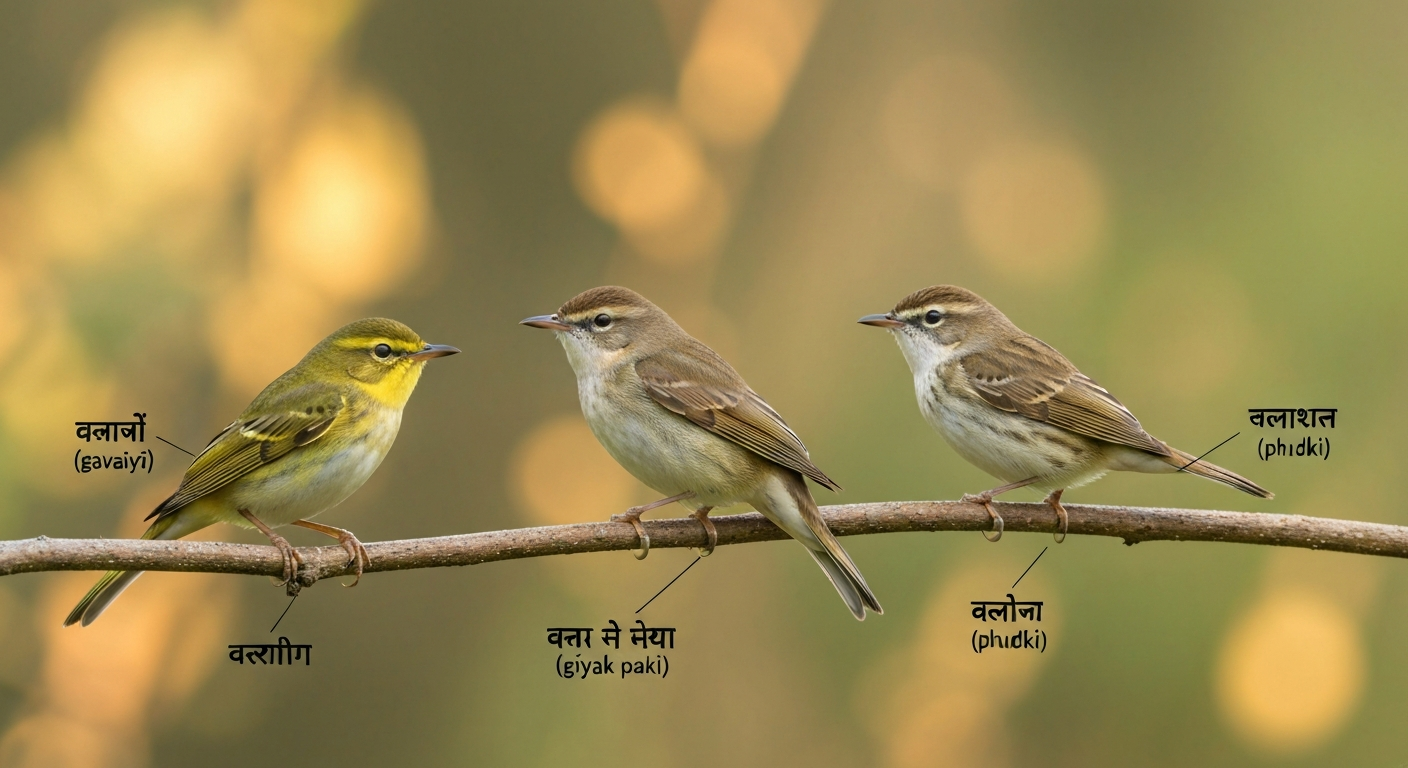
The most widely used Hindi translation for 'warbler' is गवैया (gavaiyā), meaning 'a singer' or 'one who sings. HinKhoj lists common Hindi equivalents for “warbler,” including गवैया, फुदकी, and descriptive phrases like गायक पक्षी HinKhoj English–Hindi dictionary — ‘warbler’ → गवैया / फुदकी / आलाप लेने वाला etc.. ' You will also encounter गायक पक्षी (gāyak pakṣī), which translates literally as 'singing bird,' and the colloquial फुदकी (phudkī), used in folk speech for small, restless, leaf-warbler-type birds. None of these is a formal zoological term, but gavaiyā and gāyak pakṣī are the most natural equivalents when translating ornithological or general writing from English into Hindi.
Warbler Bird Meaning in Hindi: Translation, Names & Uses

Rajesh Sharma
8 Aug 2026
Hindi translation at a glance: Devanagari, transliteration and pronunciation
There are three Hindi expressions worth knowing, each carrying a slightly different shade of meaning. The table below gives the Devanagari script, IAST transliteration (the scholarly standard), a reader-friendly phonetic hint, and an approximate IPA pronunciation for each.
| Hindi (Devanagari) | IAST Transliteration | Phonetic Hint | Approx. IPA | Meaning / Use |
|---|---|---|---|---|
| गवैया | gavaiyā | guh-VAI-yaa | /ɡəʋəjaː/ | Singer; common for a warbler's singing identity |
| गायक पक्षी | gāyak pakṣī | GAA-yak puk-SHEE | /ɡaːjək pəkʂiː/ | Singing bird; descriptive, used in formal/written Hindi |
| फुदकी | phudkī | PHUD-kee | /pʰʊdkiː/ | Small, restless, hopping bird; colloquial/folk use |
A note on transliteration standards: IAST (International Alphabet of Sanskrit Transliteration) and ISO-15919 use diacritics for precise, reversible scholarly rendering. When you see gāyak, the macron over the 'a' signals a long vowel sound, held about twice as long as a short 'a.' The Hunterian system, the Government of India's traditional romanization practice, drops these diacritics and would write simply 'gayak pakshe', useful in official documents but less precise for pronunciation. For everyday reading, the phonetic hints in the table above will serve you well.
What exactly is a warbler? The literal definition
A warbler is a small, mainly insectivorous passerine (perching songbird) belonging to several Old World families. The name comes from the English verb 'to warble,' meaning to sing with trilling, melodious variation, so at its core, a warbler is simply a bird that warbles, a little singer. What makes the category tricky is that 'warbler' is a common-name umbrella, not a single modern biological family. Recent molecular work has split what was once a catch-all family Sylviidae into distinct families: Phylloscopidae (leaf warblers), Acrocephalidae (reed warblers), Locustellidae (grass and grasshopper warblers), Cettiidae and Scotocercidae (bush warblers), among others. The IOC World Bird List, taxonomic updates (Old‑World warbler reorganisations) documents these molecularly driven splits and the reassignment of former Sylviidae species into families such as Phylloscopidae, Acrocephalidae, Locustellidae, Cettiidae and Scotocercidae IOC World Bird List — taxonomic updates (Old‑World warbler reorganisations). In India, field guides treat all of these groups under the broad label 'warblers,' and that is the convention this article follows.
Pronunciation guide: breaking the Hindi words down
Hindi pronunciation can trip up learners who rely on English spelling intuitions. Here is a syllable-by-syllable breakdown for each key term.
गवैया (gavaiyā)
Split as: ga – vai – yā. The first syllable 'ga' is a short, soft sound like the 'gu' in 'gun.' The second syllable 'vai' rhymes with 'my' but with a v-sound at the start. The final 'yā' is a long, open 'aa' sound. Put together: guh-VAI-yaa. The stress naturally falls on the middle syllable. In spoken Hindi, the final long vowel is often slightly softened or dropped in fast speech (schwa deletion), so you may hear it closer to 'guh-VAI-ya.'
गायक पक्षी (gāyak pakṣī)
Split as: gā – yak / pak – ṣī. The opening 'gā' has a long 'aa' sound, like the 'a' in 'father.' The 'yak' ends cleanly like the animal's name. In 'pakṣī,' the 'kṣ' cluster is a retroflex combination, think of pressing the tip of your tongue slightly back and producing 'ksh' quickly: pak-SHEE. IPA: /ɡaːjək pəkʂiː/. This two-word phrase is the safest choice in written Hindi because it is immediately transparent to any reader, even without ornithological background.
फुदकी (phudkī)
Split as: phud – kī. The 'ph' in Hindi is an aspirated p-sound, not the English 'f' of 'phone', say 'p' with a puff of breath: PHUD-kee. The word is onomatopoeic in feel, evoking a small bird hopping and flitting about. It is widely understood across northern India in folk speech, particularly in the Hindi belt, for any tiny, energetic little bird.
Common Indian warblers: species, Hindi names, and ID notes
India hosts a rich warbler fauna spread across multiple families. The species below represent those most commonly encountered by birdwatchers and are drawn from the Avibase India checklist and IOC World Bird List taxonomy, supplemented by field-guide and Indian Birds journal references. Hindi vernacular names are compiled from Salim Ali's Handbook traditions, regional glossaries, and Avibase local-name fields. Where a standardized Hindi name is not firmly established, a descriptive rendering is provided.
| English Name | Hindi Name (Devanagari) | Transliteration | Scientific Name | Family | Brief ID Note |
|---|---|---|---|---|---|
| Common Chiffchaff | पत्ती फुदकी | Pattī Phudkī | Phylloscopus collybita | Phylloscopidae | Dull olive-brown leaf warbler; endlessly repeats 'chiff-chaff'; common winter visitor |
| Greenish Warbler | हरित फुदकी | Harit Phudkī | Phylloscopus trochiloides | Phylloscopidae | Greenish tone, single wing-bar; brisk, high-pitched trill; abundant migrant |
| Blyth's Reed Warbler | बलथ की नरकट फुदकी | Blaith kī Narkaṭ Phudkī | Acrocephalus dumetorum | Acrocephalidae | Brown, unstreaked; skulking in gardens and scrub; one of India's commonest winter warblers |
| Clamorous Reed Warbler | बड़ी नरकट फुदकी | Baṛī Narkaṭ Phudkī | Acrocephalus stentoreus | Acrocephalidae | Large, loud; resident in reedbeds; powerful, churring song |
| Paddy-field Warbler | धान-खेत फुदकी | Dhān-Khet Phudkī | Acrocephalus agricola | Acrocephalidae | Small, pale brown with supercilium; winter visitor to paddy fields and grassland edges |
| Common Grasshopper Warbler | टिड्डी फुदकी | Ṭiḍḍī Phudkī | Locustella naevia | Locustellidae | Streaked brown; reeling insect-like song; skulks low in grass; passage migrant |
| Lanceolated Warbler | बरछी-धारी फुदकी | Barchī-Dhārī Phudkī | Locustella lanceolata | Locustellidae | Heavily streaked; tiny; secretive in tall grass; uncommon winter visitor |
| Rufous-faced Warbler | लाल-मुख फुदकी | Lāl-Mukh Phudkī | Abroscopus albogularis | Phylloscopidae | Distinctive rufous face and white throat; resident in Himalayan foothills |
| Tickell's Leaf Warbler | टिकेल की पत्ती फुदकी | Ṭikel kī Pattī Phudkī | Phylloscopus affinis | Phylloscopidae | Yellow-washed underparts; bold supercilium; breeds in high Himalayas |
| Cetti's Warbler | सेटी की फुदकी | Seṭī kī Phudkī | Cettia cetti | Cettiidae | Skulking; explosive, sudden song; rounded tail; localised winter visitor in N/W India |
Keep in mind that standardized, government-approved Hindi names do not yet exist for every warbler species. The names above follow established naming patterns, using descriptive modifiers (leaf, reed, grass) alongside phudkī as the base word for 'small warbler-type bird.' This mirrors how regional bird glossaries and Wildlife Institute references handle the group.
How to identify warblers in the field
Warblers are notoriously tricky to identify, even for experienced birders. Most Indian species are small (8–18 cm), dull brown, olive, or greenish, and spend a great deal of time hidden in reeds, grass, or dense foliage. Here is what to look and listen for.
Size and shape
Leaf warblers (Phylloscopus) are among the smallest, typically 9–11 cm, roughly the size of your thumb. Reed warblers (Acrocephalus) tend toward 12–15 cm with a longer, flatter head profile and a noticeably pointed bill adapted for probing reed stems. Grass warblers (Locustella) are compact and round-tailed. When you see a very small, slim bird flitting restlessly through leaves or reeds, think warbler first.
Song and call
Song is often your best identification tool in India, especially for species wintering in thick cover. Leaf warblers produce high-pitched, repetitive whistles or trills. Reed warblers sing in churring, chattering phrases from within reedbeds. Grasshopper warblers produce a remarkable reeling buzz that sounds more like an insect than a bird, once heard, never forgotten. Cetti's Warbler delivers a sudden, explosive burst of song from dense vegetation before immediately going silent, giving almost no chance to see the bird.
Key field marks
- Supercilium (eyebrow stripe): present or absent, broad or narrow — one of the most useful marks in leaf warblers
- Wing bars: one or two pale bars across the wing help separate many Phylloscopus species
- Underpart colour: plain white/buff vs. yellow-tinged underparts narrows leaf warbler options considerably
- Tail behaviour: cocked tail is typical of bush warblers (Horornis, Tesia); rounded vs. graduated tail shape matters for Locustella
- Streaking: streaked upperparts point to Locustella grass warblers; unstreaked upperparts are typical of most Acrocephalus reed warblers
Behaviour
Warblers are almost always in motion. Leaf warblers hover-glean and flutter from twig to twig, often hanging briefly upside down to pick insects off leaf undersides. Reed warblers clamber vertically up reed stems. Grasshopper warblers and many bush warblers are skulkers, they run mouse-like along the ground, extremely reluctant to fly. Patience and staying still is the key: let the bird come to you rather than chasing it through dense cover.
Habitat, seasonal movements, and behaviour across India
India sits at a crossroads for warbler migration. The subcontinent receives enormous numbers of wintering warblers from breeding grounds in Central Asia, Siberia, and the Himalayas, while a smaller but significant number breed locally in the Himalayas, the Western Ghats, and the northeastern hills.
The Himalayan foothills and valleys host breeding populations of Rufous-faced Warbler, Tickell's Leaf Warbler, and several Phylloscopus species from roughly April to September. After breeding, many of these birds descend to lower elevations or migrate south and west. The plains and peninsular India receive massive influxes of Blyth's Reed Warbler, Greenish Warbler, Common Chiffchaff, and Paddyfield Warbler from October through March, these wintering birds are often the most commonly encountered warblers for urban birdwatchers in Delhi, Lucknow, or Pune.
In terms of habitat, different groups occupy distinct niches. Phylloscopus leaf warblers favour gardens, forest edges, and deciduous woodland. Acrocephalus reed warblers stick closely to reedbeds, tall grass near water, and paddy fields. Locustella grasshopper warblers prefer dense, low grassland and sedge beds. Bush warblers (Horornis, Cettia) favour thick understory along forest streams. Understanding which habitat you are in is often the quickest first step to narrowing down which warbler group you are looking at.
Warblers in Hindi and Indian cultural tradition: symbolism, poetry, and folklore
In classical and folk Indian traditions, small singing birds carry significant cultural weight, but the specific English taxonomic category 'warbler' does not map directly onto a single mythological role. Instead, the symbolic power of small songbirds is distributed across a constellation of birds: the koel (कोयल, koyal), the bulbul (बुलबुल), and various unspecified birds described simply as 'little singers' in poetry and folk song. Understanding where warblers fit requires reading this broader tradition.
The singer bird in Hindi poetry (kavya)
Hindi and Urdu poetry has long used the small, unseen singing bird as a metaphor for the soul, the devotee, or the lover. The word गवैया (gavaiyā) itself appears in folk and classical poetry as an image of pure-voiced, unassuming song, the antithesis of the loud, showy bird. In Bhakti poetry, small birds singing in forests and fields were taken as expressions of divine presence: nature itself singing back to the creator. The warbler's habit of singing from deep inside dense foliage, invisible but audible, resonates with this tradition of the hidden devotee whose voice reaches the divine without being seen.
Omen traditions and folk belief
Ethno-ornithological studies of South Asian bird folklore document extensive omen traditions surrounding small songbirds. The direction of a small singing bird's flight, or its song heard at dawn before a journey, was read as auspicious or inauspicious depending on the regional tradition. In parts of rural Uttar Pradesh and Bihar, a small bird's persistent song near a house was sometimes interpreted as a message or omen, though the species was rarely distinguished precisely, a 'small warbling bird' functioned as an undifferentiated category of messenger. Grounded research (peer-reviewed ethno-ornithology work) cautions against overstating a single 'warbler mythology', these traditions are regional, variable, and often attached to whichever small songbird is locally common.
Sanskrit and classical resonance
Sanskrit literature and lexica (including Monier-Williams) record numerous terms for small songbirds, but no single classical Sanskrit word translates precisely as 'warbler' in the modern ornithological sense. The closest conceptual territory is covered by words for small, sweet-voiced birds used in nature poetry (prakṛti-kāvya). The concept of the small bird as a vehicle of auspicious sound and message is well established, it simply was not mapped onto a taxonomic category the way modern ornithology works. If you are writing in Sanskrit-inflected contexts, गायक पक्षी (gāyak pakṣī) works cleanly as a modern coinage that any Sanskrit-trained reader will immediately understand.
Regional language equivalents: Marathi, Punjabi, and Gujarati
Across Indian languages, equivalent terms are similarly descriptive rather than formally standardized. In Marathi, वटवट्या (vaṭvaṭyā) is used colloquially for small, chattering, restless birds including warbler-types, the word itself evokes incessant chatter. In Punjabi, गायक चिड़ी (gāyak ciṛī) or फुदकी (phudkī, borrowed from Hindi) are used. In Gujarati, ગાનાર પક્ષી (gānār pakṣī), 'singing bird', is the most straightforward rendering, and the colloquial ફૂદડી (phūdaḍī) is heard for tiny, flitting birds. None of these has achieved formal zoological standardization; they are working terms drawn from folk speech and regional glossaries. If your interest is specifically in Gujarati bird terminology, the weaver bird naming conventions in Gujarati offer an interesting parallel in how Indian languages handle bird naming through descriptive compounds.
Warbler in Hindi sentences: usage, phrases, and idioms
While there are no established Hindi idioms that specifically name warblers by their ornithological category, the related concept of the small singing bird, गवैया, does appear in idiomatic and literary contexts. Below are example sentences and phrases that show natural Hindi usage.
| Hindi (Devanagari) | Transliteration (IAST) | English Translation | Usage Context |
|---|---|---|---|
| वह पक्षी एक गवैया है। | Vah pakṣī ek gavaiyā hai. | That bird is a warbler (a singer). | Simple identification sentence |
| सुबह के वक्त गायक पक्षियों का गाना बहुत मधुर लगता है। | Subah ke vakt gāyak pakṣiyoṃ kā gānā bahut madhur lagtā hai. | The singing of songbirds in the morning sounds very melodious. | Nature writing, descriptive prose |
| वह तो जंगल का छोटा गवैया निकला। | Vah to jaṃgal kā choṭā gavaiyā nikalā. | He turned out to be the little singer of the forest. | Figurative / literary; used of a humble but gifted person |
| फुदकी पत्तियों में छिप कर गा रही थी। | Phudkī pattiyoṃ meṃ chipa kar gā rahī thī. | The little warbler was singing hidden among the leaves. | Descriptive, folk/colloquial register |
| उसकी आवाज़ गवैये जैसी मीठी है। | Uskī āvāz gavaiye jaisī mīṭhī hai. | His/her voice is as sweet as a warbler's. | Common simile; used as a compliment for a singer |
The figurative use of गवैया (gavaiyā) as a compliment for a gifted but unassuming singer is the most culturally alive idiom in this cluster. You will encounter it in folk poetry, old film dialogue, and everyday speech when someone wants to praise a person who sings beautifully without seeking the spotlight, very much mirroring how the actual bird sings from within dense cover. This is one of those lovely moments where ornithological behavior and cultural metaphor perfectly reinforce each other.
How 'warbler' differs from related bird categories
Readers coming from sibling topics on this site will naturally wonder how warblers compare to waders, weavers, and windhovers. The differences are fundamental and worth stating plainly.
| Bird Category | Primary Trait | Hindi Term(s) | Habitat / Behaviour | Example |
|---|---|---|---|---|
| Warbler | Small, insectivorous songbird; noted for singing | गवैया / गायक पक्षी / फुदकी | Foliage, reeds, grassland; active, flitting | Greenish Warbler, Blyth's Reed Warbler |
| Wading Bird / Wader | Long-legged bird that wades in shallow water to feed | टखनापक्षी / पनडुब्बी (regional) | Wetlands, mudflats, shorelines; probing mud | Sandpiper, Heron, Stilt |
| Weaver Bird | Builds elaborate woven nests; social, colonial | बयापक्षी / बया | Open grassland, cropland, near water; nest-weaving | Baya Weaver (Ploceus philippinus) |
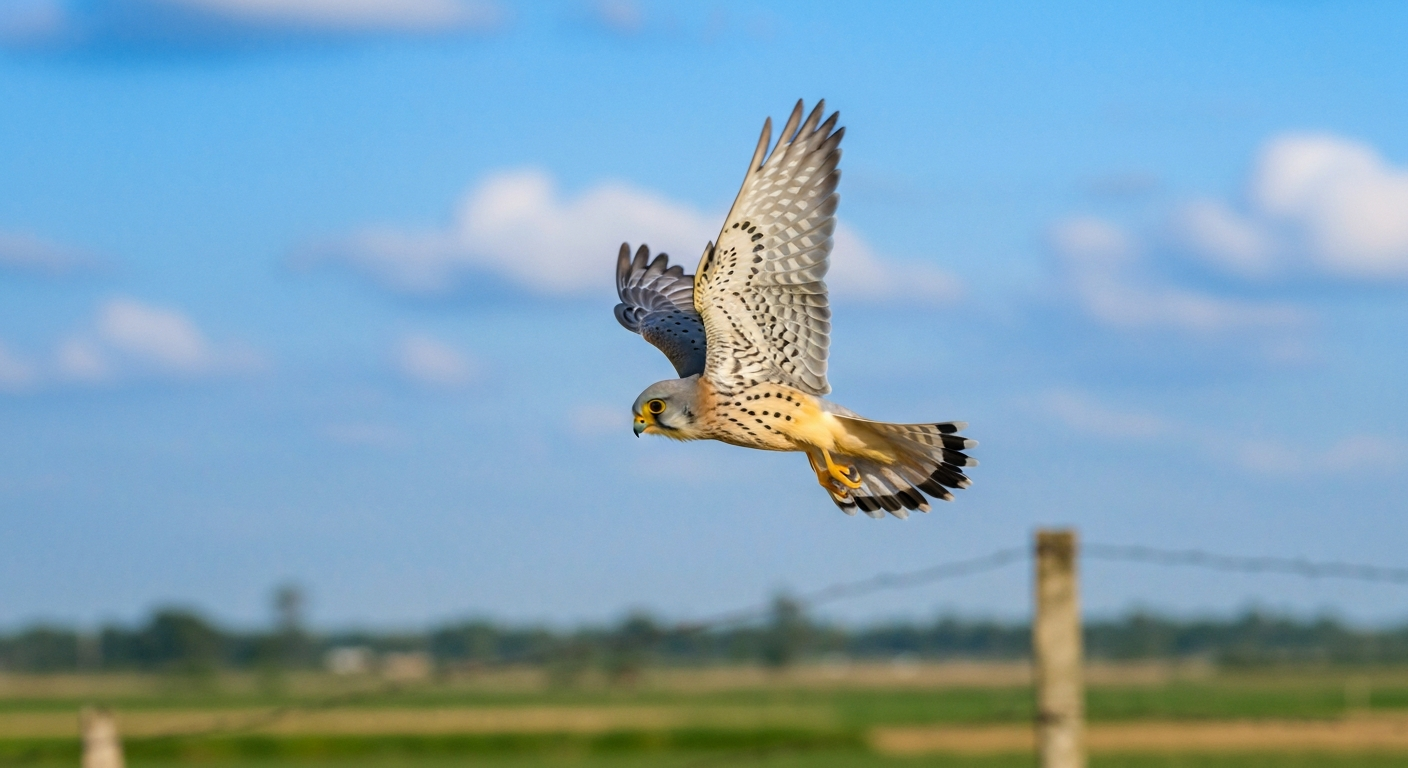
| Windhover | Bird that hovers into the wind while hunting | पवनझूलक (descriptive) | Open country; hovering flight while hunting | Common Kestrel |
Warblers are defined by their song and their insectivorous, foliage-dwelling lifestyle. Wading birds are defined by their feeding method in water. For the Gujarati equivalent and usage, see wading bird meaning in Gujarati. See the related entry on bird wading meaning in Hindi for the common Hindi terms and usage for wading birds. Weaver birds are defined by their extraordinary nest construction, the Baya Weaver, whose Hindi name बया (bayā) is one of the best-known bird names in the Hindi belt, builds elaborate hanging nests woven from grass strips. For more on the weaver bird meaning in Hindi and related names such as बया (bayā), see the weaver bird meaning in Hindi entry. Windhovers (most famously the Common Kestrel) are defined by their hovering flight in the wind while scanning for prey. The four categories represent four completely different ecological niches, taxonomic backgrounds, and cultural associations in Indian tradition. If you are exploring the weaver bird's Hindi identity or the windhover's Hindi name in more depth, those topics are covered in dedicated entries on this site.
A quick reference: 'warbler' across Indian languages
| Language | Term / Phrase | Script | Literal Meaning / Notes |
|---|---|---|---|
| Hindi | गवैया / गायक पक्षी / फुदकी | Devanagari | Singer / Singing bird / Small hopping bird |
| Sanskrit (classical) | गायक पक्षी (modern coinage) | Devanagari | No single classical equivalent; descriptive compound works |
| Marathi | वटवट्या (vaṭvaṭyā) | Devanagari | Chattering, restless small bird; folk/colloquial |
| Punjabi | गायक चिड़ी / फुदकी | Gurmukhi equivalent | Singing bird; phudkī borrowed from Hindi folk speech |
| Gujarati | ગાનાર પક્ષી / ફૂદડી | Gujarati script | Singing bird / small flitting bird; descriptive |
Across all these languages, the pattern is consistent: there is no ancient, single-word equivalent for 'warbler' as a defined taxonomic group, because the concept did not exist as a discrete category in traditional Indian natural history. What every language does have is vivid, descriptive vocabulary for the small, singing, restless, foliage-hopping bird, which is, after all, what a warbler is. The richness lies in those descriptive compounds, and they are genuinely useful for anyone reading Indian nature writing, translating field guides, or learning to talk about birds in Hindi and its related languages.
FAQ
What is the best Hindi translation(s) for the English word “warbler” (Devanagari, transliteration, simple pronunciation and IPA)?
Common Hindi renderings suitable for an article: 1) गवैया — transliteration (IAST): gavai yā / gavaiyā; simple pronunciation guide: 'guh‑vai‑yaa'; approximate IPA: /ɡəʋəjaː/. 2) गायक पक्षी — transliteration (IAST): gāyak pakṣī; simple pronunciation: 'gaa‑yak puk‑shee'; approximate IPA: /ɡaːjək pəkʂiː/. 3) फुदकी (regional/folk) — transliteration: phudkī; pronunciation: 'phud‑kee'; IPA approx.: /pʰʊd̪kiː/. Notes: use गवैया or गायक पक्षी for clear, literate translations (gavaiyā/gāyak pakṣī = ‘singer/singing bird’). Provide both Devanagari + IAST and a simple phonetic hint for learners; note schwa deletion varies in spoken Hindi. Sources: HinKhoj (dictionary entries), transliteration guidance (IAST/ISO references).
What is a concise literal definition of “warbler” I can use in the article lead?
Literal, citation‑ready definition: “A warbler is a loosely defined group of small, mainly insectivorous passerine (song)birds — in the Old World many species are treated as leaf‑warblers, reed‑warblers, bush/grass‑warblers and close relatives (families such as Phylloscopidae, Acrocephalidae, Locustellidae, Cettiidae, etc.).” Cite: Oxford Advanced Learner’s Dictionary; Merriam‑Webster for the general term; IOC World Bird List / Avibase for the taxonomic treatment and Indian occurrence.
How should I explain taxonomic/ornithological nuance about the word “warbler” in India?
Explain that “warbler” is a common‑name umbrella, not a single taxonomic family. Recent molecular work split the old “Sylviidae” into several families; in India typical warbler groups include leaf‑warblers (Phylloscopus), reed‑warblers (Acrocephalus), bush/grass‑warblers (Locustella, Horornis, Tesia), among others. Recommend citing IOC World Bird List and Avibase for the current checklist and taxonomic updates, and Grimmett, Inskipp & Inskipp or Indian Birds for field identification notes.
Can you provide a sample table of common Indian warbler species with their Hindi names, scientific names and brief ID notes (for inclusion in the article)?
Suggested table columns: English name | Scientific name | Hindi/vernacular name (Devanagari + transliteration) | Brief ID notes. Example rows you can expand using Avibase/IOC and regional sources: 1) Yellow‑browed Warbler | Phylloscopus inornatus | पत्तेदार गवैया / पत्तेदार गवैया (pattēdār gavaiyā) — literal: ‘leaf warbler’ | Small olive‑green leaf‑warbler with pale supercilium; migratory winter visitor. 2) Blyth's Reed Warbler | Acrocephalus dumetorum | रीड/कुहासा गवैया (rīḍ gavaiyā) — reed‑warbler (regional) | Streaky brown, plain face, favours reedbeds. 3) Paddyfield Warbler (or Oriental Reed‑Warbler group) | Locustella certhiola / Acrocephalus orientalis (check current split) | फुदकी / धानक गवैया (phudkī / dhānak gavaiyā) | skulking, reedy grass habitats, diagnostic tail and song features. 4) Rufous‑tailed Bush Warbler | Cettia ruficauda / Horornis caudatus (check IOC) | झाड़ी गवैया (jhāṛī gavaiyā) | Short rounded tail, secretive in undergrowth. Important: verify current scientific names and Hindi vernaculars per species using Avibase (India checklist), IOC World Bird List, Grimmett/Inskipp field guide and Indian Birds journal; there is no single pan‑India authoritative Hindi name list so cite per species’ source (Avibase / regional checklists / field guides).
What authoritative sources should I cite for species names, taxonomy and Indian occurrence when preparing the species table?
Primary sources to cite: 1) IOC World Bird List — for current taxonomy and family assignments (warbler rearrangements). 2) Avibase — India checklist for which warbler taxa occur in India. 3) Grimmett, Inskipp & Inskipp (field guide) — for ID notes and common English names in India. 4) Indian Birds (journal/portal) — for regional records, vernacular names and recent taxonomic notes. Use these together: IOC/Avibase as backbone for scientific names and status; field guides and Indian Birds for ID and vernaculars.
What are regional equivalents (Sanskrit, Marathi, Punjabi, Gujarati) I can list for ‘warbler’?
There is no single classical Sanskrit word that maps exactly to the modern ornithological ‘warbler’. Use descriptive or regional terms: - Sanskrit (descriptive): गायकपक्षी (gāyakpakṣī) or singing‑bird descriptions appear in lexica; consult Monier‑Williams for classical terms for small songbirds. - Marathi: वटवट्या / फुदकी (vatvaṭyā / phudkī) — folk names for small leaf/skulking songbirds (cite state bird lists or Marathi field glossaries). - Punjabi: ਫੁਦਕੀ / ਪਿੱਟਾ (phudkī / piṭṭā) — regional folk labels; verify per district/state lists. - Gujarati: વટવટિયા / ફુદકી (vatvaṭiyā / phudkī) — dialect forms. Note: these are dialectal/folk names, not standardized scientific names; cite regional forest department lists, local bird guides or Avibase/eBird local‑names where available.
Next Article
Windhover Bird Meaning in Hindi, Kestrel Name, Use & Culture
Windhover मतलब (केस्टरेल): हिंदी नाम, उच्चारण, पहचान, सांस्कृतिक अर्थ और संरक्षण जानकारी।