A windhover is a kestrel, specifically the Common Kestrel (Falco tinnunculus), and in Hindi it is most widely known as 'छोटा बाज़' (Chhota Baaz) or 'केस्ट्रेल' (Kestrel). The Devanagari form छोटा बाज़ is pronounced roughly as 'CHHOH-taa BAAZ', where 'chhota' means small and 'baaz' means falcon or hawk. Some regional lists and older texts also use 'मृगबाज़' (Mrigabaaz) for hovering falcons, though 'chhota baaz' remains the most common vernacular shorthand across Hindi-speaking regions.
Windhover Bird Meaning in Hindi, Kestrel Name, Use & Culture

Rajesh Sharma
7 Aug 2026
What exactly is a windhover?
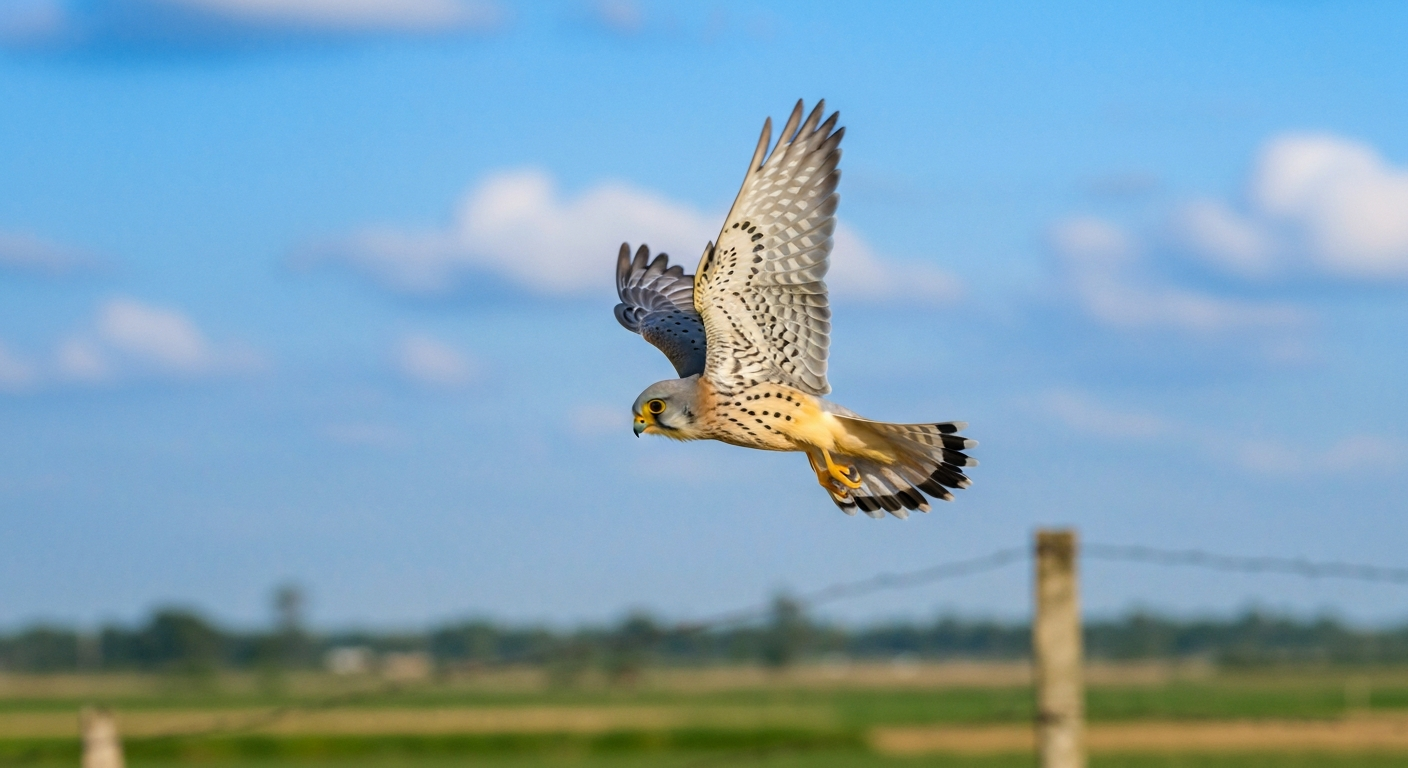
The word 'windhover' is an English dialect name that does exactly what it says on the tin: it describes a bird that hovers in the wind. blank" rel="noopener noreferrer">WINDHOVER definition in American English | Collins English Dictionary lists 'windhover' as an English dialect name for a bird that 'hovers in the wind.'. Nineteenth-century British ornithologists, including William Yarrell in his 'A History of British Birds', used 'windhover' and 'kestrel' almost interchangeably because the kestrel's characteristic hunting behaviour, holding itself almost perfectly still in mid-air against the wind while scanning the ground below, is so distinctive that the bird earned the name from it. In modern ornithology, 'windhover' refers specifically to the Common Kestrel, Falco tinnunculus, a member of the family Falconidae.
Falco tinnunculus is a small falcon measuring about 32 to 35 cm in length, with long, pointed wings and a long tail that carries a prominent dark subterminal band. The male is easy to spot: grey head, grey tail, and warm rufous-chestnut upperparts with black spotting. The female and immature birds are more heavily streaked brown above. The kestrel is one of the few raptors that routinely hovers, beating its wings rapidly while keeping its head absolutely fixed on a point below, then either dropping in stages or plunging in a stoop toward small prey like mice, voles, large insects, and lizards. This hovering flight, sometimes called 'windhovering' in biomechanics literature, is the bird's signature behaviour and the reason the name stuck.
- Scientific name: Falco tinnunculus Linnaeus, 1758
- Family: Falconidae
- Length: approximately 32 to 35 cm
- Wingspan: approximately 65 to 80 cm
- Key male features: grey head and tail, rufous back with black spots, dark subterminal tail band
- Key female features: rufous-brown upperparts with dark barring, streaked underparts
- Diagnostic behaviour: sustained stationary hovering into the wind while hunting
What windhover is called across Indian languages
Indian languages have not historically had a single dedicated word equivalent to 'windhover' as a poetic epithet, because that name arose in English dialect use. What they do have are well-established vernacular names for Falco tinnunculus itself, and those are what matter for translators, language learners, and cultural researchers. The table below brings together the names most consistently associated with this species across Hindi, Sanskrit, Marathi, Punjabi, and Gujarati, along with notes on regional usage and reliability.
| Language | Script | Transliteration | Pronunciation guide | Regional notes |
|---|---|---|---|---|
| Hindi | छोटा बाज़ | Chhota Baaz | CHHOH-taa BAAZ | Most widely used informal name; 'baaz' broadly covers falcons and hawks in everyday Hindi |
| Hindi (alt.) | केस्ट्रेल | Kestrel | KES-trel | Direct borrowing used in modern field guides and urban birding communities |
| Sanskrit | श्येन / श्येनक | Shyena / Shyenaka | SHYE-na / SHYE-na-ka | Classical term for a hawk or falcon; used conservatively — direct mapping to kestrel is not certain in classical texts |
| Marathi | छोटा ससाणा | Chhota Sasana | CHHOH-taa sa-SAA-naa | 'Sasana' is the Marathi word for falcon/kestrel; 'chhota' distinguishes it from larger falcons |
| Punjabi | ਛੋਟਾ ਬਾਜ਼ / ਲਰਜ਼ਾਨਕ | Chhota Baaz / Larzanak | CHHOH-taa BAAZ / lar-ZAA-nak | 'Larzanak' (meaning 'trembler' or 'hoverer') is an older Punjabi/northwestern dialect name recorded in historical faunal accounts for this hovering falcon |
| Gujarati | નાનો બાજ | Nano Baaj | NAA-no BAAJ | 'Nano' means small; 'baaj' is the Gujarati cognate of Hindi 'baaz'; used in Gujarati bird lists and field notes |
A note on the Sanskrit entry: classical Sanskrit texts like the Amarakosha list raptor names such as 'shyena' for hawks and falcons as a group, and 'shyenaka' as a diminutive form. Scholars who have studied birds in Sanskrit literature are careful to point out that pinning a single classical term to a specific modern species is often uncertain, so I have framed the Sanskrit entry conservatively here. The Punjabi form 'larzanak', recorded in older regional accounts, is particularly interesting because it shares the same semantic logic as 'windhover': both names describe the hovering or trembling flight. That parallel across languages says something beautiful about how closely observers, whether in England or the Punjab, paid attention to the same behaviour.
Field identification and behaviour in India
In India, the Common Kestrel occurs as a winter visitor across most of the subcontinent, arriving roughly between October and March. Two subspecies are particularly relevant for Indian birdwatchers: Falco tinnunculus interstinctus, which winters widely across northern and central India, and F. t. objurgatus, associated with parts of peninsular India including the Western Ghats, where it may be partly resident. Regional field guides such as Grimmett, Inskipp and Inskipp's 'Birds of the Indian Subcontinent' treat the species as a widespread but not abundant winter falcon.
In the field, a hovering kestrel is almost unmistakable once you know what you are looking for. The bird beats its wings rapidly, sometimes assisted by updrafts, while its head stays locked on a fixed point below, this head-stability is a function of a remarkable vestibular system and is the feature that biomechanics researchers have studied in controlled settings. After surveying from the hover, the kestrel either descends in a series of lower hovers or makes a direct stoop to the ground. It also hunts from perches: fence posts, telephone wires, lone trees, and rocky outcrops are favourite vantage points. Kestrels have also been documented using UV-reflectance cues from the urine and droppings of small mammals to identify areas of high prey activity, a finding from Viitala and colleagues published in Nature in 1995 that added a remarkable sensory dimension to an already well-studied hunter.
The call is a rapid, sharp 'kee-kee-kee' or 'ki-ki-ki', chattering and high-pitched, often given near nest sites or when the bird is alarmed. In India you are less likely to hear calls in winter than during the breeding season for resident birds. The flight profile away from hover is typical of falcons: stiff, flickering wingbeats interspersed with short glides, the long tail and pointed wingtips making a clean silhouette against the sky.
Where and when to see windhovers in India
Kestrels are birds of open country, and in India that means agricultural plains, dry scrubland, grasslands, fallow fields, and the edges of semi-arid zones. They are not forest birds. Some of the most reliable places to find wintering kestrels include the plains of Rajasthan and Gujarat, the open farmland of Punjab and Haryana, the Deccan plateau grasslands, and the scrub zones of Madhya Pradesh. In the Himalayan foothills, kestrels can appear at a range of elevations during migration.
- Best months for wintering birds: October through March
- Top habitats: open farmland, dry grassland, semi-arid scrub, roadside telephone wires and posts
- Key states for sightings: Rajasthan, Gujarat, Punjab, Haryana, Madhya Pradesh, Maharashtra (Deccan plateau), parts of Karnataka and Tamil Nadu
- Himalayan foothills: look during October to November migration windows
- Western Ghats: F. t. objurgatus may be present year-round in some areas
- Field tip: scan fence posts and overhead wires along rural roads in open country, and watch the sky for a small falcon holding a fixed position in the wind
Etymology and the windhover in poetry
The English word 'windhover' is a compound formed from 'wind' and 'hover', and it appears in dialect records from at least the early modern period in English. It is a purely descriptive, observational name, the kind of folk nomenclature that farmers and countrymen coined for the birds they saw regularly. The name is directly parallel to the older German folk name for the kestrel, 'Turmfalke' (tower falcon), and the French 'crécerelle', which refers to the chattering call, each language picking a different defining feature of the same bird.
The most famous literary use of 'windhover' is Gerard Manley Hopkins' sonnet 'The Windhover', written in 1877 and published posthumously in 1918. Hopkins, a Jesuit priest and poet, used the kestrel's hovering mastery as an emblem of divine grace and Christ's presence in the natural world. The poem opens: 'I caught this morning morning's minion, king- / dom of daylight's dauphin, dapple-dawn-drawn Falcon.' The bird becomes a vehicle for spiritual ecstasy, its aerobatic perfection a mirror of something beyond itself. It is worth noting here that some descriptions of 'The Windhover' online mistakenly attribute it to John Keats: it is Hopkins, not Keats. This matters for anyone researching the poem for literature study.
In Indian literary and cultural traditions, a direct equivalent poem or classical text celebrating the kestrel by a specific name is not something I can point to with confidence, and I prefer not to manufacture connections where the evidence is thin. What is well-attested is that birds of prey, particularly falcons, hold a significant place in South Asian literary traditions: falconry (called 'shikar' or 'baaz-dari' in Urdu and Hindi-speaking traditions) was a royal sport, and the falcon 'baaz' appears as a symbol of nobility, speed, and trained power in Urdu and Punjabi poetry. The kestrel, being too small for falconry, sits slightly outside that main tradition, but it belongs to the same family of birds that carried symbolic weight in the region.
Cultural and spiritual meanings in Indian contexts
In Hindu tradition, raptors and birds of prey carry a range of symbolic associations, though the kestrel is not typically singled out in the way that the eagle (Garuda), the crow, or the owl are in classical iconography. The Sanskrit term 'shyena' covers hawks and falcons broadly and appears in Vedic texts, including the Rigveda, in contexts relating to speed, the carrying of Soma, and solar symbolism. The famous story of the shyena (hawk) bringing the Soma plant from heaven to earth is one of the earliest bird narratives in Indian literature. Whether the 'shyena' in these passages is a kestrel specifically is unknowable, and I frame this as a broader raptor tradition rather than a kestrel-specific one.
At a folk level, hovering birds are sometimes seen as omens in various regional traditions across India, their pause in the air read as a sign of attention or watchfulness. But I have not found documented traditions that specifically single out the kestrel as a named omen bird in the way that owls or crows are in Indian folk belief. If you are researching this for cultural or ritual purposes, it is worth consulting regional ethnobotany or folk-belief compilations specific to the area you are interested in, as these associations vary considerably across states and communities.
Conservation status and basic ecology
The Common Kestrel is assessed as Least Concern on the IUCN Red List, reflecting its large global range across Europe, Africa, and Asia and its overall population size. That said, BirdLife International notes that populations have declined in parts of Europe, and the same pressures are relevant wherever the bird occurs: loss of open grassland and agricultural habitats, human persecution, secondary poisoning from pesticides and rodenticides (the kestrel eats the small mammals and insects that accumulate these substances), and general reduction in prey availability.
In India, the kestrel is not a Schedule I species under the Wildlife Protection Act 1972, but like all birds it receives baseline protection. The main practical threat in the Indian context is habitat change: the conversion of dry grasslands and fallows to intensive agriculture or development reduces the open hunting ground that kestrels depend on. Grassland conservation in India, important for species like the Great Indian Bustard, the Lesser Florican, and various harriers, also benefits kestrels by maintaining the open habitats they need.
Suggested images and alt text for this article
Three image types work best for a page like this, and getting the alt text right helps both accessibility and image-search discovery.
- Identification portrait: a close-up perched shot showing the male's grey head, rufous back, and spotted upperparts. Recommended alt text: 'Common Kestrel male (Falco tinnunculus) perched on a post showing grey head and rufous back, also called windhover or chhota baaz in Hindi'
- Hovering flight shot: the bird suspended in mid-air, wings spread, head fixed downward, ideally against an open sky or agricultural background. Recommended alt text: 'Common Kestrel hovering in flight over open farmland in India, demonstrating the windhovering behaviour that gives it its English name'
- Distribution or range map: a map of the Indian subcontinent showing winter visitor range and any resident areas. Recommended alt text: 'Distribution map of Common Kestrel (Falco tinnunculus) in India showing winter visitor range and partly resident Western Ghats populations'
Related bird meanings you might be looking for
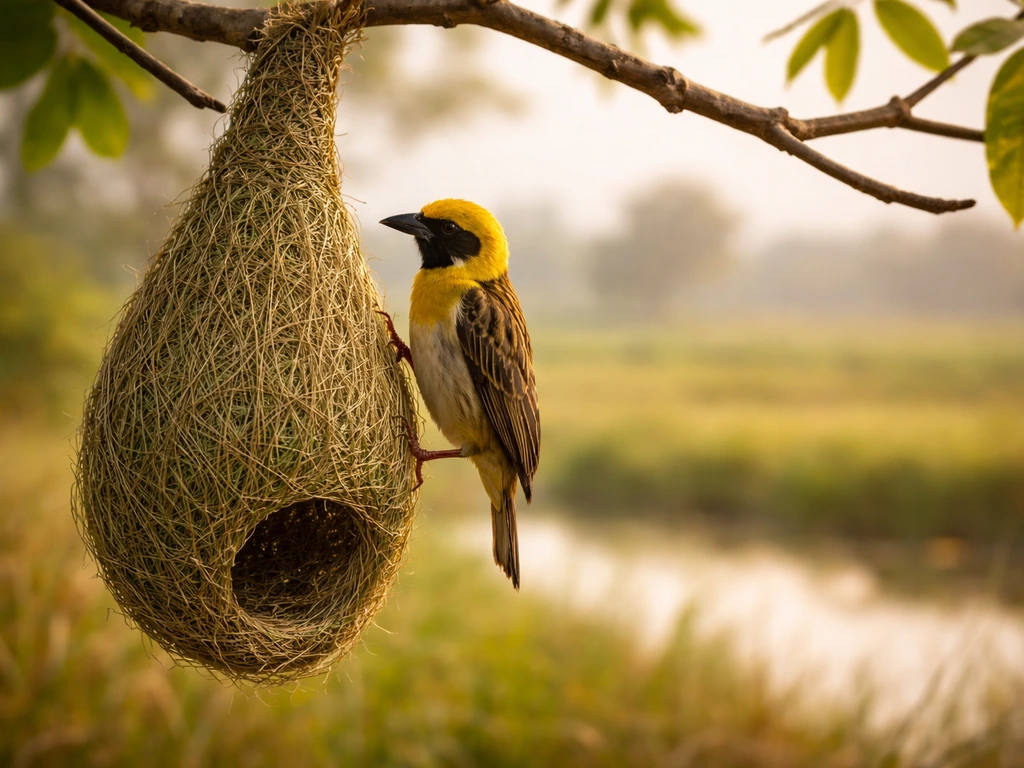
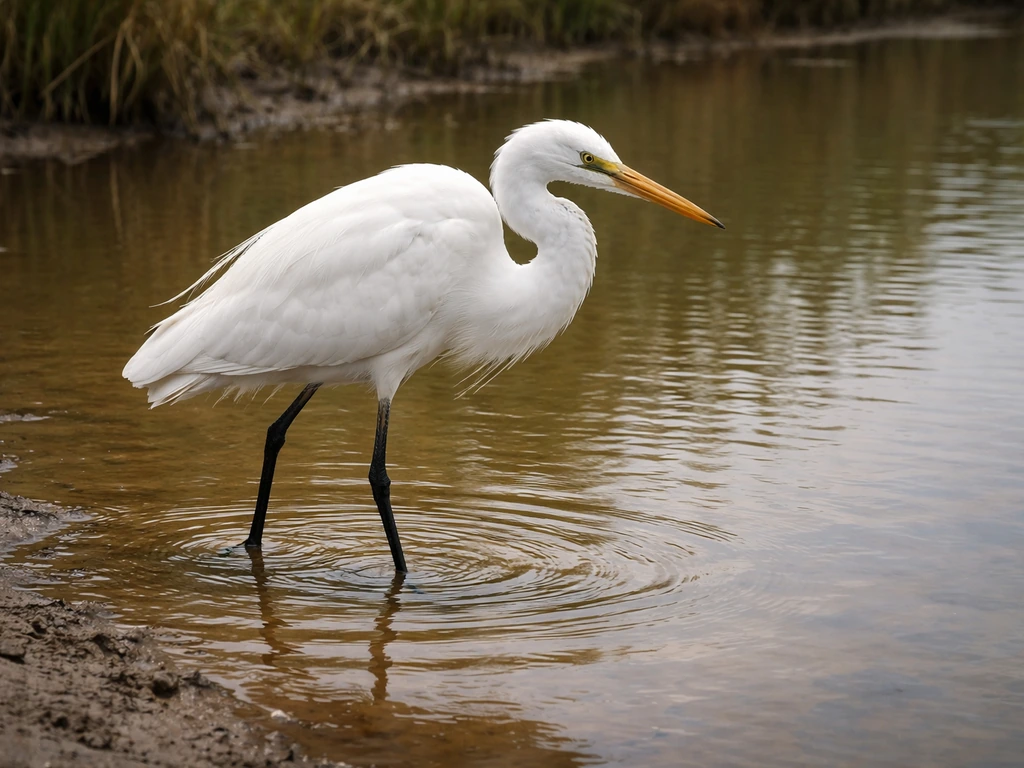
This site covers a wide range of bird terminology across Indian languages, and a few closely related topics are worth flagging here so you land on the right page. If you searched for 'windhover' but are actually curious about wading birds (the herons, egrets, stilts, and sandpipers that wade through water), that is a distinct category covered separately in the wading bird and wading bird in Gujarati entries. Warblers, the small insectivorous songbirds that are a major group for birdwatchers, have their own Hindi-language entry. For the Hindi meaning of warblers, see the warbler bird meaning in Hindi entry. If you were actually looking for the weaver bird meaning in Hindi, see the weaver bird meaning in Hindi entry. Weaver birds, famous for their elaborate woven nests, are covered in both Hindi and Gujarati entries. None of these are related to kestrels, so if you arrived here by searching for one of those terms, the entries listed above will give you what you need.
Within the raptor family, the kestrel is sometimes confused with the Shikra (Accipiter badius) or the smaller Eurasian Hobby (Falco subbuteo) by newer birdwatchers. The Shikra is an accipiter with rounded wings and a different hunting style, while the Hobby is a more aerial, swift-like falcon that does not hover. The hovering is the single most reliable field mark that separates the kestrel from these lookalikes in India.
Quick answers to common questions
Is a windhover the same as a kestrel? Yes. 'Windhover' is an English dialect name for the Common Kestrel, Falco tinnunculus, used historically in British literature and ornithology and made famous by Hopkins' 1877 poem.
How do you say 'windhover' in Hindi? The closest natural equivalent is छोटा बाज़ (Chhota Baaz), pronounced CHHOH-taa BAAZ. In modern birding contexts you will also encounter the borrowed term केस्ट्रेल (Kestrel) in field guide usage.
Where can I see a kestrel (windhover) in India? Your best chances are in open agricultural country and dry grasslands during the winter months (October to March). Rajasthan, Gujarat, Punjab, Haryana, and the Deccan plateau are among the most reliable areas. Look for a small falcon hovering over roadsides or perched on wires and fence posts.
Is the windhover poem by Keats or Hopkins? It is by Gerard Manley Hopkins, not John Keats. The poem 'The Windhover' was written in 1877 and published in 1918.
What is the Sanskrit word for kestrel or windhover? Classical Sanskrit uses 'shyena' (श्येन) for hawks and falcons as a group. A direct classical Sanskrit equivalent specific to the kestrel does not exist with certainty; the mapping should be treated as approximate.
What does 'baaz' mean in Hindi? 'Baaz' (बाज़) is a broad Hindi-Urdu term for a falcon or hawk. It is used for several species and also carries cultural connotations of speed and power from the falconry tradition.
Where to go from here
If you have come to this page primarily as a language learner or translator, the table of names above gives you what you need for Hindi, Sanskrit, Marathi, Punjabi, and Gujarati equivalents, with the important caveat about the Sanskrit entry. If you are a birder planning a trip, the field-identification section and the regional notes on where and when to look should help you find your first windhovering kestrel in India. If you arrived here as a literature student tracking down the Hopkins poem, you now have the ornithological context that makes the poem's imagery much richer: Hopkins watched a real bird doing something genuinely extraordinary, and the word he chose for the title carries centuries of dialect observation in it.
For closely related vocabulary, the entries on wading birds, warblers, and weaver birds on this site follow the same structure of script, transliteration, cultural notes, and ecology across Indian languages, and are worth exploring if you are building up a broader bird-vocabulary in Hindi or any of the regional languages covered here.
FAQ
What is the single most important authoritative fact needed to explain the meaning of 'windhover' in Hindi and nearby languages?
That 'windhover' is an English dialect name commonly applied to the Common Kestrel (Falco tinnunculus) because of its habit of hovering into the wind; authoritative ornithological sources (BirdLife, IUCN, regional field guides) should be cited for the species assignment and behaviour.
Which taxonomic and field‑identification facts must be included and what sources support them?
Include the scientific name (Falco tinnunculus), family (Falconidae), size (~32–35 cm), sexual plumage differences (grey head/ tail in males; rufous streaked females), long tail with subterminal band, pointed wings, and diagnostic hunting modes (sustained hovering, perching, low quartering). Support with regional field guides (e.g., Birds of South India, Raptors of the World), BirdLife factsheet and primary behavioural studies.
What behavioural and biomechanical evidence is needed to justify calling it a 'windhover'?
Cite historical and modern sources describing sustained hovering into the wind (Yarrell, field guides) and biomechanics/behaviour studies that label the flight mode 'windhovering' (methods and observation papers, e.g., Royal Society/PMC publications). These explain both the common English name and the hunting function.
What vernacular name details are essential for Hindi and neighboring languages?
Provide the common local names in Devanagari/other scripts, accurate transliteration, a simple pronunciation guide, and brief regional usage notes. Verify each name against authoritative regional checklists, published field guides, and linguistic/ethno‑ornithological sources because vernacular names vary by dialect and region.
Which languages should the comparative names table include and what columns are necessary?
Include at least Hindi, Sanskrit, Marathi, Punjabi and Gujarati. Columns: script form, transliteration, IPA or pronunciation hint, brief note on regional usage or ambiguity (e.g., whether term maps to 'kestrel' specifically or to 'small falcon/raptor' generally). Sources: regional field guides, lexica (Amarakośa for Sanskrit) and national checklist compilations.
How should etymology and literary/cultural references be handled?
State the English etymology briefly (wind + hover, dialectal), reference historical ornithology that calls kestrel 'windhover' (Yarrell), and correctly attribute literary works (e.g., Gerard Manley Hopkins' poem 'The Windhover' 1877). For Indian literary or symbolic parallels, include only well‑sourced or conservatively framed traditional associations; avoid speculative one‑to‑one identifications between classical names and modern species.