
In Gujarati, the weaver bird is called સુગરી (sugari) or સુઘરી (sughari), with both spellings in common use. The name traces back to the Sanskrit-rooted word સુગૃહી (sūgṛhī), which roughly means "one who keeps a good home" or "a lady with a tidy house." So when someone says "weaver bird meaning in Gujarati," the answer is twofold: the bird is named sugari/sughari, and that name itself is already packed with meaning, celebrating the bird's legendary skill at building intricate, hanging nests.
Weaver Bird Meaning in Gujarati: Name, Symbolism, and Use

Rajesh Sharma
10 Jun 2026
The Gujarati word(s) for weaver bird and how they're used

The most widely used Gujarati term for the weaver bird is સુગરી (sugari), also written as સુઘરી (sughari). Both refer to the same bird, and you'll find both spellings depending on the source. The Gujarati Vishwakosh, which is the authoritative Gujarati encyclopedia, defines the entry as "સુગરી (બાયા) (Weaver bird)" and describes it as a nest-weaving bird, a "માળો બનાવનાર" (maaḷo banāvnār), literally "one who makes nests.
" The Birds of Gujarat resource also lists the Gujarati name for the Baya Weaver (Ploceus philippinus) as સુગરી / સુઘરી, so you'll see this term used consistently in ornithological literature from the region. The Birds of Gujarat lists the Gujarati name for the Baya Weaver (Ploceus philippinus) as “સુગરી / સુઘરી” (sugari/sughari) Baya Weaver (Ploceus philippinus) as ਸੁગਰੀ / ਸੁઘਰੀ.
Beyond the sugari/sughari term, the bird is also referred to by the borrowed word બાયા (baya), which comes from the Hindi/Urdu common name Baya used across northern India. In casual Gujarati conversation, you may hear people say "baya" or "baya pakshi" (baya bird) just as often as sugari, particularly in urban areas where Hindi influence is strong. But in traditional and literary Gujarati contexts, sugari is the authentic regional term.
Why it's called sugari: the etymology behind the name
The word સુગરી (sugari) is not a random label. It's a beautifully descriptive name that comes from the Sanskrit compound સુગૃહી (sūgṛhī), which can be broken down as: સુ (su, meaning "good" or "well") + ગૃહ (gṛha, meaning "house" or "home") + ઈ (ī, a feminine suffix). Put together, sūgṛhī means "she who keeps a good home" or "the one with a fine dwelling." The Indian Express (Ahmedabad) described this beautifully, noting the name is believed to mean "a lady with a tidy home", which is a perfect encapsulation of what the baya weaver does. Its nests are not just functional; they are architectural feats.
On the English side, the word "weaver" comes from Middle English wevere, linked to the Old English wefan (to weave), with the agent suffix -er meaning "one who weaves." The compound "weaver-bird" was first recorded in English in 1826, specifically named for the ingenuity of the bird's nests, not for any connection to the weaving trade. So both the Gujarati name (sugari, rooted in sūgṛhī, the good homemaker) and the English name (weaver, the one who weaves) converge on exactly the same idea: this bird defines itself by the extraordinary nests it builds.
Symbolism and cultural meaning of the weaver bird in Indian traditions
The weaver bird, especially the Baya Weaver, holds a quietly significant place in Indian folk culture and regional symbolism. It isn't a bird of grand mythology in the way the peacock or the crow is, but it carries deep associations with domesticity, craftsmanship, devotion, and ingenuity, values that resonate strongly in Gujarati cultural life.
The nest as a symbol of devotion and skill

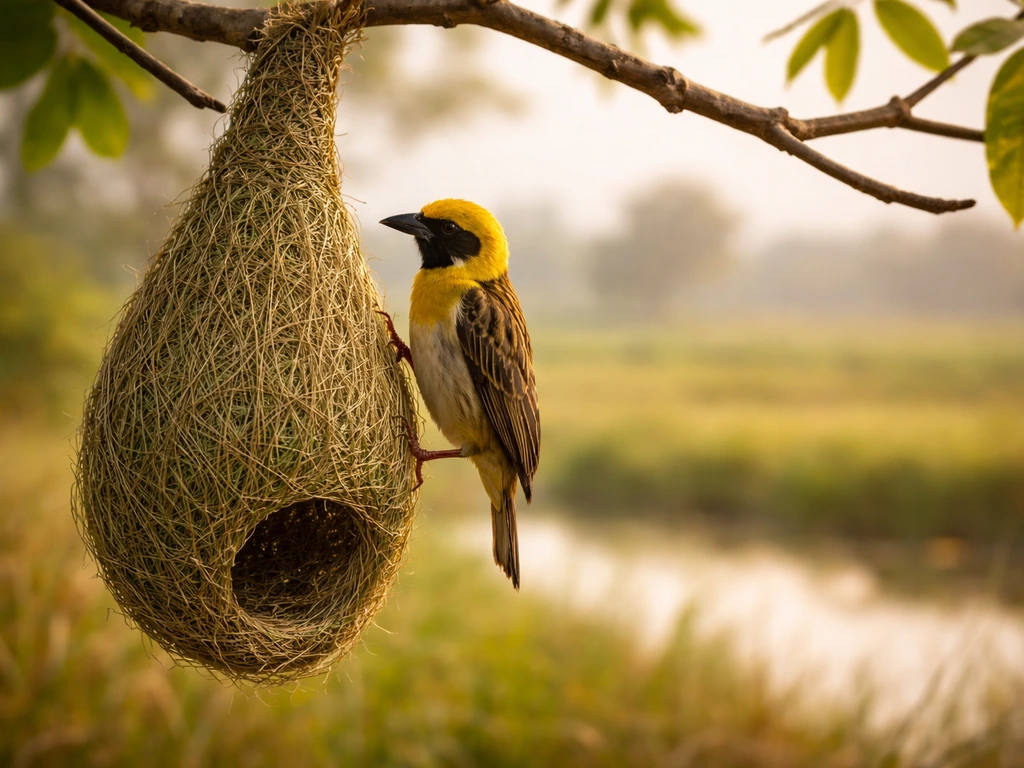
The male baya weaver builds its famous hanging, retort-shaped nest entirely to attract a mate. The nest hangs from the tips of palm, babul, or grass stems, often over water, and takes weeks of labor. If the female is unimpressed, she rejects the nest and he starts over. This behavior has made the baya weaver a symbol of persistence, devotion, and the lengths a lover will go to in order to win a partner's heart. In folk songs and oral traditions across Gujarat and Maharashtra, the sugari's nest-building is sometimes invoked as a metaphor for a man's earnest, tireless effort to create a good home for his family.
The firefly folk belief
One of the most fascinating pieces of folklore surrounding the baya weaver is the belief, documented in the Journal of the Bombay Natural History Society and in local oral tradition, that the bird captures fireflies and embeds them in wet mud on the nest walls. According to this folk belief, the fireflies illuminate the nest interior at night, helping the female care for eggs and chicks in the dark. This is almost certainly not factually accurate, but as a piece of cultural imagination, it tells you something important: people observed the baya's precision and intelligence so closely that they attributed near-magical capabilities to it. In Gujarati folk culture, the sugari became associated not just with hard work but with cleverness and resourcefulness.
Auspiciousness and household omens

Seeing a weaver bird or its nest near a home is generally considered auspicious in Gujarat and across much of western and central India. Because the sugari builds a "good home" (as the very name suggests), its presence near a human household is seen as a blessing for domestic harmony and prosperity. In rural Gujarat, farmers often avoid disturbing baya colonies nesting in trees on their land, not just for practical reasons but out of a traditional respect for the bird's industriousness, which mirrors their own agricultural values.
Spiritual and omen interpretations: when context changes the meaning
The word "meaning" in "weaver bird meaning in Gujarati" can signal two very different questions, and it's worth separating them clearly. If you’re also wondering about the weaver bird meaning in Hindi, the common Hindi term is बया (baya) weaver bird meaning in Gujarati. If you're looking for the wading bird meaning in Gujarati, that phrase can point you to the Gujarati name and usage for the wading bird itself weaver bird meaning in Gujarati. One person asking this question wants a translation (the Gujarati word for weaver bird: sugari/sughari). Another person is asking what the bird means culturally or spiritually, like what it represents as a sign or omen. Both are valid, and both have answers.
In the spiritual and omen sense, the weaver bird is not typically associated with death, danger, or bad luck in Indian traditions, a contrast to birds like the owl or certain calls of the crow, which carry heavier omen weight. Instead, the sugari is a bird of positive associations: industriousness, homemaking, marital devotion, and natural intelligence. If you encounter a weaver bird in a dream or symbolic context in Indian interpretive traditions, the most common readings involve themes of creativity, home, and steady effort yielding reward. The bird's commitment to building and rebuilding its nest is often read as a spiritual lesson in perseverance and non-attachment to outcomes.
Weaver bird species and how Gujarati names differ
"Weaver bird" isn't one species but a whole family, and in the Indian context there are at least three species you'll encounter. The Gujarati names vary by species, which is useful to know if you're trying to identify a specific bird or understand what someone means when they say sugari.
| Species | English Name | Gujarati Name | Notes |
|---|---|---|---|
| Ploceus philippinus | Baya Weaver | સુગરી / સુઘરી (sugari/sughari) or બાયા (baya) | Most common; the classic weaver bird of Indian fields and wetlands |
| Ploceus manyar | Streaked Weaver | રેખાવાળી સુગરી (rekhāvāḷī sugari) | Named for its streaked plumage; less frequently seen |
| Ploceus benghalensis | Black-breasted Weaver | કાળા કંઠવાળી સુગરી (kāḷā kaṇṭhavāḷī sugari) | Named for the black breast/throat marking |
The Gujarati Vishwakosh is the source for all three of these names, making it the most reliable reference for distinguishing species. In everyday speech, most Gujarati speakers use sugari to mean the Baya Weaver specifically, since it's by far the most common and well-known of the three. If you're in a birdwatching or naturalist context, you may need to specify by species using the fuller Gujarati name.
It's also worth knowing that if you're looking at related bird terminology in Hindi, the Baya Weaver is similarly called बया (baya) in Hindi, with the same cultural associations. IndiaBiodiversity lists “English , Baya Weaver” for Ploceus philippinus and includes non-English common names in its species entry Ploceus philippinus is called બया (baya) in Hindi. The Hindi name baya is believed to be an older vernacular form that crossed into Gujarati usage alongside the regional sugari.
If you're exploring weaver bird meaning in Hindi, you'll find the linguistic roots different but the symbolic associations very similar, since both languages draw from the same shared folk traditions of the Indian subcontinent. If you’re searching for the warbler bird meaning in hindi, it helps to first confirm the exact bird species you mean, since names can overlap.
If you are searching for windhover bird meaning in hindi, the interpretation will be different because it points to a different bird and its own cultural symbolism weaver bird meaning in Hindi.
Quick lookup: translations and terms you can use right now
| What you want to say | Gujarati term / phrase | Pronunciation guide |
|---|---|---|
| Weaver bird (general) | સુગરી | su-ga-ree |
| Weaver bird (alternate spelling) | સુઘરી | su-gha-ree |
| Baya Weaver (borrowed term) | બાયા | baa-yaa |
| Weaver bird's nest | સુગરીનો માળો (sugarino māḷo) | su-ga-ree-no maa-lo |
| Nest-weaving bird | માળો બનાવનાર પક્ષી (māḷo banāvnār pakṣī) | maa-lo ba-naav-naar pak-shee |
| Streaked Weaver | રેખાવાળી સુગરી | re-khaa-vaa-lee su-ga-ree |
| Black-breasted Weaver | કાળા કંઠવાળી સુગરી | kaa-laa kanth-vaa-lee su-ga-ree |
How to use sugari in a Gujarati sentence
- સુગરી ખૂબ સુંદર માળો બનાવે છે. (Sugari khūb sundar māḷo banāve che.) — "The weaver bird makes a very beautiful nest."
- બાયા (સુગરી) ગુજરાતના ખેતરોમાં જોવા મળે છે. (Bāyā sugari Gujarātnā khetromā jovā maḷe che.) — "The baya weaver is found in the fields of Gujarat."
- સુગરીનો માળો ઝૂલતો હોય છે. (Sugarīno māḷo jhūlato hoy che.) — "The weaver bird's nest hangs (swings)."
How to identify the bird by appearance and behavior

- Size: sparrow-sized, roughly 15 cm long
- Breeding male: bright yellow crown, dark brown mask, streaked brown back
- Non-breeding male and female: sparrow-brown with heavy streaking, no yellow crown
- Nest: the giveaway. Look for hanging, flask-shaped or retort-shaped woven nests dangling from palm fronds, tall grasses, or babul branches, often over water
- Colonies: baya weavers nest communally, so you'll typically see many nests in one tree
- Sound: a wheezing, chattering call; males display by hanging upside-down from their half-finished nests and flapping wings to attract females
If you spot a cluster of hanging woven nests over a pond or paddy field anywhere in Gujarat, you're almost certainly looking at a colony of sugari. The nest alone is enough to identify the family, no other bird in India builds anything quite like it. That nest is also the reason the Gujarati name has carried such a rich meaning for centuries: a tiny bird, no bigger than a sparrow, patiently weaving a home that embodies everything the name sūgṛhī promises.
FAQ
Is સુગરી and સુઘરી the same bird, or different weaver birds?
Yes. In Gujarati, સુગરી (sugari) and સુઘરી (sughari) are used for the same baya weaver bird, but in some sources the spelling may vary due to transliteration conventions. If you want to be unambiguous in conversation, you can add બાયા (baya) or say “બાયા વણકર” (baya weaver) style descriptions rather than relying only on spelling.
When people ask “weaver bird meaning in Gujarati,” do they usually want translation or symbolism?
If you mean a translation, the common Gujarati word is સુગરી/સુઘરી. If you mean symbolism, Gujarati readings usually connect the bird with domestic harmony, steady effort, and creativity, not with bad luck. For dream or omen questions, clarify whether you want “name meaning” or “cultural meaning,” because people use the same phrase for both.
How can I confirm it is a sugari (baya weaver) and not another bird?
Spotting the bird in the wild, the hanging retort-shaped nest is the quickest identifier, especially over ponds, palms, babul, or grass stems. If you only see a small brown bird perching, don’t assume it is a weaver, but if you see woven hanging nests in a colony, sugari is the likely match.
Since “weaver bird” can mean different species, how do I avoid mixing them up?
Names can overlap across species and regions, and “weaver bird” is a whole group. For practical identification in Gujarat, rely on the nest style (hanging woven nest) and the location (often near water or fields). If you are writing, recording, or searching, specify baya weaver (Ploceus philippinus) to avoid confusion.
Is bāya (બાયા) the same as sugari in Gujarati usage?
In everyday Gujarati speech, sugari usually refers to the baya weaver specifically, but bāya may be heard in urban areas because of Hindi influence. If you’re trying to find the exact term in older folk texts or formal references, look for sugari/sughari alongside baya.
What’s the best way to write the weaver bird name in Gujarati so it is understood correctly?
If the goal is to write the Gujarati meaning correctly, use the Gujarati script names (સુગરી/સુઘરી) rather than roman spellings alone, since romanization varies. Also note that people may casually shorten the phrase, so ask whether they want the Gujarati word for the bird or a sentence describing its symbolism.
Are weaver bird omens in Gujarati the same as omens for other birds like owl or crow?
Common mistake: assuming the bird’s symbolism is the same everywhere in India. In many Gujarati and western Indian folk contexts it is treated as positive and homemaking related, but other birds (owl, certain crow calls) carry heavier omen weight. If you are comparing meanings, separate “weaver bird” from other bird symbols.
How should I treat the firefly-in-nest story when talking about weaver bird meaning?
Traditional accounts sometimes include imaginative details, like the belief about fireflies embedded in the nest. Treat these as folklore rather than biology, but they are still useful as clues about what people noticed (precision, intelligence, and nighttime nesting behavior).
If I find a sugari nest near my home, what should I do (and what should I avoid)?
If you see hanging nests near your home, the cultural takeaway is generally auspicious, but practical care matters too. Avoid disturbing active colonies, especially during nesting periods, since the nest building and mate attraction process can restart if the area is disturbed.
What does sugari symbolize in everyday folk metaphors about relationships and home?
In folk metaphor, the male baya weaver’s repeated nest-building and persistence is often used to describe tireless effort toward a good home or committed relationship. If you are using it in writing or speech, keep the focus on persistence plus suitability (a good dwelling), not just “weaving” as a literal skill.