
Suggested title: Crane Bird Meaning in Gujarati: સારસ, Script, Pronunciation and Symbolism | Meta description: Learn the Gujarati word for crane, સારસ (sāras), its script, pronunciation, species meanings, cultural symbolism, and cross-language equivalents in Hindi, Sanskrit, and Marathi.
Crane Bird Meaning in Gujarati: Word, Script & Usage

Rajesh Sharma
24 Jul 2026
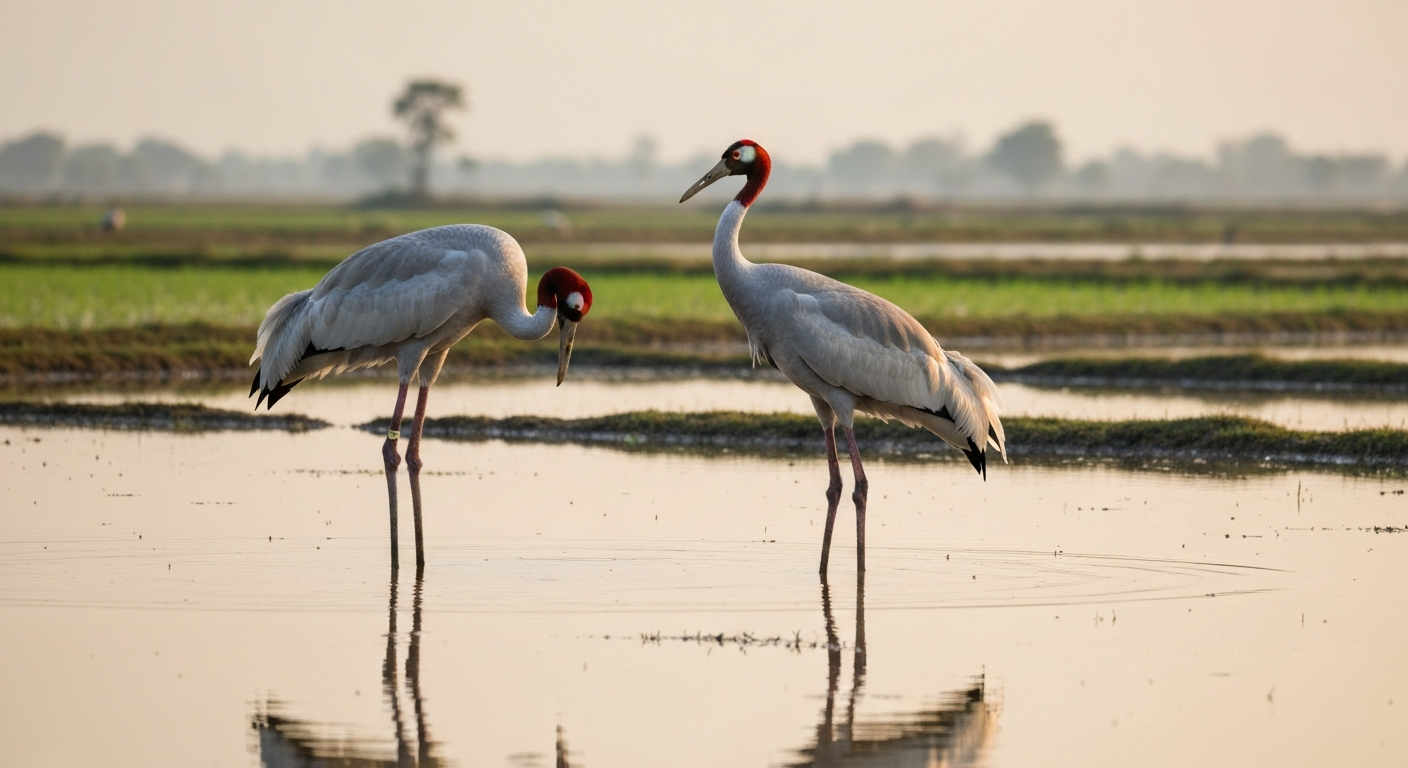
In Gujarati, the most common and culturally significant word for 'crane' is સારસ (romanized: sāras or sārasa, pronounced roughly /ˈsɑ.ɾəs/). This word refers specifically to the Sarus Crane (Antigone antigone), the tallest flying bird in the world and one of the most symbolically loaded birds in Indian tradition. A second Gujarati word, કરકરો (romanized: karakaro, pronounced [kəɾəkro]), is used for the Demoiselle Crane, a smaller migratory species that winters in large numbers across western India including Gujarat. If you look up 'crane' in a general Gujarati dictionary, you may also encounter બગલું (bagalu), but that term more accurately refers to a heron or egret, not a true crane. Knowing which word to use depends on which species you mean.
Gujarati words for crane: script, transliteration, and pronunciation
There are two main Gujarati words you need to know, each tied to a distinct species. The first and more culturally weighted one is સારસ. In Gujarati script, this is written using the Gujarati Unicode block (U+0A80–U+0AFF): the sequence is સ (U+0AB8) + ા (U+0ABE, the long-aa vowel sign) + ર (U+0AB0) + સ (U+0AB8), giving you the four-unit glyph string સારસ. The IAST transliteration is sārasa (or sāras in shortened everyday form). The Wiktionary Gujarati entry gives the IPA pronunciation as /ˈsɑ.ɾəs/, which you can approximate in English as 'SAA-rus', with the stress on the first syllable and a short schwa before the final 's'.
The second word is કરકરો. In script, the codepoint sequence is ક (U+0A95) + ર (U+0AB0) + ક (U+0A95) + ર (U+0AB0) + ો (U+0ACB, the 'o' vowel sign), giving કરકરો. The phonemic realization based on standard Gujarati phonology is [kəɾəkro], which you can roughly approximate as 'kuh-ruh-kro' with all syllables short and unstressed except the final 'kro'. This word is the standard Gujarati vernacular for the Demoiselle Crane and appears in the Gujarati Vishwakosh (the state encyclopedia) with that precise species mapping.
| Gujarati Script | Transliteration (IAST) | Approximate Pronunciation | Species It Denotes |
|---|---|---|---|
| સારસ | sārasa / sāras | /ˈsɑ.ɾəs/ (SAA-rus) | Sarus Crane (Antigone antigone) |
| કરકરો | karakaro | [kəɾəkro] (kuh-ruh-kro) | Demoiselle Crane (Anthropoides virgo) |
| બગલું | bagaluṃ | /bəgəlũ/ (buh-guh-lum) | Heron/Egret (not a true crane — use with caution) |
Which Indian crane species these Gujarati words usually denote
India has four crane species with documented occurrence in the country, and the Gujarati vocabulary maps onto them with varying degrees of specificity. Gujarati bird checklists such as the Flamingo Gujarat checklist confirm that સારસ is consistently used for the Sarus Crane and કરકરો for the Demoiselle. The Common Crane and the Black-necked Crane do not have widely standardized separate Gujarati vernacular names in popular use, though the Gujarati Vishwakosh and regional checklists treat them under descriptive labels or use transliterated English names.
| English Name | Scientific Name | Gujarati Name | IUCN Status | Occurrence in India |
|---|---|---|---|---|
| Sarus Crane | Antigone antigone | સારસ (sāras) | Vulnerable | Resident breeder; North and West India including Gujarat |
| Demoiselle Crane | Anthropoides virgo | કરકરો (karakaro) | Least Concern | Winter visitor; large aggregations in Rajasthan, Gujarat, Kutch |
| Common Crane | Grus grus | No standardized Gujarati vernacular | Least Concern | Winter visitor/stopover; recorded in Gujarat |
| Black-necked Crane | Grus nigricollis | No standardized Gujarati vernacular | Vulnerable | Very rare winter visitor; Himalayan breeding range |
Brief species notes: Sarus, Common, Demoiselle, and Black-necked cranes
Sarus Crane (Antigone antigone)
The Sarus is the bird most Indians picture when they hear the word 'crane'. Standing up to 180 cm tall, it is the world's tallest flying bird. In India, it breeds in agricultural wetlands across Uttar Pradesh, Rajasthan, Gujarat, and parts of the Gangetic plain. The species is IUCN Vulnerable, with the global population declining due to habitat loss and wetland drainage. Avibase, India checklist (species list incl. Sarus & Demoiselle Crane) lists the Sarus Crane as Antigone antigone and notes its IUCN status as Vulnerable blank" rel="noopener noreferrer">Avibase — India checklist (species list incl. Sarus & Demoiselle Crane). The Sarus is famous for its lifelong pair-bonding, which is why it occupies such a central place in Indian mythology and poetry. blank" rel="noopener noreferrer">eBird and Macaulay Library records document Sarus Crane sightings from Ahmedabad and surrounding Gujarat districts.
Demoiselle Crane (Anthropoides virgo)
The Demoiselle is the world's smallest crane and one of the most migratory. Each autumn, tens of thousands cross the Himalayas from Central Asia into the Indian subcontinent, with major wintering aggregations at Khichan in Rajasthan and in the Kutch region of Gujarat. The Gujarati Vishwakosh lists it as a winter visitor to Gujarat, and BirdCount and eBird migration maps confirm its regular occurrence in western India from approximately October to March. Its IUCN status is Least Concern.
Common Crane (Grus grus)
The Common Crane (also called the Eurasian Crane) is a winter visitor and stopover migrant in Gujarat. State of India's Birds factsheets and regional Gujarat checklists include Gujarat records for this species. It is larger than the Demoiselle and tends to occur in smaller numbers in India compared to its major wintering grounds further west and south. No widely adopted Gujarati vernacular name exists for this bird in common usage.
Black-necked Crane (Grus nigricollis)
The Black-necked Crane is a high-altitude specialist that breeds on the Tibetan Plateau and winters in limited numbers in parts of Arunachal Pradesh and Bhutan. Its occurrence in Gujarat is very rare and largely incidental. It carries deep religious significance among Tibetan Buddhist communities, but no established Gujarati cultural or linguistic tradition is associated with it. It is listed as Vulnerable by IUCN.
Crane species in Gujarat: where and when you find them
Gujarat is genuinely important crane country. The Sarus Crane is a resident breeder in the state, with photographic records from Ahmedabad district and other agricultural wetland areas logged in eBird and the Macaulay Library. It favors shallow marshes, paddy fields, and irrigation tank edges in open country. The Demoiselle Crane, known locally as કરકરો, is a significant winter visitor to Gujarat, particularly to the Kutch district. Kutch's flat arid plains and seasonal wetlands are well-documented wintering and stopover habitat for this species, mirroring the famous mass aggregations seen slightly further north at Khichan in Rajasthan. The Common Crane is also recorded in Gujarat as a winter visitor and stopover migrant, though in smaller numbers than the Demoiselle. For anyone birdwatching in Gujarat between October and February, seeing both Demoiselle and Sarus cranes in the same landscape is a realistic possibility.
How Gujaratis actually use these words: regional variants and lexical overlaps
In formal Gujarati writing, scientific communication, and the Gujarati Vishwakosh, the species boundaries are clear: સારસ = Sarus, કરકરો = Demoiselle. In everyday spoken Gujarati, however, there is some lexical blurring worth flagging. Gujaratilexicon, a major bilingual resource, lists both બગલું and સારસ under the English headword 'crane', which reflects the folk tendency in some regions to group large long-legged wading birds loosely together. Strictly speaking, બગલું refers to herons and egrets (family Ardeidae), which are entirely different birds from cranes (family Gruidae). If you are translating a text and precision matters, always use સારસ specifically for the Sarus Crane and avoid બગલું as a translation for 'crane'. Regional rural dialects in parts of north Gujarat and Saurashtra may use different local names or apply સારસ loosely to any large wading bird, so context always matters.
A practical note for language learners and translators: if you encounter the word સારસ in a Gujarati poem, proverb, or piece of classical literature, it almost certainly refers to the Sarus Crane, not to cranes in general. The cultural and poetic weight of the word is specifically attached to that one species and its symbolic associations with love and fidelity.
The same bird in Hindi, Sanskrit, Marathi, and Punjabi
One of the most elegant things about the word સારસ is how far back its roots go. The Wiktionary etymology entry for સારસ traces it directly to Sanskrit सारस (sārasa), which itself derives from Sanskrit सरस् (saras, meaning 'lake' or 'pond'), ultimately rooted in Proto-Indo-Aryan and Proto-Indo-European *sélos ('marsh'). Monier-Williams confirms sāras/sārasa as the classical Sanskrit term for the Indian crane and notes its connection to saras. This etymology makes perfect ecological sense: the Sarus Crane lives in and around lakes and wetlands. Across all the major modern Indo-Aryan languages of north India, the word has descended with minimal change.
| Language | Word for Sarus/Crane | Script | Notes |
|---|---|---|---|
| Gujarati | sāras / sārasa | સારસ | Standard term for Sarus Crane; Demoiselle = કરકરો |
| Hindi | sāras / sārasa | सारस | Widely used; also the poetic/literary standard |
| Sanskrit | sārasa | सारस | Classical source form; related to saras (lake) |
| Marathi | sāras | सारस | Used in Maharashtra for Sarus Crane; same etymology |
| Punjabi | sāras | ਸਾਰਸ | Used in Punjab; Sarus Crane is a cultural symbol in Punjab too |
The consistency across these languages is striking and reflects how deeply embedded this bird is in the shared cultural-linguistic heritage of the Indian subcontinent. Unlike many bird names that differ sharply across regions, the crane's core name has stayed almost identical from the Vedic period to modern Gujarati. This is a useful data point for language learners moving between these languages: if you know सारस in Hindi, you already know સારસ in Gujarati.
Cultural, mythological, and symbolic meanings in Gujarati and Hindu tradition
The Sarus Crane carries one of the most powerful symbolic loads of any bird in Indian tradition. Its central symbolic meaning is conjugal love and fidelity, rooted in the bird's well-documented behavior of forming lifelong monogamous pairs. This is not speculation: the Sarus is genuinely one of the very few large birds observed to mate for life, and Indian poets, scholars, and common people have recognized and celebrated this for at least two millennia.
The most famous literary connection is to the Ramayana. The Sanskrit poet Valmiki's inspiration to compose the epic is traditionally said to have been sparked by witnessing a hunter kill one of a pair of Sarus Cranes (sārasa) while they were mating. The grief of the surviving bird moved Valmiki to curse the hunter in spontaneous verse, and that verse form, the shloka, became the meter of the entire Ramayana. The word 'krauñca' (sometimes identified with the Sarus or with another crane-like bird) is used in that passage, and traditional commentators have often linked it to the sārasa. This story is retold across Indian languages including Gujarati, and it positions the crane as the literal originating symbol of Sanskrit and Indian poetry.
In Gujarati folk tradition and broader Hindu iconography, the Sarus pair (સારસ જોડ, sāras joḍ) is a conventional symbol for a devoted married couple. Gujarati literature and classical poetry use the image of two Sarus Cranes calling to each other across a lake as a metaphor for longing between separated lovers or spouses. This motif appears in medieval Gujarati bhakti poetry and continues in contemporary Gujarati song and idiom.
A caution is worth stating clearly here: some popular sources attribute highly specific spiritual powers or omens to seeing a Sarus Crane. These claims vary widely by region and community and are not uniformly held across Gujarat or India. What can be stated with confidence is that the bird is considered auspicious (shubha), that a Sarus pair in one's field is widely regarded as a good omen by farming communities in Gujarat and UP, and that harming a Sarus is considered inauspicious or even sinful in many rural traditions. Beyond this general cultural respect, specific omen-interpretations should be treated as local and variable rather than as universal Hindu doctrine.
Proverbs, idioms, and literary usage
The phrase સારસ જોડ (sāras joḍ, 'a crane pair') functions in Gujarati as a conventional way of saying 'an inseparable couple' or 'devoted partners'. In classical Sanskrit and its Gujarati literary inheritance, the sārasa appears repeatedly in nature descriptions (prakriti-varnana) as part of the standard lake-and-lotus imagery: cranes on a lotus pond are a stock scene in Sanskrit kavya, and that imagery carried forward into medieval Gujarati poetry. Some Gujarati folk songs (lokgīt) reference the Sarus calling at dawn near water as a symbol of devotion or longing, though the specific texts vary by region and oral tradition.
The crane versus the heron: a common confusion in symbolism
It is worth noting that in some folk traditions and less careful modern writing, the Sarus Crane's symbolism gets conflated with that of the heron (bagalā / बगला in Hindi and Sanskrit). In Sanskrit, the heron is actually a symbol of hypocrisy (the 'crane-like yogi' or baka, standing still as if in meditation while actually hunting fish). This is nearly the opposite of the crane's symbolism. The distinction matters linguistically too: as noted above, Gujarati's સારસ and Hindi's सारस both refer to the true crane, while बगलुं (Gujarati), बगला (Hindi), and related forms refer to herons and egrets. If you are reading a text and need to distinguish the cultural meaning, the species identification of the word used is essential.
Sample sentences in Gujarati
Seeing the words in use is the fastest way to lock in the vocabulary. Here are a few practical examples with transliterations and English meanings.
- સારસ એ ભારતનું સૌથી ઊંચું ઊડી શકે તેવું પક્ષી છે. (Sāras e Bhāratanuṃ sauthuṃ ūṃcuṃ uḍī shake tevuṃ pakṣī che.) — 'The Sarus Crane is India's tallest flying bird.'
- સારસ હંમેશાં જોડમાં રહે છે. (Sāras haṃmeśāṃ joḍmāṃ rahe che.) — 'Cranes always stay in pairs.' (Used idiomatically of devoted couples.)
- ગુજરાતમાં શિયાળામાં કરકરો જોવા મળે છે. (Gujarātmāṃ śiyāḷāmāṃ karakaro jovā maḷe che.) — 'The Demoiselle Crane can be seen in Gujarat in winter.'
- ઝીલ કિનારે સારસ નૃત્ય કરતા હતા. (Jhīl kināre sāras nṛtya karatā hatā.) — 'Cranes were dancing at the lakeside.' (A stock image in Gujarati nature poetry.)
Suggested images for this article
- Photograph: A pair of Sarus Cranes (Antigone antigone) in a Gujarat wetland or agricultural field, ideally showing both birds together. Caption suggestion: 'A pair of Sarus Cranes (સારસ) in Gujarat — the bird's lifelong pair-bonding is the basis for its symbolic meaning of conjugal fidelity in Gujarati and Hindu tradition.'
- Photograph or illustration: A flock of Demoiselle Cranes (Anthropoides virgo) in flight or roosting, ideally in a Gujarat/Kutch landscape. Caption suggestion: 'Demoiselle Cranes (કરકરો) are winter visitors to Gujarat, particularly in the Kutch region, arriving each October from Central Asia.'
How this fits with other Gujarati bird names
If you are building your Gujarati bird vocabulary, the crane entries sit alongside other culturally significant birds that the Gujarati language has preserved with great precision. The kite and the papiha, for example, both have their own distinct Gujarati names and symbolic histories worth exploring separately. The broader pattern you will notice across Gujarati bird terminology is the same one on display with સારસ: many of the most common and culturally important bird names are Sanskrit-derived and shared across Hindi, Marathi, and Punjabi, which makes cross-language learning faster than you might expect. For related cross-language entries, see quail bird meaning in Marathi for the equivalent Marathi term and usage. For related cross-language bird-name guides, see quail bird meaning in Nepali. See also our article on papiha bird meaning in Gujarati for the Gujarati name, pronunciation, and cultural symbolism of the papiha.
FAQ
What is the Gujarati word for “crane” (written, transliteration and pronunciation)?
The standard Gujarati word for the Indian crane (Sarus) is સારસ — transliteration: sārasa or sāras — pronunciation: approximately /saːrəs/ (Wiktionary gives /ˈsɑ.ɾəs/). For the Demoiselle Crane a common Gujarati name is કરકરો — transliteration: karakaro — pronunciation: roughly [kəɾəkro]. (Sources: Gujarati Vishwakosh; Wiktionary; Gujarati phonology references.)
Which Indian crane species do these Gujarati words typically denote?
સારસ (sārasa) usually denotes the Sarus Crane (Antigone/Grus antigone). કરકરો (karakaro) is used for the Demoiselle Crane (Anthropoides/Grus/Anthropoides virgo). Other English 'crane' species recorded in Gujarat include the Common (Eurasian) Crane (Grus grus) and occasional records of the Black‑necked/other migratory cranes; regional checklists list Sarus, Demoiselle and Common Crane for the state. (Sources: Gujarati Vishwakosh; Flamingo Gujarat checklist; Avibase/BirdLife.)
Do Gujarati speakers ever use other words for ‘crane’ or mix terms with heron/egret names?
Yes. Some bilingual dictionaries list multiple entries (e.g., both સારસ and બગલું for crane), and local usage can overlap with names for long‑legged wading birds. Exact usage may vary by region, speaker and context; where precision is needed, pair the Gujarati name with the scientific name. (Sources: GujaratiLexicon; Gujarati Vishwakosh.)
How common are Sarus and Demoiselle cranes in Gujarat?
Demoiselle Crane is a regular large winter visitor to western India and is well documented in Gujarat (mass wintering and migration records). Sarus Crane occurs in India including Gujarat with photographic and eBird records from locations such as Ahmedabad, though Sarus is less gregarious. The Common (Eurasian) Crane has also been recorded as a winter visitor/stopover in Gujarat. (Sources: BirdCount/eBird; Macaulay Library; Flamingo Gujarat; State of India’s Birds.)
How are these species classified scientifically and what are their conservation statuses?
Sarus Crane — Antigone antigone (formerly Grus antigone); IUCN: Vulnerable. Demoiselle Crane — Anthropoides (or Grus) virgo; IUCN: Least Concern. Common Crane — Grus grus; status variable regionally (check IUCN/BirdLife for current global status). (Sources: Avibase; BirdLife/IUCN; Birds of India pages.)
What symbolic, spiritual or cultural meanings do cranes have in Gujarati/Hindu tradition?
Cranes (sārasa) appear in Sanskrit and later Indic literature and are associated with wetlands, elegance and seasonal migration; the Sanskrit word sāras leads to the Gujarati સારસ. Some poetic and folk references use the crane as a symbol of fidelity, mourning, or auspicious wetlands life, but specific Gujarati proverbs and religious attributions vary locally. Where claims are speculative or folk‑level, note the uncertainty and prefer cited literary sources. (Sources: Monier‑Williams Sanskrit dictionary; Gujarati Vishwakosh; caution: local usages vary.)},{