
The most natural Hindi translation of 'scratching bird' is खुरचने वाला पक्षी (khurchne wala pakshi), where खुरचना (khurchna) means to scratch or scrape and पक्षी (pakshi) means bird. That is the literal, word-for-word rendering. But the reason people end up searching this phrase is rarely because they want a vocabulary lesson. Most of the time, they encountered the phrase in a folk, spiritual, or omen-related context, and they want to know what it actually signals. So let's work through both possibilities clearly.
Scratching Bird Meaning in Hindi: Literal vs Symbolic

Rajesh Sharma
23 Mar 2026
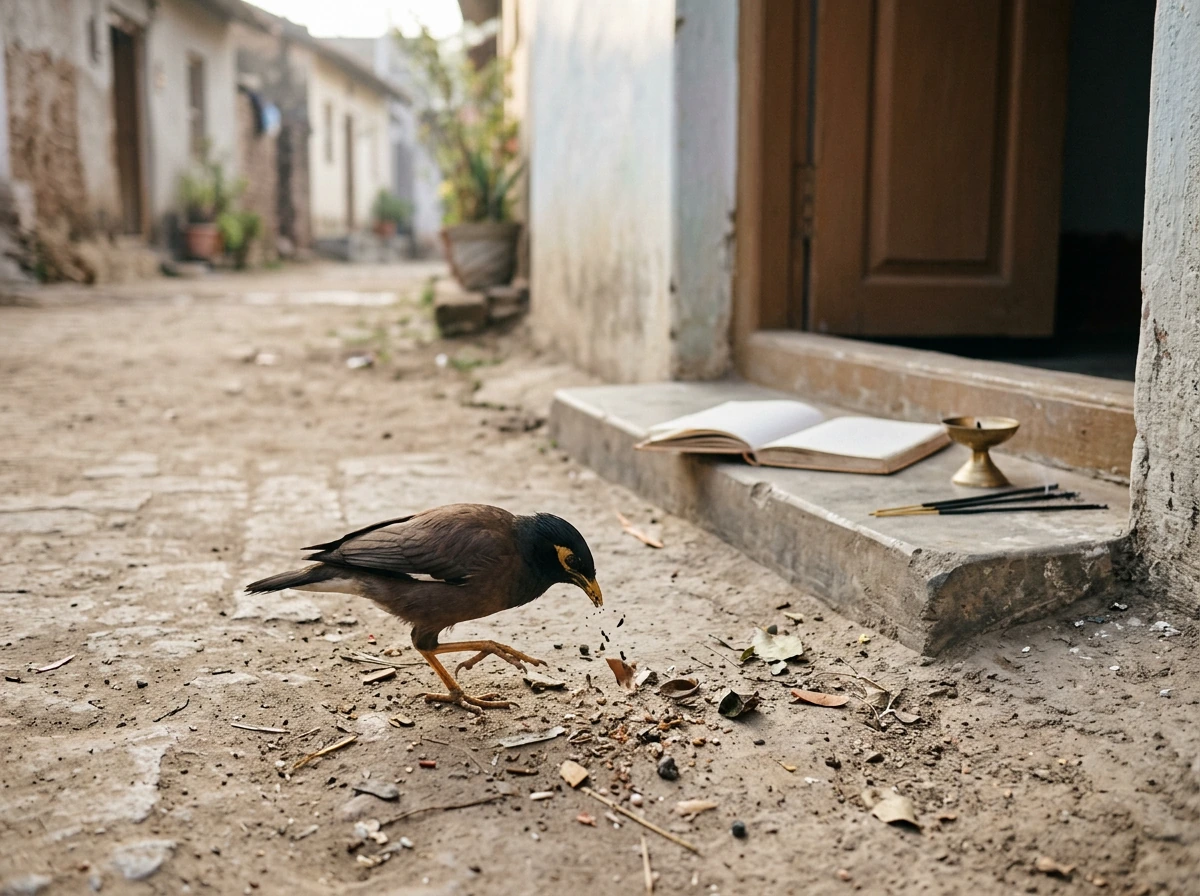
What 'Scratching Bird' Means in Hindi, Word for Word
Breaking it down: पक्षी (pakshi) is the standard Hindi and Sanskrit word for bird, used across formal writing, religious texts, and everyday speech. The action of scratching or scraping is expressed through the verb खुरचना (khurchna), which covers both scratching a surface and scraping something off. So a 'scratching bird' in a purely descriptive sense becomes खुरचता पक्षी (khurchta pakshi) or, more naturally, जमीन पर खुरचने वाला पक्षी (zameen par khurchne wala pakshi), meaning 'a bird that scratches on the ground.'
You might also encounter खुरच (khurch) as a standalone noun referring to the act of scratching, or the verb form खुरचाना (khurchana), which means to cause something to be scraped. None of these words are bird-specific on their own. They are general-action words that happen to describe what certain birds visibly do when foraging.
Literal Behavior or Symbolic Expression? Here's How to Tell
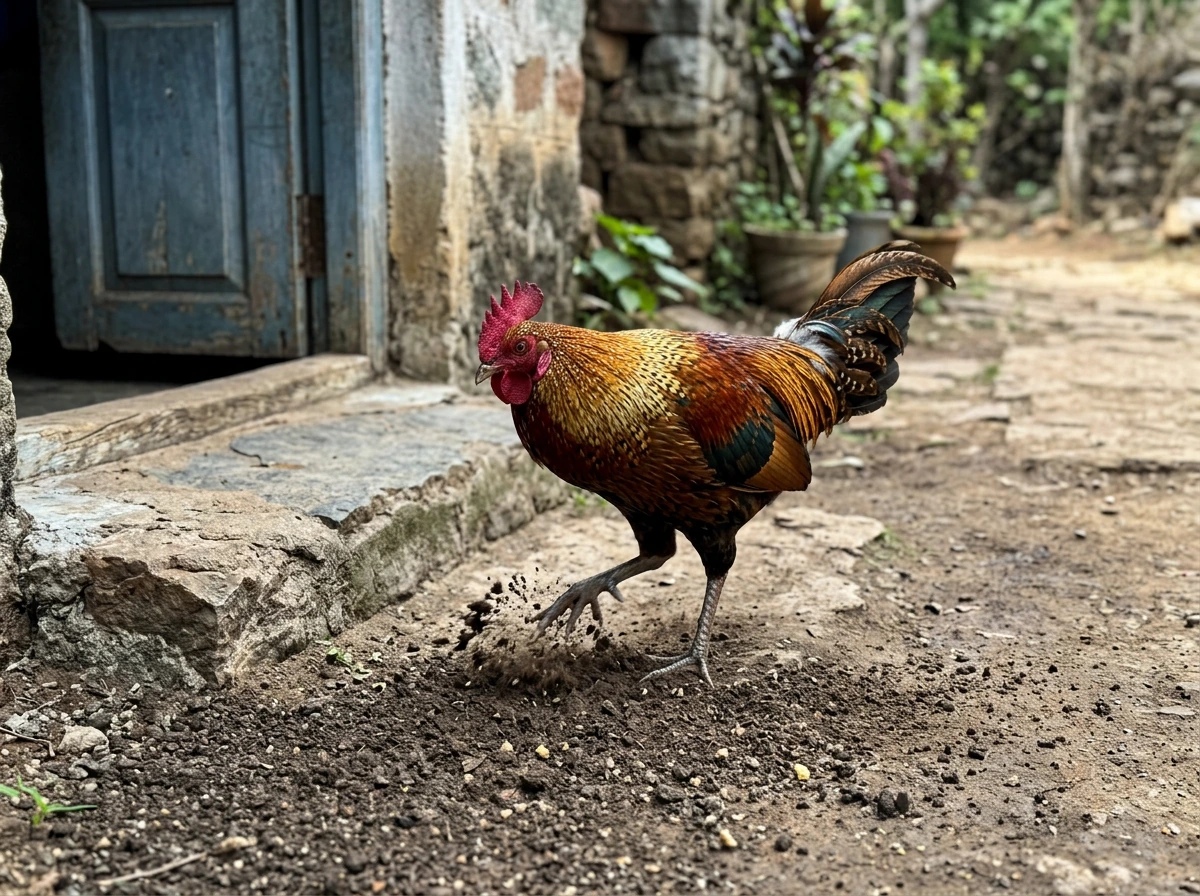
This is the core question, and the answer depends entirely on the sentence or context where you saw the phrase. In Hindi, a bird 'scratching' (खुरचने वाला पक्षी) is often just a behavioral description, the same way you would say a crow calling or a sparrow hopping. If you are also wondering about the rhea bird meaning in hindi, the same idea applies: context decides whether it is a literal description or an omen-like reference. It becomes symbolic only when the sentence explicitly frames it as an omen or sign, what Indian traditions call शकुन (shakun) for a good omen and अपशकुन (apshakun) for a bad one.
The tradition of reading bird behaviors as omens is well-documented in Indian culture and goes back to classical shakun shastra texts. But within that tradition, 'scratching' is a descriptive detail, not a fixed idiom with one locked-in meaning. So if your sentence includes words like शकुन (shakun), संकेत (sanket, meaning sign or signal), अपशकुन (apshakun), नज़र (nazar, omen/gaze), or टोटका (totka, folk remedy or superstition), you are almost certainly in symbolic territory. If those framing words are absent, the phrase is most likely just describing a bird's physical behavior.
| Context clue in the sentence | Most likely interpretation | Hindi framing words to look for |
|---|---|---|
| Bird described doing something physical | Literal behavior (foraging, ground-scratching) | खुरचना, जमीन, पंजे (claws), चोंच (beak) |
| Bird described as a sign or portent | Symbolic/omen meaning (shakun/apshakun) | शकुन, अपशकुन, संकेत, नज़र, टोटका |
| Bird mentioned in a mythological story | Folkloric or legendary reference | पुराण, लोककथा, देवता, शुभ/अशुभ |
| Bird phrase in poetry or idiom | Figurative or idiomatic use | मुहावरा, कहावत, उपमा, metaphor language |
Common Hindi Wordings for a 'Scratching Bird'
Because 'scratching bird' is not a fixed Hindi idiom, it surfaces in different forms depending on region, context, and register. Here are the wordings you are most likely to encounter:
- खुरचने वाला पक्षी (khurchne wala pakshi): The most neutral, everyday phrasing. Literally 'bird that scratches.' Used in descriptive or naturalistic writing.
- खुरचता पक्षी (khurchta pakshi): A slightly more formal or literary construction meaning 'scratching bird' as an active description.
- जमीन खुरचने वाला पक्षी (zameen khurchne wala pakshi): Specifically 'a bird that scratches the ground,' which is how you would describe foraging birds like junglefowl, peafowl, or mynas in natural-history or folk contexts.
- पंजे से खुरचने वाला पक्षी (panje se khurchne wala pakshi): 'A bird that scratches with its claws,' a more precise description used when claw behavior is the focus.
- खुरचाई करने वाला पक्षी (khurchai karne wala pakshi): A slightly regional or colloquial variant, less common in formal text but heard in spoken Hindi.
In Marathi, a closely related language, you would hear खरवडणारा पक्षी (kharwadnara pakshi) for a scratching bird. In Punjabi, ਖੁਰਚਣ ਵਾਲਾ ਪੰਛੀ (khurchan wala panchhi) follows essentially the same pattern. Gujarati uses ખંજવાળ (khanjval) for itching/scratching and પક્ષી (pakshi) for bird, giving ખંજવાળ કરતો પક્ષી in informal speech. Across all these languages, the word for bird (pakshi) is recognizable because it comes from the same Sanskrit root, making cross-language reading easier once you know the verb root in each language.
What Scratching Birds Symbolize in Indian Traditions

Indian shakun shastra, the classical science of omens, pays close attention to bird behavior. A bird scratching the ground near your home or on a journey was historically interpreted through the lens of which bird it was, where it was scratching, what direction it was facing, and what time of day the behavior occurred. The scratching action itself carries layered meanings depending on these variables.
Ground-scratching birds, especially those like the junglefowl (the wild ancestor of the domestic chicken) or the peacock, were seen as earth-connectors, birds that literally dig into the soil and bring what is hidden to the surface. In folk symbolism this translates into uncovering hidden truths, revealing what is buried, or stirring up what has been still. In some regional traditions, a bird scratching near the threshold of a house before a journey was noted as a sign of potential disruption, not necessarily catastrophic, but a prompt to pause and check your preparations.
The myna bird (मैना, maina in Hindi) is particularly associated with omen-reading in everyday Indian folk belief. When a myna scratches or pecks at the ground repeatedly near a home, village tradition in several North Indian communities reads this as an indicator of coming guests or news. You can explore the myna's symbolic meanings in more depth in the dedicated article on myna bird meaning in Hindi.
More broadly, the symbolic weight of a scratching bird in Indian traditions comes down to two themes: searching and revealing. A bird that digs and scratches is looking for something below the surface. Applied symbolically, this maps onto the idea of inquiry, persistence, and the surfacing of hidden knowledge, which connects to the broader Sanskrit concept of विवेक (vivek), discernment or the ability to distinguish truth from illusion.
Mythology, Folklore, and Legendary Bird Connections
No single legendary Indian bird is defined specifically by its scratching behavior, but several mythological birds have attributes that overlap with the 'scratching' symbolism of earth-contact, revelation, and hidden knowledge. The most significant is Garuda (गरुड़), the divine eagle of Hindu mythology and vehicle of Vishnu. Though Garuda is primarily known for flight and sovereignty, his earth-contact role includes destroying the serpents that hide underground, a mythological parallel to the idea of a bird scratching into the earth to uncover what lies beneath.
The Jatayu (जटायु) of the Ramayana is another figure worth noting. Jatayu, a vulture king who acts as a witness and defender, represents a bird whose actions carry moral and spiritual consequence. While Jatayu does not scratch the ground, the broader point from his story is that bird behavior in Indian mythology is rarely incidental. Birds act with intention, and their actions signal something larger.
In Rajasthani and Marwari folk traditions documented in shakun texts, there are references to पक्षी शकुन विचार (pakshi shakun vichar), entire frameworks for reading bird omens. These texts list specific birds and behaviors. Ground-scratching is categorized under 'earth behaviors' along with pecking and dust-bathing, and the omen value changes depending on which side of the body the bird scratches, how many times, and what it does immediately after. This level of specificity tells you that in folk tradition, the scratching bird was a known and watched category of omen, even if it does not carry one fixed universal meaning. For those curious about how bird deaths are interpreted in this same omen-reading tradition, the article on dead bird meaning in Hinduism covers that symbolic territory in detail.
How to Confirm the Right Meaning Based on Your Context
The fastest way to figure out what your specific 'scratching bird' reference means is to look at the surrounding sentence or passage for these three things: the type of bird named, the framing language (descriptive vs. omen-based), and the setting (natural, ritual, poetic, or conversational).
- Identify the bird species if one is named. A scratching crow (कौआ, kaua) in an omen context carries very different weight than a scratching peacock (मोर, mor). Crows are the most common omen-birds in Indian folk tradition, so any behavior of a crow tends to get an omen reading automatically.
- Look for shakun framing words: शकुन, अपशकुन, संकेत, नज़र, शुभ, अशुभ. If any of these appear nearby, the scratching bird is functioning as a symbolic sign, not just a behavioral description.
- Check the genre. Folk sayings (कहावतें, kahawaten) and proverbs often use bird behaviors metaphorically. Naturalistic writing, birding guides, or animal behavior descriptions use them literally. Poetry can go either way.
- If the phrase appears in a regional language (Marathi, Punjabi, Gujarati), match the verb used for 'scratch' in that language to confirm the behavior being described. The concept is consistent, but the verb root differs.
- When in doubt, the default interpretation of खुरचने वाला पक्षी in a plain sentence is literal. Symbolic meaning is always signaled by additional framing in Indian textual and oral tradition. It is not left implicit.
Common Confusions and Similar Bird Phrases to Watch Out For
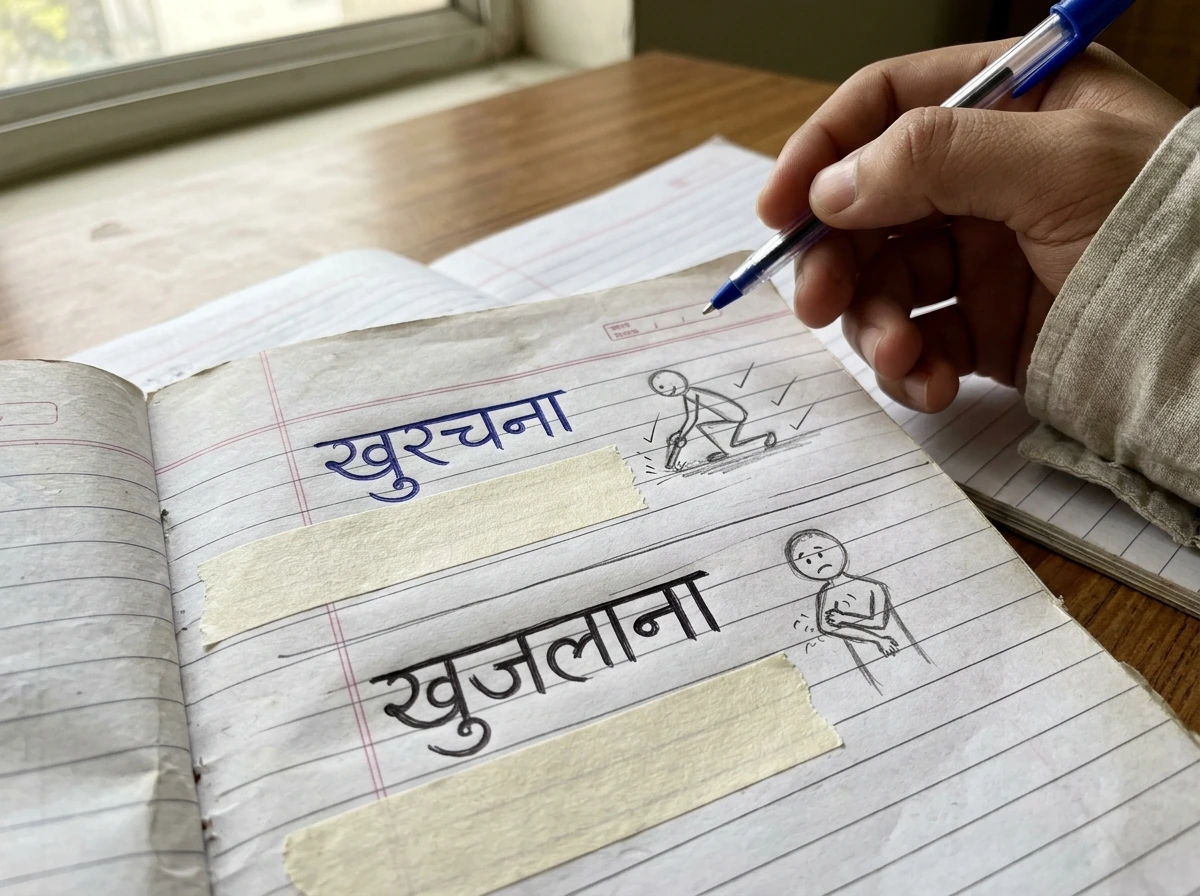
The most common confusion is between खुरचना (khurchna, to scratch/scrape) and खुजलाना (khujlana, to itch/scratch oneself). These are related but different actions. खुरचना is about making contact with a surface and dragging or scraping it, which is what a bird does when foraging. खुजलाना refers to the sensation of itching and is used for self-scratching in response to irritation. A bird scratching its own feathers with its beak is खुजलाना territory; a bird scratching the ground for food is खुरचना territory.
Another confusion comes from the word चुनना (chunna), which means to pick or select, but is also used for a bird pecking or picking at the ground. You might see जमीन से चुनना (zameen se chunna, to pick from the ground) used almost interchangeably with जमीन खुरचना (zameen khurchna, to scratch the ground) in folk descriptions of foraging. The distinction is subtle: खुरचना implies a scraping or digging motion, while चुनना implies selective picking. Both describe ground-feeding behavior, but they are not the same gesture.
You may also encounter the phrase पंख फड़फड़ाना (pankh fadphadana), meaning 'flapping wings,' which is a completely different bird behavior but often appears in the same omen-reading contexts as scratching. Do not conflate the two. Similarly, नोचना (nochna), meaning to claw or tear at something, is sometimes confused with खुरचना in folk descriptions of aggressive bird behavior, but nochna carries a much more violent connotation.
For readers navigating the broader world of Indian bird names and meanings, it helps to know that many bird-behavior terms in Hindi come from Sanskrit verb roots that appear similarly across Marathi, Gujarati, and Punjabi. If you are working in one of those languages and cannot find a match, check the Sanskrit root and look for cognates. The crane (known as सारस, saras in Hindi, discussed in the article on crane bird in Hindi) offers a good example of how one Sanskrit-origin bird name travels cleanly across multiple Indian languages, which is the same principle that applies to action words like खुरचना.
If you came across the phrase 'scratching bird' in a spiritual or vastu context specifically, be aware that vastu shastra sometimes uses bird omens differently from classical shakun shastra. In vastu, the direction a bird scratches toward can carry meaning about which area of life is being 'stirred up.' But this is a specialized interpretation and not the default meaning of the phrase. Unless your source explicitly mentions vastu, stick with the shakun shastra framework for cultural interpretation, or treat the phrase as purely descriptive if no omen language surrounds it.
FAQ
How can I tell if “scratching bird” is meant as a warning, a good sign, or just description in Hindi text?
Check for omen framing words. If you see terms like शकुन (good omen), अपशकुन (bad omen), संकेत (sign/signal), नज़र (omen/gaze), or a line that refers to a coming event, it is likely symbolic. If the sentence simply describes location and behavior without those markers, it is usually just a foraging description.
Does the meaning change if the bird scratches indoors versus outdoors?
Yes, in folk omen reading the setting matters. Ground-scratching near a home exterior, boundary, or doorway is treated differently than similar scratching far from the house. If your passage specifies “on the threshold,” “near the gate,” or “inside the house,” the context is hinting at an event affecting that space.
What if the phrase is not “scratching bird” but a specific bird name doing scratching, like मैना (myna)?
Then meaning usually becomes bird-specific rather than generic. The article notes myna in particular as commonly linked with guests or news when it scratches or pecks repeatedly near a home. So you should prioritize the named bird’s common folk association, then use omen framing words to confirm whether it is being treated symbolically.
Is there a reliable Hindi way to rephrase “scratching bird meaning in Hindi” for someone who wants the translation only?
If you want a clean translation without symbolism, use the descriptive form: “जमीन पर खुरचने वाला पक्षी” (a bird that scratches on the ground). Avoid adding omen words unless the original source explicitly uses शकुन या अपशकुन style framing.
How many times does a bird scratch matter for omen interpretation?
In shakun-style folk frameworks, repeated counts can shift the interpretation, even when the action category is the same (ground scratching). If your source includes a number, “multiple times,” or “repeatedly,” treat the repetition as meaningful rather than decorative.
What direction or side of the body matters if my source mentions it?
Some folk texts track directionality and side (for example, which side the bird uses while scratching, or where the bird is positioned relative to you). If your passage includes words about direction, side, or orientation, don’t ignore them, because they can be the main driver of the symbolic reading.
Can “scratching” in the phrase actually refer to scratching one’s own feathers, not ground scraping?
Yes. If the context says the bird is scratching its feathers with its beak or showing self-irritation behavior, it aligns more with खुजलाना (self-scratching/itching) rather than खुरचना (scraping the ground or surface). That one detail can flip the interpretation from foraging-focused to self-focused behavior.
What’s the safest approach if I only have a partial sentence and I cannot identify the bird type?
Use the three-step method: confirm whether omen framing words exist, check whether the setting is described, and see if any bird name appears. If neither the bird type nor omen language is present, default to “descriptive meaning” (scratching/scraping behavior) because symbolic meanings are not fixed for the phrase alone.
Does vastu shastra interpretation override shakun shastra here?
Not automatically. Vastu can assign different meaning based on direction and the “life area being stirred,” but the article says that is a specialized interpretation. Unless your source explicitly signals vastu (not just general spirituality), treat the phrase under shakun shastra rules or as descriptive.
Why do I sometimes see “pick/select” wording (चुनना) together with scratching, and are they interchangeable?
They can appear in similar folk descriptions, but they are not identical actions. चुनना emphasizes selective picking, while खुरचना emphasizes scraping or digging. If the text uses “dragging/scraping/digging,” lean toward खुरचना. If it says “picking/collecting” from the ground, lean toward चुनना.
How should I avoid mixing up scratching with other bird behaviors like flapping or clawing?
Do not assume all bird-omen references are the same category. The article warns against conflating scratching with पंख फड़फड़ाना (flapping wings) or नोचना (clawing/tearing). If your text explicitly mentions wings flapping or tearing/clawing, focus on that action’s separate symbolism or descriptive meaning.