
When someone searches for 'cricket bird meaning in Hindi,' they are usually trying to pin down one of two things: the Hindi name for a bird whose call sounds like a cricket, or a specific species that gets loosely called a 'cricket bird' in casual conversation. The short answer is that Hindi does not have a single fixed term for 'cricket bird' the way it has, say, 'मोर' (mor) for peacock. Instead, the phrase maps onto a small group of birds identified by their repetitive, insect-like chirping, and the most likely candidates in the Indian context are the Coppersmith Barbet (known colloquially as 'tuk-tuk' or 'टुकटुक चिड़िया') and the Zitting Cisticola ('घास की फुटकी' or 'पितपिती'). Which one is meant depends entirely on where you heard the sound, at what time of day, and in what kind of habitat.
Cricket Bird Meaning in Hindi: Name, Species and Cultural Context

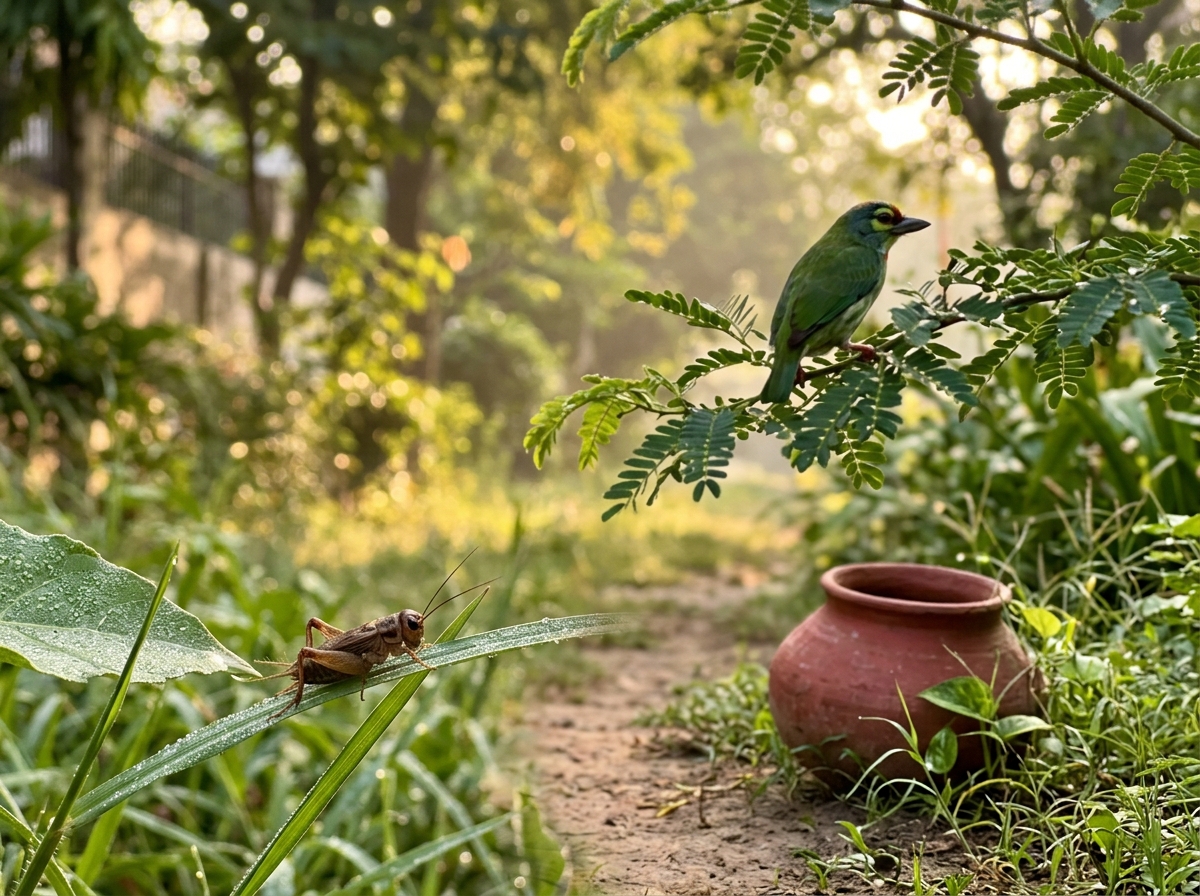
What 'cricket bird' actually means in Hindi
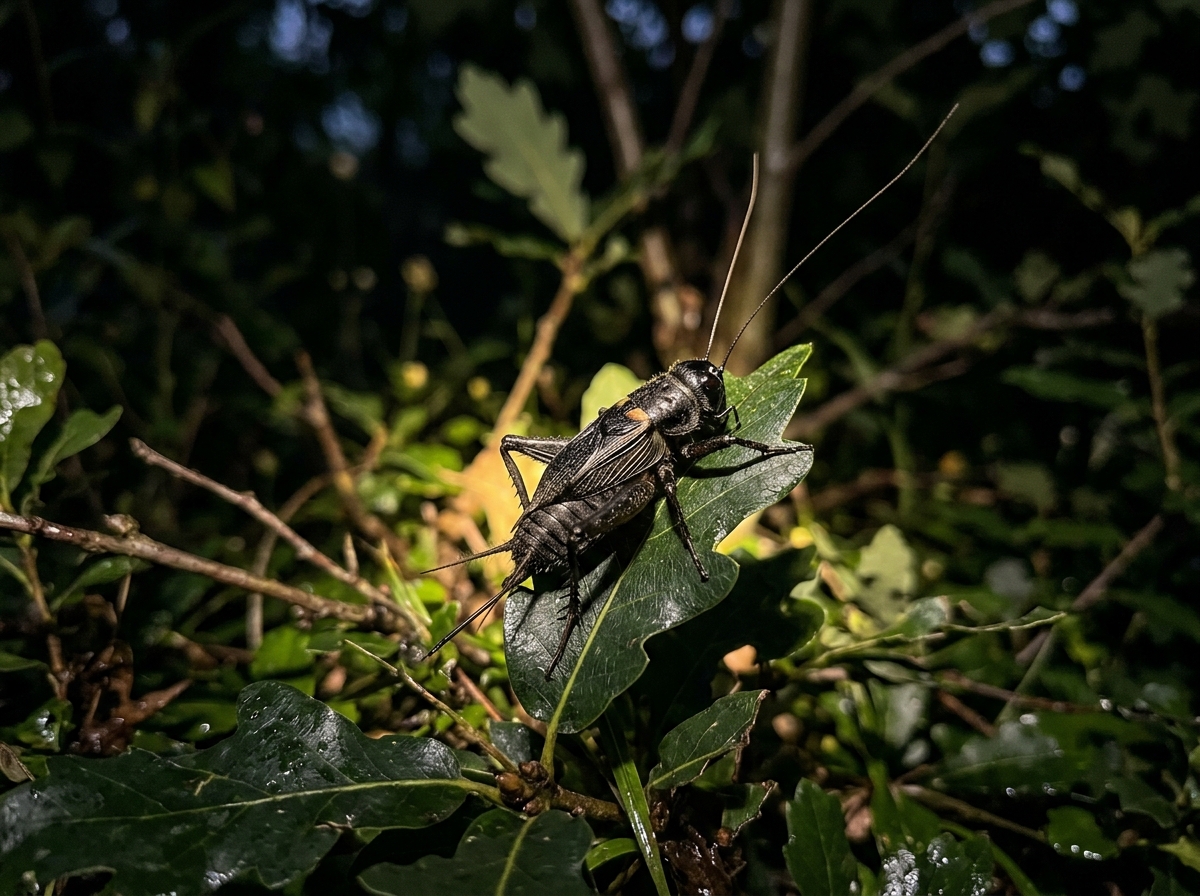
In Hindi, a cricket (the insect) is called 'झींगुर' (jhingur). A bird that sounds like one would naturally get described as 'झींगुर जैसी आवाज़ वाली चिड़िया' (jhingur jaisi awaaz waali chidiya), meaning 'a bird with a cricket-like voice.' This is a descriptive phrase, not a fixed species name. In practice, Hindi speakers in villages and towns use sound-based nicknames for birds all the time, a tradition that goes back to Sanskrit ornithology where birds were named directly after their calls. The Coppersmith Barbet, for example, is often called 'टुकटुक' or 'टुक-टुक चिड़िया' because its call literally sounds like someone tapping metal with a small hammer, a rhythm that many listeners, especially those unfamiliar with the bird, initially mistake for a large insect or even a mechanical sound.
So when you see or hear the phrase 'cricket bird' used in a Hindi context, treat it as a folk description rather than a formal classification. The bird behind it needs to be confirmed by sound, time of day, and habitat, which is exactly what the sections below help you do.
Which bird is actually being referred to: the two main candidates
There are two birds that consistently come up when people use 'cricket bird' loosely in the Indian subcontinent. They sound superficially similar to a cricket or a cicada but are very different birds with very different habitats.
Coppersmith Barbet (Psilopogon haemacephalus): the most common match
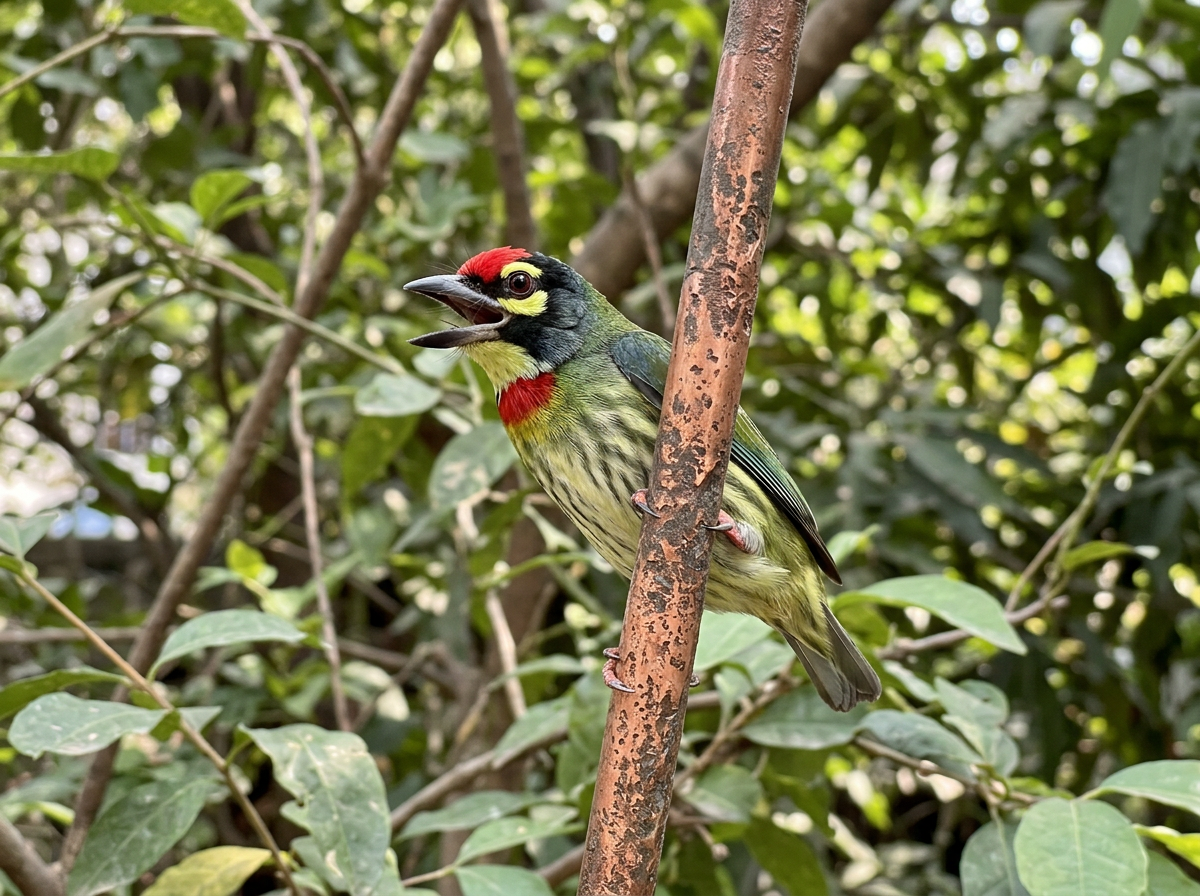
The The Coppersmith Barbet is the bird most frequently described as sounding 'cricket-like' or 'insect-like' in Indian urban and semi-urban settings. Its call is a loud, monotonous 'tuk...tuk...tuk' repeated at a metronomic pace of roughly 108 to 121 times per minute. This repetition at a fixed tempo is exactly what makes listeners think of a cricket or a cicada rather than a bird. Its Hindi names reflect this sound directly: 'टुकटुक,' 'टुक-टुक चिड़िया,' or simply 'बसंत' (Basant) in some regions because it calls loudly during the hot, pre-monsoon months. In Sanskrit literature and Wikisource records of Indian bird nomenclature, barbet-group birds with this hammering call have been documented under sound-descriptive terms like 'टुण्टुक' and 'तिन्तिडीक,' reinforcing how deeply the sound-naming tradition runs in Indian languages.
Zitting Cisticola (Cisticola juncidis): the grassland match
The Zitting Cisticola is a tiny grassland bird whose call, a sharp, repetitive 'zit-zit-zit' or a soft insistent chipping, genuinely resembles a cricket in a meadow. Its documented Hindi vernacular names from the BNHS (Bombay Natural History Society) Vernacular Names database include 'घास की फुटकी' (ghas ki phutki) and 'पितपिती' (pitpiti). Both names describe its small size and its constant, ticking chirp. In the Monghyr region, it is recorded as 'Tuntunia,' and in Gujarat as 'Ghasni fudki,' again all names built around sound or grassland association. If someone heard a cricket-like bird in an open field, paddy edge, or grassland and is calling it a 'cricket bird,' the Zitting Cisticola is almost certainly what they encountered.
| Feature | Coppersmith Barbet (टुकटुक चिड़िया) | Zitting Cisticola (घास की फुटकी) |
|---|---|---|
| Hindi folk name | टुकटुक, बसंत | घास की फुटकी, पितपिती |
| Call description | Loud, metallic tuk-tuk-tuk at fixed tempo | Soft, insistent zit-zit-zit or chipping |
| Habitat | Trees, urban gardens, wooded areas | Grasslands, paddy fields, open scrub |
| Time of peak calling | Hot hours of the day (late morning to afternoon) | During undulating display flight, daytime |
| Size | Medium (15–17 cm), stocky | Tiny (10 cm), streaked brown |
| Most likely 'cricket bird' scenario | Urban/suburban listener near trees | Rural/field listener near grass or crops |
A third bird worth a brief mention is the Spectacled Bulbul, whose song has been described in eBird records as 'a jumble of cricket-like chirping.' However, this species is far less commonly associated with the 'cricket bird' label in Hindi vernacular use, so unless you are in a forest edge or dense shrubbery in the Western Ghats region, it is not the first candidate to check.
How to confirm which bird you mean: sound, time, and location
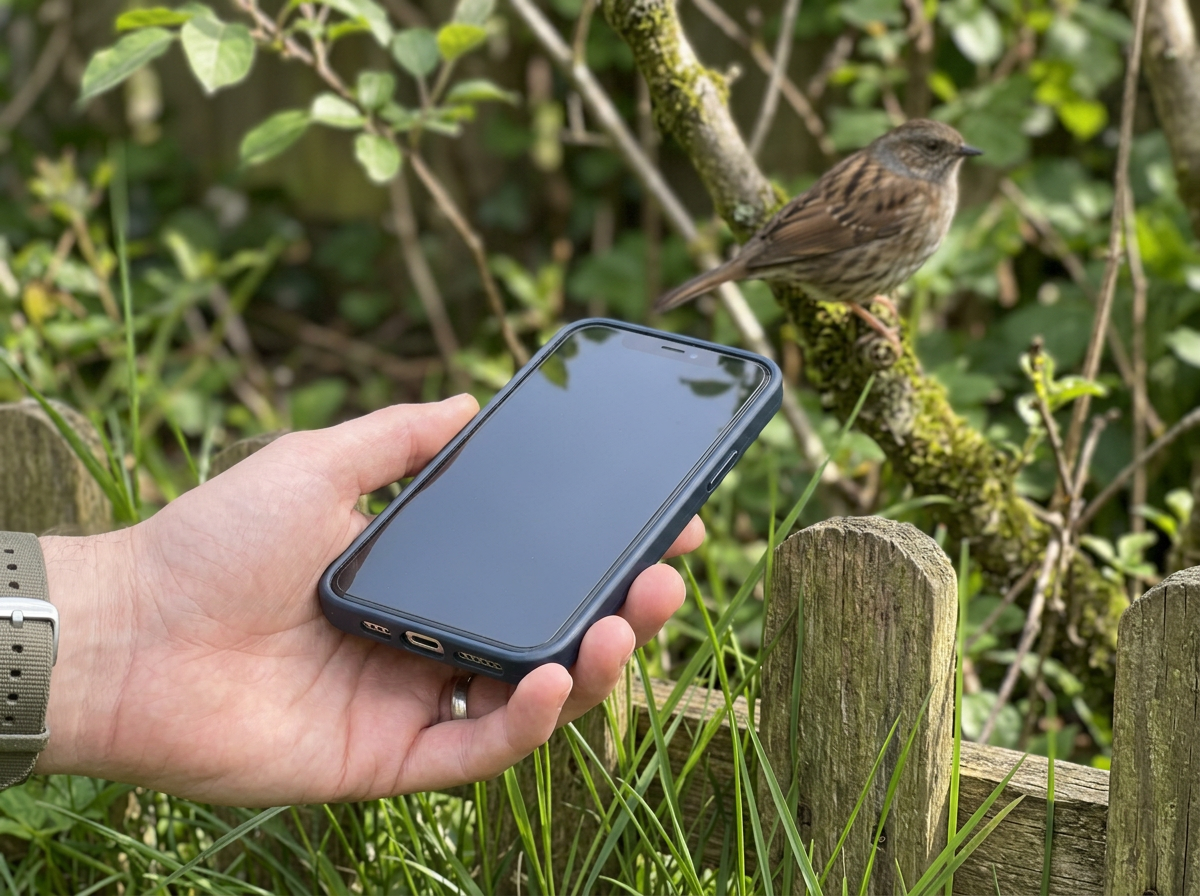
The overlap between these birds' descriptions is real, and sound alone is not always enough to separate them. Here is how to narrow it down systematically.
Listen for the rhythm and volume
The Coppersmith Barbet's 'tuk-tuk-tuk' is loud, carries long distances, and has a distinctly metallic quality, like a small hammer on copper sheeting. It is even-paced and relentless. The Zitting Cisticola's call is much softer, higher-pitched, and comes in short bursts, often synchronized with a bouncy up-and-down display flight over grass. If you can hear the sound clearly from 50 metres away and it sounds mechanical or metallic, lean toward the barbet. If it sounds like a faint, rapid 'zit' from low in a field, lean toward the cisticola.
Check the time of day
The Coppersmith Barbet is famously active during the hottest parts of the day, roughly 10 am to 3 pm, when most other birds have gone quiet. This is noted in Sanskrit ornithological literature as well, which describes its 'tuk-tuk' call as characteristic of the hot midday period. If you hear your 'cricket bird' most loudly at noon in summer, the barbet is the very strong candidate. The Zitting Cisticola calls throughout the day and is especially active in the early morning and during its undulating display flights.
Check where you are standing
This is the fastest separator. If you are in a garden, near a fruiting or flowering tree, in an urban park, or anywhere with a decent tree canopy, look up: the Coppersmith Barbet is almost always perched in the canopy, often invisible despite its loud call because it does not move much while calling. If you are standing in a field, near paddy, in grassland, or at the edge of a marsh, the Zitting Cisticola is almost certainly your bird, as it rarely ventures into tree cover.
What 'cricket bird' sounds and omens mean in Hindi culture
Hindi and broader Indian folk tradition has a rich relationship with bird sounds as omens and signals. The cricket insect (झींगुर, jhingur) itself carries associations with late nights, monsoon arrival, and in some folk traditions, the presence of spirits or ancestors, particularly when heard unexpectedly. A bird that sounds like a cricket, then, can sometimes inherit a shadow of that symbolism in rural storytelling.
The Coppersmith Barbet's call, however, carries its own distinct cultural meaning. In Hindi and Sanskrit tradition, the barbet is associated with the arrival of the hot season (ग्रीष्म, grishma) and the approach of monsoon. Its relentless calling in April and May was historically seen as an announcement of the change of seasons. 'बसंत' (Basant, meaning spring), one of its regional Hindi names, ties it to seasonal celebration and renewal rather than to any dark omen. There is no prominent negative symbolism attached to it the way there is, for example, to a dead bird in Hinduism (a topic covered separately on this site). In fact, hearing the Coppersmith Barbet's call in spring is generally treated as a cheerful, ordinary sign that the season is turning.
The Zitting Cisticola carries far less cultural weight in Hindi folk tradition, largely because it is a small, unobtrusive grassland bird that does not feature prominently in mythology or classical literature. Its sound, however, is familiar enough to farmers that some communities treat its calling above paddy fields as an indicator of healthy crop conditions, simply because the bird nests in low grass and its presence suggests undisturbed vegetation.
In terms of omens, neither bird carries the strong symbolic charge that, say, a crow, an owl, or a myna bird holds in Hindi tradition. If someone is asking about 'cricket bird meaning in Hindi' from a spiritual or omen-reading perspective, the honest answer is that the cultural significance comes more from the cricket insect (झींगुर) than from any specific bird, and the 'cricket bird' phrase is primarily a linguistic and ornithological question rather than a deeply mythological one.
How other Indian languages name and describe these birds
One of the most useful things about understanding 'cricket bird' across Indian languages is that the naming logic, using the bird's sound as the name, is consistent across Hindi, Marathi, Punjabi, Gujarati, and Sanskrit. The words differ but the method is the same.
| Language | Name for Coppersmith Barbet / equivalent | Name for Zitting Cisticola / equivalent | Naming logic |
|---|---|---|---|
| Hindi | टुकटुक, बसंत (Tuk-Tuk, Basant) | घास की फुटकी, पितपिती (Ghas ki phutki, Pitpiti) | Sound + habitat description |
| Sanskrit (classical texts) | टुण्टुक, तिन्तिडीक (Tuntuk, Tintidik) | Not specifically named; described by grassland/insect-call context | Onomatopoeic naming tradition |
| Gujarati | Not separately documented under 'cricket bird'; barbet called by sound-descriptive terms | घसनी फुड़की (Ghasni fudki) | Habitat (ghas = grass) + diminutive |
| Punjabi | Broadly grouped under sound-descriptive folk names; tuk-tuk type reference | Minimal distinct folk name documented | Sound similarity noted in vernacular use |
| Marathi | Similar to Hindi folk names; sound-based reference | Similar to Hindi 'phutki' family of names | Shared Devanagari sound-word tradition |
Sanskrit literature is particularly valuable here because it shows the tradition of sound-based bird naming goes back at least two thousand years. The term 'टुण्टुक' (Tuntuk) in Wikisource records of Sanskrit bird nomenclature captures the same repetitive tapping that modern Hindi speakers encode as 'टुकटुक.' Similarly, the word 'तिन्तिडी' (Tintidi) appears in some Sanskrit texts to describe small, chirping, insect-like bird sounds, showing that the 'cricket-like' descriptor has always needed multiple species to cover its range. This cross-language consistency is actually helpful: if you look up a bird name in one Indian language and find a sound-descriptive root (tuk, tun, zit, pit), you can be reasonably confident the same bird or a closely related one will have a parallel name in the other languages too.
For readers interested in how other birds get named by their sounds across Indian languages, the entries on myna bird meanings and crane bird names in Hindi on this site follow the same cross-language mapping approach and are worth exploring alongside this one.
Practical next steps: how to identify and verify your cricket bird
If you have heard a 'cricket bird' and want to confirm exactly which one it is, here is a practical sequence to follow.
- Record the sound on your phone, even a short 10-second clip. This single step removes most of the guesswork. Upload the recording to eBird's Macaulay Library or run it through the Merlin Bird ID app by Cornell Lab, which has a Sound ID feature that works well for Indian species including the Coppersmith Barbet and Zitting Cisticola.
- Note the exact time. If it was between 10 am and 3 pm in the hot season (March to June), the Coppersmith Barbet is the most probable answer.
- Note the habitat. Tree canopy or urban garden: barbet. Open grassland, paddy edge, or scrub: cisticola.
- Search eBird for your district or region and filter for either species. Both have India-wide distribution maps that show where each is commonly reported, which helps you cross-check your own sighting against what is likely in your area.
- If you want to check the Hindi or regional name, use the BNHS Vernacular Names of Birds database or Hindi Wiktionary. Search under 'Cisticola juncidis' for the cisticola names and 'Psilopogon haemacephalus' for the barbet names. This will give you documented vernacular names across Hindi, Gujarati, Punjabi, and Bengali so you can cross-reference what you heard people call it locally.
- If you are asking from a cultural or spiritual angle, the key Hindi term to research further is 'झींगुर' (jhingur) for the cricket-insect symbolism, and 'बसंत पक्षी' (Basant pakshi) for the seasonal bird associations connected to the barbet's call in folk tradition.
The bottom line is this: 'cricket bird' in Hindi is almost always the Coppersmith Barbet ('टुकटुक चिड़िया') if you are in an urban or wooded setting during the hot season, or the Zitting Cisticola ('घास की फुटकी') if you are in a grassland or agricultural area. The naming tradition behind both is the same ancient Indian practice of letting the bird's own voice become its name. The naming tradition behind both is the same ancient Indian practice of letting the bird's own voice become its name, a habit so consistent across Hindi, Sanskrit, Gujarati, and Marathi that once you understand the logic, identifying the right bird becomes much more intuitive.
FAQ
“Cricket bird” सुनकर क्या मैं उसे झींगुर (jhingur) समझ लूं?
नहीं, झींगुर की आवाज़ आम तौर पर रात/मॉनसून सीज़न में ज्यादा सुनाई देती है और वह कीट की होती है। “क्रिकेट बर्ड” कहने में लोग अक्सर पक्षी के कॉल का जिक्र करते हैं, खासकर अगर आवाज़ दिन में आती हो (Coppersmith Barbet दोपहर के आसपास) या घास/खेत में लगातार टिक-टिक जैसी हो (Zitting Cisticola).
अगर कोई “टुकटुक चिड़िया” बोले, क्या वह हमेशा Coppersmith Barbet ही होता है?
ज्यादातर मामलों में हाँ, क्योंकि “टुकटुक/टुक-टुक” का मेटालिक, तेज और एक जैसी रिद्म वाला कॉल Coppersmith Barbet से ही सबसे ज्यादा मैच करता है। फिर भी एक गलती यह है कि दूर से सुनाई देने वाली किसी अन्य कॉल को भी लोग “टुकटुक” कह देते हैं, इसलिए दूरी (क्या 50 मीटर पर भी स्पष्ट है) और समय (10 am से 3 pm) देखें।
“घास की फुटकी” किस पक्षी के लिए कहा जाता है?
आम तौर पर यह Zitting Cisticola को संदर्भित करता है, क्योंकि इसका कॉल ऊंचा, छोटा और लगातार “zit” जैसा होता है और वह घास के बीच रहता है। अगर आवाज़ पेड़ों की कैनोपी में लगातार दिखती है, तो यह Zitting Cisticola नहीं भी हो सकता है।
अगर कॉल बहुत तेज है लेकिन मैं पेड़ नहीं देख पा रहा, तो क्या करूं?
पहला स्टेप है आवाज़ के सोर्स की दिशा नोट करना, फिर कैमरा/दूरबीन से ऊपर कैनोपी में देखने की कोशिश करना। Coppersmith Barbet अक्सर चिल्लाता तो है लेकिन बहुत कम हिलता है, इसलिए वह दिखने में देर हो सकती है।
दोपहर में “क्रिकेट बर्ड” सुनाई दे रहा है, पर आवाज़ “zit” जैसी लगती है। कौन सा सही हो सकता है?
ऐसा मिश्रण सुनने में हो सकता है क्योंकि दूरी, हवा, और आसपास की वनस्पति आवाज़ को बदल देती है। नियम यह रखें: अगर आवाज़ बिल्कुल टिक-टिक, नरम और घास के पास से आती लगे तो Zitting Cisticola की संभावना बढ़ती है, और अगर मेटालिक “tuk-tuk” जैसी, रिद्म में लगातार और तेज लगे तो Coppersmith Barbet ज्यादा संभावना है।
क्या यह पहचान फोटो से करना संभव है?
केवल फोटो पर भरोसा करना अक्सर मुश्किल है क्योंकि पक्षी छोटा हो सकता है (खासकर घास में) या दूर हो। सबसे भरोसेमंद तरीका है कॉल रिकॉर्ड करना (5 से 10 सेकंड) और साथ में लोकेशन, समय, और हैबिटैट (पार्क कैनोपी बनाम खुले खेत/घास) लिख लेना।
क्या Spectacled Bulbul भी “क्रिकेट bird” के नाम से बुलाया जा सकता है?
कभी-कभी लोग “क्रिकेट-like” गाने के आधार पर कह देते हैं, लेकिन हिंदी में यह लेबल आम तौर पर Coppersmith Barbet या Zitting Cisticola के मुकाबले कम चलता है। अगर आप Western Ghats जैसे घने झाड़ीदार इलाके के forest edge में हैं, तभी Spectacled Bulbul को ज्यादा प्राथमिकता दें।
“क्रिकेट bird” का आध्यात्मिक/ओmen वाला अर्थ कैसे समझूं?
अगर सवाल किसी “शगुन” की भावना से है, तो ध्यान रखें कि लोक-सांकेतिक अर्थ ज्यादा हद तक झींगुर (कीट) से जुड़ता है। “क्रिकेट बर्ड” शब्द का मुख्य इस्तेमाल अक्सर भाषा और पक्षी की आवाज़ के संदर्भ में होता है, किसी निश्चित भविष्यवाणी के लिए नहीं।
मैं ग्रामीण इलाके में हूं और स्थानीय लोग आवाज़ का नाम अलग बोलते हैं, तो मैं कैसे compare करूं?
आप sound-pattern को “मूल” मानकर compare करें। “tuk-tuk” (धातु जैसा, बराबर रिद्म) आम तौर पर barbet की तरफ संकेत करता है, जबकि “zit/zit” (छोटा, नरम, घास से) cisticola की तरफ। स्थानीय नाम चाहे कुछ भी हों, इसी पैटर्न से मिलान आसान हो जाता है।
किस सामान्य गलती से गलत पक्षी तय हो जाता है?
सबसे आम गलती यह है कि आवाज़ को केवल “कीट जैसी” होने के कारण पक्षी मान लिया जाए, या फिर सिर्फ एक बार सुनकर अनुमान लगा लिया जाए। बेहतर है कम से कम 2 से 3 मिनट सुनें, समय (सुबह/दोपहर/शाम) और जगह (पेड़ बनाम घास/खेत) नोट करें, फिर निष्कर्ष निकालें।
Roc bird meaning in Hindi: पौराणिक रूक का अर्थ
पौराणिक रूक का अर्थ समझें: ROC विशाल दैत्य पक्षी, प्रतीक, सही हिंदी शब्द और खोजने के सही तरीके