
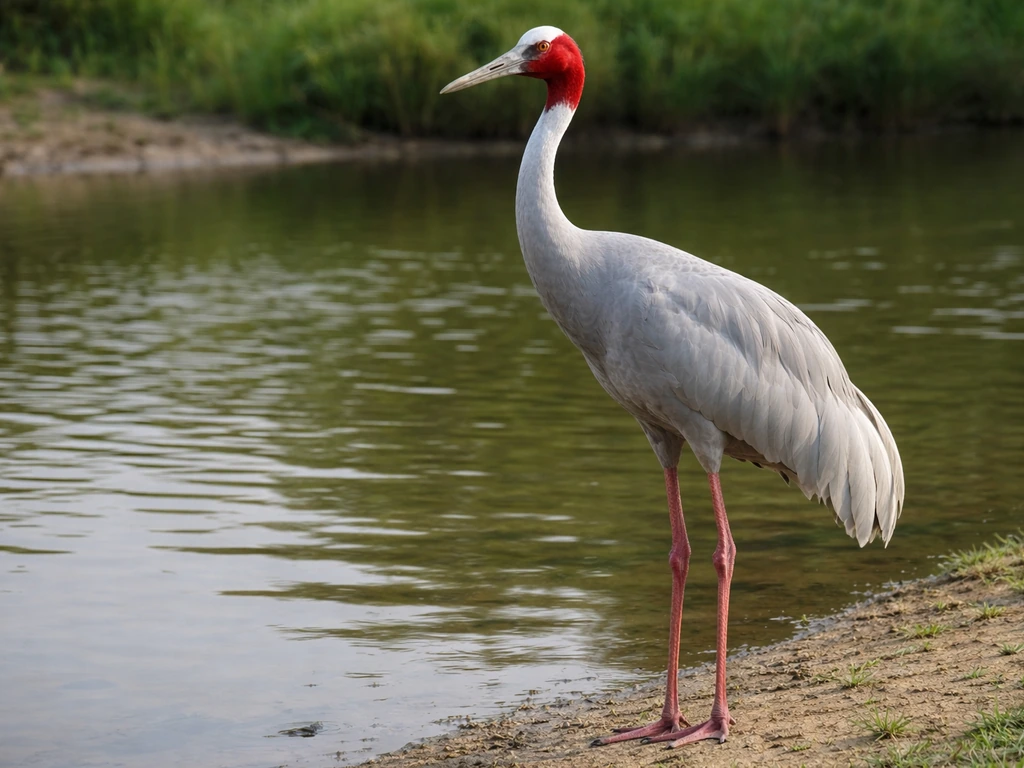
In Hindi, "Saras" (सारस, pronounced sā-ras) means the Sarus Crane, a large, grey-bodied crane with a striking red head and upper neck, known scientifically as Grus antigone. The word traces straight back to the Sanskrit sārasa, which literally means "of a lake" or "bird of the lake." So when you see or hear "saras bird" in Hindi, it is referring to this specific, very real crane species, the tallest flying bird in the world, and not to a mythological creature, though the bird carries enormous cultural weight in Indian tradition.
Saras Bird Meaning in Hindi: English Name and Symbolism

Rajesh Sharma
30 May 2026
Quick Answer: Saras Bird Meaning in Hindi and English
| Term | Script | Language | English Meaning |
|---|---|---|---|
| Sāras / Saras | सारस | Hindi | Sarus Crane (Grus antigone) |
| Sārasa | सारस | Sanskrit | Of a lake / lake bird / crane |
| Sāras Krauncha | सारस क्रौंच | Hindi (field guides) | Sarus Crane (compound form) |
| Sarus | — | English | Sarus Crane (borrowed from Hindi sāras) |
| Saras / Sirhans | — | Hindi variants (older texts) | Sarus Crane (spelling variants) |
The English word "sarus" (as in sarus crane) is actually borrowed directly from the Hindi सारस (sāras). Merriam-Webster spells the Hindi root as sāras and traces it to Sanskrit sārasa. The English spelling "sarus" versus the Hindi/romanized "saras" is just a transliteration difference, they refer to the same bird and the same word. If you have come across "Saras bird meaning in English," the answer is simply: Sarus Crane.
What "Saras Bird" Actually Refers To: Real Bird vs Symbolic Reference
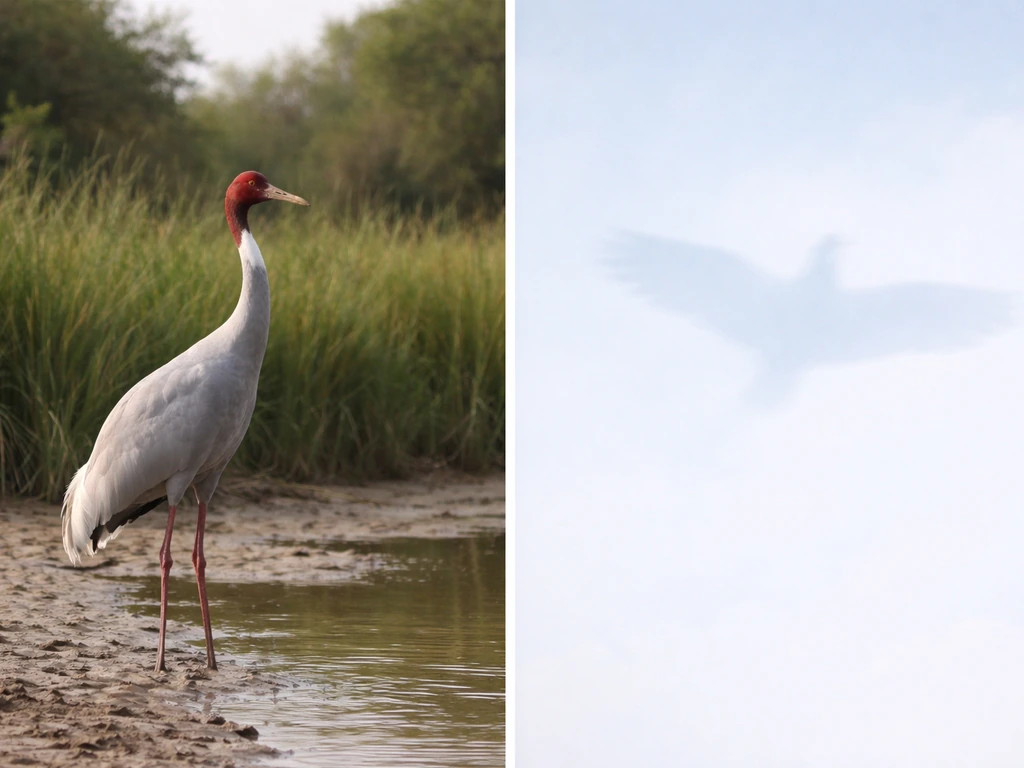
This is the key disambiguation most people need. "Saras" in Hindi is not a mythological bird like the Garuda or a purely symbolic creature. It is a living, observable species, the Sarus Crane (Grus antigone), that happens to carry deep symbolic meaning. Older ornithological literature, including Salim Ali's classic "The Book of Indian Birds," lists the Hindi name as सारस right alongside the scientific name Grus antigone, treating it as the standard common name in Indian ornithology.
That said, the word सारस does appear in classical Sanskrit texts, including passages of the Ramayana, where sārasa is glossed as "a crane, born in a lake." In those literary and mythological contexts, the word still refers to crane-type birds rather than to a fictional creature. The symbolism layered onto the bird (loyalty, love, fidelity) comes from the bird's own behavior, which ancient poets and scholars observed and immortalized. So whether you encounter सारस in a nature guide, a Hindi poem, or a Ramayana verse, it is pointing to the same family of large cranes, with the Sarus Crane being the primary referent in the Indian subcontinent.
One nuance worth knowing: classical Sanskrit dictionaries occasionally list sārasa as a synonym for haṃsa (swan), and some scholarly sources note the terms can overlap semantically in certain textual traditions. If you are reading a very old Sanskrit text and see sārasa used in a context that does not fit a crane, a swan interpretation might be relevant. For modern Hindi usage, in everyday speech, field guides, or regional conversation, सारस unambiguously means the Sarus Crane. This is a different bird from the swan (हंस, haṃsa), and if you are curious about swan terminology in Hindi, that is a separate entry worth exploring.
Common Hindi Terms Used for Saras (and How to Match Them to English)
You will run into a few different Hindi forms depending on your source. A PDF snippet from University of Nebraska, Lincoln (via CiteseerX) also lists Hindi-name variants for the Sarus Crane, including forms like Saras and Sirhans, as spelling or OCR/lexicon-style variants used for the same concept different Hindi forms. Here is how they all connect:
- सारस (sāras): The standard, everyday Hindi word for Sarus Crane. This is what you will find in most dictionaries, news articles about wildlife, and conversations in Uttar Pradesh and other northern states where the bird is common.
- सारस क्रौंच (sāras krauñca): A compound form used in some field guides and ornithological references. Krauñca (क्रौंच) is itself an old Sanskrit-derived word for crane, so this is essentially "crane-crane" — a reinforcing compound that leaves no room for misidentification.
- Saras / Sirhans: Romanized spelling variants documented in older Hindi ornithological literature and biodiversity databases. Both map to सारस and mean Sarus Crane.
- Sārasa (sārasa): The Sanskrit parent form, used in classical texts, Ayurvedic literature, and Sanskrit dictionaries. Means crane or lake bird.
The pronunciation guide that helps most people: sā (long 'a' as in "father") + ras (rhymes with "bus"). The stress falls gently on the first syllable. In quick spoken Hindi you will often hear it as just "SAA-ras."
English Meaning and Translation Variants People Search For
People searching for "saras bird meaning in Hindi" are usually trying to resolve one of a few specific translation questions. If you specifically meant the phrase “saras bird meaning in Hindi,” it points to the Sarus Crane, commonly written as सारस in Hindi. This helps answer questions like sparrow bird meaning in hindi by clarifying which bird name people are actually searching for. Here are the most common search intents and the direct answers:
| Search Query | Direct Answer |
|---|---|
| Saras bird meaning in Hindi | सारस (sāras) — the Sarus Crane |
| Saras bird meaning in English | Sarus Crane (Grus antigone) |
| Saras bird in English meaning | Sarus Crane; sometimes called Indian Crane in older texts |
| What is saras in English? | Sarus or Sarus Crane |
| Saras crane meaning | A large crane species; Hindi सारस from Sanskrit sārasa = lake bird |
| Sarasa meaning Sanskrit | Crane; literally "of a lake" or "born in a lake" |
A practical note on spelling: English dictionaries (including Merriam-Webster) standardize the English bird name as "sarus" not "saras." The Hindi word is सारस (romanized as sāras or saras). So the slight spelling shift between the Hindi source word (saras) and the English bird name (sarus) can confuse people searching online, but they are the same bird, and the same etymological root.
Cultural Symbolism of the Saras in Indian Traditions

The Sarus Crane is one of the most symbolically loaded birds in Indian culture, and the meaning goes well beyond just a name. Here is what सारस represents across different traditions:
Marital Fidelity and Eternal Love
The Sarus Crane is widely regarded as a symbol of lifelong love and marital fidelity across northern India, particularly in Uttar Pradesh, Rajasthan, and the Gangetic plains. The belief, reinforced by centuries of folklore, is that Sarus cranes mate for life and that if one partner dies, the surviving bird pines so deeply it may stop eating. This is not pure myth, Sarus cranes do form strong, long-term pair bonds and are described as perennially monogamous.
Indian folklore elevated this observed behavior into a cultural ideal, making the saras a living emblem of "only death dare do us part" commitment. It is common in rural communities for people to see a pair of Sarus cranes as an auspicious sign for a marriage.
Classical Literature and the Ramayana Connection

The word sārasa appears in Sanskrit classical texts including the Ramayana. One of the most famous passages in Indian literary history involves the Valmiki Ramayana's opening verse (the Krauncha shloka), where the poet witnesses a crane (often identified as krauñca, a crane synonym used alongside sārasa) being killed, and his grief spontaneously becomes the first poetic verse. This story places the crane, and by extension the sārasa, at the very origin of Sanskrit poetry itself. Whether the specific bird in that verse is best identified as the Sarus Crane or another crane species is a matter of scholarly discussion, but the cultural association between सारस / sārasa and poetic inspiration and grief over lost love is deep and lasting.
State Bird and Conservation Symbol
On a more contemporary note, the Sarus Crane is the state bird of Uttar Pradesh, a designation that reflects how central this bird is to the cultural and natural identity of the region. Conservation campaigns in India, Nepal, and Southeast Asia frequently invoke the bird's symbolic status as a way to build public support for wetland protection.
Ayurvedic and Classical Textual References
Classical Ayurvedic and Sanskrit lexicographic texts group sārasa among birds associated with water bodies (lakes, ponds, marshes). Cologne Digital Sanskrit Dictionaries (Monier-Williams-style scan) lists sārasa among birds associated with water bodies such as lakes and ponds. The very etymology of the word, from Sanskrit sāra (essence/lake), places the bird conceptually in the world of clean, still water, which in Indian symbolic thinking is associated with purity, contemplation, and auspiciousness.
How to Verify the Exact Meaning From Your Source
The meaning of सारस is quite stable across contexts, but the context you are reading in can shift which aspect of the word is emphasized. Here is a practical approach to confirming what your specific source means:
- If your source is a modern Hindi dictionary or wildlife guide: सारस = Sarus Crane (Grus antigone). No ambiguity. Cross-check with the scientific name if given.
- If your source is a Sanskrit text (Ramayana, Mahabharata, classical poem): sārasa refers to a crane-type bird. Check whether the text uses it alongside krauñca or haṃsa — if alongside haṃsa (swan), rare interpretations as swan are possible, but crane is the default.
- If your source is an older English-language ornithology book (pre-1980): You may see "Indian Crane" used as an English equivalent alongside "Sarus." Both refer to Grus antigone.
- If the romanized spelling is "saras," "sarus," "sarasa," or "sāras": These are all the same word in different transliteration styles. Do not treat different spellings as different birds.
- If you see "सारस क्रौंच" (sāras krauñca): This is an emphatic compound, used when the author wants to make the crane identification unambiguous. Treat it as a precise species reference.
- If the context is folklore, wedding symbolism, or rural Indian storytelling: सारस is being invoked for its symbolism of lifelong love and fidelity, not just as a bird name.
A quick online verification tip: search for "सारस पक्षी" (sāras pakṣī, meaning "saras bird") on Hindi Wikipedia or nature databases. If you want the English name too, the “common swift bird in hindi” phrase is often used to look up the right identification and translation. You will land directly on the Sarus Crane species page, which confirms the mapping instantly. The scientific name Grus antigone on that page is your definitive anchor.
Related Bird-Name Terms and Terminology Cross-Checks
Hindi bird terminology for large, long-legged waterbirds can overlap in ways that confuse learners. Here are the key terms to distinguish सारस from its neighbors:
| Hindi Term | Script | English Bird | Key Distinction |
|---|---|---|---|
| Sāras / Sārasa | सारस | Sarus Crane | Red head, grey body; from Sanskrit 'lake bird' |
| Haṃsa | हंस | Swan (or goose in some texts) | White waterbird; different species and symbolism entirely |
| Krauñca | क्रौंच | Crane (generic, poetic) | Sanskrit/literary term for crane; used alongside sāras |
| Baglā / Bagulā | बगुला | Heron / Egret | White wading bird; unrelated to cranes; often confused |
| Sāras Krauñca | सारस क्रौंच | Sarus Crane (specific) | Compound used in field guides for precision |
The haṃsa / सारस distinction is the most important one to keep in mind. In classical Sanskrit texts, sārasa is occasionally listed as a synonym adjacent to haṃsa (swan), which has led some readers to conflate the two. But in practical Hindi usage, and in ornithology, these are completely separate birds. The swan in Hindi is हंस (haṃsa), and it carries its own rich symbolic tradition.
If you are also looking for the swan angle, search for “swan bird meaning in Hindi” to compare the Hindi terms and contexts. Similarly, the white stork (a long-legged waterbird that can superficially resemble a crane) has its own Hindi terminology and should not be confused with सारस. If you are also looking up the white stork bird meaning in Hindi, it is a different bird with its own name and interpretation.
If you are exploring this topic because you encountered "saras" in a text alongside other bird names like lark, skylark, sparrow, or starling, those are all very different bird families, small passerines rather than large wading cranes. The सारस is in an entirely different ornithological category: tall, grassland-wetland dwelling, and one of the world's largest flying birds at up to 1.8 meters in height. Context almost always makes it clear which type of bird is being discussed, and knowing the Hindi script form सारस gives you a reliable anchor whenever you need to confirm the identification.
FAQ
Does सारस in Hindi always mean Sarus Crane, or can it mean something else in old texts?
In everyday Hindi, सारस (sāras) almost always means the Sarus Crane (Grus antigone). If a verse or caption uses सारस but describes a swan-like bird, smooth water surface behavior, or explicitly matches हंस (haṃsa), then the writer may be using the older semantic overlap, not the modern/common meaning.
How can I confirm whether सारस in a Ramayana line refers to a crane or a swan?
If you are reading a Ramayana or Sanskrit passage, look for clues like “lake, marsh, wetland,” “crane-type bird,” or the specific context of grief after a crane is killed. Those cues align with sārasa meaning a crane-type bird, but if the text is clearly about swans, then treat it as haṃsa (हंस) instead.
Why do some sites spell it saras, and others spell it sarus, is it the same bird?
“Saras” in the phrase saras bird meaning in hindi is typically the same as सारस (sāras) transliterated differently. However, if your search result spells it as “Sarus” or uses the English common name, that should still map to the same bird, since the Latin-sounding spelling is an English convention, not a different animal.
What is the fastest way to verify the correct meaning if romanization is confusing?
Use the script form सारस when checking authenticity, because romanization can vary (sāras, saras). Another practical check is to match the scientific name Grus antigone, which uniquely identifies the Sarus Crane even if the surrounding language is poetic or regional.
Is the “mate for life, pines if partner dies” part myth or biology?
Sarus Crane symbolism (fidelity, lifelong pairing) is widely discussed, but it is not a guarantee that every individual crane behaves the same way. If you are using it for writing or storytelling, phrase it as a cultural belief supported by commonly observed pair-bond behavior rather than as a guaranteed biological fact for every case.
I saw a crane-like bird mentioned, how do I avoid confusing सारस with similar birds like storks or swans?
If you are comparing birds, don’t rely on English “crane” alone, because other long-legged birds can be loosely described as cranes in casual writing. In Hindi, cross-check the name: सारस (Sarus Crane) is distinct from हंस (haṃsa, swan) and also different from names for storks, even if appearance overlaps.
What if I saw “saras” in a text that also lists small birds like sparrow or sparrow-like names?
When a source says “saras” alongside small birds (sparrow, skylark, starling, lark), it is very likely a different word entirely, because सारस refers to a large crane-type bird. In that case, re-check the original Hindi script in the document or try searching the exact Hindi term सारस पक्षी.
How should I phrase saras bird meaning in hindi in a simple, correct way for a caption or note?
For school projects or captions, you can safely write: “सारस, meaning Sarus Crane (Grus antigone), a tall grey crane with a red head.” If the caption is meant to be poetic, you can add the cultural symbolism (loyalty and marital fidelity), but still keep the biological ID clear first.
Next Articles

Swan Bird Meaning in Hindi: नाम, प्रतीक और अर्थ
सवान का हिंदी नाम और मतलब, प्रतीक और आध्यात्मिक अर्थ, साथ ही समान पक्षियों से फर्क समझें

Common swift bird in Hindi: नाम, पहचान और परंपरा
कॉमन स्विफ्ट पक्षी की हिंदी पहचान, नाम के विकल्प, रूप-व्यवहार, आवास, और परंपरागत अर्थ जानें

Swift Bird Meaning in Hindi: Name, Identification, Culture
Swift bird meaning in Hindi: नाम, पहचान cues, गलतफहमी स्वैलो से फर्क, और भारतीय सांस्कृतिक प्रतीक