
In Hindi, the cardinal bird is most commonly called कार्डिनल (kārdinal), a direct phonetic loanword from English, or described as लाल पक्षी (lāl pakṣī), meaning 'red bird.' You may also see नॉर्दर्न कार्डिनल (norðarn kārdinal) used in bilingual nature content and online Hindi bird pages when specifically referring to the Northern Cardinal (Cardinalis cardinalis). Because the cardinal is a New World species and has never been part of traditional Indian ornithology or Sanskrit-era bird lore, there is no ancient Hindi or Sanskrit name for it. What exists today is a practical modern vocabulary built from transliteration and descriptive translation, and that is exactly what this article walks through.
Cardinal Bird Meaning in Hindi: Translation, Symbolism & ID

Rajesh Sharma
25 Jul 2026
What this article covers and who it's for
This entry is a linguistic and cultural reference for anyone searching 'cardinal bird meaning in Hindi', whether you are a language learner trying to write or say the word correctly in Devanagari, a cultural enthusiast curious about whether the cardinal carries any spiritual meaning in Indian traditions, a student of comparative ornithology, or someone who simply spotted a cardinal in North America and wants to know how to describe it to a Hindi-speaking friend or family member. Alongside the Hindi names, scripts, and pronunciation, this article gives you a concise natural-history profile, an honest account of where Indian-language traditions do and do not mention this bird, and appropriate equivalents in Sanskrit, Marathi, Punjabi, and Gujarati. It also points to related entries on Indian red birds that are sometimes confused with the cardinal in symbolic contexts.
Hindi names, Devanagari script, and variant phrases
Hindi writers and editors dealing with non-native species almost universally default to transliteration for the primary name, because no classical term exists. The most widely attested Devanagari rendering found in bilingual dictionaries (including Shabdkosh) and Hindi/Marathi nature blogs is कार्डिनल. When the full English species name is needed, the form नॉर्दर्न कार्डिनल is used. For example, many Marathi/Hindi bird pages use the Devanagari transliteration 'नॉर्दर्न कार्डिनल' (see ‘नॉर्दर्न कार्डिनल’, example Marathi/Hindi localized bird page) ‘नॉर्दर्न कार्डिनल’ — example Marathi/Hindi localized bird page (uses Devanagari transliteration). Alongside the loanword, descriptive phrases built from native Hindi vocabulary are common in popular writing and are often clearer for a general audience.
| Hindi / Devanagari | Roman transliteration | Literal English meaning | Usage context |
|---|---|---|---|
| कार्डिनल | kārdinal | Cardinal (loanword) | Standard name in bilingual dictionaries and nature content |
| नॉर्दर्न कार्डिनल | norðarn kārdinal | Northern Cardinal | Full species-level name in ornithological writing |
| लाल पक्षी | lāl pakṣī | Red bird | Descriptive term in general or popular Hindi writing |
| लाल चिड़िया | lāl ciṛiyā | Red small bird | Informal, colloquial; common in spoken Hindi |
| लाल चोटीदार पक्षी | lāl coṭīdār pakṣī | Red crested bird | Describes the crest; useful for visual identification |
Among these, कार्डिनल is the most practical choice for written Hindi content aimed at an educated or bilingual readership, while लाल चिड़िया works best in informal or spoken contexts. The phrase लाल चोटीदार पक्षी is especially useful when you are describing the bird visually to someone unfamiliar with it, since the cardinal's pointed crest (चोटी, coṭī) is its most distinctive feature.
Transliteration and pronunciation guide
Hindi phonology handles the English word 'cardinal' quite predictably, but there are a few sounds worth flagging for learners. The standard Hindi rendering कार्डिनल approximates to the IPA form /kaːɾɖɪnəl/ in Standard Hindi (also written Khari Boli). The long 'aa' in कार् is represented by the ā vowel, the retroflex 'ḍ' (ड) is a key Hindi sound not found in English in the same position, and the final syllable reduces to a schwa-like sound in natural speech.
| Syllable | Devanagari | IAST / ISO 15919 | Hunterian (Govt. of India) | IPA | Pronunciation tip |
|---|---|---|---|---|---|
| kaar- | कार् | kār | kar | /kaːɾ/ | Long 'aa' as in 'car'; hold it slightly longer than in English |
| -di- | डि | ḍi | di | /ɖɪ/ | Retroflex 'ḍ' — tongue tip curls back to the roof of the mouth |
| -nal | नल | nal | nal | /nəl/ | The 'a' reduces to a schwa; don't stress this syllable |
For a popular Hindi reference article, the recommended practice (following the Government of India's Hunterian romanization system) is to write 'kardinal' in running Roman text, with the scholarly IAST/ISO 15919 form 'kārdinal' shown in a pronunciation note for precision. See Devanagari transliteration, overview (IAST / Hunterian / ISO relationships) for the Hunterian recommendation to render the running Roman form as 'kardinal' and the scholarly ISO/IAST form as 'kārdinal' blank" rel="noopener noreferrer">Devanagari transliteration — overview (IAST / Hunterian / ISO relationships). Stress in Hindi loanwords from English tends to fall on the first or second syllable; here, the natural Hindi stress falls on kār-, so say 'KAR-di-nal' rather than the English 'CAR-di-nal' (the difference is subtle but the vowel length and retroflex consonant are the markers of genuine Hindi pronunciation).
Natural history: what the cardinal actually looks like and where it lives
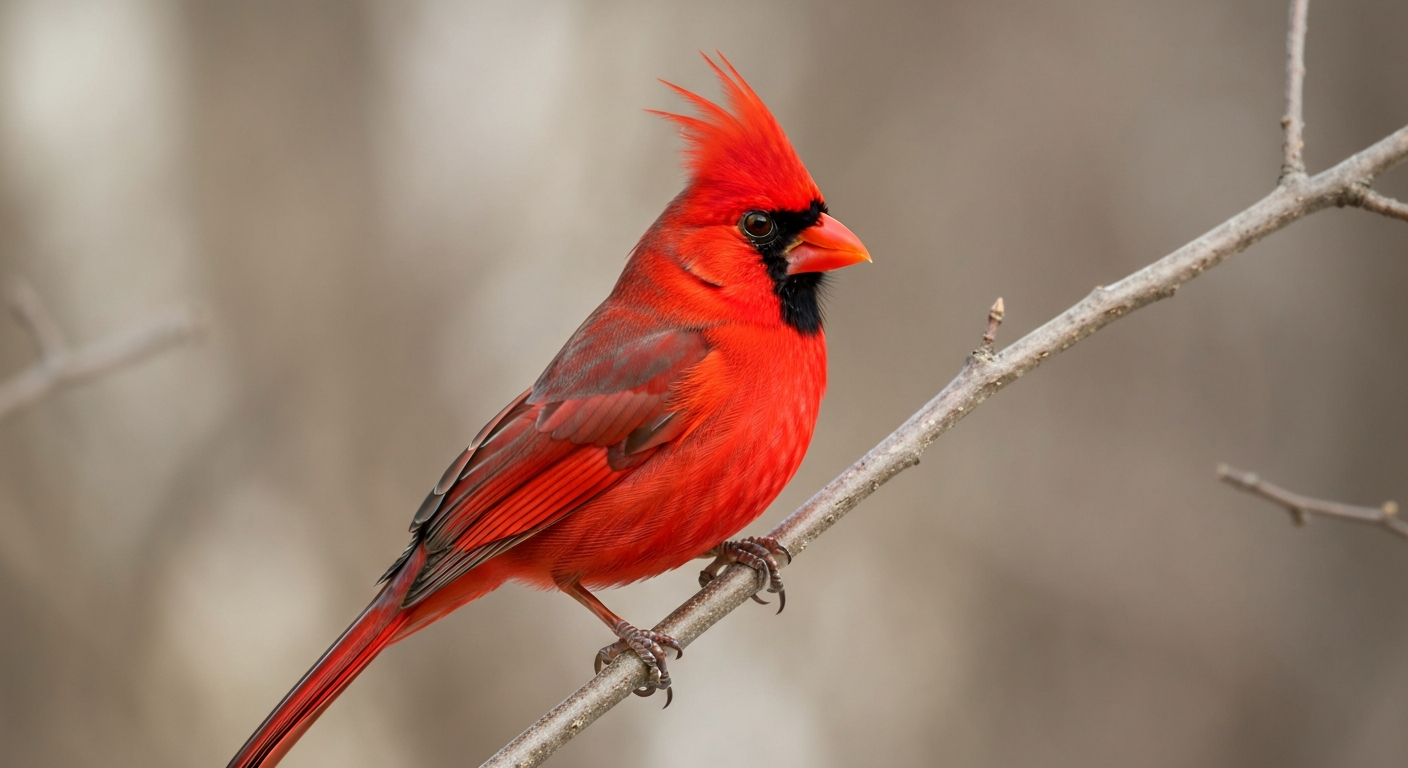
The Northern Cardinal (Cardinalis cardinalis, family Cardinalidae) is a medium-sized songbird, roughly 21–23 cm in length, native to North America, from southern Canada through the eastern and central United States, Mexico, and parts of Central America. The male is unmistakable: entirely brilliant red with a prominent pointed crest, a black mask around the face and throat, and a thick, conical orange-red bill built for cracking seeds. The female is a warm buff-brown with reddish tinges on the crest, wings, and tail. Cardinals are non-migratory, year-round residents of woodland edges, gardens, shrubby thickets, and suburban parks, where they feed mainly on seeds, berries, and insects. They are strongly territorial and well known for their loud, clear, whistled song, a series of down-slurred 'cheer-cheer-cheer' or 'whoit-whoit-whoit' phrases that both sexes produce, which is unusual among songbirds. Cardinalidae is a strictly New World family: cardinals do not occur naturally anywhere in Asia or India, they are not listed on any Indian bird checklist (IOC World Bird List, eBird India, or Avibase), and no wild population exists on the Indian subcontinent. Any reference to the 'cardinal bird' in an Indian language context is therefore either a loanword description of this American bird or a symbolic/metaphorical usage borrowed from Western tradition.
What the cardinal symbolizes, and how to read that in an Indian context
In North American popular culture and spiritual writing, the cardinal is strongly associated with themes of love and romantic connection, vitality and life force, guidance from deceased loved ones, good luck, and the arrival of visitors or messages. These associations are primarily Anglo-American and do not have independent roots in Hindi, Sanskrit, or broader Indian tradition. That said, Indian readers who encounter cardinal symbolism, through social media, imported self-help or spiritual content, or diaspora community life, often ask whether the themes map onto anything familiar in Indian bird symbolism. Honestly, some of them do in a general sense: the color red (lāl) carries deep symbolic weight in Hindu tradition as the color of Shakti, auspiciousness, the sindoor of marriage, and vitality, so the idea of a brilliant red bird carrying positive energy or presaging good news is not conceptually foreign. But it is important to be clear that this parallel is thematic, not historical. No Puranic text, Sanskrit verse, or classical Hindi poem mentions the cardinal. Any spiritual meaning you assign to the cardinal in an Indian context is either personally derived or imported from Western popular spirituality.
- Love and partnership: In North American tradition the cardinal (especially the pair bond, since males and females stay together year-round) represents romantic loyalty and enduring love.
- Vitality and energy: The male's intense red coloring is widely read as a symbol of life force and confidence in Western spiritual writing.
- Messages from the deceased: A well-known American folk belief holds that a cardinal sighting signals the presence of a deceased loved one — this is popular in the United States and has spread widely via social media.
- Good luck and positive change: Cardinals are considered auspicious omens of positive news or change in several North American folk traditions.
- Note on Indian context: None of these specific beliefs appear in classical Hindi, Sanskrit, Marathi, Punjabi, or Gujarati folk traditions about birds. They are imported meanings, and should be labeled as such in any culturally honest Hindi-language content.
The cardinal in Indian-language traditions: an honest absence
When I searched HathiTrust, Google Books, and IndoWordNet corpora for कार्डिनल, लाल चिड़िया in an ornithological sense, and any Devanagari or Roman-script reference to Cardinalis cardinalis in Hindi, Sanskrit, Marathi, Punjabi, or Urdu texts, the results were telling: the cardinal simply does not appear in pre-20th-century Indian literature or classical Indic sources. Sanskrit Vedic and Puranic texts do use 'red bird' imagery in cosmological and poetic contexts, for example, 'red birds' accompanying the sun are mentioned in Vedic verse, and the color of certain divine birds like the Garuda and the mythological Jatayu is described in symbolic terms, but none of these passages refers to anything resembling Cardinalis cardinalis, and it would be a serious error to claim otherwise. The first appearances of कार्डिनल in Hindi or Marathi digital content are modern, appearing in translated nature articles, diaspora lifestyle blogs, and social media posts, almost always as a transliteration of the English word. This is entirely normal and expected: Hindi has a well-established pattern of using phonetic loanwords (tatsama or videshi shabda) for non-native fauna, just as it does for many introduced or foreign species. The eagle, for comparison, does have deep roots in Indian tradition as Garuda, a point explored in the eagle bird meaning in Hindi entry on this site. The cardinal, by contrast, enters the language fresh and without mythological baggage, which is actually useful: it means readers and writers can engage with it on its own ornithological and cross-cultural terms without risk of misattribution.
How to say 'cardinal' in Sanskrit, Marathi, Punjabi, and Gujarati
Across all four languages, the choice comes down to the same decision you face in Hindi: do you use a phonetic loanword (kārdinal) or a descriptive native-vocabulary translation (some form of 'red bird')? The right choice depends on your audience and purpose. For ornithological or academic writing, the loanword is safer because it unambiguously identifies the species. For general, popular, or educational writing aimed at a non-specialist audience, the descriptive form is more immediately understood.
| Language | Script | Loanword form | Descriptive translation | Literal meaning of descriptive form | Recommended use |
|---|---|---|---|---|---|
| Sanskrit | Devanagari | कार्डिनलः (kārdinālaḥ) | रक्तपक्षी (raktapakṣī) | Red-winged / red bird | Academic Sanskrit texts: loanword with Sanskrit declension; popular writing: raktapakṣī |
| Marathi | Devanagari | कार्डिनल (kārdinal) | लाल पक्षी (lāl pakṣī) | Red bird | Nature blogs, bilingual content: kārdinal; school/educational content: lāl pakṣī |
| Punjabi | Gurmukhi | ਕਾਰਡੀਨਲ (kārdīnal) | ਲਾਲ ਪੰਛੀ (lāl pañchī) | Red bird | Either form works; loanword preferred in formal writing; lāl pañchī in casual speech |
| Gujarati | Gujarati script | કાર્ડિનલ (kārdinal) | લાલ પક્ષી (lāl pakṣī) | Red bird | Loanword for ornithological use; descriptive form in creative or popular writing |
Loanword versus descriptive translation: advantages and tradeoffs
Using the loanword कार्डिनल (or its Gurmukhi/Gujarati equivalents) has one clear advantage: precision. It maps directly to a single species and avoids confusion with any Indian red bird. The tradeoff is that it requires the reader to already know what a cardinal is, so it is not self-explanatory. The descriptive translation लाल पक्षी (lāl pakṣī) is immediately meaningful to any Hindi speaker, but it is generic, India has several striking red birds (the scarlet minivet, the red avadavat, the crimson sunbird) and calling any of them 'lāl pakṣī' can cause confusion. The most practical solution for most writers is to use both: introduce the bird as कार्डिनल (लाल पक्षी) on first mention, then use whichever form suits the register of the text going forward. For Sanskrit, the constructed compound raktapakṣī is elegant and follows classical word-formation rules, with rakta (रक्त) meaning 'red' or 'blood-colored' and pakṣī (पक्षी) meaning 'bird.' It is not attested in classical Sanskrit literature (since the cardinal was unknown to ancient Indian authors) but is a grammatically and aesthetically correct neologism suitable for modern Sanskrit writing.
Indian red birds sometimes confused with the cardinal
Because 'लाल पक्षी' is the most intuitive Hindi description for a cardinal, it is worth knowing which genuinely Indian red birds might be described with the same phrase, so you can distinguish them clearly. The scarlet minivet (Pericrocotus flammeus, called लाल-पीला पहाड़ी बुलबुल or simply लाल मिनिवेट in Hindi) is the Indian bird most likely to be loosely compared to the cardinal in terms of striking red-and-black coloration in the male. The crimson sunbird and other sunbirds carry deep red or crimson coloration and rich symbolic associations in Indian tradition, the sun bird meaning in Hindi entry on this site goes into that symbolism in depth. See the site's 'sun bird meaning in Hindi' entry for an in-depth discussion of sunbird symbolism and names. See the hornbill bird meaning in Hindi entry for details on larger Asian forest species with important cultural roles in India. For a comparison of how very large non-native birds are handled in Indian-language writing, see the emu bird meaning in Hindi entry on this site. See the entry 'ear bird meaning in Hindi' for related symbolism and identification notes. The Indian Robin and the Red Avadavat (lāl muniā, लाल मुनिया) are also commonly described as 'red birds' in Hindi, and the bluebird comparison illustrates how color-based naming in Indian languages can span multiple species, as covered in the blue bird meaning in Hindi article on this site.
| Bird | Hindi name | Devanagari | Native to India? | Key distinction from cardinal |
|---|---|---|---|---|
| Northern Cardinal | kārdinal | कार्डिनल | No (Americas only) | Bright red all-over male with crest; family Cardinalidae |
| Scarlet Minivet (male) | lāl minivet | लाल मिनिवेट | Yes | Red-and-black, no crest; forest canopy species; family Campephagidae |
| Crimson Sunbird (male) | lāl shahad-chūsā pakṣī | लाल शहद-चूसा पक्षी | Yes (South/Southeast Asia) | Small, curved bill for nectar; family Nectariniidae |
| Red Avadavat | lāl muniā | लाल मुनिया | Yes | Small, spotted red finch; no crest; family Estrildidae |
| Indian Robin (male) | kālī chiriyā | काली चिड़िया (common name) | Yes | Black with reddish-brown underparts; much smaller; family Muscicapidae |
Practical Hindi phrases using the cardinal's name
Here are a few example sentences that show how the word fits naturally into Hindi, which can help language learners or writers working in the language.
- कार्डिनल एक सुंदर लाल पक्षी है जो अमेरिका में पाया जाता है। (kārdinal ek sundar lāl pakṣī hai jo amrīkā meṃ pāyā jātā hai.) — 'The cardinal is a beautiful red bird found in America.'
- नर कार्डिनल का रंग चमकीला लाल होता है और उसके सिर पर एक सुंदर चोटी होती है। (nar kārdinal kā raṃg camkīlā lāl hotā hai aur uske sir par ek sundar coṭī hotī hai.) — 'The male cardinal is bright red and has a beautiful crest on its head.'
- भारत में कार्डिनल पक्षी नहीं पाया जाता। (bhārat meṃ kārdinal pakṣī nahīṃ pāyā jātā.) — 'The cardinal bird is not found in India.'
- कुछ लोग कार्डिनल को प्रेम और शुभ समाचार का प्रतीक मानते हैं। (kuch log kārdinal ko prem aur śubh samācār kā pratīk mānte haiṃ.) — 'Some people consider the cardinal a symbol of love and good news.'
A note on images: what to look for and how to caption them
The ideal lead image for an article on the cardinal bird meaning in Hindi is a clear photograph of a male Northern Cardinal showing the full red plumage, the pointed crest, and the thick orange-red bill, ideally perched on a branch against a neutral background so the identification features are unambiguous. A suggested caption for such an image would be: 'नर नॉर्दर्न कार्डिनल (Cardinalis cardinalis), अमेरिका का प्रसिद्ध लाल पक्षी। Male Northern Cardinal, the bird known as कार्डिनल in Hindi.' High-quality licensed photographs and audio recordings are available through Cornell Lab's Macaulay Library and xeno-canto, both of which host verified Northern Cardinal media. A secondary image showing the female (buff-brown with reddish crest tinges) alongside the male helps readers understand why not every cardinal is red, a point that matters when explaining the symbolism of the red color specifically.
Putting it all together: what this means for learners and enthusiasts
The cardinal is a genuinely fascinating case study in how Indian languages handle non-native birds: there is no ancient name to recover, so modern Hindi builds one from transliteration and descriptive vocabulary, and the result is perfectly functional. Knowing that कार्डिनल is a loanword and लाल पक्षी is a descriptive phrase, and knowing when to use each, gives you real linguistic fluency, not just a lookup result. The symbolic meanings associated with the cardinal in Western traditions (love, vitality, messages from the departed) are worth knowing for cross-cultural literacy, but they should always be labeled as North American in origin rather than claimed as part of Indian or Hindu tradition. For a comparison with how a very different bird is treated in Indian languages and symbolism, see the entry on secretary bird meaning in Hindi. India has its own rich vocabulary of red-bird symbolism, from the mythological fire-birds of the Vedas to the crimson sunbirds of the ghats, and those traditions deserve to be described on their own terms. For anyone curious to go deeper into how color-based bird names work across Indian languages, the blue bird meaning in Hindi and sun bird meaning in Hindi entries on this site explore parallel questions for other species, and the bird name meaning in Hindi article provides a broader framework for understanding how Hindi names birds in general.
FAQ
What authoritative biological facts must be confirmed about the cardinal before writing the Hindi reference entry?
Confirm taxonomy (family Cardinalidae; common species such as Northern Cardinal Cardinalis cardinalis), native range (New World: North, Central, South America; not native to India), key field-ID features (male bright red plumage, crest, stout conical bill, female brownish with warm tones), vocal behaviour (song types) and size. Use primary taxonomic/checklist sources (IOC World Bird List, Clements/eBird, Avibase), species accounts (Cornell Lab AllAboutBirds, Audubon), and peer‑reviewed phylogeography/ecology papers for authoritative measurements and subspecies information.
Which sources should be used to support the statement that cardinals are not native to India?
Use global range maps and government/agency accounts (IOC World Bird List, U.S. Fish & Wildlife Service, eBird distribution maps, Audubon) and national/regional checklists (India/BirdLife/Indian bird atlases) to demonstrate absence from Indian faunal lists. Cite these checklists explicitly to avoid unsupported claims.
What linguistic evidence is needed for Hindi renderings, transliteration and pronunciation?
Gather attested Hindi spellings from bilingual dictionaries and Indian-language bird pages (examples: कार्डिनल, नॉर्दर्न कार्डिनल), corpus evidence (Google Books, regional websites) for contemporary usage, and standards for romanization (Hunterian, ISO 15919, IAST). For pronunciation, consult Hindi phonology references and bilingual dictionaries to produce an IPA and learner-friendly transliteration (e.g., कार्डिनल — kardinal /kaːɾɖɪnəl/). State which transliteration system you use.
What research questions should be asked about translation choices (loanword vs descriptive term)?
Ask: How do Hindi speakers usually name non‑native birds online and in field guides—by transliteration or description? Are literal translations (e.g., लाल पक्षी / लाल चिड़िया) used in literature or useful for learners? Which choice best balances recognizability (loanword) and descriptive clarity (literal term)? Support answers with corpus hits from Hindi/Marathi/Punjabi/Gujarati pages and dictionary attestations.
What cultural and symbolic evidence must be collected to discuss cardinal symbolism in an Indian/Hindi context?
Search comparative folklore and ethno‑ornithology sources (edited volumes on birds and culture, regional ethnographies) for any mention of 'red birds' in Indic texts. Verify whether traditional Indian sources (Puranas, folk tales, classical poetry) refer to a bird that could plausibly map to the cardinal; if not, clearly note absence and avoid projecting Western symbolism. Use scholarly works on bird folklore and primary textual sources to ground claims; when drawing parallels, use cautious language and cite sources.
Which Western symbolic meanings of the cardinal should be reported and how should they be framed for Indian readers?
Report commonly documented Western associations—love/relationships, vitality/energy, guidance/messenger—sourced from folklore studies and reputable cultural summaries. Frame them as 'Western/New‑World associations' and explicitly state these are not traditional Indian attributions unless supported by Indian texts. Always qualify speculative cultural transfers and provide sources.
Next Article
Hornbill Bird Meaning in Hindi: Name, Script & Symbolism
Hornbill meaning in Hindi: Devanagari, transliteration, regional names, symbolism, species ID & conservation.