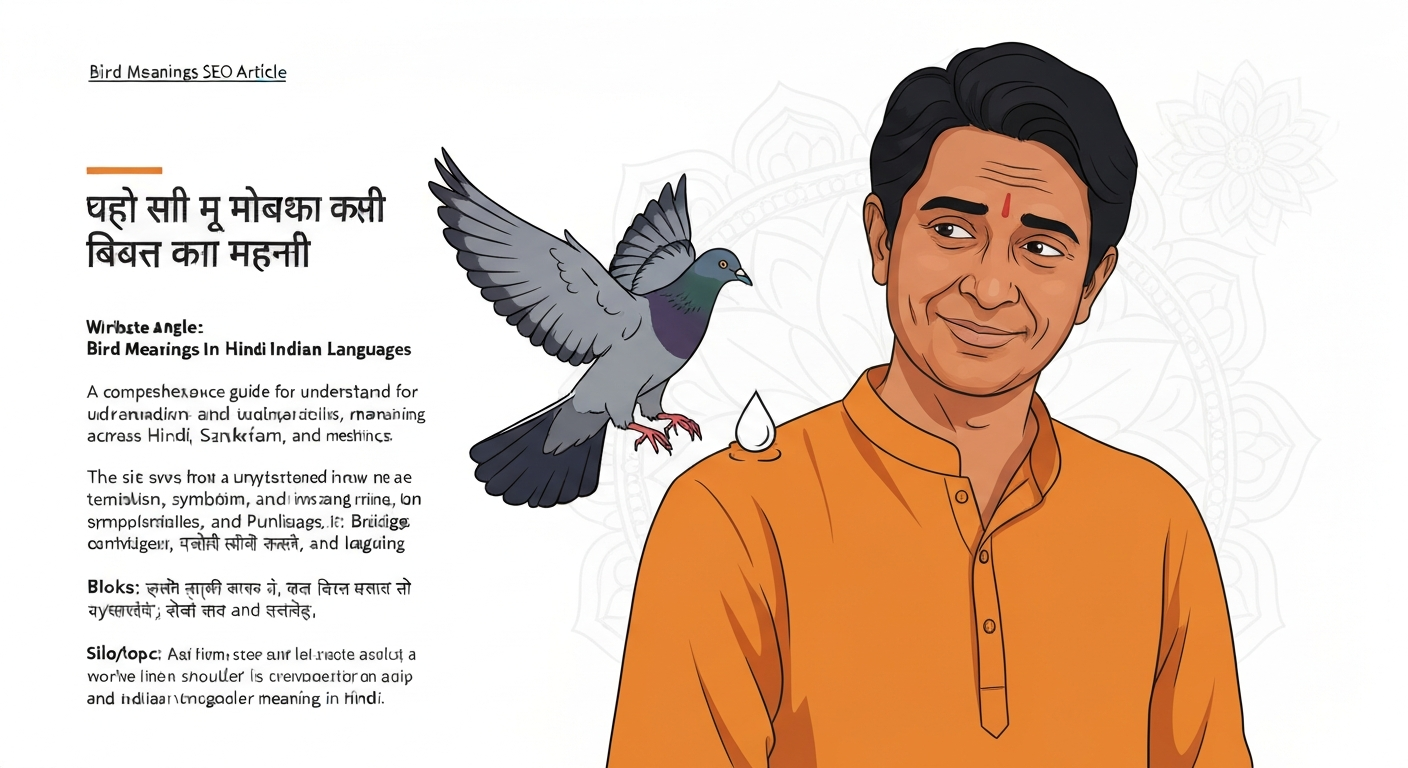
In most parts of India, a bird dropping landing on your right shoulder is broadly treated as a sign of incoming good luck, especially if the bird responsible is a pigeon. But the honest answer is that the meaning shifts depending on which bird did it, which region you are in, and who you ask. There is no single pan-Indian ruling on this, and that ambiguity is itself part of what makes the belief so interesting culturally.
Bird poop on right shoulder meaning in Hindi: Cultural guide

Rajesh Sharma
13 Jul 2026
Is bird poop on the right shoulder good or bad?
The quick, practical consensus from Hindi-language popular media and folk-belief columns is: mixed, but leaning positive on the right side. Pigeon droppings on the right shoulder are most commonly reported as an auspicious omen in popular Indian culture. Crow droppings, on the other hand, tend to be read with more caution and are sometimes linked to ancestral signals rather than straightforward luck. The immediate real-world reaction for most people, regardless of region, is annoyance followed by a quick clean-up, with omen commentary happening conversationally afterward. Treat any specific belief here as a cultural report, not a verified cause-and-effect rule.
How to say it in Hindi: translation and pronunciation
The most natural, everyday Hindi way to say 'bird poop on the right shoulder' is written in Devanagari as: दाहिने कंधे पर पक्षी का मल. The IAST transliteration is: dāhine kandhe par pakṣī kā mal. If you want to express the event as something that happened to you (which is how people actually say it), the verbal form is: पक्षी का मल दाहिने कंधे पर लगना (pakṣī kā mal dāhine kandhe par lagnā), meaning literally 'bird's excrement falling/sticking on the right shoulder'.
| Component word | Devanagari | IAST transliteration | English meaning |
|---|---|---|---|
| Bird | पक्षी | pakṣī | bird (general) |
| Poop / excrement | मल | mal | excrement, droppings |
| Right | दाहिना / दाहिने | dāhinā / dāhine | right (side) |
| Shoulder | कंधा / कंधे | kandhā / kandhe | shoulder |
| On / upon | पर | par | on, upon |
| To fall / stick on | लगना | lagnā | to touch, fall on, stick to |
| Crow | कौवा | kauvā | crow |
| Pigeon | कबूतर | kabūtar | pigeon, dove |
| Sparrow | गौरैया | gauraiyā | house sparrow |
| Peacock | मोर | mor | peacock |
| Myna | मैना | mainā | myna bird |
A short sample phrase you might hear in conversation: 'अरे, कबूतर ने दाहिने कंधे पर मल कर दिया, शायद किस्मत अच्छी होगी!' (Are, kabūtar ne dāhine kandhe par mal kar diyā, shāyad kismat acchī hogī!), 'Oh, a pigeon just pooped on my right shoulder, maybe my luck is about to turn good!' The word पक्षी (pakṣī) comes from the Sanskrit root pakṣa, meaning wing or side, and is the standard formal and literary term for bird across Hindi and Sanskrit.
Birds and omens in Indian culture: a brief background
Birds occupy a deeply layered symbolic space in Indian traditions. In Sanskrit texts, the study of bird omens was part of a formal discipline called Śakunaśāstra (शकुनशास्त्र), literally 'the science of omens from birds.' Crows feature prominently in Garuda Purana ritual contexts as messengers connected to the pitṛs (ancestors). The peacock (मोर, mor) is the vehicle of Kartikeya and widely used in temple iconography as an auspicious motif. Sparrows and mynas appear in folk sayings across many regional languages. This long tradition means that when a bird drops something on you, people in Indian communities are drawing on centuries of layered folk-reading, not just a casual superstition.
It is worth being clear upfront: most of what follows under 'interpretations' is documented popular belief and folk attribution. These are things people say and believe, reported here as cultural data. They are not predictions, and they are not endorsed as factual outcomes.
Common interpretations: cultural, spiritual, and folk-belief perspectives
- Incoming financial good luck: the most widely circulated popular interpretation, especially when the bird is a pigeon, is that droppings landing on you (particularly on the right side) signal that money or good fortune is on its way. This is reported heavily in popular Hindi and English-language media covering Indian superstitions.
- Ancestral communication via crows: in Shastriya (classical) and folk traditions, crows are connected to pitṛs (ancestral souls). A crow dropping on you can be read as an ancestral signal, though whether it is positive or cautionary varies by region and context.
- Spiritual cleansing or reset: some communities interpret a bird dropping as a moment of symbolic purification — the unpleasant event 'resets' your luck or washes away a period of bad fortune.
- A random event, nothing more: a significant proportion of urban and educated Indians treat the event purely as an inconvenience with no omen value, reflecting the range of attitudes even within a single culture.
- Right side as intrinsically auspicious: drawing on a broader South Asian folk-astrology principle that 'right' (dāhinā) correlates with positive outcomes and 'left' (bāyāṃ) with negative ones, many folk commentators automatically assign the right-shoulder version a more favorable reading.
- Call to perform a small puja or gratitude practice: in some households, particularly in more traditionally observant families, the event prompts a small offering or a verbal thanks to the deity, treating the bird as a divine messenger.
- Warning or heads-up from the universe: a minority interpretation, more common with crows, treats the dropping as a nudge to pay attention or be careful in the near future.
What the bird species says about the meaning
Species matters a great deal in Indian folk-reading of bird events. The same landing spot carries a different weight depending on which bird was responsible, and these distinctions are fairly consistently reported across popular sources, even if they are not uniform across all regions.
| Bird (Hindi name) | Sanskrit name | Commonly reported folk meaning of droppings | General cultural standing |
|---|---|---|---|
| कबूतर (kabūtar) — Pigeon | kapota | Most often described as a positive omen, linked to incoming good luck or financial gain | Broadly auspicious; associated with peace and Venus (Shukra) in some jyotish traditions |
| कौवा (kauvā) — Crow | kāka / vāyasa | Associated with ancestral messages; sometimes inauspicious, sometimes a timely warning — context-dependent | Ambiguous; deeply embedded in ritual (Shraddha ceremonies); can be auspicious or cautionary |
| गौरैया (gauraiyā) — Sparrow | caṭaka | Generally considered a mild positive sign; sparrows are seen as household-friendly birds | Affectionate and positive; linked to domestic well-being |
| मैना (mainā) — Myna | sārikā | A myna dropping is not widely documented with a specific omen value; treated as neutral or mildly positive | Associated with speech, communication, and good cheer in folk culture |
| मोर (mor) — Peacock | mayūra | No widely documented specific belief about peacock droppings as an omen; the bird itself is strongly auspicious | Highly auspicious; national bird of India; vehicle of Kartikeya; associated with Saraswati |
| चील (cīl) — Kite / Eagle | śyena | No consistent documented folk meaning for droppings found in surveyed sources | Powerful and often neutral; associated with sky and vision |
| कोयल (koyal) — Cuckoo | kokila | No documented droppings-specific omen found; the bird is auspicious primarily through its call, not its droppings | Auspicious, associated with spring and the voice of Kamadeva |
For species where no documented belief was found in the surveyed sources, it is more accurate to say 'no widely circulated omen reading exists for this species' than to invent one. The absence is itself useful information for anyone researching Indian bird symbolism.
Right shoulder versus left shoulder: how the side changes things
The right-versus-left distinction runs deep in South Asian folk-astrology and observational traditions. For a recent popular-media treatment linking right/left bodily signs to folk-astrology readings, see Khulizuban (popular column explaining folk-astrology readings for right/left twitching of shoulders) Khulizuban (popular column explaining folk-astrology readings for right/left twitching of shoulders).. In jyotish-influenced folk columns and popular Vastu/omen discussions, right (दाहिना, dāhinā) is consistently treated as the auspicious, active, solar side, while left (बायाँ, bāyāṃ) is associated with the lunar, receptive, or sometimes cautionary side. The same principle is applied to body twitches, directional omens, and first-step rituals. Applied to bird droppings, the popular extrapolation is straightforward: right shoulder equals more favorable reading, left shoulder equals more cautious or potentially negative reading.
That said, this is an extrapolation from a general folk principle, not a rule specifically codified for bird droppings in any classical text I have encountered. No single pan-Indian authoritative source specifically states 'right shoulder = good, left shoulder = bad' for bird droppings in a canonical way. The belief exists and is widely reported, but it is popular folk application rather than Shastriya prescription. Regional contradictions exist, particularly in some parts of Maharashtra and Rajasthan where context, time of day, and species override side-of-body reading.
| Shoulder side | Common folk interpretation | Strength of documented belief | Notes |
|---|---|---|---|
| Right (दाहिना, dāhinā) | Generally positive: good luck, financial gain incoming, auspicious signal | Moderately well-attested in popular media and online folk-belief discussions | Strongest when bird is pigeon; weaker when bird is crow |
| Left (बायाँ, bāyāṃ) | Generally cautionary: bad luck, need for care, or at minimum a neutral event | Less consistently documented than right; more regional variation | Some communities treat both sides equally as 'it's just a bird' |
| Head (सिर, sir) | Often reported as the most strongly auspicious in popular discourse | Frequently cited in pop-culture lists of bird dropping omens | Pigeon on head treated as especially lucky in many popular sources |
| Chest / front (सीना, sīnā) | Mixed; no dominant documented interpretation found | Weakly documented | No clear regional consensus found |
How meanings vary across Hindi, Sanskrit, Marathi, Punjabi, and Gujarati
One of the things I find most valuable about approaching bird symbolism from a multilingual Indian-language perspective is that the regional differences are real and documented, not just theoretical. Here is what the surveyed sources actually show for each language region.
Hindi
In Hindi-language popular media, the dominant framing treats bird droppings (particularly pigeon droppings) as a commonly reported good-luck sign, especially on the right side. This is the reading most widely circulated in Hindi-language news features on Indian superstitions and social media discussions. The phrase 'शकुन' (śakun, omen) or 'अपशकुन' (apaśakun, bad omen) is used to frame the event depending on which reading applies. Crow-related events are more frequently discussed in the context of 'पितृ' (pitṛ, ancestral) signals rather than simple luck.
Sanskrit
Classical Sanskrit texts on omens (Śakunaśāstra) discuss birds extensively as omen-bearers, but they focus primarily on bird calls, flight direction, and perching locations rather than droppings specifically. The crow (kāka) and eagle (śyena) receive the most attention in these systems. The formal Sanskrit term for an auspicious omen is 'śakuna' (शकुन) and for an inauspicious one 'apaśakuna' (अपशकुन). While droppings are not the primary focus of classical Śakunaśāstra, the pigeon (kapota) is noted in some texts as a bird whose proximity or behavior carries ambivalent meaning depending on context.
Marathi
Marathi-language cultural sources show regional variability within Maharashtra itself. Marathi local press pieces on bird omens document that pigeon droppings inside a home can be read either as auspicious or inauspicious depending on the specific locality and family tradition. The Marathi word for pigeon is 'कबूतर' (the same borrowing from Persian as Hindi) or the more regional 'पारवा' (pāravā). Crow is 'कावळा' (kāvaḷā) in Marathi, and crow behavior is similarly discussed in folk columns with ancestral/pitṛ associations, consistent with the broader South Asian pattern. Marathi sources suggest this is an area where family and village tradition override any single regional rule.
Punjabi
Punjabi cultural commentary includes bird-related folk attitudes, and the crow (ਕਾਂ, kāṃ in Punjabi) features prominently in Punjabi proverbs and folk sayings. However, the surveyed sources did not produce a specific documented Punjabi proverb or saying about bird droppings on the right versus left shoulder. A Punjabi-language blog and local‑culture commentary supports this absence, documenting bird-related attitudes in Punjabi while not presenting any specific proverb about droppings on the right versus left shoulder (see Punjabi-language blog and local‑culture commentary) Punjabi-language blog and local‑culture commentary (illustrates Punjabi bird-related attitudes but does NOT supply a specific proverb about droppings on right/left shoulder).. The general right-as-auspicious framework applies in Punjabi folk-astrology contexts, and pigeon (ਕਬੂਤਰ, kabūtar) is broadly positive in Punjabi culture as a symbol of peace. The absence of a specific documented belief here is worth noting honestly rather than filling in with unsupported claims.
Gujarati
Gujarati cultural tradition has a strong connection to birds through the Jain-influenced ethic of ahimsa, and bird feeding (particularly of pigeons and sparrows) is a common Gujarati devotional practice. The Gujarati word for bird is 'પક્ષી' (pakṣī, same root as Hindi/Sanskrit), and pigeon is 'કબૂતર' (kabūtar). Pigeon droppings in Gujarati folk culture are broadly treated as positive, consistent with the reverence for pigeons as recipients of seva (devotional service). Again, no specific Gujarati proverb about right-shoulder droppings was located in the surveyed sources, and that absence is reported honestly.
| Language / Region | Key vocabulary | Documented folk attitude to pigeon droppings | Crow association | Strength of right-vs-left belief |
|---|---|---|---|---|
| Hindi | पक्षी (pakṣī), कबूतर (kabūtar), कौवा (kauvā), शकुन (śakun) | Commonly reported as good luck | Ancestral/pitṛ signal; ambiguous | Moderately documented in popular sources |
| Sanskrit | pakṣin, kapota, kāka, śakuna, apaśakuna | Ambivalent in classical texts; context-dependent | Extensive omen-reading tradition (Śakunaśāstra) | General right/left auspicious framework present in classical thought |
| Marathi | पक्षी (pakṣī), पारवा (pāravā), कावळा (kāvaḷā) | Variable: auspicious or inauspicious by locality and family | Ancestral associations consistent with broader tradition | Regional variation overrides simple rule |
| Punjabi | ਪੰਛੀ (pañchī), ਕਬੂਤਰ (kabūtar), ਕਾਂ (kāṃ) | Broadly positive for pigeon; no specific droppings proverb found | Prominent in Punjabi folk sayings; crow as message-carrier | No documented specific right-shoulder rule found |
| Gujarati | પક્ષી (pakṣī), કબૂતર (kabūtar) | Positive, consistent with devotional pigeon-feeding tradition | Less prominent than in Hindi/Marathi sources | No documented specific right-shoulder rule found |
What to do right after it happens: cleaning and customary responses
Practical cleaning steps
Before anything else, clean up properly. Bird droppings can carry pathogens including Histoplasma capsulatum and Cryptococcus neoformans in some contexts, and public-health guidance (including from the CDC and municipal health agencies) is consistent on the basics: do not rub or dry-wipe the dropping, as this can spread material and aerosolize dried droppings. Wet the area first, then remove gently. For clothing, a damp cloth to lift the material followed by a standard laundry wash is the recommended approach. For skin, wash with soap and water promptly. If you are ever dealing with a heavy accumulation of droppings in an enclosed space (rather than a single incident outdoors), PPE including gloves and respiratory protection are advised.
- Do not rub the dropping dry — this can spread it and, with older dried deposits, may release fine particles.
- Use a damp cloth or paper towel to gently lift the material away from clothing or skin.
- Wash the affected clothing normally in the laundry as soon as practical.
- Wash any affected skin with soap and water.
- Dispose of the used cloth or paper in a sealed bag.
- Wash your hands thoroughly after handling.
Customary responses and community-reported rituals
What happens after the cleaning is where culture comes in. The most commonly reported immediate reactions in popular Indian media and social commentary are: a sharp exclamation (often in Hindi: 'अरे!' or 'हाय!'), followed by laughter or commiseration from bystanders, followed by someone offering the folk-luck framing ('अरे, यह तो शुभ है!', 'Oh, this is actually auspicious!'). These are community-reported practices and conversational norms, not prescribed rituals.
- Accepting the 'good luck' framing conversationally: by far the most commonly documented response in urban and semi-urban Indian communities is to accept (or at least repeat) the 'it means good luck is coming' interpretation, treating it as a positive spin on an unpleasant event.
- A verbal thanks or short prayer: some traditionally observant individuals follow the cleaning with a brief verbal acknowledgment to the deity or the bird as a messenger — something along the lines of 'धन्यवाद, ईश्वर' (dhanyavād, Īśvar — 'Thank you, God'), treating the event as a divine signal.
- Bathing or changing clothes: in some households, particularly more orthodox ones, changing the affected clothing and taking a bath as a ritual cleansing act is standard practice — this overlaps with the practical hygiene step but carries an additional purification meaning.
- Offering grain to birds: a practice reported in some communities, especially Gujarati and some Marathi households, is to offer a small amount of grain (dana) to birds as an act of gratitude following the event, particularly if it is interpreted as a sign from a pigeon.
- Visiting a temple or making a small daan (charity): some folk-astrology columns suggest that if the bird was a crow and the reading is cautionary, making a small charitable gift or visiting a temple to light a diya is a recommended response to neutralize any negative reading.
- Noting it in context of current life circumstances: the most practical cultural use of the omen reading is to mentally connect it to an ongoing situation — a job interview coming up, a business decision, a family matter — and use the 'good luck' frame as a confidence boost, which is how most people who take the belief seriously actually deploy it.
All of the above are documented cultural practices and folk responses. They are reported here as descriptions of what people do and say, not as prescriptions or as causal recommendations. The line between practical tradition, community bonding ritual, and simple superstition is often blurry in these contexts, and that is part of what makes them worth understanding rather than dismissing.
A quick note on related topics worth exploring
If you arrived here curious about bird symbolism and language more broadly, the vocabulary and cultural frameworks in this article connect to several adjacent topics. For a related vocabulary entry, see the article on bird brain meaning in Hindi. Understanding what individual birds are called in Hindi is a natural extension, the names themselves carry etymological and cultural weight, since a word like pakṣī (पक्षी, from the Sanskrit root for 'winged') or mor (मोर, peacock) carries meaning beyond just labeling the animal. The way birds communicate through calls and chirps also has a documented omen-reading tradition in Indian languages, and the phrase a bird makes can shift the interpretation of any other bird-related event you experience. For more on how bird sounds are interpreted and the vocabulary used, see a dedicated explanation of bird chirp meaning in Hindi (destination: 842c111d-3906-4cbd-b6cd-20a139a63e2c). These connections between language, sound, and symbolic meaning are what make Indian bird-naming traditions such a rich area for language learners and cultural enthusiasts alike. For a direct translation and usage notes of the English phrase 'bird's‑eye view', see bird eye view meaning in Hindi. For beginners, a concise resource titled bird box explained in hindi introduces common bird-related terms and cultural notes useful for learners.
FAQ
Literal Hindi translation and pronunciation — how do you say “bird poop on right shoulder” in Hindi and how is it pronounced?
Common literal Hindi phrasing: “दाहिने कंधे पर पक्षी का मल” (IAST transliteration: dāhine kandhe par pakṣī kā mal). A natural verbal form: “(किसी) पक्षी का मल दाहिने कंधे पर लगना” (kisi pakṣī kā mal dāhine kandhe par laġnā). Pronunciations: पक्षी /pakṣī/ (“pak-shee”), दाहिना /dāhinā/ (“daa-hi-na”), कंधा /kandhā/ (“kun-dhaa”), मल /mal/ (“mul”). For native audio of component words (e.g., कबूतर/kabūtar) see crowd‑recorded resources such as Forvo.
Quick answer — is bird poop on the right shoulder considered good or bad in Hindi/Indian contexts?
Short answer: there's no single pan‑Indian rule. Popular folk opinion is mixed: many people joke or report pigeon droppings as a sign of good luck, crows often carry cautionary or ancestor‑related associations, and right vs left sometimes matters in local omen systems (right often read positively). But reactions are commonly pragmatic (annoyance/cleaning) followed by culturally variable omen‑talk. These are reports of belief, not factual causal claims.
What are common cultural, spiritual, and superstition-based interpretations generally reported?
Common reported readings (folk/cultural summaries): - Pigeon droppings: often reported in popular sources as a folk sign of impending good luck or fortune (not universal). - Crow droppings: frequently associated with ancestor‑omens (pitṛs) or warnings; sometimes seen as inauspicious. - Peacock: culturally auspicious symbol, so association tends positive in broader iconography (specific droppings interpretations are less commonly stated). - Other species (kingfisher, raptors): little consistent documentary evidence of species‑specific droppings omens; absence of evidence means no widely documented belief. Interpretations vary by local tradition, context, time, and storyteller; treat these as cultural attributions rather than proven signals.
How does meaning change depending on the bird species?
Documented patterns in popular/folk sources: - Pigeon (कबूतर / kabūtar): often reported as ‘good luck’ in many pop‑culture pieces. - Crow (कौवा / kauvā): linked to ancestral omens or warnings in many traditions; sometimes seen as inauspicious. - Peacock (मयूर / mayūr): generally auspicious in Indian art and ritual symbolism; explicit droppings‑omens less commonly cited. - Other species: no consistent, widely documented meanings found for many species; local traditions may vary.
Does right shoulder vs left shoulder change interpretation?
Right vs left is semantically important in many South Asian omen systems (e.g., body‑twitch superstitions often treat right as positive, left as negative), so some communities may read droppings on the right shoulder more positively. However, there is no single, authoritative pan‑Indian rule that 'droppings on right shoulder = good' for all regions or birds; local beliefs differ and contradictions exist.
What are documented regional/language variations (Hindi, Sanskrit, Marathi, Punjabi, Gujarati)?
Regional notes from surveyed sources: - Hindi: popular columns and social talk report mixed readings; pigeon = often joked as lucky, crow = cautionary; right/left distinctions appear in folk columns. - Sanskrit: classical literature does not give a uniform droppings omen rule; birds like crows and peacocks have symbolic roles (e.g., crows linked to ancestors), but direct droppings‑omens are chiefly folk matters. - Marathi: regional press pieces document variable local readings; some communities read certain bird appearances/droppings as auspicious or inauspicious. - Punjabi/Gujarati: explicit proverbs specifically about “droppings on right/left shoulder” were not found in the surveyed sources; folk attitudes exist but are less consistently documented in sampled material. In all languages the pattern is heterogenous and depends on local custom.