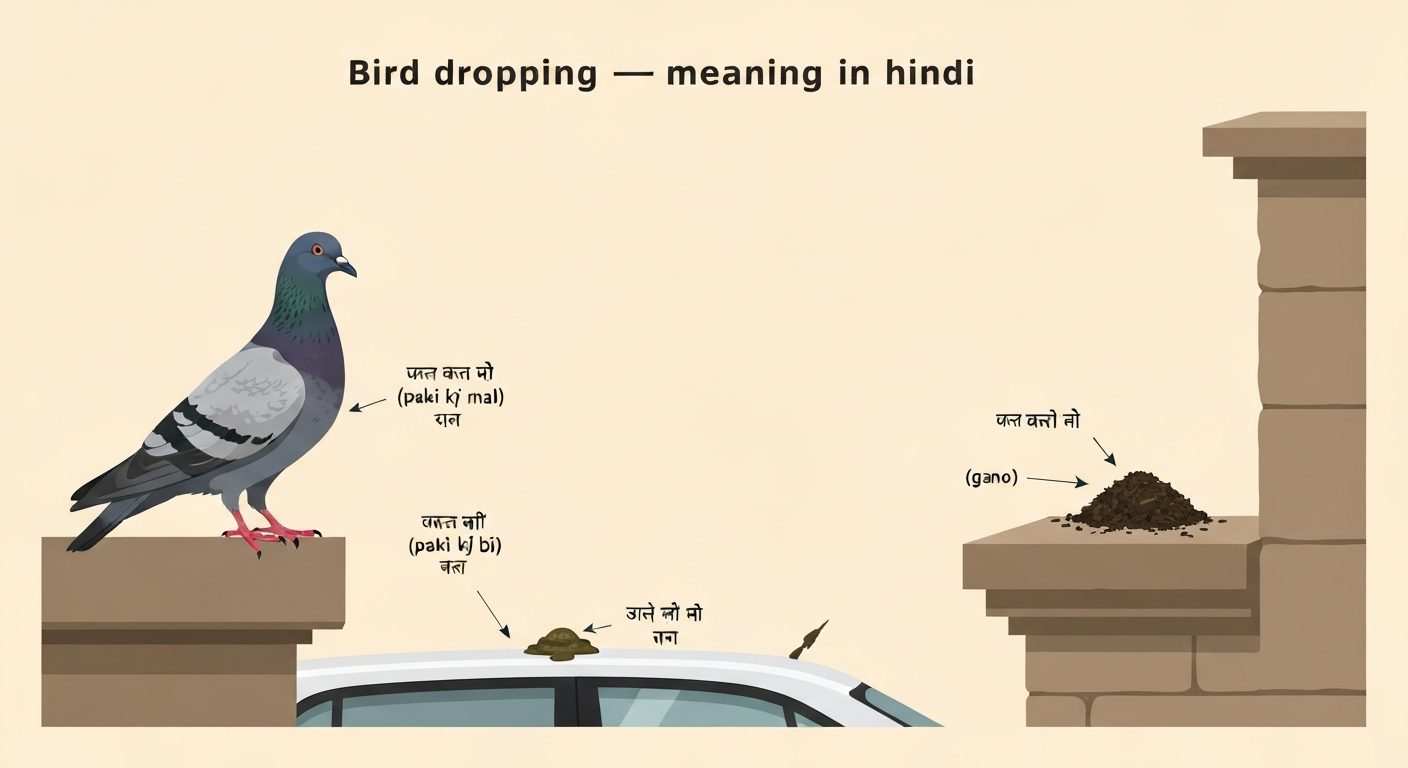
Bird dropping in Hindi is most accurately translated as पक्षी का मल (pakṣī kā mal, pronounced roughly "puk-shee kaa mul"). That is the standard, neutral phrase you will find in formal writing, news reports, and government documents. In everyday speech, people often say पक्षी की पोटी (pakṣī kī poṭī) for a more colloquial feel, much the way English speakers switch between "feces" and "poop" depending on the situation. If you are dealing with fertilizer or agricultural contexts, the technical loanword गुआनो (gūāno) is the recognised Hindi term for guano specifically.
Bird Dropping Meaning in Hindi: Translation, Uses & Contexts

Rajesh Sharma
16 Jul 2026
What this article covers and who it is for
This entry is part of a broader reference guide covering bird terminology, symbolism, and meanings across Hindi, Sanskrit, Marathi, Punjabi, and Gujarati. Whether you are a language learner trying to find the right Hindi word for a translation exercise, a gardener researching guano as a fertiliser, or someone curious about what Indian folk tradition says when a bird drops on you, this article walks through all of those angles in one place. It covers literal translations and pronunciations, regional equivalents in four Indian languages, figurative and cultural uses, practical agricultural notes, and basic sanitation guidance.
Primary Hindi translations, synonyms, and pronunciations
The core Hindi word for feces is मल (mal), a formal, neutral noun derived directly from Sanskrit. Combined with पक्षी (pakṣī, "bird"), you get the standard phrase for bird droppings. The word पक्षी itself carries an IPA pronunciation of /pək.ʂiː/, the retroflex "sh" sound (ʂ) is the distinctive feature that trips up learners. A second common Hindi word for bird is पंछी (panchhī, /pən.t͡ʃʰiː/), which is softer and more colloquial, so you will hear पंछी की पोटी in relaxed, everyday conversation.
| Hindi phrase | Romanization (IAST) | Pronunciation guide | Register |
|---|---|---|---|
| पक्षी का मल | pakṣī kā mal | puk-shee kaa mul | Formal / neutral |
| पक्षियों का मल | pakṣiyoṃ kā mal | puk-shee-yon kaa mul | Formal plural |
| पक्षी की पोटी | pakṣī kī poṭī | puk-shee kee po-tee | Colloquial / everyday |
| पंछी का मल | paṃchī kā mal | pun-chhee kaa mul | Colloquial / neutral |
| पक्षी की विष्ठा | pakṣī kī viṣṭhā | puk-shee kee visht-haa | Literary / classical |
A note on register: मल is appropriate in medical, journalistic, and government writing. विष्ठा (viṣṭhā) is the classical Sanskrit-derived option that appears in literary Hindi and older texts, you would not use it in casual conversation. पोटी is the informal word most parents and children use and it appears frequently in popular Hindi media, including ABP Live health articles warning about the risks of bird droppings in urban areas.
Technical and agricultural term: guano in Hindi
When the context shifts to fertiliser, deposits, or soil science, the English loanword 'guano' is simply transliterated as गुआनो (gūāno) in Hindi. Government agricultural documents, competitive exam syllabi, and academic Hindi texts all use this word without substitution, so there is no native-root Hindi equivalent that has fully displaced it in technical writing. If you are reading a Hindi-medium UPSC or agricultural science text and see गुआनो, it refers specifically to accumulated bird or bat droppings valued as a nitrogen and phosphorus-rich fertiliser. In spoken contexts, a Hindi speaker might clarify it as पक्षी की बीट का खाद (pakṣī kī bīṭ kā khād, "bird-dropping fertiliser") or simply call it जैविक खाद (jaivik khād, "organic manure") in a farming discussion.
The word बीट (bīṭ) is worth noting separately. It is a widely used informal Hindi term specifically for bird droppings, more so than पोटी in the context of birds, and you will hear it when someone says "कार पर चिड़िया की बीट पड़ गई" ("A bird has dropped on the car"). It sits at a register somewhere between formal मल and casual पोटी.
Equivalent words in Sanskrit, Marathi, Punjabi, and Gujarati
Across the Indo-Aryan languages of the Indian subcontinent, the words for bird and for excrement follow recognisably related roots but diverge in their everyday forms. The table below gives the most widely used equivalents, with pronunciations, so you can navigate a conversation or text in each language.
| Language | Word for bird | Word/phrase for bird droppings | Romanization | Pronunciation guide |
|---|---|---|---|---|
| Sanskrit | पक्षी / पक्षि (pakṣī / pakṣi) | पक्षी-विष्ठा / पक्षी-पुरीषम् | pakṣī-viṣṭhā / pakṣī-purīṣam | puk-shee-visht-haa / puk-shee-pu-ree-sham |
| Marathi | पक्षी / पक्ष्याचे (pakṣī / pakṣyāce) | पक्ष्याचे शेण | pakṣyāche śeṇa | puk-shya-che shhen |
| Punjabi | ਪੰਛੀ (panchhī) | ਪੰਛੀ ਦਾ ਮਲ / ਪੰਛੀਆਂ ਦੇ ਪਾਖਾਣੇ | panchhī dā mal / panchhīāṃ de pākhāṇe | pun-chhee daa mul / pun-chhee-aan de paa-khaa-ne |
| Gujarati | પંખી / પક્ષી (paṅkhī / pakṣī) | પંખીનું મળ / પક્ષીનું મળ | paṅkhīnuṃ maḷ / pakṣīnuṃ maḷ | pun-khee-num mal / puk-shee-num mal |
A few things stand out when you compare these. Marathi uses शेण (śeṇa), which is its general word for dung (closely associated with cow dung in everyday usage), and simply prefixes it with the word for bird to specify the source. Punjabi keeps मल (mal) in formal registers but also has पाखाणा (pākhāṇā), a broader word for excreta used in health contexts. Gujarati's word for bird, પંખી (paṅkhī), is the form most commonly heard in spoken Gujarati, though the classical Sanskrit-derived પક્ષી is also understood. For Sanskrit, classical lexica such as Monier-Williams record both विष्ठा (viṣṭhā) and पुरीषम् (purīṣam) for excrement; in Sanskrit literature on ornithology, birds are sometimes described in nesting contexts where droppings (विष्ठा) are mentioned as part of nest construction materials. Always treat those classical usages as historical and literary rather than as living speech.
Literal meaning versus figurative and idiomatic uses
In literal use, पक्षी का मल or पक्षी की बीट describes the physical substance, what you wipe off a car windshield or notice on a temple roof. Hindi journalism uses the formal phrase in health and sanitation reporting, while everyday conversation almost always reaches for बीट or पोटी. Figuratively, the concept appears in a small set of Hindi idioms and expressions. The phrase "नाक पर मक्खी न बैठने देना" (not letting a fly sit on one's nose) is a well-known idiom for extreme fastidiousness or pride, and bird droppings function in similar folk expressions about purity, cleanliness, and auspiciousness, though these tend to be regional and oral rather than codified in dictionaries.
In written Hindi, bird droppings rarely appear in a purely figurative sense the way 'rubbish' or 'nonsense' works in English. They appear more often as a concrete image in poetry or prose, as a sign of neglect, of time passing over a building, or of the indifference of nature. Classical Sanskrit literature sometimes uses bird imagery in this way, where a once-grand structure is described as now home to nesting birds leaving their marks, विष्ठा serving as a marker of ruin and abandonment.
Cultural meanings, omens, and regional beliefs
The beliefs described in this section are folk and cultural traditions, reported here as such. They are not scientific claims and vary significantly by region, community, and family tradition. That said, they are genuinely widespread across Indian popular culture and worth understanding if you are interested in how bird symbolism functions in everyday Indian life.
Across many parts of North India, it is a common folk belief that if a bird drops on you, it is a sign of good luck or incoming wealth. The logic, as many people explain it, is that the event is so improbable and unpleasant that fortune must be compensating you for the inconvenience. You will hear this said with a laugh: "चिड़िया ने गिरा दिया, आज पैसे मिलेंगे" ("A bird dropped on you, you'll get money today"). This belief has parallels in several European traditions as well, but in the Indian context it is often tied to ideas about auspiciousness (शुभ, śubh) and divine randomness.
On the other side, birds dropping on ritual objects, on food, or on a person during a ceremony can be seen as inauspicious (अशुभ, aśubh) in some regional traditions, requiring ritual cleansing before the ceremony continues. The crow (कौआ, kauā) is the bird most frequently discussed in omen traditions, its call, its landing location, and yes, its droppings all carry interpretive weight in folk astrology and shakunshastra (शकुनशास्त्र, the traditional study of omens). Again, these are cultural observations, not prescriptions, and they vary widely even within a single state.
In terms of purity taboos, bird droppings fall under the general concept of मल (mal) or अशुचि (aśuci, impurity) in texts dealing with ritual cleanliness. Contact with bird droppings before prayer or temple entry would typically require washing in most Hindu household traditions, though the specific rules differ by community, caste tradition, and regional practice. This is a cultural-linguistic observation drawn from the way मल is discussed in texts on ritual purity, not a prescriptive religious ruling.
Guano as fertiliser: a brief practical note
Guano (गुआनो) is recognised in agricultural science as one of the most effective naturally occurring fertilisers, rich in nitrogen, phosphorus, and potassium. In India, bat guano and seabird guano are both used in organic farming, though large-scale coastal guano deposits of the kind found in South America are not a feature of Indian agriculture. Hindi-language agricultural extension materials and government soil-health documents refer to it as गुआनो-खाद or simply गुआनो when discussing imported or specialist organic inputs. If you are a gardener using bird droppings from backyard poultry or pigeons, the Hindi term you are more likely to encounter in a local nursery or farming guide is पक्षी खाद (pakṣī khād) or चिड़िया की बीट का खाद. It should always be composted before use on edible plants, as fresh droppings can carry pathogens, a point agricultural extension services consistently emphasise.
Public health and sanitation: everyday guidance
Bird droppings in urban environments are a genuine public health and property concern, and Hindi-language media covers this topic regularly. This section offers non-medical, general guidance. If you have a health concern after contact with bird droppings, consult a qualified medical professional, not a website.
From a household and public-space perspective, the main practical points are straightforward. Bird droppings are corrosive because of their uric acid content, which is why they damage vehicle paint, stone facades, and metal railings over time. The three components of avian droppings (solid feces, white chalky urates, and liquid urine) are all present together on surfaces, and the white chalky material people notice is primarily uric acid salts. In Hindi, you might see the phrase पक्षियों के मल से नुकसान (pakṣiyoṃ ke mal se nukasān, "damage from bird droppings") in news reports about monument preservation or vehicle care.
- Remove bird droppings from vehicles and surfaces promptly — the longer they sit, the more corrosive damage the uric acid causes.
- Use water and a soft cloth or sponge rather than dry wiping, which scratches the surface beneath.
- In public spaces such as bus stands, markets, and temple courtyards, bird droppings on the ground are a slip hazard especially in wet conditions.
- Dried droppings, once airborne as dust, can carry respiratory irritants — ventilate spaces before sweeping up large accumulations of dried material, and consider wearing a face covering.
- For significant accumulations (pigeon colonies on rooftops, for example), professional cleaning services are the safer choice over DIY removal.
In the context of vehicles, the phrase चिड़िया की बीट से गाड़ी का रंग खराब होना (ciṛiyā kī bīṭ se gāṛī kā raṃg kharāb honā, "bird droppings damaging car paint") appears in automotive care articles in Hindi. It is a common enough concern that several Hindi car-care platforms have dedicated articles on it. For public monuments and heritage buildings, the Archaeological Survey of India has published Hindi-language guidelines on managing bird infestation and cleaning protocols.
Bird strike and related aviation term in Hindi
While bird dropping and bird strike are very different events, they appear together in the same broad category of bird-human interaction and are frequently searched in related clusters. A bird strike (the collision of a bird with an aircraft) is rendered in Hindi as पक्षी टक्कर (pakṣī ṭakkar) or sometimes पक्षी से विमान की टक्कर in news reporting. The Directorate General of Civil Aviation (DGCA) uses the term in safety bulletins in both English and Hindi. Bird droppings on aircraft are a separate maintenance concern, distinct from a bird strike event but also tracked in aviation safety records for reasons of corrosion and sensor contamination.
Related bird terms worth knowing in Hindi
Since this site covers the full range of bird-related Hindi vocabulary, a few connected terms come up naturally alongside bird dropping. A bird bath is पक्षी स्नान-कुंड (pakṣī snān-kuṃḍ) or simply पानी की परात (pānī kī parāt) in everyday gardening talk, the bowl of water put out for birds. If you want the exact bird bath meaning in Hindi, see the separate entry titled "bird bath meaning in Hindi". A bird nest is पक्षी का घोंसला (pakṣī kā ghośalā), a word that appears in children's Hindi textbooks and folk songs alike. For the bird nest meaning in Hindi, see the entry for 'पक्षी का घोंसला' (bird nest meaning in Hindi). These three concepts (dropping, bath, nest) together describe the basic cycle of a bird's presence in a space, and understanding all three terms gives you a much richer picture of how Hindi speakers talk about birds in domestic and garden settings.
One other connected query worth flagging: a popular search in this subject area asks which bird drinks only rainwater, a fascinating ornithological and cultural question tied to Indian folk belief about the chataka bird (चातक, cātaka) in Sanskrit and Hindi poetry. The chataka is the pied cuckoo (Clamator jacobinus), famously described in classical literature as waiting only for raindrops rather than drinking from any other source. That specific tradition sits at the intersection of ornithology, mythology, and Sanskrit poetry, and is worth exploring in its own dedicated entry.
Quick-reference summary
| Language | Standard term for bird dropping | Romanization | Notes |
|---|---|---|---|
| Hindi (formal) | पक्षी का मल | pakṣī kā mal | Use in writing, news, official contexts |
| Hindi (colloquial) | पक्षी की बीट / पोटी | pakṣī kī bīṭ / poṭī | Everyday speech; बीट is bird-specific |
| Hindi (technical) | गुआनो | gūāno | Fertiliser/agricultural contexts only |
| Sanskrit | पक्षी-विष्ठा | pakṣī-viṣṭhā | Classical/literary; not living speech |
| Marathi | पक्ष्याचे शेण | pakṣyāche śeṇa | Neutral/colloquial register |
| Punjabi | ਪੰਛੀ ਦਾ ਮਲ | panchhī dā mal | Formal; ਪਾਖਾਣਾ in health contexts |
| Gujarati | પંખીનું મળ | paṅkhīnuṃ maḷ | Spoken Gujarati; પક્ષી also understood |
FAQ
What is the most accurate, neutral Hindi translation of “bird dropping” (literal bird feces)?
Literal neutral Hindi: पक्षी का मल (pakṣī kā mal) — plural/collective: पक्षियों का/के मल (pakṣiyoṃ kā/ke mal). Pronunciation: पक्षी /pək.ʂiː/; मल /məl/. Register: neutral/formal. Alternative everyday words: पक्षी की पोटी (pakṣī kī poṭī) — colloquial; गुआनो (gūāno / गुआनो) is used as a technical loanword for guano (fertilizer deposits). Cite standard Hindi lexica (Shabdkosh, OUP) for register notes.
How should I romanize and give pronunciation for Hindi forms in the article?
Use practical romanization (IAST or simple transliteration) plus IPA for clarity. Examples: पक्षी का मल — pakṣī kā mal (IAST) — IPA: /pək.ʂiː kaː məl/. For reader-friendly copy you may use 'pakshee ka mal' alongside the scholarly IAST. Sources for mapping: Devanagari transliteration guides (IAST/ISO‑15919) and IPA references (Wiktionary/phonology pages).
What Sanskrit, Marathi, Punjabi, and Gujarati equivalents should I include?
Sanskrit: पक्षि / पक्षी (pakṣi/pakṣī) + विष्ठा (viṣṭhā) or पुरिष (puriṣa) for excrement in formal/literary register — e.g., पक्षिणः विष्ठा (pakṣiṇaḥ viṣṭhā) (classical/literary). Marathi: पक्ष्याचे शेण (pakṣyāche sheṇ) or पक्ष्यांचे शेण (neutral/colloquial). Punjabi: ਪੰਛੀ ਦਾ ਮਲ / ਪੰਛੀਆਂ ਦੇ ਪਾਖਾਣੇ (panchhī dā mal / panchhīā̃ de pākhāṇe). Gujarati: пંખીનું મલ / પક્ષીનું મલ (paṅkhīnuṃ mal / pakṣīnuṃ mal). Note register: Sanskrit forms are literary/historical; modern vernaculars use simple compounds with local word for dung (sheṇ, mal, pākhāṇā). Verify dialectal variants with native speakers and regional dictionaries.
How do I distinguish literal (guano/feces) from figurative or symbolic uses in Hindi and related cultures?
Make an explicit section: (A) Literal: biological/ornithological meaning — bird excreta, described neutrally as मल/पोटी/गुआनो; technical contexts use 'guano' (गुआनो) for fertilizer deposits. (B) Figurative/symbolic: idiomatic or superstitious uses (e.g., 'bird dropping as omen' or 'sign of luck') should be presented as cultural beliefs or folk sayings and clearly labeled as beliefs, not facts. Use cautious language: cite news reports, folklore studies, or regional proverb collections when available; avoid universal claims. Example phrasing: 'कुछ लोकमान्यताओं में पक्षियों का मल भाग्य या अपवित्रता के संकेत के रूप में देखा जाता है — यह क्षेत्रीय लोकविश्वास है, और सभी समुदायों में समान नहीं होता।' (Some folk beliefs treat bird droppings as omen or impurity — this is regional folklore and not universal.)
What practical notes should the article give (fertilizer, public health, cleaning, vehicle/building impact)?
Include short, sourced practical points: - Fertilizer/guano: 'गुआनो' is used in agricultural/technical contexts; cite government/agricultural documents for usage and management. - Public health/cleaning: Bird droppings can be nuisance and, in some contexts, a vector for pathogens; present general caution and cite public‑health or veterinary sources rather than making medical claims. - Damage to vehicles/buildings: acidic droppings can etch paint/stone over time; cite conservation or municipal guidance on cleaning. - Ornithology/avian medicine: droppings contain fecal + urate + urine components and can be diagnostically useful (avian‑medicine sources). Use authoritative vet/avian sources and municipal advisories for removal and safety tips.
What is the aviation term 'bird strike' and its Hindi rendering?
English technical term: 'bird strike' — collision between an aircraft and one or more birds. Hindi rendering commonly used: पंखियों से टक्कर (pankhiyoṃ se ṭakkar) or बर्ड स्ट्राइक (bird strike / बर्ड स्ट्राइक) as a loan term in technical documents. More formal Hindi: विमान‑पक्षी टक्कर (vimān‑pakṣī ṭakkar). Cite aviation safety literature and government aviation translations for preferred renderings in technical contexts.
Next Article
Bird Beak Meaning in Hindi: Chonch, Bill, Pronunciation
Bird beak in Hindi chonch or bill, pronunciation, examples, beak vs bill differences, and figurative Hindi use