
In Hindi, the word for pigeon is कबूतर (kabootar). That is the direct, everyday answer. It is the standard term you will find in dictionaries, used in homes, markets, streets, and literature alike. The word is masculine (पु.) and is pronounced roughly as kuh-BOO-tar, with the stress on the middle syllable. If someone asks you "pigeon bird meaning in Hindi," कबूतर is the word they are looking for, full stop.
Pigeon Bird Meaning in Hindi: Name, Pronunciation & Symbolism

Rajesh Sharma
16 Apr 2026
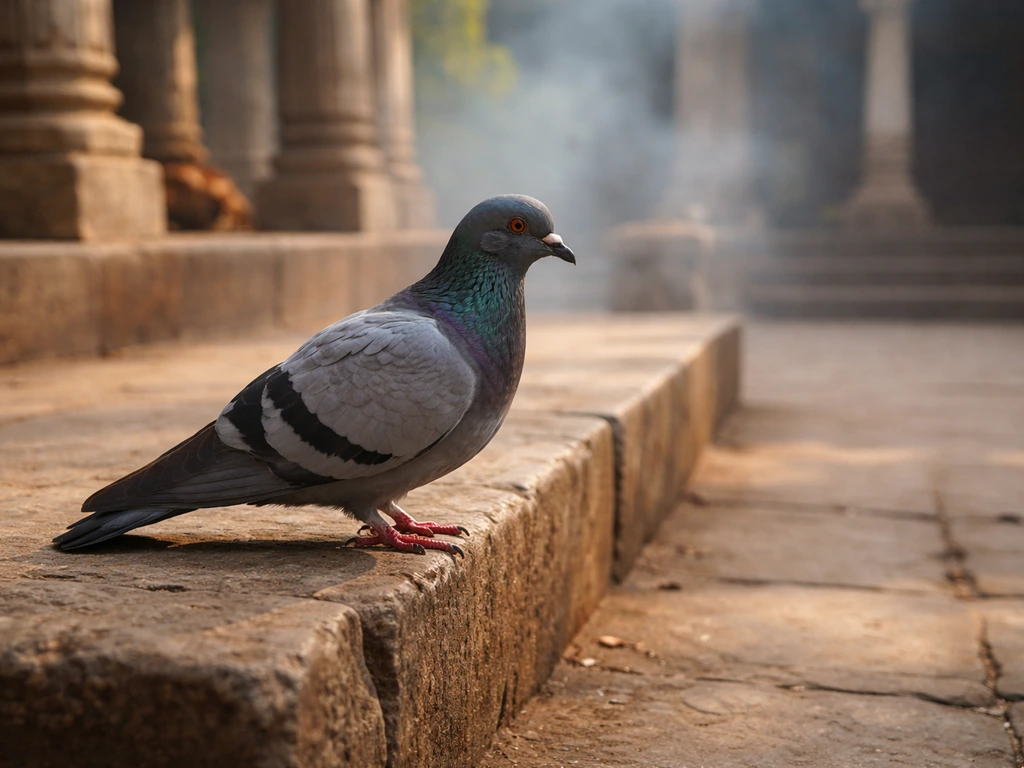
The Hindi word kabootar and what it actually means
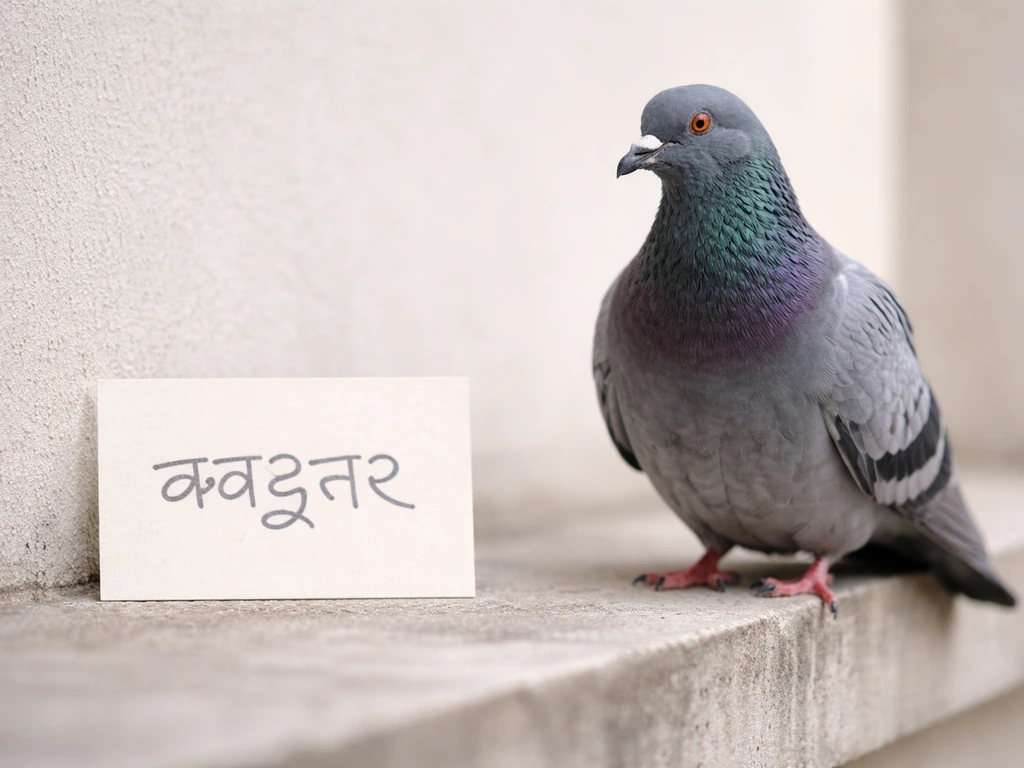
कबूतर refers to the common pigeon, the same bird found on window ledges, temple courtyards, and railway platforms across India. Collins' Hindi-English dictionary lists the meaning directly as "pigeon," and multiple dictionary sources confirm it as the standard everyday bird-name rather than a poetic or archaic term. This matters because some bird names in Hindi are reserved for literary use while others are genuinely spoken in daily conversation. कबूतर falls firmly in the everyday camp. You would use it when telling someone there is a pigeon on the roof, when buying pigeon feed near a mosque or temple, or when reading a Bollywood song lyric.
There is a secondary Sanskrit-rooted word you will sometimes encounter: कपोत (kapota). This is the classical term for pigeon or dove and appears in Sanskrit texts, religious contexts, and formal Hindi prose. In modern spoken Hindi, कबूतर is overwhelmingly the word people actually use, while कपोत shows up in devotional poetry, Puranic stories, and formal writing. Knowing both helps you navigate different registers of the language.
How pigeon is named across Indian languages
If you are mapping the word across regional languages, here is a quick reference. The roots and sounds shift, but the bird being described is the same common pigeon.
| Language | Word for Pigeon | Script | Notes |
|---|---|---|---|
| Hindi | Kabootar | कबूतर | Standard everyday term; widely used across North India |
| Sanskrit | Kapota | कपोत | Classical root; used in religious and literary texts |
| Marathi | Kabutar / Paro | कबुतर / पारो | Kabutar is the common spoken form; paro is older/regional |
| Punjabi | Kabootar | ਕਬੂਤਰ | Essentially the same word; very common in Punjabi folk songs |
| Gujarati | Kabutar / Kabootar | કબૂતર | Close to the Hindi form; used in everyday speech |
The near-identical forms across Hindi, Punjabi, and Gujarati come from a shared Persian-Arabic borrowing route, which is why kabootar sounds so similar across these languages. The Sanskrit kapota is the older Indic root and surfaces more in Marathi literary tradition and Sanskrit-influenced texts. If you are a language learner moving between these traditions, recognizing kapota in Sanskrit helps you unlock a whole layer of mythological references that kabootar alone would not.
It is worth comparing this kind of cross-language mapping with how other birds work in Indian languages. Take the kingfisher, for example: kingfisher bird in Hindi meaning follows a similarly layered pattern, where the everyday Hindi name differs from the Sanskrit poetic term, and each language community has developed its own pronunciation and connotation for the same bird.
What pigeons symbolize in Indian culture

Pigeons carry a rich symbolic weight in Indian tradition that goes well beyond being just a common urban bird. The most prominent associations are:
- Peace and non-violence (ahimsa): Pigeons are often released at religious gatherings, weddings, and political events as a gesture of peace, echoing the universal dove-as-peace symbol but with deep roots in Indian devotional practice.
- Love and longing: In Urdu and Hindi poetry, kabootar is a frequent metaphor for a messenger of love, carrying letters or tokens between separated lovers.
- Devotion and offering: Feeding pigeons (kabootar ko dana dena) near shrines and dargahs is considered an act of spiritual merit across Hindu and Muslim communities in India.
- Omens and messages: In folk belief, a pigeon entering a home can be read as a sign, either auspicious (a guest or good news arriving) or inauspicious depending on regional tradition.
- Constancy and return: Because trained pigeons were historically used to carry messages, they became symbols of reliable communication and faithfulness.
The symbolic layer is important to hold alongside the literal meaning. When someone says "वो कबूतर की तरह है" (he is like a pigeon), they are usually invoking gentleness, timidity, or a messenger quality, not making a literal ornithological observation. Context is everything, and we will come back to how to distinguish the two uses.
Pigeons in Hindu mythology and religious texts
The Sanskrit word कपोत (kapota) appears prominently in Hindu religious literature. One of the most famous stories is from the Mahabharata, where King Shibi sacrifices flesh from his own body to protect a dove (kapota) seeking refuge from a hawk. The dove turns out to be Agni, the fire god, and the hawk is Indra, testing Shibi's righteousness and compassion. This story elevated the pigeon/dove to a symbol of those deserving protection, a creature whose safety is worth personal sacrifice.
In Shaivite tradition, the pigeon is associated with Kamadeva (the god of love) and with desire and longing. The Shiva Purana also mentions kapota in contexts of asceticism and renunciation, where the bird's simple life becomes a model for spiritual detachment. The Garuda Purana references pigeons as birds whose appearance near a home can carry specific omens, giving the bird a firm place in Jyotish (astrological) and vastu traditions as well.
Sufi and Islamic devotional culture in India has also deeply embraced kabootar. At many dargahs (shrines of Sufi saints), pigeons are kept and fed as an act of devotion. The birds are seen as sacred, gentle creatures whose presence blesses the space. This cross-religious reverence for the pigeon is quite unique compared to birds like the crow, whose symbolism tends to be more ritually specific. Birds like the geese bird in Hindi carry very different mythological associations, tied specifically to Brahma and Saraswati in Hindu tradition rather than to the broad, cross-community devotional usage of the pigeon.
Pigeons in Hindi sayings, poetry, and everyday speech
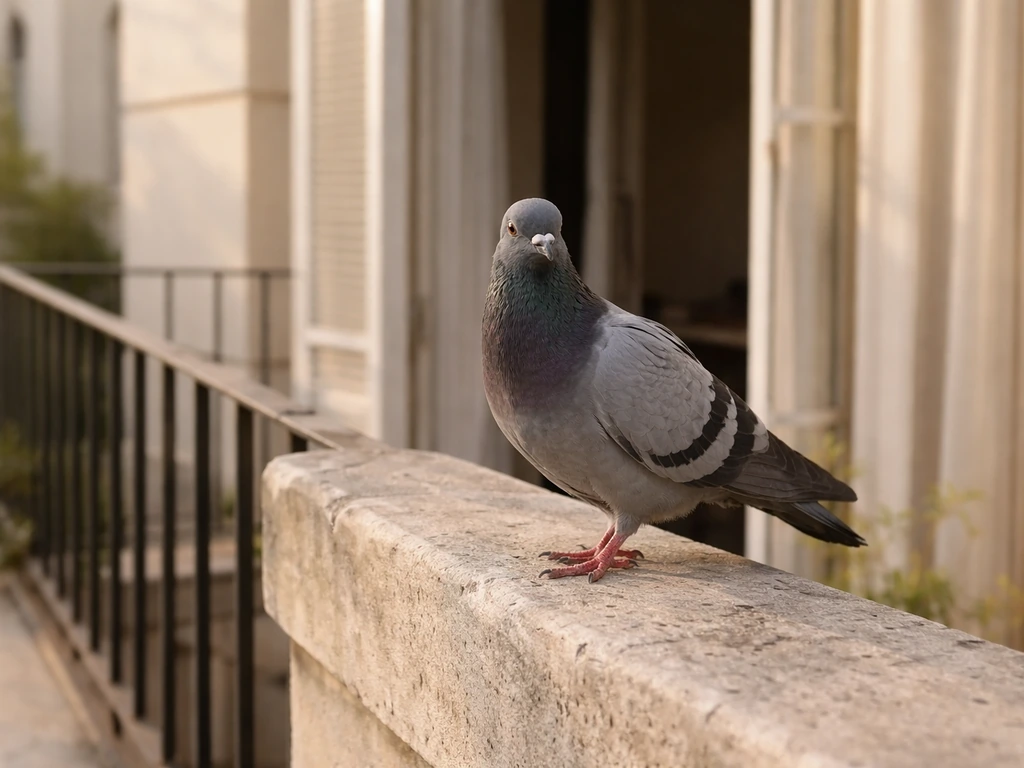
कबूतर shows up in several well-known Hindi and Urdu idioms and proverbs. Understanding these helps you decode texts and conversations where the word appears but is clearly not describing an actual bird.
- "कबूतर उड़ाना" (kabootar udaana) literally means "to release pigeons" but idiomatically refers to spreading news or sending a message, sometimes with a gossipy connotation.
- "आँख मूँद के कबूतर" (aankh moond ke kabootar) refers to someone who buries their head and ignores reality, like a pigeon that thinks it is hidden when its eyes are closed, similar to the English "burying your head in the sand."
- In Urdu ghazals and Hindi film songs, the pigeon carrying a love letter (chitthi or khat) is a classic romantic trope. Phrases like "mere kabootar, le ja sandesa" (my pigeon, carry this message) appear in folk songs across North India.
- In devotional texts and prayers, asking for the protection of a kapota (pigeon) is a way of invoking the compassion shown by King Shibi, essentially praying for refuge and protection for the vulnerable.
When you encounter kabootar in a text, notice the verb paired with it. If the pigeon is flying, being fed, or carrying something, the sentence is likely working symbolically. If the sentence describes the bird's feathers, habitat, or behavior in a naturalistic way, it is a literal usage. Poetry almost always uses pigeon symbolically. Prose and everyday conversation can swing either way, but the messenger and peace associations tend to dominate.
Other bird names in Indian languages follow similar patterns where the literal and symbolic meanings coexist. The finch bird in Hindi, for instance, carries its own set of cultural associations that are quite distinct from the pigeon's messenger and peace imagery, even though both are common small birds.
Literal bird vs. symbol: how to tell which meaning is in play
This is the practical skill that ties everything together. When you see कबूतर or कपोत in a Hindi or Sanskrit text, here is a simple framework to decide whether you are dealing with the literal bird or a symbolic use:
- Check the genre first. A wildlife article, a cooking recipe, or a description of a market scene almost certainly means the literal bird. A ghazal, a Puranic story, or a proverb almost certainly has a symbolic dimension.
- Look at the verb or action. Literal pigeons peck, fly, coo, and nest. Symbolic pigeons carry messages, represent peace, seek refuge, or embody the soul of a devotee.
- Note the script and register. Classical Sanskrit uses कपोत (kapota), which is a strong signal you are in a religious or literary context. Modern Hindi using कबूतर in casual conversation is almost always literal.
- Consider the company the word keeps. If kabootar appears alongside words like prem (love), sandesa (message), or dargah (shrine), it is working symbolically. If it appears alongside words like pankh (feathers), ghonsla (nest), or daana (grain), it is literal.
- When in doubt, assume both layers are present. Good Indian poetry often works on both levels simultaneously, describing a real pigeon while also meaning something about love, devotion, or the soul.
This same interpretive approach applies when researching other birds whose names shift meaning depending on context. If you have been exploring how Hindi handles birds that are less common in South Asian settings, the articles on puffin bird meaning in Hindi and penguin bird meaning in Hindi show how the language deals with birds that have no deep indigenous cultural symbolism, which is a useful contrast to a bird like the pigeon that is embedded in centuries of tradition.
Verifying kabootar in real Hindi usage
If you want to confirm the word in authentic contexts, here are the most reliable approaches. First, look up कबूतर in a standard Hindi dictionary like the one published by the Central Hindi Directorate (Kendriya Hindi Nideshalaya) or use Collins' Hindi-English dictionary, which directly confirms the pigeon meaning. [Collins' Hindi-English dictionary](https://www. collinsdictionary.
com/us/dictionary/hindi-english/%E0%A4%95%E0%A4%AC%E0%A5%82%E0%A4%A4%E0%A4%B0) defines कबूतर (kabūtar/kabootar) as a pigeon, describing the grey bird commonly seen in towns. Second, search for the word on Hindi Wikipedia (hi. wikipedia. org) to see the bird described in full Hindi prose alongside taxonomic information.
Third, listen to Hindi film songs that use kabootar in lyrics, such as the famous "Kabootar Ja Ja Ja" from the 1989 film Maine Pyar Kiya, which captures both the literal bird image and the messenger symbolism in one catchy phrase. Fourth, for Sanskrit usage, searching कपोत in digital Sanskrit lexicons like Monier-Williams will give you the full classical range of the word including its mythological citations. SanskritDictionary’s [kapota (कपोत) entry](https://sanskritdictionary. com/?
q=kapota%22) (drawing on Monier-Williams) defines kapota as “a dove, pigeon” and notes its classical/lexical usage.
The bottom line: कबूतर (kabootar) is the correct, standard Hindi word for pigeon, both in everyday speech and in dictionary definitions. कपोत (kapota) is the classical Sanskrit form that adds religious and literary depth. Between these two words, you have everything you need to understand how the pigeon appears across Indian languages, mythology, and daily life, from the birds clustered around a temple courtyard to the love letter carried across the mountains in a centuries-old folk song.
FAQ
Is कबूतर always the right Hindi word for pigeon, or can I use कपोत in everyday speech?
Yes, both are used to mean “pigeon,” but कबूतर (kabootar) is what you should expect in daily Hindi, casual conversation, and most modern media. कपोत (kapota) is more common in Sanskrit-flavored, devotional, or classical writing, so if you are translating a contemporary sentence you’ll usually choose कबूतर.
How can I tell in a Hindi poem or song whether कबूतर means an actual pigeon or a metaphor?
If you are unsure whether the text is literal or symbolic, check the verb and the grammatical partners. Literal uses usually describe physical actions like sitting, flying, cooing, building, nesting, or eating. Symbolic uses often appear with human traits, emotions, or roles like “like him,” “messenger,” or “peace,” and the surrounding lines will feel metaphorical.
Do Hindi speakers say “pigeon bird” the same way, or is it redundant?
In Hindi, “pigeon bird” sounds redundant because कबूतर already means pigeon. If you want to sound natural, just say “कबूतर” (or “कबूतर का…” for possession). Using “bird” in English-style phrasing can make your sentence feel translation-like.
What’s the correct way to pronounce कबूतर for it to be understood?
For pronunciation, keep the stress around the middle syllable as the article notes (roughly kuh-BOO-tar). Also, treat the first “ka” as short and clean, not drawn out, because Hindi vowel timing matters for meaning clarity when spoken quickly.
How does the meaning change when कबूतर appears in plural or declined forms?
When you see plural or related forms, the core root stays the same: कबूतर can become कबूतरों (kabootaron) in plural oblique forms, and कपोत can take classical inflection in Sanskrit-rooted lines. If you are doing translation, prioritize the base meaning, then match the grammar required by the sentence.
Are pigeons always symbolized as love or peace in Hindi, or does it vary?
A common mistake is assuming symbolic “pigeon” always relates to love or messenger themes. The article covers multiple traditions, but in real text you should follow the immediate context, for example, near religious narratives it may lean toward protection and devotion, while in romance poetry it may lean toward longing.
If I’m reading a story, what clues suggest कबूतर is being used literally versus symbolically?
In many places, literal pigeons are strongly tied to everyday city life, so idioms can still coexist with literal observations. If the line mentions location details like roof, balcony, temple courtyard, or platform, it is more likely literal. If it focuses on character comparison or moral qualities, it is more likely symbolic.
When translating kabootar to another Indian language, how do I avoid mixing up everyday versus classical register?
If you are mapping to other languages, be careful that similar-sounding forms do not guarantee the same register. For example, a word related to Persian-Arabic borrowings may feel everyday, while the Sanskrit-derived term often feels more classical or poetic, even when everyone “knows” it refers to the same bird.
Next Article
Penguin Bird Meaning in Hindi: Translation, Pronunciation
Hindi mein penguin bird meaning, sahi translation, pronunciation, sentences, aur symbolism ko clearly samjhein