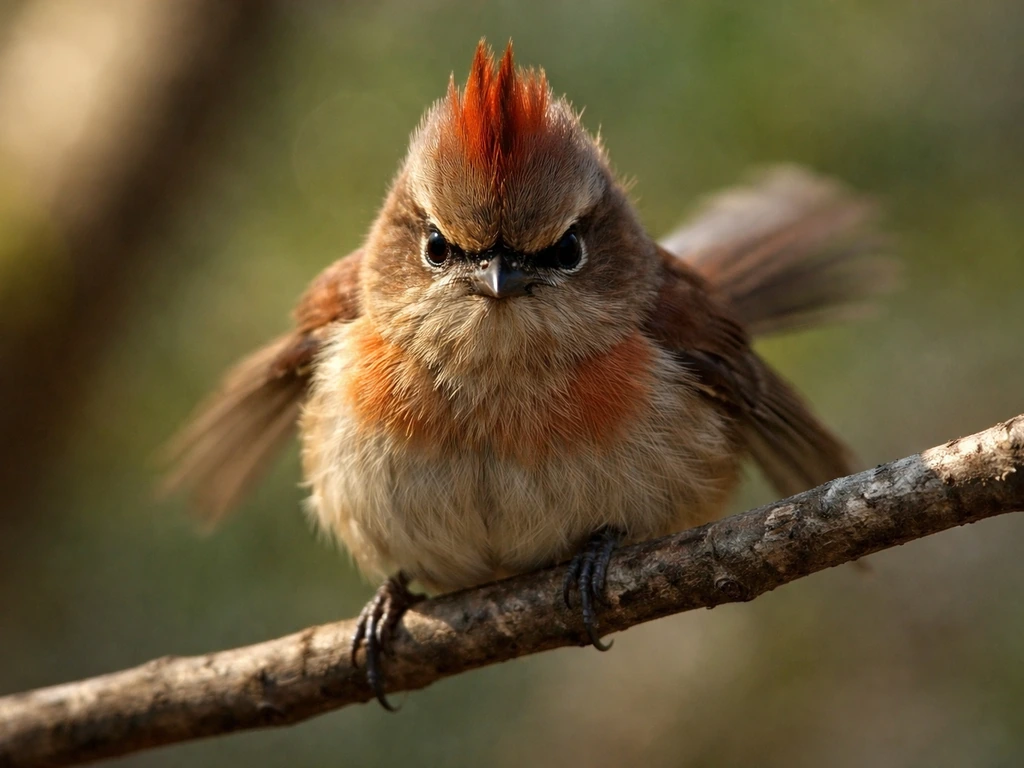
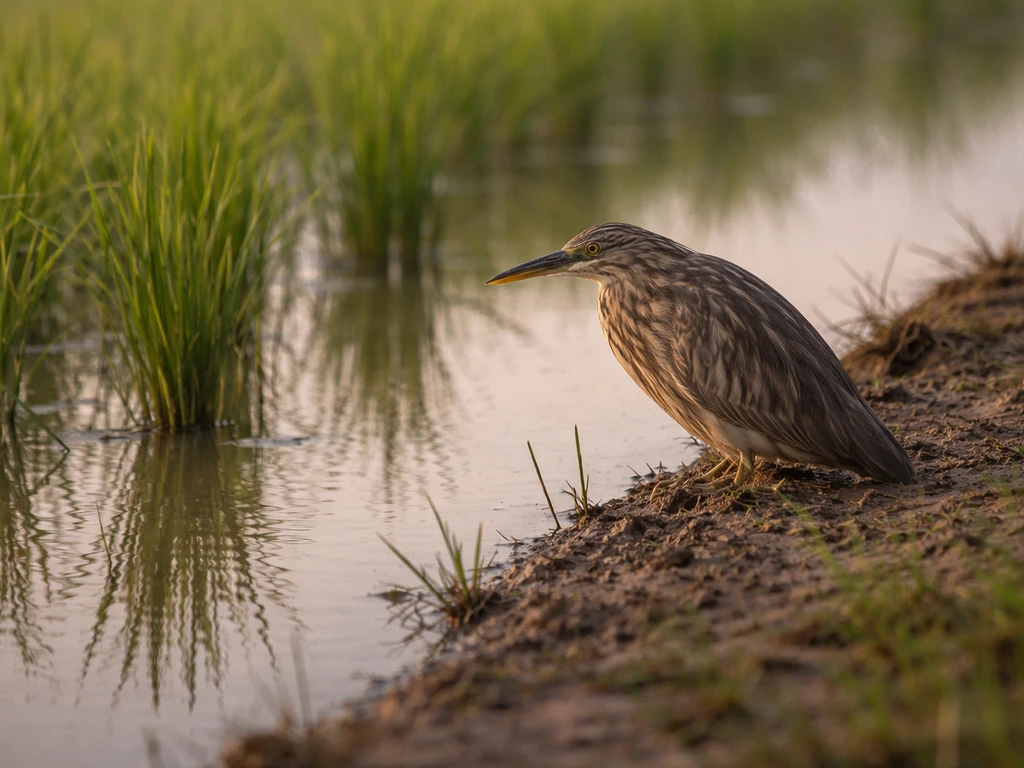
When someone says 'paddy bird' in an Indian context, they almost always mean the Indian Pond Heron (Ardeola grayii). IndiaBiodiversity also records “Paddy Bird” and “Paddybird” as vernacular/common names for Ardeola grayii Paddy Bird" and "Paddybird. Its most common Hindi name is 'Andha Bagla' (अंधा बगला), which literally means 'blind heron,' and it is called that for a charming reason: the bird stands so still in paddy fields that it seems unaware of everything around it. The direct Hindi translation of the phrase 'paddy bird' is 'धान पक्षी' (Dhan Pakṣī), but that is a dictionary-level translation, not what anyone actually calls the bird in daily life. In everyday Hindi, Bagla or Andha Bagla is what you will hear.
Paddy Bird Meaning in Hindi: What Bird It Refers To

Rajesh Sharma
6 Jun 2026
The two birds behind the name 'paddy bird'
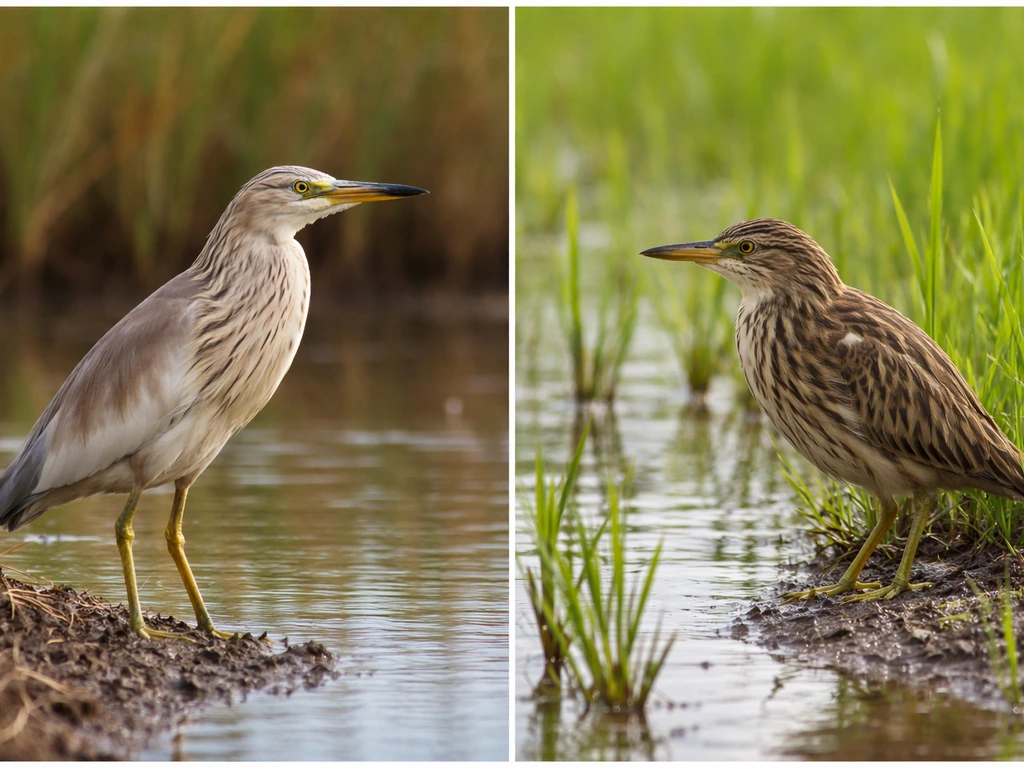
There are actually two birds that go by 'paddy bird' in different parts of the world, and it helps to know both so you don't get confused by English sources. The first and by far the most common in India is the Indian Pond Heron (Ardeola grayii). The second is the Java Sparrow (Padda oryzivora), which Britannica lists under the alternate names 'ricebird' and 'paddy bird' because it raids rice crops in large flocks. However, the Java Sparrow is not native to the Indian subcontinent in the wild, so if you are in India and someone points to a bird in a paddy field and says 'paddy bird,' they mean the Indian Pond Heron almost without exception.
The Indian Pond Heron is confirmed as 'Paddy Bird' or 'Paddybird' across authoritative sources including Wikipedia, IndiaBiodiversity.org, and multiple birding checklists from Indian national parks like Ranthambhore. Its scientific name, Ardeola grayii, pins it down precisely. It is a small, stocky heron, barely 45 cm tall, and it lives in and around rice paddies, wetlands, irrigation ditches, and shallow ponds all across the subcontinent.
Hindi names for the paddy bird, with regional variations
The most widely used Hindi name is Andha Bagla (अंधा बगला). 'Andha' means blind, and 'Bagla' means heron or egret. The name captures the bird's famous habit of standing motionless for long stretches, looking as though it cannot see anything approaching. Government wildlife documents, including a PDF from India's Department of Environment and Forests titled 'Chidiya: The Flight of Colours,' list Andha Bagla as the official Hindi local name for Ardeola grayii.
You will also encounter simply 'Bagla' (बगला) on its own, used loosely for any heron-like white bird in Hindi-speaking regions. The more specific 'Andha Bagla' is what distinguishes the pond heron from larger herons and cattle egrets. In addition, the direct transliteration 'Dhan Pakṣī' (धान पक्षी) appears in Hindi dictionaries as a phrase-level translation of 'paddy bird,' though ornithologists and birdwatchers will never use that term in the field.
| Language/Region | Name Used | Script | Notes |
|---|---|---|---|
| Hindi (standard) | Andha Bagla | अंधा बगला | Most common field name |
| Hindi (general) | Bagla | बगला | Used loosely for herons/egrets |
| Hindi (dictionary) | Dhan Pakshi | धान पक्षी | Literal translation, not field usage |
| Sanskrit root | Baka | बक | Classical Sanskrit term for heron; basis of Bagla |
| Marathi | Andha Bagala / Bagla | अंधा बगळा | Same 'blind heron' concept |
| Gujarati | Andhu Baglo | આંધળો બગલો | Regional phonetic variant |
| Punjabi | Bagla / Bagli | ਬਗਲਾ | General heron reference |
The Sanskrit root 'Baka' (बक) is worth knowing because it appears in classical texts and mythology as the generic word for heron. Bagla evolved from this root and spread across Hindi, Gujarati, Marathi, and Punjabi. So when you see 'Baka' in an old text and 'Bagla' in a modern Hindi conversation, they are pointing at the same family of birds.
How to confirm you are looking at a paddy bird in a rice field
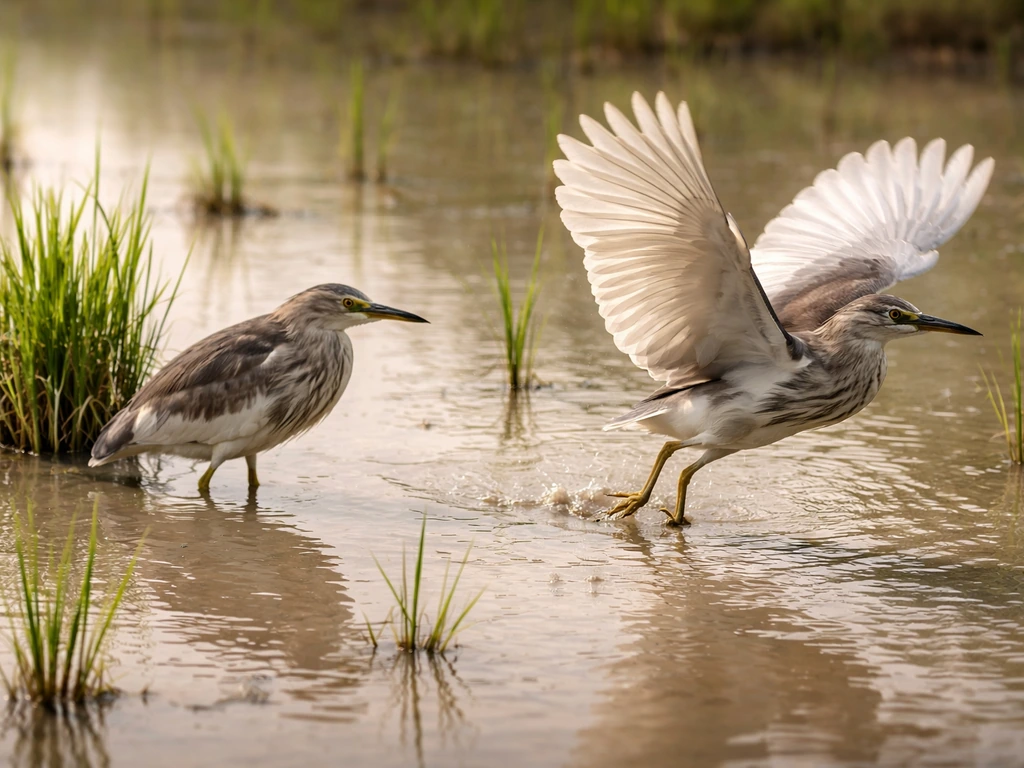
The Indian Pond Heron has one of the most striking field identifications in Indian birding: it is almost invisible when standing still, and almost unmissable when it flies. When perched or wading, it shows a drab, brown-streaked, camouflage-like plumage that blends perfectly with dry grass, muddy banks, and paddy stubble. Then the moment it takes flight, brilliant glistening white wings and a white rump flash into view. If you see a small heron-shaped bird explode into white from a muddy field edge, you have found your paddy bird.
Here are the key field clues to confirm it is Ardeola grayii and not a cattle egret, little egret, or some other wading bird:
- Size: Small and stocky, about 45 cm, noticeably smaller than a large egret or grey heron
- Resting plumage: Drab brownish-buff with heavy dark streaking on the neck and breast, looks 'dirty' compared to white egrets
- Flight reveal: Suddenly pure white wings and rump appear the instant it flies, a dramatic contrast
- Posture: Hunched, neck pulled in, often stands completely still at water edges or in flooded paddy fields
- Habitat: Shallow water, paddy fields, drainage channels, pond margins, even roadside ditches
- Behavior: Slow, deliberate steps or complete stillness while hunting; rarely runs or chases prey aggressively
If you are in North India, the breeding season (roughly April to July) is the best time to see its most colorful form: the head and neck turn a rich rufous-brown and the bill becomes bright blue at the base. Outside the breeding season, the streaky drab look dominates.
Symbolism, folklore, and the 'bagla bhagat' connection
The Indian Pond Heron carries a surprisingly rich symbolic life in Hindi and Hindustani folk tradition. Its most famous role is in the idiom 'Bagla Bhagat' (बगला भगत), which translates roughly to 'the heron-saint' or 'the heron-devotee.' The phrase describes a hypocrite: someone who stands still with an outward appearance of calm, meditation, or piety while secretly waiting to strike at the first opportunity. The image comes directly from how the bird hunts, standing motionless like a meditating ascetic, then lunging at a fish in a flash. This idiom appears in classical Hindustani and is referenced in texts like the Hitopadesha, one of India's oldest collections of moral fables.
The 'Andha Bagla' name carries its own folk belief: that the bird is semi-blind or oblivious because it stands so still even as people approach. There is a kind of gentle humor in the name, an affectionate tease at a bird that seems to exist in its own world. In village settings across Uttar Pradesh, Bihar, and Bengal, the pond heron perching on a buffalo's back or standing at the edge of a farmer's field is a familiar, almost domestic sight. It rarely appears in the elevated mythological register the way the peacock or crane does, but it is deeply embedded in everyday rural imagery and proverbs.
Interestingly, the heron family in Sanskrit literature generally occupies a morally ambiguous space. The Baka (heron) in the Mahabharata appears as a demon-figure, and in the Hitopadesha, the heron's patient stillness is specifically used as a metaphor for cunning patience rather than genuine virtue. So the symbolism of 'paddy bird' in Indian tradition sits somewhere between the meditative and the deceptive, which gives it a more complex cultural identity than most common birds.
Common confusion cases and how to avoid them

The biggest source of confusion around 'paddy bird meaning in Hindi' is that the phrase can technically point in three different directions depending on where you read it. Here is how to keep them straight:
- Paddy bird as Indian Pond Heron (Ardeola grayii): This is correct for virtually all Indian contexts. If someone in India is talking about a bird they saw in a rice field and calls it a paddy bird, this is the one.
- Paddy bird as Java Sparrow (Padda oryzivora): This usage comes mainly from Western ornithological sources. The Java Sparrow is native to Indonesia and is kept as a cage bird in India, so you might encounter this meaning in pet-bird or Britannica-type references. It is not what most Indians mean.
- Dhan Pakshi (धान पक्षी) as a translation: This is a dictionary phrase, not a real bird name anyone uses. If you search ShabdKhoj or similar sites, you will get 'Dhan Pakshi' as the Hindi for 'paddy bird,' but no birder, farmer, or naturalist in India uses that term.
- Confusion with Cattle Egret (Bubulcus ibis): Cattle egrets also live in paddy fields and are white, but they are larger, fully white even at rest, and tend to follow cattle. The pond heron's drab resting plumage is the key differentiator.
- Confusion with Little Egret or Intermediate Egret: Both share paddy-field habitats, but they are entirely white at rest, taller, and have different beak and leg coloring. The pond heron's streaky brown at rest is unique.
One more thing worth noting: if you come across articles about 'tailor bird meaning in Hindi' or 'dicky bird meaning in Hindi,' those follow a similar pattern of English bird-nicknames being searched for Hindi equivalents. The paddy bird query is slightly different because 'paddy bird' is actually an established field name for Ardeola grayii, not just a casual nickname, which makes the identification more certain once you know this.
Quick checklist and next steps to verify the bird
If you want to lock down which bird is being talked about in a specific context, here is a fast verification workflow: Cornell’s Merlin Bird ID “Photo ID” is positioned as instant bird identification guidance trained on extensive image data, including resources related to eBird All About Birds.
- Check the habitat description: Was the bird seen in or near a rice paddy, shallow pond, or irrigation ditch in India? If yes, go straight to Indian Pond Heron (Ardeola grayii).
- Check the resting color: Drab brown and streaky at rest, but white wings in flight = Indian Pond Heron. Fully white at rest = look at egret species instead.
- Check the behavior: Standing completely still for long periods, neck tucked in, then a sudden slow walk or flight? That is classic Ardeola grayii.
- Use Merlin Bird ID (Cornell Lab's free app): Tap 'Photo ID,' point your phone at the bird, and the app will confirm the species instantly. It is trained on a massive photo library and works well for Indian bird species.
- Search eBird.org: Type 'Indian Pond Heron' in the species search, then use the Maps tab to check if it is recorded in your location. eBird has extensive data across all Indian states.
- Map the Hindi name: Once confirmed as Ardeola grayii, you can confidently use 'Andha Bagla' (अंधा बगला) in Hindi conversation. If you need the name in Marathi, use 'Andha Bagala'; in Gujarati, 'Andhu Baglo.'
- If using a local guide: Ask them for the local name of the 'Bagla jo kheton mein rehta hai' (the heron that lives in the fields), and they will know immediately which bird you mean.
The paddy bird is one of India's most commonly seen but least celebrated birds. It sits at the edge of nearly every flooded field across the country, from Kashmir to Kerala, disguised in plain sight. Knowing its Hindi name, its folklore, and its unmistakable field marks puts you in a position to identify it confidently and talk about it accurately in any Indian language context. If you are wondering about the tailor bird meaning in Hindi, start by matching the local Hindi name people use for the bird in question.
FAQ
Is “paddy bird” ever used to mean a different bird in India?
Rarely. In Indian paddy-field contexts, it almost always refers to the Indian Pond Heron (Ardeola grayii), locally called Andha Bagla. If a “paddy bird” is being discussed outside India, then the Java Sparrow can be involved, so check whether the source is describing India specifically or global birding records.
What should I look for if I only see the bird standing still and not flying?
Focus on the camouflage look first, then the wing-and-rump flash as confirmation. When it is wading or perched, Ardeola grayii blends into mud and stubble with a drab, streaky pattern, so you may miss it until it moves. A quick “watch for a sudden white flash” strategy helps, especially from field edges near irrigation channels.
How can I tell “Andha Bagla” apart from cattle egrets and little egrets?
Use the overall shape and behavior. Ardeola grayii tends to be smaller and stockier, often showing a more streaked brown, and it relies on staying motionless in paddy habitat. Cattle and little egrets are typically brighter, more uniformly pale, and are less associated with that classic “invisible while standing still” pond-heron look.
Does the Hindi name “Bagla” always mean the same bird?
No. “Bagla” is sometimes used loosely for heron or egret-type birds, especially in casual speech. If someone wants the specific pond heron, they usually say Andha Bagla or mention the paddy-field habit. When you hear only “Bagla,” ask whether they mean the motionless pond heron of rice fields.
What does “Andha Bagla” imply, is it a literal description?
It is folk shorthand for how the bird behaves in the field. The “blind” part refers to its extreme stillness and stealth-like hunting posture, not an injury or true eyesight problem. So, you should treat it as behavior-based naming, not a medical or anatomical claim.
When is it easiest to identify the Indian Pond Heron using color cues?
During breeding season in North India, roughly April to July. The head and neck can become more rufous-brown, and the bill base can look brighter bluish. Outside that window, the bird is more uniformly drab and streaked, so rely more on habitat plus sudden flight cues.
If I read “Dhan Pakṣi” in a dictionary, should I use it in real conversation?
Generally no. It is best understood as a literal phrase-level translation. In everyday Hindi, people normally say Bagla or Andha Bagla when they mean Ardeola grayii, especially in rural or birdwatching contexts.
Does the folklore like “Bagla Bhagat” mean anything when I’m learning the bird name?
Yes, it helps you remember behavior. “Bagla Bhagat” refers to the bird’s hunting posture, standing very still before striking. If you associate the idiom with the motionless paddy-field stance, you will remember the correct bird even when color is muted.
How do I quickly confirm which “paddy bird” a non-Indian source is referring to?
Check geography first, then the species name if given. If the text clearly places the sighting in the Indian subcontinent, it is almost certainly Ardeola grayii. If it references rice-crop raids by a flock species and uses alternate English names like ricebird/paddy bird, then it may be talking about the Java Sparrow.
I saw a bird called “Baka” in an older Hindi or Sanskrit text, is that the same as Bagla?
It usually points to the heron family, and Bagla is often linked to that root tradition. However, old texts may not specify a single modern species. So use “Baka equals heron” as a family-level clue, then match the paddy-field and behavior details to confirm Ardeola grayii.
Next Article
Angry Bird Meaning in Punjabi: Hindi Urdu Equivalents
Punjabi ਵਿੱਚ angry bird ਦਾ ਅਰਥ, my angry bird ਲਈ ਕੁਦਰਤੀ ਤਰਜਮੇ, ਉਚਾਰਣ ਅਤੇ Hindi Urdu equivalents