
Title: I Cried Little Bird Meaning in Hindi: Literal, Poetic, and Idiomatic Translations Explained
I Cried Little Bird Meaning in Hindi: Translation & Uses

Rajesh Sharma
26 Jul 2026
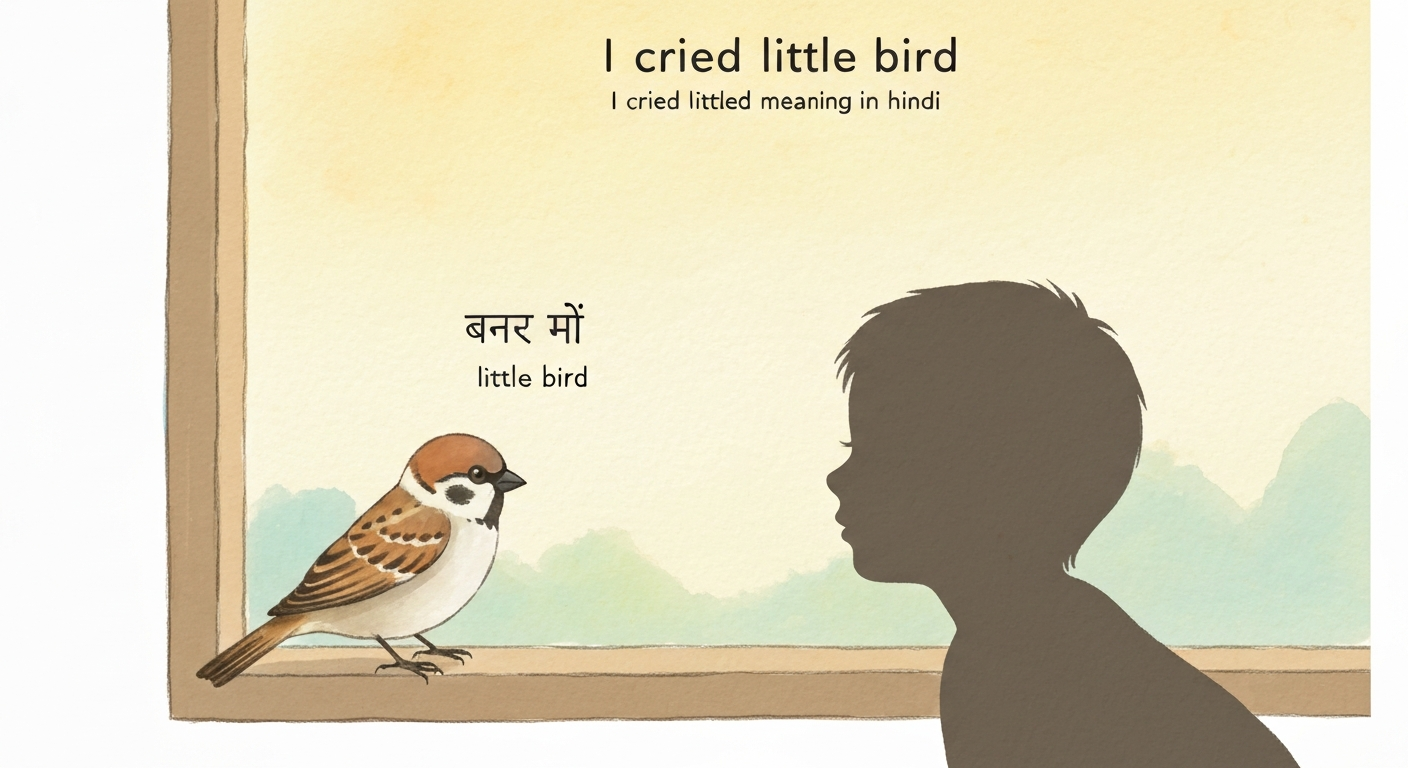
Meta description: Learn what 'I cried little bird' means in Hindi, literal translation (Devanagari + IAST), poetic readings, idiom context, and parallel Sanskrit, Marathi, Punjabi, and Gujarati equivalents.
If you searched 'I cried little bird meaning in Hindi,' the most likely answer depends on where you saw the phrase. As a literal sentence it translates to मैं रोया, छोटी चिड़िया (main royā, choṭī ciṛiyā) for a male speaker, or मैं रोई, छोटी चिड़िया (main roī, choṭī ciṛiyā) for a female speaker. Dictionary entries list 'cry' → रोना and the past 'cried' → रोया / रोई (cry, Cambridge English→Hindi dictionary) cry — Cambridge English→Hindi dictionary. As a line from the classic English nursery rhyme 'Once I Saw a Little Bird,' the 'I cried' part means 'I called out' rather than 'I wept,' giving मैंने कहा / मैंने पुकारा (maiṃne kahā / maiṃne pukārā). Neither form is a fixed English idiom, so there is no single idiomatic Hindi equivalent the way there is for 'a little bird told me.'
How to figure out which meaning you actually need
Three very different situations send people to search for this phrase, and getting the wrong one means getting a wrong translation. The fastest way to sort them out is to ask: where did I read or hear this?
- Nursery rhyme or children's poem: The phrase almost certainly comes from the 19th-century English rhyme 'Once I Saw a Little Bird,' which contains the line 'So I cried, Little bird, will you stop, stop, stop?' Here 'cried' means 'called out' or 'said loudly,' not 'wept.' The reading is poetic and literal at the same time.
- A real-life event: Someone is describing that they cried (wept) while looking at or thinking about a little bird. This is fully literal, and the translation follows straightforward Hindi verb conjugation for रोना (ronā).
- An idiom search: Some users arrive here after a chain of bird-related idiom searches. 'I cried little bird' is not itself a recognised English idiom, but it can get confused with 'a little bird told me,' which is a well-documented idiom meaning 'I heard this from a source I won't name.'
Once you know which situation applies, the correct Hindi rendering becomes clear. The sections below handle each case in order.
Precise literal Hindi translation (Devanagari + IAST)
Taking the phrase word by word gives you the building blocks for any literal rendering. Hindi marks gender on both the speaker and the object being described, so two forms are always needed.
| English word | Hindi (Devanagari) | IAST transliteration | Notes |
|---|---|---|---|
| I (subject) | मैं | maiṃ | Unchanged regardless of gender |
| cried (wept) — male speaker | रोया | royā | Perfect tense, masculine agreement |
| cried (wept) — female speaker | रोई | roī | Perfect tense, feminine agreement |
| cried (called out) — male speaker | चिल्लाया / पुकारा | cillāyā / pukārā | For nursery-rhyme 'cried out' sense |
| cried (called out) — female speaker | चिल्लाई / पुकारी | cillāī / pukārī | For nursery-rhyme 'cried out' sense |
| little (adj.) | छोटी / नन्ही | choṭī / nanhī | Feminine to agree with चिड़िया (bird, f.) |
| bird | चिड़िया | ciṛiyā | Common everyday word; also पंछी (pañchī), पक्षी (pakṣī) in formal/poetic register |
Putting these together, the full literal sentence 'I cried (wept), little bird' in Hindi is: मैं रोया, नन्ही चिड़िया (maiṃ royā, nanhī ciṛiyā), male speaker; or मैं रोई, नन्ही चिड़िया (maiṃ roī, nanhī ciṛiyā), female speaker. A slightly more natural spoken phrasing would be मैं नन्ही चिड़िया के लिए रोया / रोई (maiṃ nanhī ciṛiyā ke lie royā / roī), meaning 'I cried for the little bird.'
Pronunciation tips for these words
- चिड़िया (ciṛiyā): three syllables — chi-RI-ya. The retroflex ड़ (ṛ) is pronounced with the tongue flapped back against the roof of the mouth, not like the English 'd'. Native-speaker audio is widely available on Forvo if you want to check this sound.
- रोया (royā): two syllables — RO-ya. The final 'a' is slightly nasalised in many dialects but is often silent in fast speech.
- नन्ही (nanhī): nan-HEE. The first syllable ends with a nasal 'n', and the final vowel is long.
- मैं (maiṃ): a single nasalised syllable, like 'main' in English but with the nasal running through the whole vowel — closer to French 'main.'
Poetic and nursery-rhyme reading: what 'I cried' means in that context
The nursery rhyme 'Once I Saw a Little Bird' is a 19th-century English children's poem in which a child spots a bird hopping on the windowsill, calls out to it to stop, and the bird flies away. The relevant line is: 'So I cried, Little bird, will you stop, stop, stop?' In this context, 'cried' is an archaic or literary use meaning 'called out' or 'exclaimed,' not 'wept.' Hindi children's and educational texts render this kind of 'cried' as मैंने कहा (maiṃne kahā, 'I said') or मैंने पुकारा (maiṃne pukārā, 'I called out'), and the full line becomes: मैंने पुकारा, छोटी चिड़िया, क्या तुम रुकोगी? (maiṃne pukārā, choṭī ciṛiyā, kyā tum rukogī?). In Hindi children's poetry you also find the affectionate address चिड़िया रानी (ciṛiyā rānī, literally 'bird queen') used instead of the plain 'little bird,' which gives verses a warmer, more playful register.
In classical Hindi and Urdu poetry, the image of a crying bird (चिड़िया रोई / ciṛiyā roī) is a standalone poetic motif representing longing, separation, or grief, the bird's call interpreted as weeping. You will find lines like चूँ-चूँ करके चिड़िया रोई (cūṃ-cūṃ karke ciṛiyā roī, 'the bird cried, cheeping and cheeping') in folk songs and children's verse. This is the phrase running the other way: the bird cries, not the speaker.
Idiomatic readings and Hindi equivalents
'I cried little bird' is not a fixed English idiom. The idiom searchers in this space are usually thinking of 'a little bird told me,' which means 'I know this information but I'm not saying where I heard it.' In Hindi, this idiom has no direct single-phrase equivalent, but the meaning is typically conveyed as: किसी ने मुझे बताया पर मैं नाम नहीं लूँगा / लूँगी (kisī ne mujhe batāyā par maiṃ nām nahīṃ lūṃgā / lūṃgī), meaning 'someone told me but I won't say who.' A shorter colloquial workaround is हवा से पता चला (havā se patā calā), literally 'I came to know from the wind,' which captures the same spirit of a nameless, mysterious source. The bird angle connects to a very old tradition: Ecclesiastes 10:20 contains an image of a bird carrying news, and Indian folklore has its own rich parallel in birds as divine messengers, think of the role of parrots and cuckoos in Sanskrit literature as carriers of messages between separated lovers.
Translations across Indian languages at a glance
Below are parallel translations of the primary literal phrase 'I cried (wept), little bird' across five Indian languages. Each rendering uses the most natural everyday vocabulary for that language.
| Language | Script | Transliteration (IAST) | Notes |
|---|---|---|---|
| Hindi (male speaker) | मैं रोया, नन्ही चिड़िया | maiṃ royā, nanhī ciṛiyā | Standard colloquial Hindi |
| Hindi (female speaker) | मैं रोई, नन्ही चिड़िया | maiṃ roī, nanhī ciṛiyā | Gender agreement on verb |
| Sanskrit | अहं रुदितवान्, क्षुद्रः पक्षी | ahaṃ ruditavān, kṣudraḥ pakṣī | Classical; ruditavān = 'having wept' (masc.); kṣudra = tiny/minor |
| Marathi (male speaker) | मी रडलो, छोट्या चिमणे | mī raḍalo, choṭyā cimaṇe | चिमणी / चिमणे = common Marathi word for sparrow/small bird |
| Punjabi (male speaker) | ਮੈਂ ਰੋਇਆ, ਨਿੱਕੀ ਚਿੜੀ | maiṃ roiā, nikkī ciṛī | ਨਿੱਕੀ = small/little in Punjabi |
| Gujarati (male speaker) | હું રડ્યો, નાની પંખી | huṃ raḍyo, nānī paṃkhī | પંખી (paṃkhī) = common Gujarati word for bird |
A note on Sanskrit: the verb root for crying or weeping is रुद् (rud-), giving perfect participial forms like रुदित (rudita). See the Monier‑Williams entry for अल्प (alpa) and the related entries for पक्षी and रुद् in the Sanskrit‑English dictionary for lexical confirmation. The word for a small or minor bird in classical Sanskrit is kṣudra-pakṣī (क्षुद्रपक्षी), though in children's or devotional contexts a diminutive like खग-शिशु (khaga-śiśu, 'young bird') sounds more natural. Sanskrit rarely constructs sentences the same way Hindi does, so treat the Sanskrit row above as a careful gloss rather than a fully natural classical sentence.
When to use each version: register and usage notes
Choosing the right register matters a lot in Hindi, and the same idea can land very differently depending on which words you pick. Here is a practical breakdown.
- Everyday conversation (literal, weeping sense): Use मैं रोया / रोई and चिड़िया without embellishment. This is natural, low-register speech suitable for casual storytelling.
- Children's writing or classroom Hindi (nursery-rhyme sense): Use मैंने पुकारा or मैंने कहा for the 'called out' sense, and चिड़िया रानी for the address. This matches the register of Hindi textbook exercises on the nursery rhyme.
- Formal or literary writing (poetic sense): Swap चिड़िया for पक्षी (pakṣī) or विहग (vihaga) for an elevated, Sanskrit-influenced tone. Use विलाप (vilāp) for 'lamented' rather than just रोना if the scene is emotionally dramatic.
- Idiomatic use (when 'a little bird told me' is intended): Drop the bird metaphor and use हवा से पता चला or किसी सूत्र से सुना (kisī sūtra se sunā, 'I heard from some source') — these are naturalised, widely understood equivalents in modern Hindi journalism and everyday speech.
- Sanskrit or devotional texts: Stick to the rud- root forms and pakṣī for accuracy. Avoid directly calquing English word order.
Disambiguation: three short scenarios
These quick scenarios show how the same search phrase points to very different Hindi renderings depending on context.
- Nursery-rhyme line (poetic/literal): A Hindi teacher is teaching the poem 'Once I Saw a Little Bird' and needs to translate 'So I cried, Little bird, will you stop?' The correct Hindi is: मैंने पुकारा, 'चिड़िया रानी, क्या तुम रुकोगी?' (maiṃne pukārā, ciṛiyā rānī, kyā tum rukogī?). The 'cried' here means 'called out,' and the affectionate चिड़िया रानी preserves the nursery-rhyme warmth.
- Real-life emotional event (literal): A writer describes how watching a tiny bird fall from its nest moved them to tears: 'I saw the little bird and I cried.' Hindi: मैंने नन्ही चिड़िया को देखा और मैं रो पड़ा / पड़ी (maiṃne nanhī ciṛiyā ko dekhā aur maiṃ ro paṛā / paṛī). The verb रो पड़ना (ro paṛnā) — 'to burst into tears' — is more natural here than the bare past tense.
- Idiom confusion (bird-based idiom): A user thinks 'I cried little bird' might be an idiom like 'a little bird told me.' It is not the same idiom. 'A little bird told me' in Hindi is best rendered किसी ने मुझे बताया, नाम नहीं लूँगा (kisī ne mujhe batāyā, nām nahīṃ lūṃgā) or colloquially as हवा से खबर मिली (havā se khabar milī, 'news came on the wind').
Example sentences in English and Hindi
Here are four parallel English and Hindi sentences covering the main uses of the phrase, with IAST transliteration and a note on any natural alternatives.
| English sentence | Hindi (Devanagari) | IAST | Natural alternative / note |
|---|---|---|---|
| I cried when the little bird fell. | जब नन्ही चिड़िया गिरी, मैं रो पड़ा। | jab nanhī ciṛiyā girī, maiṃ ro paṛā. | रो पड़ा (ro paṛā) sounds more spontaneous than just रोया. |
| She cried out, 'Little bird, please stop!' | उसने पुकारा, 'चिड़िया रानी, रुको!' | usne pukārā, ciṛiyā rānī, ruko! | पुकारा (pukārā) = called out; ruko = stop (imperative). |
| The little bird cried all night. | नन्ही चिड़िया रात भर रोती रही। | nanhī ciṛiyā rāt bhar rotī rahī. | रोती रही = kept crying (continuous past). |
| A little bird told me about the news. | हवा से खबर मिली। (किसी ने बताया, पर नाम नहीं लूँगा।) | havā se khabar milī. (kisī ne batāyā, par nām nahīṃ lūṃgā.) | The idiomatic flavour of 'a little bird told me' uses the metaphorical 'wind' in Hindi. |
Birds as messengers and symbols of sorrow in Indian tradition
The image of a small weeping bird is not random in Indian culture, it connects to a deep tradition of reading birds as carriers of emotion and news. In classical Sanskrit literature, the koel (कोयल / koyal) and its cry are consistently associated with longing and the pain of separation (विरह / viraha). The Ramayana and Mahabharata both use birds as omens and divine messengers: Jatayu, the divine vulture, is a figure of sacrifice and grief; the parrot (शुक / śuka) in Sanskrit texts carries love messages between separated partners. Even in folk songs across Rajasthan and UP, a tiny bird (चिड़िया) crying on a branch signals that someone is missing a loved one. This grounding means that when a Hindi speaker hears 'the little bird cried,' the emotional resonance is culturally immediate, it is not just a sound but a sentiment.
The symbolic range of the small crying bird in Indian languages covers four main registers: the bird as messenger (carrying news, secret or open), the bird as omen (its cry predicting arrival or departure of a loved one), the bird as emblem of innocence and fragility (used in children's verse), and the bird as a stand-in for the human soul in some Sufi and Bhakti poetic traditions. Each of these registers shapes how a translator should approach a phrase like 'I cried, little bird' depending on its original context.
Bird-related idioms in Hindi: a quick comparison
Since several related searches land in this space, here is a side-by-side view of the bird-phrase family that this topic belongs to. For a related query, see an explanation of 'wise old bird meaning in Hindi' which covers cultural nuance and idiomatic uses. The idioms 'a little bird told me,' 'once I saw a little bird,' 'rare bird,' and 'wise old bird' all have distinct Hindi treatments, and knowing the differences helps avoid mix-ups.
| English phrase | Type | Hindi equivalent / rendering | IAST | Core meaning |
|---|---|---|---|---|
| I cried, little bird | Nursery-rhyme line (literal / poetic) | मैंने पुकारा, चिड़िया रानी | maiṃne pukārā, ciṛiyā rānī | Called out to a small bird |
| I cried (wept), little bird | Literal emotional sentence | मैं रो पड़ा, नन्ही चिड़िया | maiṃ ro paṛā, nanhī ciṛiyā | Wept in the presence of / for a small bird |
| A little bird told me | Fixed English idiom | हवा से खबर मिली / किसी ने बताया | havā se khabar milī / kisī ne batāyā | Heard from an unnamed source |
| Once I saw a little bird | Opening line of nursery rhyme | एक बार मैंने एक नन्ही चिड़िया देखी | ek bār maiṃne ek nanhī ciṛiyā dekhī | Literal narrative opening |
| Rare bird | Figurative / idiomatic | दुर्लभ व्यक्ति / विरल पक्षी | durlabha vyakti / virala pakṣī | An unusual or exceptional person or thing |
| Wise old bird | Informal British idiom | चालाक बुज़ुर्ग / अनुभवी व्यक्ति | cālāk buzurg / anubhavī vyakti | A shrewd, experienced person |
If you landed here while looking for any of these related phrases, especially 'a little bird told me' or 'once I saw a little bird', the sibling articles on this site go into much greater depth on each of them, including their folklore origins, full Hindi idiomatic equivalents, and usage examples across Indian languages.
Putting it all together: a quick reference
To recap the essentials in one place: 'I cried little bird' is most commonly a line from a nursery rhyme where 'cried' means 'called out' (मैंने पुकारा), not wept. If the phrase describes genuine weeping, use मैं रो पड़ा / रो पड़ी with नन्ही चिड़िया. If it is an idiom confusion with 'a little bird told me,' use हवा से खबर मिली or किसी ने बताया, पर नाम नहीं लूँगा. Across Marathi, Punjabi, Gujarati, and Sanskrit, each language has its own natural word for 'small bird' (चिमणी, ਚਿੜੀ, પંખી, kṣudra-pakṣī) and its own verb for weeping (रडणे, ਰੋਣਾ, રડવું, rud-), so a good translation always starts by identifying the language and register before choosing vocabulary. The cultural weight of a small crying bird in Indian tradition, spanning children's verse, classical Sanskrit poetry, folk songs, and Sufi metaphor, means the image is never flat; it always carries emotional and symbolic overtones worth naming in translation.
FAQ
What are the likely search intents behind “i cried little bird meaning in hindi”?
Three main intents: 1) Literal/translation intent — the user saw the phrase and wants an accurate Hindi translation (e.g., from a nursery rhyme or plain sentence). 2) Poetic/lyric intent — the user encountered the phrase in a poem or song and wants a poetic rendering or explanation. 3) Idiomatic/misheard intent — the user actually means or confuses it with related idioms (e.g., “a little bird told me”). Answering all three helps disambiguate and provide correct Hindi equivalents and usage notes.
What is the precise literal Hindi translation of “I cried, ‘Little bird’”?
Literal translation (speech/quote): मैंने चिल्लाकर कहा, "छोटी चिड़िया"। Devanagari + IAST: मैंने चिल्लाकर कहा, "छोटी चिड़िया" (mainne cylākara kahā, "choṭī ciṛiyā"). Notes: Use मैंने चिल्लाकर कहा or मैंने कहा/मैंने पुकार कर कहा depending on register; choose छोटा/छोटी (choṭā/choṭī) to match the speaker’s gender agreement for adjectives is not required here because चिड़िया is feminine (छोटी). If the sentence is “I cried, ‘Little bird, will you stop?’” use: मैंने कहा, “छोटी चिड़िया, क्या तुम रुकोगी/रुकोगे?” (female/male addressee forms).
How to render “I cried little bird” as a short poetic line in Hindi?
Poetic renderings (natural for songs/poems): 1) मैंने पुकारा, ‘छोटी चिड़िया’ — mainne pukārā, 'choṭī ciṛiyā' (neutral poetic). 2) मैंने कहा—"ओ छोटी चिड़िया" — mainne kahā — 'o choṭī ciṛiyā' (adds vocative 'o' for poetry). 3) चिड़िया को पुकारा मैंने — ciṛiyā ko pukārā mainne (inverted, poetic Hindi). These preserve the lyrical feel; use छंद/intonation to match meter.
What is the idiomatic interpretation if the user meant an idiom rather than a literal line?
If intended idiom, likely confusions: 1) “A little bird told me” — English idiom meaning “I heard this from someone (unnamed).” Hindi equivalent: किसी ने मुझे बताया (kisi ne mujhe batāyā) or better idiomatic: किसी ने कहा/मुझे किस‑ने बताया कहा नहीं (contextual). A closer idiomatic Hindi phrase used colloquially: 'किसी चोरासी ने बताया' is not standard — stick to: 'मुझे किसी ने बताया' or 'किसी ने कहा कि...' 2) If searching lyric lines, label as poetic/child‑verse usage rather than fixed idiom.
Exact Hindi equivalents for the related idioms listed in the brief?
Provided with literal gloss and context: 1) “A little bird told me” — Hindi: मुझे किसी छोटे स्रोत/किसी ने बताया — common: 'मुझे किसी ने बताया' (mujhe kisi ne batāyā). Usage: coy way to decline source. 2) “Once I saw a little bird” — Hindi literal: 'एक बार मैंने एक छोटी चिड़िया देखी' (ek bār mainne ek choṭī ciṛiyā dekhī). 3) “Rare bird” (idiomatic for someone unusual) — Hindi: 'अद्वितीय व्यक्ति' or colloquial 'दुर्लभ/नायाब' — literal: 'दुर्लभ चिड़िया' (durlabh ciṛiyā). 4) “Wise old bird” (English idiom, jocular) — Hindi: 'बुद्धिमान बूढ़ा' is literal; idiomatic equivalent: 'बुद्धिमान व्यक्ति' or humorous: 'बुजुर्ग सयाना' (bujurgsayānā). For each give register note (formal vs colloquial).
Provide transliteration (IAST) and pronunciation guidance for the key Hindi words: 'I', 'cried', 'little', 'bird'
Words with Devanagari + IAST + short pronunciation tip: 1) मैं — main — [mɛ̃] (nasal vowel) 2) मैंने — mainne — ['mɛːn.ɳe] (past marker; pronounce the retroflex n) 3) रोया / रोई — royā / roī — ['roː.jā] / ['roː.iː] (gendered; रोया masculine, रोई feminine) 4) कहा — kahā — [kə.'ɦaː] (said) 5) छोटा / छोटी — choṭā / choṭī — ['tʃʰoː.ʈaː] / ['tʃʰoː.ʈiː] (retroflex ṭ) 6) चिड़िया — ciṛiyā — [t͡ʃiɽi.jaː] (ɽ is retroflex flap). Use IAST for publication: choṭī ciṛiyā (छोटी चिड़िया). For audio, link to native recordings (Forvo) or include IPA in pronunciation boxes.
Next Article
Wise Old Bird Meaning in Hindi and Symbolism Explained
Meaning of wise old bird in Hindi plus bird symbolism, common Hindi equivalents, examples, and a context checklist.